Frugal Living
Everyday ways to spend less and live well on less.
Frugal Living: 15 Simple Money Habits for Beginners and Beyond
Frugal living is not a contest to see who can live with the least. It is the practical habit of directing limited money toward what matters most. Done well, it helps an ordinary household keep more of its income, cut avoidable costs, prepare for surprises, and move toward goals that are bigger than this month’s bills.
This guide is for people with paychecks, irregular income, children, caregiving responsibilities, debt, rising bills, or simply a wish to feel less financial pressure. You do not need a finance degree or a perfect spreadsheet. You need a clear view of your choices and a system simple enough to use when life is busy.
Below you will find how to be frugal starting this week, a simple plan for your first 30 days, 15 money habits that cover every major part of household finances, and practical advice on retirement on a budget for readers over 50. Work on one habit at a time. Each one is a stream of attention pointed at one part of your financial life, and together they form a complete beginner’s system.
What Frugal Living Really Means
Frugal living means getting real value from the money, time, and things you already have. It is different from being cheap. Cheap focuses only on the lowest price, even when a flimsy item breaks quickly or creates more work. Frugality looks at the full cost, including repairs, replacements, interest, time, and stress.
It also leaves room for enjoyment. A frugal household can spend happily on a favorite tradition while cutting waste somewhere else. The point is not to remove every pleasure; it is to stop paying for things you do not use, do not value, or did not really choose.
For a beginner, the most useful shift is this: frugality is a system, not a mood. Willpower runs out at the end of a long day. A bill calendar, an automatic transfer, and a short shopping list keep working when you are tired. That is why this guide focuses on money habits rather than one-time cuts, and why frugal living works best when you build one habit at a time.
How to Be Frugal: Where Beginners Should Start
Most people who try frugal living for the first time make the same mistake: they try to change everything in one weekend. They cancel every subscription, start a strict grocery budget, and promise never to order takeout again. By week three, the plan feels like punishment and the old habits return.
A better start has three steps:
- See your money clearly. Look at the last month of bank and card activity. Group spending into broad categories such as housing, food, transportation, bills, debt, and “everything else.” You are looking for patterns, not passing judgment.
- Protect the basics first. Make sure shelter, utilities, food, essential transportation, and minimum debt payments are covered before you set any savings target.
- Pick one or two habits. Choose the areas below that would make the biggest difference right now. Small, repeated wins build confidence faster than a dramatic overhaul.
The table below gives you a one-glance view of all 15 money habits, the question each one answers, and a first action that takes less than an hour.
|
Habit |
Question it answers |
First useful action |
|
1. Budgeting and cash flow |
Where will money go before it arrives? |
Map income and bills by date |
|
2. Emergency savings |
How will we handle an unexpected cost? |
Open a separate savings space |
|
3. Debt repayment |
Which balances should get extra money? |
List rates, balances, and minimums |
|
4. Banking fees and interest |
Is our bank charging us unnecessarily? |
Check fees and account rates |
|
5. Insurance and recurring bills |
Are we paying for the right things? |
Audit policies and subscriptions |
|
6. Groceries and household goods |
How can routine purchases cost less? |
Set a realistic category limit |
|
7. Utilities and home costs |
Which home expenses can be lowered? |
Review usage and services |
|
8. Housing affordability |
Is our housing cost sustainable? |
Calculate the full housing cost |
|
9. Transportation |
What does getting around really cost? |
Add payments, fuel, repairs, and insurance |
|
10. Mindful spending |
How can we interrupt impulse buys? |
Add a waiting period for wants |
|
11. Secondhand buying and selling |
When can used goods save cash? |
Build a safe buying checklist |
|
12. Family money routines |
How can the household decide together? |
Create one weekly check-in |
|
13. Earning extra income |
Can we improve the income side? |
Identify one sellable skill or asset |
|
14. Investing basics |
How can money grow over time? |
Learn account, risk, and fee basics |
|
15. Meaningful goals |
What is the money meant to make possible? |
Name one specific, measurable goal |
The habits overlap, but they are not interchangeable. Cutting spending cannot replace emergency savings. A higher income cannot fix borrowing for routine expenses. Investing is valuable, but it should rest on accessible savings and manageable debt. If you want a longer list of quick wins to pair with this system, our frugal living tips collect dozens of small, practical ideas.
Frugal Living for Beginners: Your First 30 Days
For a beginner, a month is long enough to see real results and short enough to stay motivated. This 30-day plan touches the habits that matter most for a beginner, two small actions per week. Nothing on it costs money to start.
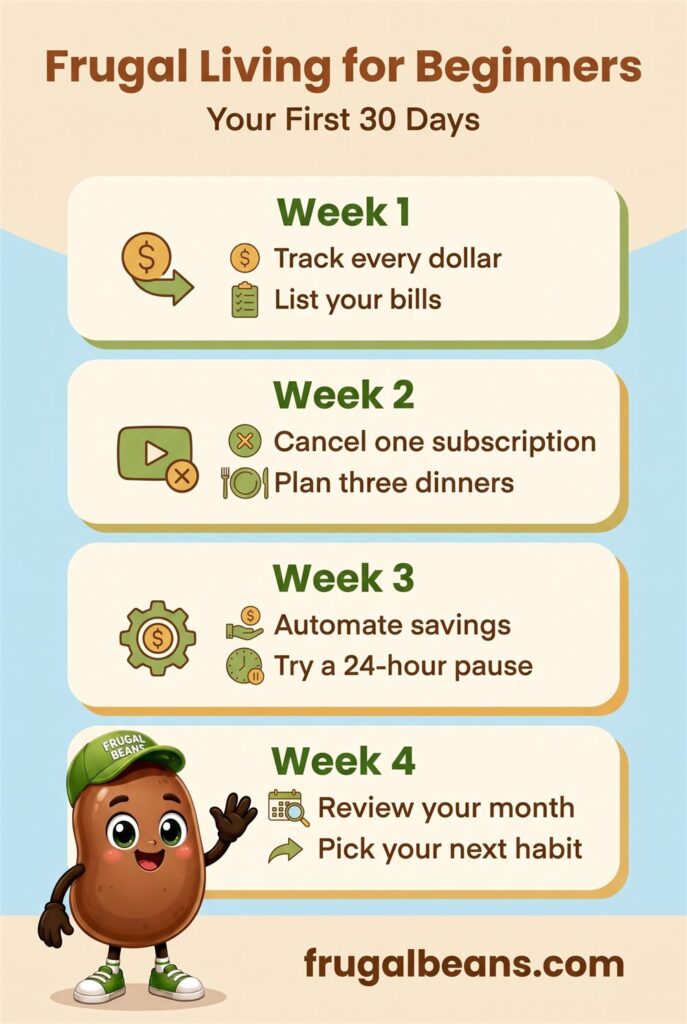
Week 1: Track Every Dollar and List Your Bills
Write down every purchase for seven days, including small ones like coffee, snacks, and app charges. At the same time, list every bill with its amount and due date. By Sunday you will know where money actually goes and which week of the month is tightest.
Week 2: Cancel One Subscription and Plan Three Dinners
Look through your statements for recurring charges and cancel or pause one you did not use last month. Then plan three simple dinners before your next grocery trip, built around what is already in the pantry. These two moves attack the two most common beginner leaks: forgotten charges and last-minute food spending.
Week 3: Automate Savings and Try a 24-Hour Pause
Set up an automatic transfer to a separate savings account the day after payday, even if the amount is small. Then adopt a 24-hour pause on any nonessential purchase. If you still want the item tomorrow and it fits the plan, buy it without guilt.
Week 4: Review Your Month and Pick Your Next Habit
Compare this month’s spending with your Week 1 notes. Celebrate what worked, adjust what did not, and choose the next habit from the list below. Frugal living for beginners is a cycle: notice, decide, act, and review.

15 Simple Money Habits for Frugal Living Beginners
These are the core money habits of frugal living for beginners. Each habit below explains what it covers, why it matters, what to do first, and a mistake to avoid. The small examples use simple numbers so you can see the arithmetic. Your own numbers will differ, and that is fine.
1. Budgeting and Cash-Flow Planning

Budgeting assigns income to needs, goals, debt, and flexible spending. Cash-flow planning adds timing, showing when pay arrives and when bills leave. A household can have enough income for the month and still come up short during one week, so the calendar matters as much as the totals.
Start here: List reliable take-home income, record bills by due date, and divide annual expenses into monthly “sinking fund” amounts. Give the remainder a job, including a modest amount for enjoyment. Review weekly and adjust without treating changes as failure.
Avoid: Budgeting from an ideal month, forgetting irregular expenses, and creating so many categories that the plan becomes exhausting.
Example: If rent is due on the first and insurance on the twentieth, a calendar budget reserves part of the first paycheck for the later bill, preventing a credit card balance even when monthly income is adequate.
2. Emergency Savings
Emergency savings is cash for unplanned, necessary costs such as a car repair, urgent travel, a short income gap, or a major home problem. It is separate from predictable annual expenses. A reserve keeps a shock from becoming expensive credit, a missed payment, or a forced sale of long-term investments.
Start here: Begin with a small starter goal, such as $500 or one week of essential expenses, then build toward several months of core costs as your situation allows. Keep the money separate but accessible, automate a transfer after payday, and refill the account after you use it. The Consumer Financial Protection Bureau’s guide to building an emergency fund walks through setting a goal and finding money to save. Our free emergency fund calculator works out how many months of essential costs fit your situation.

Avoid: Investing emergency money, counting a credit limit as savings, or setting a target so large you never begin. A reserve being used does not mean it failed.
Example: Jordan saves $35 each payday. Six months later, a $420 water-heater repair is paid from savings instead of a card, and the automatic transfer restarts afterward.
3. Debt Repayment
This habit covers credit cards, personal loans, medical balances, vehicle loans, and student debt, plus the routines that keep new debt from replacing old debt. Interest turns yesterday’s purchase into tomorrow’s obligation, and every minimum payment is part of a future paycheck that is already spent.
Start here: List each balance, rate, minimum, and due date. Pay every minimum on time, then send extra money using either the avalanche method, which targets the highest rate first, or the snowball method, which targets the smallest balance first. The free debt snowball calculator compares the two with your real numbers. Keep a small cash buffer, and contact lenders early if payments are becoming unmanageable.
Avoid: Switching methods every month, treating a balance transfer as repayment, and sending every spare dollar to debt while leaving nothing for predictable expenses.
Example: Maya pays all minimums and sends an extra $150 to the highest-rate card. When it is paid off, she rolls that payment into the next balance instead of increasing lifestyle spending.
4. Banking Fees and Interest
Banking includes checking and savings accounts, overdraft charges, ATM fees, account minimums, transfer fees, card interest, and the rate paid on your cash. Fees may be small, but they repeat. Interest earned on safe cash and interest avoided on debt both improve results without extra work hours.
Start here: Review two or three months of statements for fees. Choose accounts whose requirements fit your habits, set low-balance and due-date alerts, and compare savings rates once in a while. Pay card balances in full when you can; otherwise follow a clear repayment plan.
Avoid: Chasing a high rate without understanding access rules, and ignoring repeated small fees because each one looks minor.
Example: Priya pays two $15 overdraft fees each month. An alert and a small buffer stop the fees, returning $360 a year to her budget.
5. Insurance and Recurring Bills
Recurring charges are easy to forget: subscriptions, memberships, software, service contracts, and automatic renewals. Insurance belongs here too, because it protects against losses that would overwhelm a household. The goal is the right protection at a fair price, with no paid-for services you never use.
Start here: Inventory recurring charges at least once a year. For insurance, understand limits, deductibles, and exclusions. Compare quotes after life changes, cancel unused services, and set reminders before promotional rates expire.
Avoid: Dropping essential coverage to save a few dollars, paying for duplicate protection, or assuming an automatic renewal is still the best price.
Example: A household finds three subscriptions and an old roadside membership totaling $62 a month. It keeps the most useful service and redirects $50 to savings.
6. Groceries and Household Goods
Groceries, cleaning supplies, personal-care items, and paper goods are small purchases that repeat constantly. That makes them one of the best places for a beginner to practice frugal living, because a weekly change adds up without touching rent or your job.
Start here: Set a limit based on your actual history, keep a short inventory, compare unit prices, shop with a list, choose store brands when quality is acceptable, and plan for busy nights so takeout does not become the default. Our free unit price calculator helps with the comparisons.
Avoid: Buying bulk without storage space, chasing every discount, and confusing the lowest price with the lowest total cost. An unused cheap item is not a bargain.
Example: A household finds $90 a month going to duplicate toiletries and forgotten cleaning products. A quick inventory before shopping cuts that category by $40.
7. Utilities and Home Costs
This habit covers electricity, heating, water, internet, phone service, and home maintenance. A lower bill, a better service plan, or a timely repair saves money month after month, and preventive care can head off expensive damage. Our guide on how to save money at home goes room by room through the details.
Start here: Compare bills across seasons, investigate unusual increases, seal drafts, change filters, and remove services you do not need. Ask providers about lower plans when promotions end, and keep maintenance records. Our free home maintenance calendar turns this habit into a 12-month checklist for your home. If you own your home, our free Homeowner Repair Cost Playbook shows typical repair costs and lifespans for major systems so you can plan ahead instead of paying emergency rates.
Avoid: Spending hundreds on an upgrade without calculating payback, or cutting heating and cooling so far that it creates a health risk.
Example: A family drops an unused premium internet feature and changes a phone plan. The $48 monthly reduction goes into a home-repair fund.
Checking your phone plan?
Lyca Mobile offers prepaid, month-to-month wireless plans with no credit check or contract, on a major national network. Compare its price with what you pay now before you switch.
Partner link. Frugal Beans may earn a commission if you sign up, at no extra cost to you. Compare it with your current plan before you switch.
8. Housing Affordability
Housing affordability includes rent or mortgage payments, property taxes, insurance, utilities, maintenance, required fees, and the commuting a location creates. Housing is usually the largest fixed expense. If it is too high, small frugal tactics cannot fully repair the budget.
Start here: Calculate the total monthly cost rather than the advertised payment, and stress-test it against income changes and repairs. When comparing homes, include moving costs and commuting. If you are thinking about selling, count the full costs of selling a house before deciding a move will save money.
Avoid: Stretching for a bigger home because the payment is technically possible, ignoring maintenance, and treating a temporary raise as permanent affordability.
Example: A home costs $250 less each month but adds $130 in commuting. The true saving is $120, and the move only makes sense if it does not require another vehicle.
9. Transportation Costs
Transportation means vehicle payments, fuel, maintenance, repairs, registration, parking, insurance, depreciation, transit, and the occasional rental. The payment is only one part of the cost. A car may be essential for work or caregiving, but transportation debt can crowd out every other goal.
Start here: Add up a year of transportation spending and divide by twelve. Keep up with maintenance, compare insurance, combine errands, and use transit, walking, biking, or car-sharing where practical. Before replacing a vehicle, compare repair costs with the full cost of owning the replacement.
Avoid: Shopping by monthly payment, skipping maintenance, and assuming a newer vehicle is automatically cheaper.
Example: Sam’s $410 payment hides another $260 a month for fuel, insurance, repairs, and registration. Seeing the $670 total encourages maintenance and delays an upgrade.
10. Mindful Spending and Impulse Purchases
Mindful spending connects each purchase to a real need, value, or goal. It applies to online shopping, convenience spending, upgrades, social pressure, and emotional purchases. Budgets rarely fail because of one dramatic mistake; they fail through many small unplanned decisions.
Start here: Use a 24-hour or seven-day waiting rule, remove saved payment details from shopping sites, unsubscribe from promotional emails, and keep a running want list. Set aside a small amount of fun money so enjoyment is allowed rather than forbidden. For a quick reset, try a one-week no spend challenge and check off each day.
Avoid: Relying on willpower while keeping triggers everywhere, and labeling every pleasure irresponsible. Mindfulness should support satisfaction, not eliminate joy.
Example: Alex puts a $120 purchase on a seven-day list. A week later, Alex realizes it duplicates something already owned and moves the money to a travel goal.
11. Secondhand Buying and Selling
Secondhand habits include buying used furniture, tools, clothing, electronics, and vehicles, and selling things you no longer need. Used goods can lower purchase prices and keep useful items in circulation. Selling can turn clutter into cash, though skipping the purchase entirely is often the bigger win.
Start here: Decide on required features before browsing, research typical prices, inspect condition, check safety recall information, and count transport and repair costs. When selling, describe items honestly, protect personal information, and use safe meeting and payment practices.
Avoid: Buying something only because it is cheap, ignoring missing parts, and spending hours selling an item worth very little.
Example: Noor buys a sturdy used desk for $70, pays $20 for transport, and saves $190 compared with a $280 new desk, after confirming its condition and dimensions.
12. Family Money Routines
Family routines are shared practices that make good money behavior normal: a weekly planning talk, a repair-first rule, a library habit, or an agreement about gifts. One person cannot carry every financial decision forever. Shared routines reduce conflict and teach children that money is a tool rather than a secret.
Start here: Hold a 15-minute weekly check-in about upcoming bills and plans. Give age-appropriate responsibilities, build low-cost traditions, and agree on spending limits and how to handle exceptions.
Avoid: Making frugality feel like punishment, criticizing a partner’s every purchase, or passing adult money stress on to children.
Example: Every Sunday, a family checks the calendar, picks two free activities, and confirms upcoming bills. Fifteen minutes prevents several last-minute purchases.
13. Earning Extra Income
Frugal living is not only about cutting. There is a limit to how far expenses can fall, while a useful skill or asset can bring in more money. This habit covers raises, job changes, freelance work, small services, and selling skills.
Start here: Begin with a skill, asset, or available hour you already have. Calculate net income after taxes, supplies, travel, platform fees, and time. Ask for a raise with evidence of results, and set aside part of any irregular income for taxes.
Avoid: Treating revenue as profit, underpricing your time, or buying expensive equipment before testing demand. Extra work also has a health and family cost.
Example: Lee earns $300 from tutoring but spends $45 on travel and supplies. The $255 net amount goes toward debt, with a tax reserve set aside.
14. Investing Basics and Long-Term Wealth
Investing puts money into assets that may grow or produce income over time. For a beginner, the essentials are time horizon, diversification, risk, account types, fees, and the difference between investing and speculation. Consistent contributions often matter more than trying to predict short-term prices.
Start here: Build emergency savings and deal with high-interest debt before taking on significant risk. Learn each account’s purpose, fees, tax treatment, and withdrawal rules. Match investments to your time horizon, diversify, and automate a contribution you can afford.
Avoid: Investing emergency money, following unverified tips, trading often, ignoring fees, and expecting guaranteed returns. Do not invest in something you cannot explain plainly.
Example: After building a cash reserve, Elena sets up a modest automatic contribution to a diversified long-term option and reviews it twice a year instead of reacting to daily market news.
15. Financial Independence and Meaningful Goals
Financial independence means having enough control over income, savings, and expenses to make important choices without being trapped by every paycheck. The goal might be a career change, caregiving, fewer work hours, school, travel, or simply a calmer buffer. Frugal habits are much easier to keep when they serve a clear purpose.
Start here: Write three goals with a time frame, an amount, and a reason. Separate short-term goals from long-term ones, track progress, celebrate milestones, and revise plans when work, health, or family changes.
Avoid: Copying someone else’s definition of success, postponing all enjoyment, or chasing a savings rate that harms your health or relationships.
Example: Instead of saying “retire early,” Chris aims to work four days a week in five years. The specific target makes saving, debt, and skill-building decisions concrete.
Turn the 15 Money Habits into a Simple Routine
You do not need to work on all 15 habits every day. Each week, spend 15 to 30 minutes checking balances, due dates, flexible spending, and one chosen habit. Write down one action, one decision, and one question. A system that produces decisions is more useful than paperwork that produces guilt.
- Weekly: Check balances, upcoming bills, and the next seven days of plans.
- Monthly: Compare spending with the budget, move money to savings, update debt balances, and question one recurring cost.
- Quarterly: Review insurance, transportation, income opportunities, and your main goals.
- Annually: Recalculate fixed costs and decide which habits deserve more attention next year.
Rotate the deeper topic each month: transportation one month, insurance the next, family routines after that. Over a year, every habit gets a proper look without any single week feeling overloaded.
Adapting Frugal Living to Your Income and Household
Frugal living looks different in every household, so adjust these money habits to fit your situation. On a low or unstable income, start with cash-flow visibility, essential bills, assistance programs, and protection from high-cost debt. A budget is not a moral judgment when income is not enough. It can show whether the real solution is benefits, negotiation, community resources, or a job change rather than another tiny cut. Our guide to saving money on a tight budget focuses on exactly that situation.
For a moderate-income household, the largest gains usually come from fixed costs, debt strategy, insurance, transportation, and automatic savings. Send part of every raise to goals before lifestyle creep absorbs it.
For a higher-income household, focus on intentional spending, appropriate risk, taxes, fees, and long-term goals. A bigger paycheck can hide waste, but it does not remove the need for a reserve or a plan.
Single adults may want a larger reserve because one income carries more risk. Couples should talk about shared and separate money without turning differences into a scorecard. Families with children need room for care, school, and activities. Older adults and caregivers may put more weight on health costs, housing safety, and reliable cash flow. The right version of frugality protects your household’s actual weak spots.
Retirement on a Budget: Frugal Living After 50
Frugal living can matter even more after 50, when many households are planning for, or already living on, a fixed income. Retirement on a budget starts with the same cash-flow habit described above: list dependable monthly income, such as Social Security, a pension, or planned withdrawals from savings, and match it against essential bills by due date. Keep a cash reserve so a car repair or a home problem does not force you to sell investments at a bad time.
Health care deserves its own line in the budget. Medicare has premiums, deductibles, and copays, and Original Medicare generally does not cover routine dental, vision, or hearing care, so plan for those costs and review your coverage options each year during open enrollment. If your home has become larger or costlier than you need, compare the full cost of staying with the full cost of moving before you decide to downsize.
Senior discounts can help, but ask about the age requirement and compare the price with regular sales. Finally, protect your savings from scams: hang up on unexpected calls, texts, or emails that demand fast payment by gift card, wire transfer, or cryptocurrency, and check any claim by contacting the company or agency at a number you look up yourself.
How to Choose Trustworthy Money Advice
Prefer information that explains its assumptions, separates facts from opinions, discloses costs, and admits risk. Be cautious when a claim promises fast wealth, guaranteed returns, effortless debt elimination, or a product that is right for everyone.
Compare more than one credible source before a major decision, and favor sources that encourage questions rather than pressure you to act today. Government resources are a good neutral starting point; the CFPB’s Start Small, Save Up page has free tools for building a savings habit. For major tax, legal, insurance, or investment decisions, consider qualified professional advice and ask what it costs up front.
Frugal Living: Frequently Asked Questions
What is the first step in frugal living for beginners?
Track your spending for one week and list every bill with its due date. You cannot cut what you cannot see. Once you know where money goes and when bills land, choose one habit, such as canceling an unused subscription or planning three dinners, and build from there.
How much money can a beginner save with frugal living?
It depends entirely on your starting point, so track your own numbers instead of chasing a headline figure. Small repeated changes add up: stopping two $15 overdraft fees a month returns $360 a year, before counting any grocery, subscription, or utility savings.
Is frugal living the same as being cheap?
No. Being cheap focuses only on the lowest price, even when that item breaks quickly or costs more over time. Frugal living looks at total cost and value, and it leaves room to spend on the things you truly care about.
How long does it take to build frugal money habits?
Most people notice a difference within the first month if they focus on one or two habits at a time. Use the 30-day plan above, then add a new habit each month. Expect setbacks; a missed week is information, not failure.
The Bottom Line
The 15 money habits in this guide are not 15 rules for living a smaller life. They are 15 ways to make your money more intentional. Budgeting gives income direction. Emergency savings absorbs shocks. Debt repayment frees future paychecks. Smarter choices about bills, food, home, housing, and transportation protect the biggest parts of the budget. Mindful spending, family routines, extra income, investing, and clear goals turn today’s decisions into long-term freedom.
The best approach to frugal living for beginners is to start small: pick one habit this week, follow the 30-day plan, and give each new habit a place in your monthly routine. You do not need to be perfect. You need a system that helps you notice, decide, and act before small problems become expensive ones. For more everyday ideas once you have the basics in place, browse our full list of ways to save money.
This guide is for general education and planning. Apply the ideas to your own circumstances and verify important account and policy details.
Ways to Save Money: 30 Simple Habits That Repeat Every Month

The best ways to save money are not dramatic one-time sacrifices; they are small, boring habits that repeat every month without much thought. Money feels tight for many ordinary households even when no single expense looks outrageous. Rent or a mortgage takes its share, utilities arrive on schedule, the car needs fuel and repairs, and small purchases fill the gaps between paychecks. When prices rise or income changes, it can feel as though you are always reacting instead of deciding.
If you have ever asked, “What are the best ways to save money?” this guide collects 30 practical answers, grouped by where the money actually goes: food, home and utilities, transportation, bills and subscriptions, shopping, and the money systems that hold it all together. None of them require extreme coupon binders or eating rice for a month. Most take an afternoon to set up and then keep paying off quietly, which makes them dependable ways to save money every month.
The Frugal Beans Mindset: Give Every Dollar a Job
Here at Frugal Beans, the whole idea fits in one sentence: treat every dollar as a useful resource and give it a clear job before it disappears. That does not mean buying the cheapest thing every time or refusing every pleasure. It means noticing where money goes, protecting what matters, and finding repeatable ways to make a limited income go further.
Frugality is different from being cheap. Being cheap focuses only on the lowest price, even when the result is poor quality, unsafe or wasteful. Being frugal considers total value: price, usefulness, durability, time, risk and enjoyment. A $12 item that sits unused is not a bargain, and a durable item that lasts for years may cost less in the long run.
Before trying any of the ways to save money below, ask three quick questions:
- What do we have? Income, savings, useful possessions, skills and support, without pretending any of them are bigger than they are.
- What do we need money to do? Housing, food, transportation, health, debt payments and goals.
- What can change? Expenses, habits, timing and income that can be adjusted without harming safety or dignity.
If you are brand new to this, our guide to frugal living for beginners walks through the first month step by step.
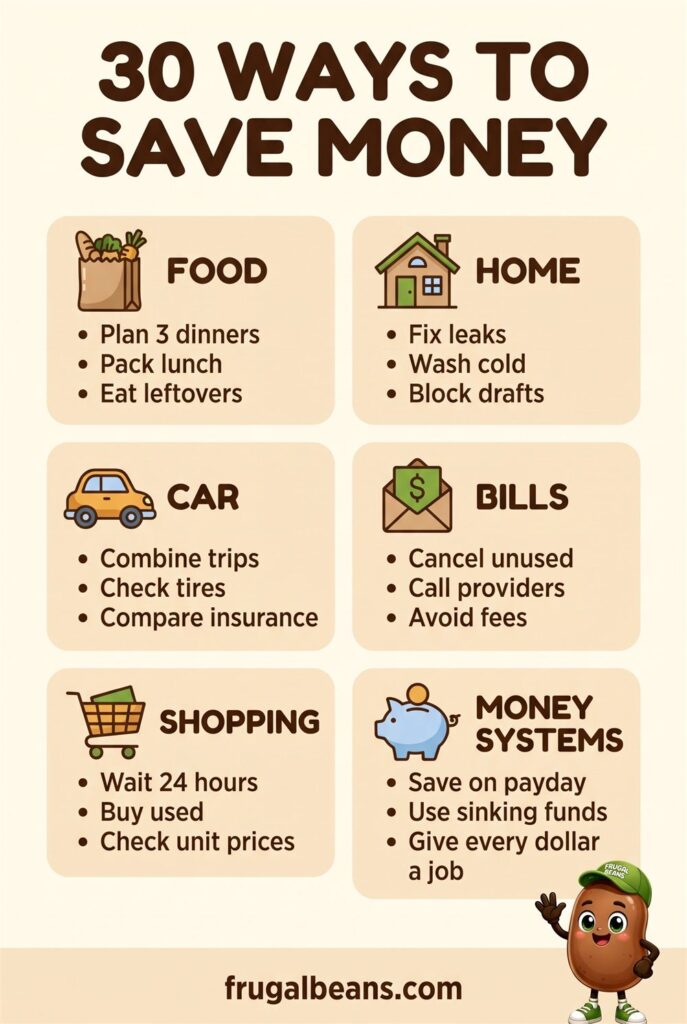
30 Ways to Save Money at a Glance
Use this one-page summary as a checklist. Pick three ideas that fit your household, try them for a month, and keep the ones that stick. The sections below explain the reasoning behind each habit and how to set it up.
Ways to Save Money on Food
Food is where many people look first, and for good reason: it is a frequent purchase, so a small improvement repeats dozens of times a month. Groceries are only one part of the picture, but they are a good place to build momentum. To set a realistic monthly target, our free grocery budget calculator uses USDA food plan costs for your household.
1. Plan Three Dinners Before You Shop
You do not need a full weekly meal plan. Pick three flexible dinners, check what is already in the fridge, freezer and pantry, and build the list from there. Planning a few meals prevents the common cycle of buying ingredients for something new while older food quietly expires. It is one of the easiest ways to save money on food.
2. Pack Lunch Most Workdays
A packed lunch is one of the most reliable small ways to save money because it repeats every workday. Suppose a bought lunch costs $12 and a packed one costs about $4 in groceries. That is $8 a day, or roughly $160 over 20 workdays. Your numbers will differ, but the math is worth doing for your own routine.

Make it easy: cook a little extra at dinner, portion it straight into containers, and keep a few grab-and-go items such as fruit, carrots or boiled eggs ready for busy mornings.
3. Keep an “Eat First” Bin and Eat Leftovers
Put a clear bin on an eye-level fridge shelf for leftovers and produce that needs to be used soon. Food you throw away is money you already spent. Freeze extra portions in labeled containers rather than hoping everyone will want the same leftovers on the fourth day. Eating what you already bought is a quiet way to save money every week.
4. Keep Two Default Cheap Dinners for Tired Nights
Expensive takeout usually happens when everyone is exhausted and nothing is ready. Choose two low-effort meals you can always make, such as bean tacos, pasta with vegetables, or eggs and toast, and keep the ingredients on hand. If you are weighing paid convenience instead, see whether meal delivery services are worth it for your household.
5. Compare Unit Prices and Try Store Brands
The shelf tag often shows a unit price, the cost per ounce or per count. Use it to compare package sizes and brands. Store brands and seasonal produce can stretch a grocery budget, but a bigger package is only a bargain if you actually use all of it. When the tags use different units, our free unit price calculator does the math for you.
Ways to Save Money at Home on Utilities
Most households save money on utilities through behavior and maintenance rather than gadgets. These habits cost little or nothing and work in both owned and rented homes. For a deeper room-by-room walkthrough, read our guide on how to save money at home.
6. Fix Drips and Running Toilets Quickly
A small leak runs all day, every day. Replacing a worn washer or flapper is often a simple job, and fixing it promptly protects cabinets and floors from water damage too. Small repairs like this save money on both water and damage.
7. Wash Full Loads in Cold Water
Run the washer and dishwasher only when they are full, and use cold water for everyday clothes when the care label allows it. Air-dry when convenient, and clean the dryer lint screen after every load so air moves freely. Cold water and full loads save money on energy without any new equipment.
8. Nudge the Thermostat and Dress for the Season
Move the thermostat a few degrees toward the outdoor temperature, especially when you are asleep or away, and add a sweater or a fan instead. Close doors to rooms that do not need the same temperature. A degree or two each way can save money on every heating and cooling bill.
9. Block Drafts Before Buying Upgrades
A draft stopper or rolled towel under an exterior door is a cheap first step. Before spending $200 on a device to save $20 a year, check how long it would take to pay for itself. Simple habits like this usually pay back faster than equipment.
10. Maintain What You Own
Clean filters on schedule, replace worn seals, and follow appliance care instructions. The biggest home bills come from the furnace, air conditioner, water heater and major appliances failing at the worst moment. Our free Homeowner Repair Cost Playbook lists typical lifespans and repair costs so you can plan a replacement instead of paying emergency rates.
Not sure a repair quote is fair?
HomeFix.Expert lets you describe the problem and the quote to a home repair expert online, as a paid consultation, before you pay for a big home repair.
Partner link. Frugal Beans may earn a commission if you buy a consultation, at no extra cost to you.
Ways to Save Money on Transportation
Transportation is a structural expense, so when you save money here, the improvements tend to be larger than any single shopping trick. Start by calculating the full monthly cost of each vehicle: payment, fuel, insurance, maintenance, repairs, parking and registration. A low sticker price does not guarantee a low total cost.
11. Combine Errands Into One Trip
Group errands by location and do them in one loop instead of several separate drives. Fewer trips means less fuel and less wear on the car, and it often cuts impulse stops as well. Planning the route ahead is one of the small ways to save money on fuel.
12. Keep Up With Basic Car Maintenance
Check tire pressure monthly, follow the oil-change schedule in your owner’s manual, and deal with small problems before they become big ones. Smooth driving helps too: the U.S. government’s fuel economy site explains how aggressive driving lowers gas mileage and what to do instead.
13. Compare Car Insurance Every Year
Get quotes at renewal, ask about discounts you may qualify for, and review your coverage levels. Keep the protection you genuinely need; becoming dangerously underinsured is not frugality.
14. Try One Car-Free Option
Where it is practical and safe, compare driving with public transit, cycling, walking or carpooling for one regular trip. Some households find they can share one vehicle instead of two. If a car is essential, prioritize reliability and reasonable operating costs over status.
Ways to Save Money on Bills, Subscriptions and Fees
Recurring bills deserve attention because a successful cut repeats automatically. Trimming a $60 monthly bill frees $720 over a year, more than skipping a long list of small purchases, and you only have to do it once.

15. Cancel Subscriptions You Did Not Use Last Month
Scroll through your bank and card statements and list every recurring charge: streaming, apps, software, memberships and boxes. Cancel or pause anything you did not use last month. Cancel through the company’s actual billing system, then check your next statement to confirm the charge stopped. Few habits save money as reliably as this one.
16. Turn Off Auto-Renew When You Start a Free Trial
Free trials are designed to roll into paid plans. Set a calendar reminder or switch off auto-renew on day one, then decide deliberately whether the service is worth keeping.
17. Call Providers and Ask for a Better Rate
Phone, internet and insurance companies often have lower plans than the one you are on. Ask what options exist, remove features you do not use, and compare competing offers. A 20-minute call can lower a bill for every month that follows. Calling is one of the most underrated ways to save money each month.
18. Stop Paying Bank Fees
Check for monthly maintenance fees, overdraft charges, out-of-network ATM fees and paper-statement charges. Set up low-balance alerts and keep a small cushion in checking so a timing mistake does not set off a chain of fees. If your account keeps charging you, look for one that does not. Avoiding fees is a simple way to save money that takes no ongoing effort.
19. Line Up Due Dates With Payday
A household can earn enough over a month and still run short in a particular week because bills are due before payday. Put every bill on one calendar and ask providers to move due dates where possible. Autopay protects against late fees, but still review the account monthly for charges you do not recognize, renewals that went up in price, and duplicate services.
20. Review Housing at Renewal Time
Housing is usually the biggest bill. If rent or a mortgage takes too much of your income, options include a compatible housemate, moving at lease renewal, a smaller place, or living closer to work. Moving has its own costs, so compare the full picture rather than assuming a lower monthly payment is automatically better.
Smart Shopping: Small Ways to Save Money on Things You Buy
When you shop, you save money less by finding the perfect coupon and more about adding a little friction between the urge and the purchase.
21. Use a 24-Hour Pause
Wait a day before buying anything nonessential above a set amount, and keep a 30-day list for bigger purchases. For a bigger reset, try a week or a month with our no spend challenge calendar. During the pause, write down the problem the item solves and where it will live. If you cannot answer, the purchase may be a response to advertising rather than a need. The pause alone can save money on purchases you would have regretted.
22. Remove Saved Cards and Unsubscribe From Promo Emails
One-click checkout and daily sale emails make spending effortless. Delete saved payment details from shopping apps and unsubscribe from promotional messages. These changes do not require willpower; they simply add a moment for a deliberate decision.
23. Buy Used When It Is Safe and Easy to Inspect
Clothing, furniture, tools, books and many household goods are good secondhand candidates. Buy used when the condition is clear and safety is not in question, and skip anything just because it is cheap.
24. Sell or Donate What You Do Not Use
Photograph items honestly, research a realistic price, and account for platform fees and your time. Bundle low-value items when that makes listing worthwhile. The goal is space and useful cash, not turning your home into a resale warehouse. Selling what you no longer use can save money on storage and raise cash for your goals.
25. Borrow Before You Buy
Libraries, tool-lending programs, neighbors and friends can cover occasional-use items. Agree on return dates and who is responsible for damage so that saving money does not create conflict.
Money Systems That Make Saving Automatic
The first 25 habits free up money. These last five make sure that money actually goes somewhere useful instead of quietly disappearing into everyday spending. This is the “give every dollar a job” part of the Frugal Beans approach.
26. Take a Simple Cash-Flow Snapshot
Gather two or three months of bank statements and bills, and group spending into broad categories. You do not need to explain every coffee. A basic snapshot might look like this:
|
Category |
Question to ask |
|
Take-home income |
Is this a conservative, dependable number? |
|
Housing and utilities |
Is the home affordable for our current income? |
|
Transportation |
What is the full cost, including repairs and insurance? |
|
Food and household supplies |
Which purchases are planned, and which are rushed? |
|
Debt minimums |
Which balance costs the most interest? |
|
Flexible spending |
Which choices provide real value? |
|
Savings and extra debt payment |
What future problem is this money preventing? |
The basic equation is simple: take-home income minus essentials, flexible spending and goals equals what is left. If the result is negative, do not blame yourself. Look for the largest pressure points first, because a rent payment, car loan or high-interest balance can matter more than a dozen small cuts.
27. Move Savings on Payday, Automatically
Set an automatic transfer to savings for the day your paycheck lands. When saving is the default, you do not have to rely on whatever is left at the end of the month. Start with an amount you can sustain, even if it is small, and raise it when a bill goes away. Automation helps you save money without having to decide again every month.
28. Build an Emergency Fund in Stages
An emergency fund is cash set aside for necessary, unexpected expenses or a loss of income. Start with a small starter goal, then work toward one month of essential expenses and eventually a larger cushion suited to your job stability and family. Keep it accessible but separate from everyday spending. The CFPB’s guide to building an emergency fund has practical tips for getting started. To find your own number, try our free emergency fund calculator. If a game helps you stick with it, our free 100 envelope challenge tracker makes each deposit a small daily win.
29. Use Sinking Funds for Predictable Bills
A sinking fund is money set aside gradually for an expense you know is coming: annual insurance, car registration, school supplies, holiday gifts. Divide the yearly cost by twelve and save that amount each month. An emergency is unplanned; a yearly bill is not, even if it feels like a surprise.
30. Pay Down High-Interest Debt With a Clear Order
Keep every minimum payment current, then send extra money to one balance at a time. The debt avalanche method targets the highest interest rate first and usually saves the most interest. The debt snowball method targets the smallest balance first for quicker wins. Pick the one you will stick with. Our debt snowball calculator shows both plans side by side.
For example, suppose a household can add $250 a month beyond the minimums. It applies the $250 to the top-priority balance, and when that balance is gone, it rolls the whole payment into the next one. The key is keeping the total payment the same as balances disappear, rather than treating freed-up money as permission to spend more.
Clever Ways to Save Money Without Feeling Deprived
Sustainable frugality is not built on constant refusal. A plan that cuts every enjoyable thing usually ends in a rebound spending spree. These clever ways to save money keep the plan livable.
Protect What You Value, Cut What You Forget
Sort your spending into three groups: needs that protect safety, health, housing and work; values you deliberately choose because they improve your life; and habits that are mostly automatic or forgettable. Cut the forgettable spending first; that is where you save money without missing anything. If a weekly dinner with friends matters to you, keep it and cancel the streaming service nobody watches.
Use a Replacement Ladder
Swap an expensive habit for a slightly cheaper one before going to the cheapest option. For example, move from frequent restaurant delivery to pickup, then from pickup to one planned restaurant meal a week, while keeping easy meals at home. Gradual steps are more likely to last than strict rules that clash with real schedules.
Watch Out for Lifestyle Inflation
When income goes up, it is easy for spending to follow: a bigger apartment, a nicer car, more upgrades. Enjoying part of a raise is reasonable. Decide before it arrives how much will go to savings or debt, how much to a meaningful improvement, and how much to everyday flexibility. When a loan ends, redirect the old payment to a goal for a few months before deciding what to do with it.
Earn a Little More
Frugality has a floor. You can only cut so far before it harms your health or work. Asking for a raise with evidence of your results, picking up a side project, or selling unused items can add more breathing room than eliminating another modest pleasure. Give that extra income a specific job so it does not dissolve into ordinary spending. For more ideas when the budget is already lean, see our ways to save money on a tight budget.
A Monthly Routine: Ways to Save Money Every Month
A short monthly check-in is one of the simplest ways to save money every month, because it turns good intentions into a habit. Pick one evening or weekend morning and keep the review short enough that you will actually repeat it.
- Close last month. Check balances, confirm bills cleared, and compare actual spending with the plan. Look for patterns, not individual sins.
- List next month’s known costs. Rent, utilities, debt payments, insurance, birthdays, appointments and any annual bills coming due.
- Assign income before spending it. Fund essentials first, then debt minimums, savings, goals and flexible categories. If income varies, use a conservative estimate.
- Choose one fixed-cost action. Cancel a service, call a provider, compare insurance or change a phone plan. One finished action beats a long list of intentions.
- Choose one variable-cost experiment. Try a cheaper replacement, a no-buy week for one category, or packed lunches every day for a month.
- Direct extra money. Send any surplus, refund or bonus to the current priority, such as the emergency fund or the top debt.
- Talk it over. Share what is working and what feels too tight. A plan the whole household agrees on lasts longer than one imposed on everyone else.
Expect imperfect months. A sick child, a broken appliance or a family obligation can knock the plan off track. Note what happened, use your reserves if that is what they are for, and return to the routine without trying to make up for it through extreme cutbacks. For more everyday ideas to rotate into your routine, browse our frugal living tips.
Ways to Save Money: Frequently Asked Questions
What are the best ways to save money?
The best ways to save money are the ones that keep working without constant effort: canceling recurring charges you do not use, planning meals around what you already have, moving savings automatically on payday, and paying down high-interest debt in a clear order. Look at your biggest costs first, such as housing, transportation and insurance, because one change there can outweigh many small cuts.
What are the easiest ways to save money right away?
Cancel subscriptions you did not use last month, plan three dinners from what is already in your kitchen, and set up an automatic transfer to savings on payday. All three can be done in one afternoon and cost nothing to start.
How much money can small habits really save?
It depends on your starting point, so track your own numbers rather than chasing a headline figure. Small habits add up because they repeat: trimming a $60 monthly bill frees $720 over a year, and that is before counting groceries, fees or utilities.
Is it better to cut spending or earn more?
Both help you save money, and they work best together. Start by cutting low-value recurring costs because each cut repeats automatically. Once spending is reasonably lean, further cuts tend to hurt, and earning more usually adds more breathing room.
What should I do with the money I save?
Give it a job right away. A common order is a small starter emergency fund, then extra payments on high-interest debt, then sinking funds for predictable bills, then a larger emergency fund and long-term goals. Moving the money automatically keeps it from drifting back into everyday spending.
The Bottom Line
The most effective ways to save money are the ones you set up once and then repeat without thinking: a packed lunch, a canceled subscription, a full washer, a payday transfer. Each one helps you save money in a small way, but together they change how much room you have every month.
Start with visibility rather than perfection. Pick three habits from this list, try them for a month, and keep what works. Then give every dollar you free up a clear job, whether that is an emergency fund, a smaller debt or a goal that matters to you. That is the Frugal Beans approach: not spending the least, but making deliberate choices that turn a limited income into more freedom over time.
How to Save Money at Home: 25 Easy Habits That Really Work

Learning how to save money at home starts with a simple idea: a frugal home is not a home where every purchase is a struggle or every room feels deprived. It is a home designed to use money, time, energy, and possessions with care. Frugality means choosing what matters most and reducing waste around it. That might mean cooking a simple meal instead of ordering takeout, repairing a dripping tap before it damages a cabinet, or waiting a day before buying something that only looked appealing in a shop.
The goal is to make your spending support your life reliably. A household that saves on routine expenses can redirect money toward debt payments, an emergency fund, family activities, a future move, or simply less financial pressure at the end of each month. Small decisions compound because they repeat. Saving $12 on a weekly grocery trip is not just a $12 win; over a year, it can become more than $600.
A practical frugal home begins with observation rather than guilt. Notice where money leaves the household, decide which comforts matter, and build systems that make good choices easier. This guide to how to save money at home walks through the habits that work best, room by room, and ends with 25 easy changes you can try this month.
What Frugality Really Means at Home
Frugality is the practice of getting useful value from the money and resources you already have. It is different from being cheap. Being cheap focuses only on the lowest price, even when a low-quality item fails quickly or creates more work. Frugality considers the full cost, including repairs, replacements, time, energy, and stress.
For example, buying a $15 pair of shoes that falls apart in two months may cost more than buying a durable $60 pair that lasts two years. The durable pair is not automatically the right choice, but it deserves comparison. A frugal decision asks, “What will this cost me over its useful life, and will it solve a real problem?”
Frugality also leaves room for generosity and enjoyment. A household can spend freely on a favorite tradition while cutting waste elsewhere. If Saturday breakfast at a local café is important to you, keep it and examine unused subscriptions or poorly planned grocery trips instead. A sustainable budget is one you can follow. For more ways to save money at home with this mindset, see our frugal living tips, or start with frugal living for beginners.
Start with a Home Money Map
The first step in learning how to save money at home is to create a simple map of household spending. Review the last month of bank and card activity and group purchases into broad categories such as housing, utilities, food, transportation, household supplies, health, entertainment, and unexpected costs. The purpose is to see patterns.
Mark each expense as essential, useful, optional, or wasteful. Essential covers rent, basic food, and medication. Useful covers spending that saves time or supports health. Optional covers choices you value but could pause. Wasteful covers forgotten memberships, duplicate purchases, late fees, and discarded food.
Then choose one or two categories for a first adjustment. Trying to change everything at once often creates enthusiasm followed by fatigue. Reducing food waste and canceling two unused subscriptions may accomplish more than an overhaul of every expense.
A home money map might look like this:
|
Area |
Question to ask |
First useful action |
|
Food |
What do we buy and fail to use? |
Plan three flexible dinners before shopping |
|
Utilities |
Which usage is automatic or unnoticed? |
Check heating, cooling, and standby power |
|
Household goods |
Do we own duplicates? |
Make a “use before buying” shelf |
|
Subscriptions |
What did we use last month? |
Cancel or pause anything unused |
|
Repairs |
What is becoming more expensive? |
Schedule one small repair this week |
|
Convenience |
Which purchase happens when we are rushed? |
Prepare a low-effort backup option |
How to Save Money at Home on Food

Food is where most people first learn how to save money at home, because small planning changes affect many meals. Start by checking what you already have. A pantry, freezer, and refrigerator inventory prevents the common cycle of buying ingredients for a new recipe while older food quietly expires. A clear “eat first” bin in the fridge keeps the food that needs attention in plain sight.
Plan meals around ingredients that can appear in more than one dish. A roast chicken might become dinner, sandwiches, and soup. A pot of beans can serve as filling for wraps, a base for chili, or part of a rice bowl. Freeze extra portions in labeled containers rather than hoping everyone will want leftovers on the fourth day.
Keep a short list of reliable, low-effort meals for busy nights. Pasta with vegetables, eggs and toast, bean tacos, rice with frozen vegetables, or soup from leftover ingredients can protect the budget from expensive last-minute orders. Convenience is not a character flaw; it is a predictable need. The frugal solution is to plan affordable convenience before you are exhausted. If you are weighing paid convenience, our look at whether meal delivery services are worth it walks through the real cost.
Shop with a list, but allow substitutions. If the planned vegetable is expensive, choose a similar one on sale. Compare unit prices, which show the cost per standard amount. A larger package is not a bargain if part will be discarded. Saving money never requires eating food that looks or smells unsafe. Our free unit price calculator makes the size comparison quick.
Save Money at Home on Utilities

When you save money at home on utilities, the savings usually come from behavior and maintenance. Turn off lights in empty rooms, but remember that heating, cooling, water heating, and large appliances often have a greater effect. Use a schedule when practical, close doors to rooms that do not need the same temperature, and wash full loads.
Ways to save on electric bill costs without new gear
The cheapest ways to save on electric bill costs are habits, not purchases. Heating and cooling typically use the largest share of energy in a home, so a few degrees on the thermostat matters more than switching off one lamp. Run the dishwasher and washing machine only with full loads, unplug chargers you are not using, and switch electronics off at a power strip at night. If your utility offers time-of-use rates, ask whether moving laundry or dishwashing to off-peak hours would help.
Hot water deserves special attention. Shorter showers, fixing a dripping faucet, and using cold water for suitable laundry loads can reduce both water and energy use. Air-dry clothing when convenient. Clean appliance filters and vents according to their instructions because blocked airflow can make equipment work harder. Our free home maintenance calendar builds a month-by-month home maintenance checklist so these jobs don’t slip.
Do not spend $200 on a gadget to save $20 without checking the numbers. A low-cost draft stopper may be worthwhile, while a costly upgrade may take years to repay. For rented homes, ask the landlord before changing wiring, plumbing, windows, or heating equipment. ENERGY STAR keeps a practical list of energy savings at home, and its heating and cooling guide covers thermostats, filters, and when equipment is worth replacing.
Save Money at Home by Maintaining What You Own
Many household purchases are responses to inconvenience. A drawer is messy, so a person buys an organizer. A shirt is missing a button, so a person buys another shirt. A meal feels difficult, so a person buys specialized equipment. Before buying, pause and ask whether the problem can be solved with something already in the home.
Create a waiting rule for nonessential purchases. A 24-hour pause may be enough for a small item, while a 30-day list suits expensive purchases. During the pause, write down the problem, storage location, and expected use. If you cannot answer, the purchase may be responding to advertising rather than need.

Maintenance is one of the quietest ways to save money at home. Clean dryer lint, replace worn seals, and follow appliance care instructions. Keep basic screwdrivers, tape, spare batteries, thread, and a measuring tape. Learn which repairs are safe to do yourself and which require a qualified professional. A frugal home does not treat safety as an experiment.
Not sure whether it is a do-it-yourself job?
HomeFix.Expert lets you describe the problem to a home repair expert online, as a paid consultation, to find out whether it is a safe fix to do yourself or a job for a professional.
Partner link. Frugal Beans may earn a commission if you buy a consultation, at no extra cost to you.
The biggest maintenance bills come from the systems that run the house: the furnace, air conditioner, water heater, and major appliances. Knowing their age and warning signs lets you plan a replacement instead of paying emergency rates. Our free home system lifespan tracker shows which one is likely to need replacing first and how much to set aside each month. Our free Homeowner Repair Cost Playbook lists typical lifespans and repair costs for each one.
When a technician quotes a big repair, run the numbers through our free repair or replace calculator before you agree. Knowing whether to fix or replace a major system is one of the quickest ways to save money at home.
Borrowing and sharing can also reduce ownership costs. A library, tool-lending program, neighborhood group, or collection of resources among friends can provide occasional-use items without requiring every household to store and maintain them. Agree in advance about return dates and responsibility for damage so that saving money does not create conflict.
Ways to Save Money at Home, Room by Room
For a frugal home, walking through the house one room at a time is one of the simplest ways to save money at home, because each room has its own habits and its own leaks. Use the infographic as a checklist, then read the notes below for the reasoning behind each habit.
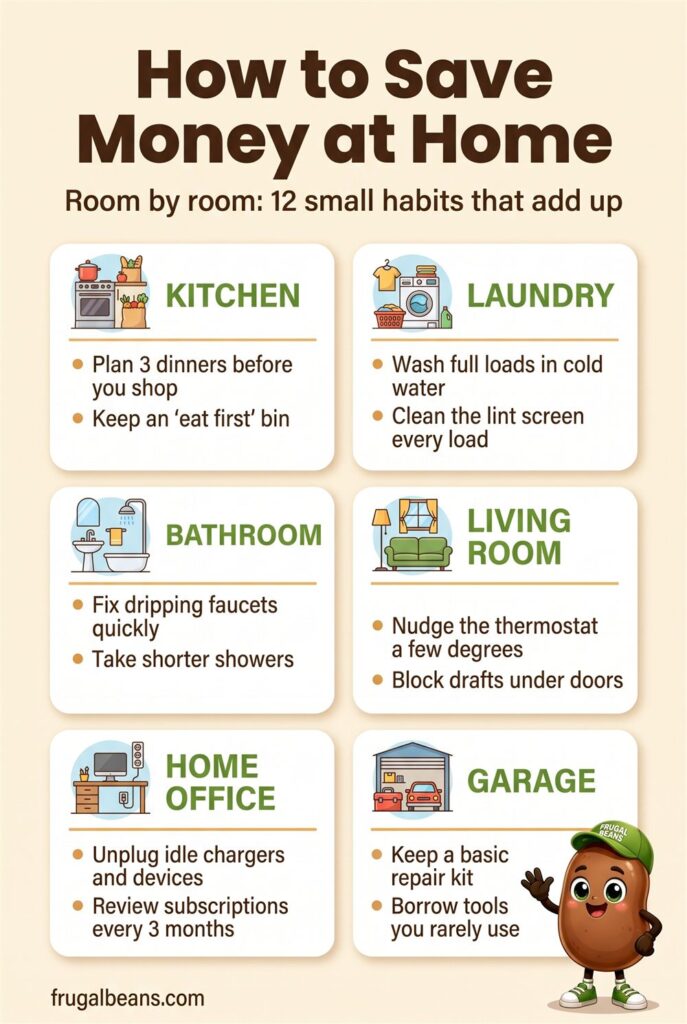
Kitchen
Plan three dinners before you shop and build the list from what is already in the cupboards. Keep an “eat first” bin so leftovers and soft produce get used before they spoil. Food you throw away is money you already spent.
Laundry
Wash full loads and use cold water for everyday clothes when the care label allows it. Clean the dryer lint screen after every load; it keeps air moving, shortens drying time, and reduces a common fire risk.
Bathroom
Fix dripping faucets and running toilets quickly, since a small leak runs all day, every day. Shorter showers cut both the water bill and the energy used to heat that water.
Living Room
Nudge the thermostat a few degrees toward the outdoor temperature and dress for the season. Block drafts under exterior doors with a simple draft stopper or a rolled towel before considering larger upgrades.
Home Office
Unplug idle chargers and switch off devices at a power strip when you finish for the day. Set a reminder to review subscriptions every three months and cancel anything you did not use.
Garage and Storage
Keep a basic repair kit so small fixes do not turn into service calls. Borrow tools you rarely use instead of buying them, and store what you own where you can find it, so you never buy a duplicate.
Make a Frugal Home Budget That Is Easy to Use
A budget is a plan for money, not a punishment for spending. Begin with reliable income, then list fixed costs, flexible costs, savings, and debt payments. Include irregular expenses such as insurance, school costs, gifts, maintenance, and travel. Divide an annual cost by twelve and set aside that monthly amount when possible.
Give every category a realistic amount. If groceries usually cost $500, writing down $250 will not make the difference disappear; it will only make the budget look unsuccessful. For a fair starting number, try our grocery budget calculator, which uses USDA food plan costs. Use recent spending as a starting point, then reduce one area gradually. A budget helps you decide before the money is gone, and it turns small habits into a steady plan to save money at home. Our 11 budgeting tips cover how to set those amounts.
Try a weekly household check-in that lasts fifteen minutes. Review upcoming bills, meals, appointments, and any planned purchases. Confirm what is in the checking account and what must remain available. Keep the discussion neutral. The question is not “Who spent too much?” but “What does the household need to prepare for next?”
25 Easy Habits to Save Money at Home
These are the most practical ways to save money at home. Use them as experiments rather than rules. Pick three, try them for a month, and keep the ones that stick.
- Keep a visible “eat first” box in the refrigerator for food that needs attention soon.
- Plan three flexible dinners before every grocery trip.
- Make one weekly grocery trip and use a short top-up list for genuinely missing essentials.
- Compare unit prices instead of package prices.
- Prepare one inexpensive meal component, such as cooked rice, washed vegetables, or boiled eggs, for the next few days.
- Freeze extra portions in labeled containers.
- Keep two default low-cost dinners for nights when you are too tired to cook.
- Wash full loads and use cold water when the care label allows.
- Clean the dryer lint screen after every load.
- Air-dry clothing when it is convenient.
- Fix dripping faucets and running toilets quickly.
- Take shorter showers.
- Nudge the thermostat a few degrees and dress for the season.
- Block drafts under exterior doors.
- Turn off lights and unplug idle chargers in empty rooms.
- Clean or replace HVAC and appliance filters on schedule.
- Store cleaning products together and check existing supplies before buying replacements.
- Use a 24-hour pause for small nonessential purchases and a 30-day list for big ones.
- Set a calendar reminder to review subscriptions every three months.
- Turn off automatic renewal when starting a trial, then decide deliberately whether to continue.
- Keep a basic repair kit and learn the safe, simple fixes.
- Borrow tools you rarely use instead of buying them.
- Place a donation box in a closet and remove items when it is full instead of letting clutter spread.
- Use cloths, towels, and washable containers when practical, without buying a whole new set of products to pursue zero waste.
- Keep a small emergency fund for home repairs so a broken appliance does not automatically become high-interest debt.
When you are working out how to save money at home, the best habits are the ones that remove decisions. A labeled freezer, a default low-cost dinner, and an automatic transfer to savings reduce willpower. If a system fails, adjust it rather than blaming its users.
How to Save Money at Home When You Rent or Share
Renters and roommates can still create a frugal home without replacing windows or installing major equipment. Focus on reversible actions: efficient lighting, draft control that does not damage surfaces, sensible thermostat settings, careful water use, and organized shared supplies. Ask about utility billing rules before changing habits that affect other residents.
In a shared home, agree on systems. Decide how groceries, shared replacements, and repairs will be handled. A shared list can prevent three people from buying dish soap in one week. If one roommate uses most of an item, a contribution rule may be fairer than an equal split.
Do not sacrifice privacy, safety, or basic comfort to meet an arbitrary target. A cheaper home may not be cheaper if it creates a long commute, poor sleep, or frequent emergency expenses. Consider total housing cost, not just advertised rent.
Use Savings for Security First
Once you start to save money at home and frugal changes create room in the budget, give the savings a job. A small starter emergency fund can cover a minor repair or urgent trip without relying on a credit card. After that, work toward several weeks or months of essential expenses, depending on your income stability and responsibilities. High-interest debt may deserve priority because interest can grow faster than ordinary savings. Our free emergency fund calculator can help you set that target.
Keep savings separate from spending money but accessible for real emergencies. Track progress clearly. Paying off a $300 balance or setting aside the first $500 is meaningful even if the long-term goal is much larger.
Avoid turning every saving into permission for immediate consumption. Some rewards are healthy, but decide in advance how much of a windfall or monthly surplus will go to security, goals, and enjoyment. This balance helps frugality feel like progress rather than permanent restriction.
How to Save Money at Home: Frequently Asked Questions
What is the fastest way to save money at home?
The fastest way to save money at home is to start with food waste and unused subscriptions. Both can be fixed in an afternoon: take a fridge and pantry inventory, plan three dinners from what you have, and cancel anything you did not use last month. These changes need no equipment and no upfront cost.
How much can a household save with frugal habits?
It depends on your starting point, so track your own numbers rather than chasing a headline figure. Small repeat savings add up: trimming $12 from a weekly grocery trip is more than $600 over a year, before counting any utility or subscription changes.
Is it worth buying energy-saving gadgets to save money at home?
Only when the numbers work. Habits such as shorter showers, full laundry loads, and thermostat adjustments cost nothing, and they are some of the easiest ways to save on electric bill costs. Before buying a device, compare its price with a realistic monthly saving and check how many years it would take to pay for itself.
How can renters save money at home?
Focus on reversible changes: draft stoppers, careful thermostat use, efficient bulbs you can take with you, shorter showers, and shared-supply systems with roommates. Ask the landlord before changing anything permanent.
The Bottom Line
A frugal home is built through ordinary choices that protect what the household values. It starts with seeing the flow of money clearly, then reducing waste in food, utilities, purchases, and convenience spending. It uses maintenance, planning, and shared systems to make savings repeatable. It also recognizes that the cheapest option is not always the best option when quality, safety, time, and stress are included.
Choose one small change today: inspect the pantry, cancel an unused subscription, plan a low-effort dinner, or schedule a repair. Keep what works and revise what does not. If you want to know how to save money at home without feeling deprived, this is the answer: start small and keep going. Over time, these decisions can turn a home into a steadier financial base—one that supports comfort, resilience, and the life you actually want to live.
Frugal Living Tips: 21 Simple Ways to Live Well on Less

The best frugal living tips are not about making life small; they are about making your money useful on purpose. Ms Frugal Quaker, the plain-spoken voice behind the original version of this post, would put it simply: before you spend, ask whether the purchase supports the life you are trying to build. That one question can help a household spend less without turning every grocery trip or family outing into a test of willpower.
Frugal living means using what you have carefully, choosing value over appearance, and leaving room for the future. It is not a contest to see who can spend the least. It is a set of habits that keeps money flowing toward what your household actually values and away from waste, impulse, and forgotten charges.
This guide collects the tips for frugal living that work best in real households. You will find the mindset behind them, a simple spending map, practical ideas for food, clothing, repairs, and borrowing, a numbered list of 21 tips you can try this month, and a short plan for the months when money is tighter than usual.
What Living Frugally Really Means
Frugality is different from being cheap. Being cheap focuses only on the lowest price, even when a poor-quality item costs more over time. Frugal living considers the total cost of a choice: the price, how long it lasts, what it costs to maintain, and the effect it has on your household’s peace of mind.
A $20 pair of work boots that splits in three months is not a bargain if a sturdier pair would have lasted for years. The sturdier pair is not automatically the right answer either, but it deserves a fair comparison. The frugal question is, “What will this cost me over its useful life, and does it solve a real problem?”
Enough Before More
The heart of a frugal lifestyle is learning to define “enough.” Enough does not mean refusing every improvement. It means recognizing when something already meets your needs.
A phone that makes calls, runs the apps you need, and holds a charge may be enough even if a newer model has a better camera. A packed lunch may be enough even if coworkers order delivery. A clean, well-fitting jacket may be enough for another winter after a small repair. When you notice “enough,” the pressure to upgrade loses much of its pull.
Frugal, Not Deprived
People who live frugally for years usually keep a few things they love. If Saturday breakfast out is a family tradition, keep it, and trim the subscriptions nobody opens instead. A plan you can follow beats a perfect plan you abandon in two weeks. If you are just getting started, our guide to frugal living for beginners walks through the first steps in more detail.
How to Live Frugally: Start With a Clear Reason
Learning how to live frugally is much easier when you know what the savings are for. A budget is easier to follow when it serves a purpose. “Spend less” is vague and discouraging. “Save $600 for car repairs by December” gives every small choice a connection to a real need.
Write down three priorities for the next six to twelve months. One might be an emergency fund, which is money set aside for an unexpected cost such as a broken appliance or a short stretch without work. Another might be paying down a credit card. A third could be something positive, such as a family visit or replacing an unreliable laptop. If saving feels like a chore, a savings challenge such as our 100 envelope challenge tracker can make the first goal feel like a game.
Next, list your monthly take-home income and your essential expenses: housing, utilities, basic food, transportation, insurance, minimum debt payments, and necessary medical costs. Then list flexible spending, such as restaurants, subscriptions, clothing, hobbies, and convenience purchases. Do not criticize the list. Accuracy is more useful than shame.
A short weekly check-in keeps the plan realistic. Look at what was spent, compare it with the plan, and adjust the next week. If the household spent too much on takeout because everyone was exhausted, the fix may be two easy freezer meals, not a lecture about discipline.
Build a Household Spending Map for Frugal Living
Many budgets fail because their categories do not match real life. A household might have a “food” category but no way to see the difference between groceries, coffee runs, school lunches, and delivery fees. A spending map should be detailed enough to reveal patterns but simple enough to keep up.
Here is an illustrative monthly map for a household with $4,000 in take-home income. The amounts are examples, not rules.
|
Spending group |
Example amount |
Frugal focus |
|
Housing and basic utilities |
$1,450 |
Review renewals and reduce avoidable energy use |
|
Transportation and insurance |
$600 |
Combine errands and maintain the vehicle |
|
Groceries and household supplies |
$600 |
Plan meals around what is already on hand |
|
Debt payments |
$400 |
Pay minimums first, then target one balance |
|
Savings and future needs |
$450 |
Automate a manageable amount each payday |
|
Health, school, and necessary care |
$250 |
Plan for recurring costs before they arrive |
|
Personal spending and fun |
$250 |
Spend freely within a visible limit |
|
Total |
$4,000 |
Adjust categories to fit your priorities |
The point of a table like this is not to make every month identical. It is to reveal tradeoffs. If there is no cushion for irregular costs, an unexpected $300 repair has to come out of another category or go on a credit card. Seeing that risk in writing is often the motivation a household needs to make a gradual change. For more ideas on trimming each line, see our list of practical ways to save money.
Frugal Living Tips for Food Without the Misery
Food is one of the easiest places to put frugal living tips to work because small routines repeat many times a month. The goal is not to eat the cheapest possible meals. The goal is to waste less and make convenient, satisfying food easy to reach at home.
Keep a Use-First Shelf
Choose one shelf in the refrigerator for leftovers, opened produce, and items close to their date. Plan one flexible meal each week that can absorb them, such as fried rice, soup, pasta, grain bowls, or omelets. This turns random odds and ends into dinner instead of trash.
Cook With Overlapping Ingredients
Pick a few dependable meals that share ingredients. A roast chicken can become dinner, sandwiches, and soup. A pot of beans can fill tacos, top a salad, or start a simple stew. Frozen vegetables make it easier to cook when fresh produce has run out.
Store brands are often a sensible choice, but compare the unit price rather than the package price. The unit price shows the cost per ounce, pound, or item, which makes different package sizes easier to compare. A bigger package is not a bargain if half of it ends up in the bin. Our free unit price calculator compares up to six items at once.
Plan for Tired Nights
Keep a short list of backup meals: oatmeal with fruit, eggs and toast, canned soup with a sandwich, or pasta with frozen vegetables. They may not be exciting, but they can prevent a costly delivery order. Frugal living works best when it prepares for tired days instead of pretending they will not happen. If you are weighing paid convenience, our look at whether meal delivery services are worth it breaks down the real cost.
Tips for Frugal Living: Clothes, Laundry and Repairs

Clothing and household goods rarely blow up a budget in one purchase, which is why these frugal living tips focus on small, repeat savings. They leak money through small replacements, and that is exactly where steady frugal habits pay off. Before buying, check what you already own. Many households discover they have three of something they thought they needed.
Wash Smarter, Dry for Free
Wash full loads, use cold water for everyday clothes when the care label allows, and air-dry when the weather and your schedule cooperate. A clothesline or a folding drying rack costs little and can take some of the load off the dryer. Clothes that are not tumbled every week also tend to keep their shape and color longer, which means fewer replacements.
Mend Before You Replace

The same thinking applies to the big systems in your home. When a furnace, air conditioner or appliance breaks, our free repair or replace calculator shows whether fixing it is the frugal choice for a unit that age, one of the most practical frugal living tips for homeowners. To see which system is likely to need replacing next, and what to save for it, try our free home system lifespan tracker.
Want a second opinion on a repair?
HomeFix.Expert lets you ask a home repair expert online, as a paid consultation, whether a repair is worth doing before you spend.
Partner link. Frugal Beans may earn a commission if you buy a consultation, at no extra cost to you.
A missing button, a loose hem, or a small seam tear is often a ten-minute fix with a needle and thread. Keep a small sewing kit with a few colors of thread, spare buttons, safety pins, and small scissors. If sewing is not your thing, a local tailor or a handy friend may still cost less than a new garment.
The same thinking applies around the house. Tighten the loose cabinet hinge, replace the worn washer in a dripping faucet, and clean the dryer lint screen after every load. Small maintenance keeps small problems from becoming expensive ones. For larger systems such as the furnace, water heater, and major appliances, our free Homeowner Repair Cost Playbook lists typical lifespans and warning signs so you can plan instead of paying emergency rates.
Know When to Call a Pro
Frugality never means treating safety as an experiment. Electrical work, gas appliances, and anything structural belong with a qualified professional. Get more than one estimate, and ask whether a safe temporary fix exists while you save for the full job.
Borrow Before You Buy: A Frugal Living Tip That Adds Up
Borrowing is one of the most overlooked frugal living tips. Ms Frugal Quaker liked to talk about building a collection of “many resources”: the places and people that help a household solve problems before spending money. That collection might include a public library, a community swap group, a tool-lending program, a free local events calendar, a food pantry, workplace benefits, or a trusted neighbor.
A library can offer books, movies, classes, internet access, and in some areas, museum passes or even tools. A community group may help someone find a used crib, spare moving boxes, or a recommendation for an honest repair person. A pantry can support a tight month so a household does not have to choose between food and another bill. Using available help is not a personal failure. These resources exist to make communities stronger and household money less fragile.
Make a note on your phone or a page in a household folder. Add each resource’s name, what it offers, opening hours, any eligibility rules, and the date you last checked. Include informal resources too, like a neighbor who lends a ladder or a friend who trades babysitting. The list is most valuable when it is ready before you need it.
21 Frugal Living Tips to Try This Month
These 21 frugal living tips are grouped into six themes: plan, cook, repair, borrow, wait, and save. Do not try them all at once. Pick two or three, use them for a month, and keep the ones that fit your household.
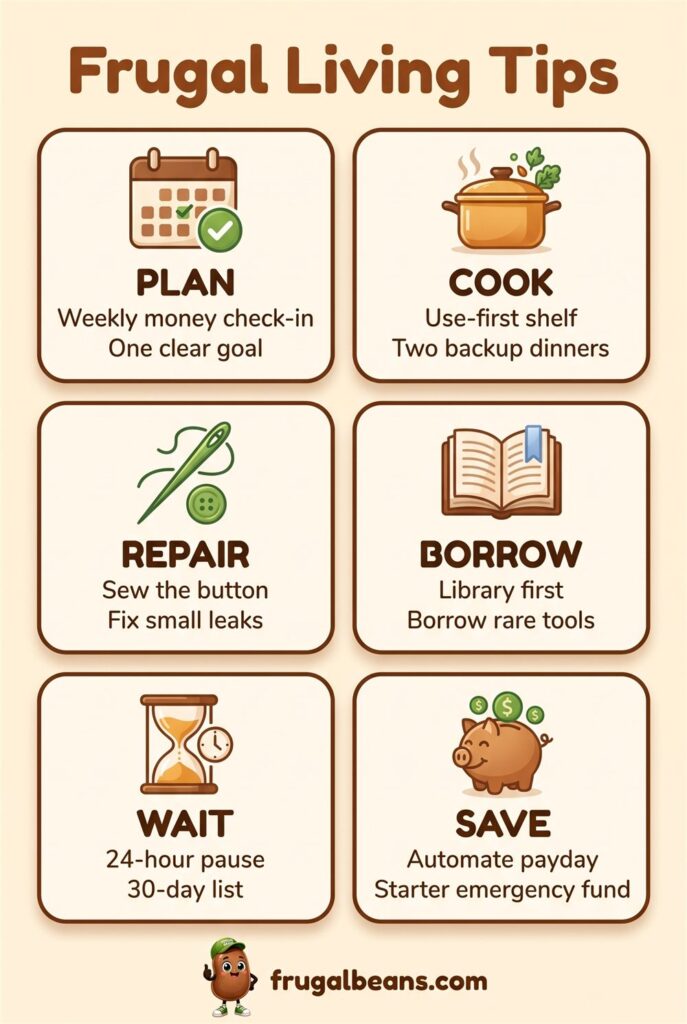
- Hold a weekly money check-in. Spend fifteen minutes reviewing upcoming bills, meals, and planned purchases.
- Name one clear savings goal. Give it a dollar amount and a date so small choices have a purpose.
- Review the last 30 days of transactions. Circle the three purchases that surprised you most.
- Combine errands into one trip. Fewer trips mean less fuel, less time, and fewer impulse stops.
- Keep a use-first shelf in the fridge. Put leftovers and soft produce where everyone sees them.
- Plan dinners from what you already have. Check the pantry and freezer before writing a grocery list.
- Keep two backup dinners on hand. Simple meals for tired nights protect the budget from takeout.
- Pack a drink and snack before you leave home. Small convenience purchases add up quickly.
- Sew the button and fix the hem. A basic sewing kit extends the life of clothes you already like.
- Fix small leaks quickly. Dripping faucets and running toilets waste water every hour they run.
- Wash full loads in cold water and air-dry when you can. Follow care labels and let the sun do some of the work.
- Check the library first. Books, movies, classes, and sometimes passes or tools are free to borrow.
- Borrow rare-use tools instead of buying them. Ask a neighbor, a tool library, or a community group.
- Use swap groups for kids’ gear and seasonal items. Children outgrow things long before they wear out.
- Use a 24-hour pause for small extras. If you still want it tomorrow, it may be a planned choice.
- Keep a 30-day list for big purchases. Write down the problem it solves and compare alternatives.
- Review subscriptions every three months. Cancel anything you did not use and note annual renewal dates.
- Automate a small transfer on payday. Even $10 a paycheck builds the habit before the amount grows.
- Build a starter emergency fund. A few hundred dollars can keep a minor surprise off a credit card. When you are ready for the full target, the emergency fund calculator sizes it for your household.
- Call one provider about a lower rate. Ask about a cheaper plan, a fee waiver, or a better renewal price.
- Give every adult a no-questions allowance. A small, guilt-free amount keeps the whole plan sustainable.
These frugal living tips are deliberately modest. A habit that survives a busy week is worth more than an ambitious plan that lasts three days.
Frugal Living Tips That Survive a Bad Month
Every household has months when the paycheck is short, a medical bill arrives, or the car needs work at the worst possible time. The frugal living tips that matter most are the ones that still function when you are stressed and tired.
Protect the Essentials First
List the bills that keep the household safe and running: housing, utilities, food, transportation to work, insurance, and necessary medicine. Pay those first. If something has to slip, call the company before the due date and ask about a payment plan or a later date. Many will work with you if you ask early.
Switch to a Bare-Bones Budget for a While
Pause the flexible categories, not forever, just for this stretch. Our free no spend challenge calendar makes it easier to stick with: mark each day you hold the line and watch the streak grow. Eat from the pantry and freezer, skip nonessential shopping trips, and lean on the resource list you built earlier. A library card, a pantry, and a neighbor with a ladder are exactly what a bad month calls for. Our guide to saving money on a tight budget has more ideas for these weeks.
Use Savings Without Guilt
If you built an emergency fund, this is what it is for. Using it is not failure; it is the plan working. Once the month passes, restart the automatic transfer, even at a smaller amount, and rebuild gradually.
Keep One Small Comfort
Cutting everything at once often leads to a rebound spending spree. Keep one inexpensive comfort, such as a favorite coffee at home or a free outing with family, so the tight stretch feels survivable rather than punishing.
Use a Frugal Lifestyle to Pay Down Debt and Grow Savings
When money is tight, saving and paying debt at the same time can feel impossible. A balanced plan usually protects a small starter emergency fund while making every required debt payment. After that, direct extra money toward one priority at a time.
A starter fund of even a few hundred dollars can stop a minor emergency from becoming new credit card debt. The Consumer Financial Protection Bureau’s guide to building an emergency fund explains how to set a goal and make saving automatic.
Once that buffer exists, choose a debt strategy. The debt avalanche sends extra money to the balance with the highest interest rate, which can reduce the total interest you pay. The debt snowball sends extra money to the smallest balance first, which can create faster emotional wins. Either method works if payments are made consistently.
When a frugal lifestyle change frees up money, give it a job right away. If you cancel a subscription, move the same amount to savings or a debt payment that day. Money without a job tends to drift back into everyday spending.
Keep Your Frugal Lifestyle Kind and Sustainable
The people who live frugally for the long haul tend to share one trait: they leave room for joy. A household budget should include some enjoyment. If every purchase is treated as evidence of failure, people tend to abandon the plan and spend reactively. Set a reasonable personal allowance for each adult and, when it fits, a small amount for children. Money inside that boundary can be spent without debate.
Do not use frugality as a reason to ignore health, safety, or dignity. Skipping needed medicine, driving on worn tires, or refusing necessary professional help is not a bargain. The lowest price today can create a much bigger cost later. A sustainable plan protects essentials first and looks for savings around them.
Households also move through seasons. A new baby, a job change, or caring for a parent may require spending in new ways for a while. That is not failure. The purpose of a financial plan is to help you respond calmly, not to produce a perfect record. Many of the habits in this guide also work room by room; our guide on how to save money at home covers the kitchen, laundry room, and more.
Frugal Living Tips: Frequently Asked Questions
What are the easiest frugal living tips to start with?
Start with food waste and unused subscriptions. Both can be handled in an afternoon: check the fridge and pantry, plan a few dinners from what you have, and cancel anything you did not use last month. Neither change requires any upfront cost.
How do I live frugally without feeling deprived?
Keep a few things you truly value and cut waste around them. Give each adult a small allowance that can be spent without explanation, and focus first on spending that brings little joy, such as late fees, forgotten subscriptions, and food that spoils.
Is frugal living the same as being cheap?
No. Being cheap looks only at the lowest price. Frugal living looks at the total cost, including how long something lasts, what it takes to maintain, and whether it solves a real problem. Sometimes the frugal choice costs more up front.
How much money can frugal living save?
It depends on where you start, so track your own numbers rather than chasing a headline figure. Small repeat savings add up: cutting $10 a week from takeout is $520 over a year, before counting any subscription or utility changes.
The Bottom Line
A frugal lifestyle is thoughtful use, not constant deprivation. Start with a reason for saving, map the money you already spend, and change a few defaults that create repeat costs. Plan food for tired days, mend and maintain what you own, borrow before you buy, and give your savings a clear job.
Pick two or three of these frugal living tips today and try them for a month. Keep what works and adjust what does not. Over time, a pause before buying, a dinner made from what is on hand, and a small automatic transfer add up to breathing room: more control, fewer emergencies, and a clearer path toward the life your household values.
Is Meal Kit Delivery Worth It? 7 Smart Questions to Decide

Are meal delivery services worth it for your household, or is meal kit delivery just an expensive way to answer the question “what’s for dinner?” A box arrives with measured ingredients and a recipe card, or a tray arrives ready to heat. The convenience can be real, especially for a busy family, a new parent, or someone who wants to cook more often without planning every meal. The price can also be much higher than it first appears.
Whether meal delivery services pay off depends less on the advertised price per serving and more on how they fit your actual habits. You need to count delivery fees, skipped boxes, unused ingredients, grocery spending, takeout, food waste, and the value of your own time. A service can be a sensible purchase if it replaces expensive last-minute meals and food that would otherwise spoil. It can be a poor deal if it adds another food expense without replacing anything.
This guide gives you a simple way to decide whether meal kit delivery or a prepared-meal plan makes sense, using your own numbers. You will work out a real cost per serving, compare meal kits with prepared meals, groceries, and takeout, spot the hidden charges, and then run through seven smart questions that tell you whether a meal kit subscription has earned a place in your budget.
What You Are Paying For with Meal Kit Delivery and Prepared Meals
Meal delivery services fall into two broad categories, and the money trade-offs are different for each. Some companies offer both types, so it helps to know which one you are actually comparing.
Meal Kits
With meal kit delivery, a company sends measured ingredients and step-by-step instructions that you cook at home. The bill usually covers the ingredients, recipe development, portioning, packing, insulated shipping, and delivery. You are also paying for the planning work that a grocery trip normally requires: someone else picked the recipes, wrote the shopping list, and bought exactly the amounts you need.
Prepared Meals
Prepared-meal services send food that is fully cooked or mostly cooked, so you only need to heat and serve it. Here you are paying for cooking labor, packaging, refrigeration, and the convenience of skipping the stove entirely. Prepared meals usually save more time than meal kits, but the portions and variety may feel more limited.
The Two Options You Are Really Competing With
Every delivered meal is competing with two familiar alternatives: groceries you cook yourself, and takeout or restaurant delivery. Cooking from groceries is usually the cheapest per serving but takes the most planning and time. Takeout is fast and requires no cleanup but is usually the most expensive. Meal kits and prepared meals sit somewhere in between, and that middle position is exactly why the answer is different for every household.

In every case, the listed price of meal kit delivery or prepared meals rarely tells the whole story. A weekly order might advertise eight servings at $10 each, or $80. After a delivery fee, the total might be $95. If one meal is too spicy, another is not filling enough, and two servings end up in the freezer, your effective cost is far higher than $10 per serving. The useful number is the cost of food you actually eat, not the number printed in the promotion.
The Real Meal Kit Delivery Cost: Hidden Charges to Count
Before deciding, calculate the full meal kit cost of a typical order. Include every recurring charge and the costs that the order itself creates. A meal kit may require cooking oil, salt, spices, butter, or other pantry items. A prepared meal may require side dishes, drinks, or extra portions for a bigger appetite. Use this table as a checklist when you look at your first few orders.
|
Expense to check |
Why it matters |
Question to ask |
|
Menu price |
The advertised price is usually only the starting point. |
What is the price before and after discounts? |
|
Delivery fee |
A weekly charge can materially change the cost of small orders. |
Can I combine orders or qualify for free delivery? |
|
Taxes and surcharges |
These may appear at checkout rather than on the menu page. |
What is the final charge on my statement? |
|
Pantry add-ons |
Missing oil, spices, or staples create extra grocery trips. |
Do I already have the required basics? |
|
Unused servings |
Food that is never eaten is part of the cost. |
How many portions will realistically be eaten? |
|
Replacement meals |
A kit may not replace takeout if it is inconvenient. |
Will this prevent another food purchase? |
|
Subscription waste |
Forgotten skips can create unwanted boxes. |
How easy is it to pause or cancel? |
Shipping and Delivery Fees
Many meal kit delivery services charge a flat delivery fee per box. On a large order, that fee is spread across many servings and barely moves the math. On a small order, it can add a noticeable amount to each plate. Always divide the fee into your per-serving number rather than treating it as a separate, forgettable line.
Skipped Boxes and Missed Deadlines
Most meal kit subscription plans ship automatically unless you skip a week before a cutoff date. If you travel, work irregular shifts, or simply forget, a box can arrive that nobody has time to cook. That box still counts toward your real meal kit cost, even if half of it goes in the trash.
Auto-Renew and Introductory Discounts
Welcome offers can make the first box look like a bargain, while later boxes cost the full price. Decide whether the regular price works before the discount runs out, and set a reminder for the date the subscription renews. If you want to stop a recurring charge, the Consumer Financial Protection Bureau explains how to stop automatic payments from your bank account, including telling the company in writing and keeping records of the date you asked. Remember that stopping a payment is not the same as canceling the service, so cancel the subscription itself, too.
Portions and Pantry Add-Ons
Check serving sizes against the people you are feeding. A box marketed for a family may provide smaller portions than active teenagers or hungry adults expect. If you routinely add bread, rice, salad, or a second main dish, add those costs to the order before you calculate anything.
Are Meal Delivery Services Worth It Compared with Groceries and Takeout?
The fairest way to compare options is one number: effective cost per serving. Use this simple calculation for every option you are considering:
Total cost ÷ servings actually eaten = effective cost per serving.
Here is a worked example using made-up numbers. Suppose a two-person household orders three meal kits with two servings each. The food costs $66, delivery costs $10, and the household spends $4 on missing pantry ingredients. The order total is $80 for six planned servings, or about $13.33 per serving. If one serving is thrown away and one portion is too small to count as a full meal, the order provides only four satisfying meals. The effective cost is then $20 per satisfying meal.
A Four-Way Example (Illustrative Numbers Only)
To see how the comparison works, here is the same week of six dinner servings priced four ways. These figures are examples to show the arithmetic, not real prices from any company or store. Replace them with what you actually pay.
|
Option |
Example weekly cost |
Servings eaten |
Cost per serving |
|
Meal kit |
$80 (food, delivery, pantry add-ons) |
6 |
About $13.33 |
|
Prepared meals |
$75 (six trays at $11 plus $9 delivery) |
6 |
$12.50 |
|
Groceries |
$30 in ingredients |
6 |
$5.00 |
|
Takeout |
$90 (two orders for two at $45 each) |
4 |
$22.50 |
In this example, groceries win easily on price, and takeout loses badly. The meal kit and prepared meals land in the middle. That is the key insight: whether meal kit delivery saves money depends almost entirely on which column it is replacing. If the kit replaces the grocery column, it costs more. If it replaces the takeout column, it may cost less. To see what a reasonable grocery spend is for your household, try our grocery budget calculator.

Be Honest About Your Real Alternative
Do not compare a meal kit only with the cheapest possible grocery basket. Compare it with what you actually buy when you are tired, rushed, or out of ingredients. For a grocery benchmark, the USDA publishes USDA Food Plans, which estimate the cost of a healthy diet at four levels, from the Thrifty plan up through the Low-Cost, Moderate-Cost, and Liberal plans, along with monthly cost-of-food reports. They can give you a rough sense of where your own grocery spending sits.
Time matters, too. Consider a household that spends $25 on groceries for a home-cooked dinner for four, or $6.25 per serving. If preparing it takes 90 minutes, the household may still prefer a $55 kit, or $13.75 per serving, on a stressful evening. That preference puts a value on time, which is fine, but it still needs a spending limit.
Meal Kit or Groceries? A 6-Step Cost Check
If you want a quick routine instead of a spreadsheet, use these six steps after your first two or three meal kit delivery orders. The infographic below follows the same steps, so you can save it and keep it handy.
- Add up the full order. Use the final charge on your statement, plus delivery, tax, and any pantry items you had to buy.
- Count the servings you actually eat. Leave out anything thrown away, frozen and forgotten, or too small to count as a meal.
- Divide the total by those servings. That is your effective cost per serving.
- Price the grocery version. After cooking a favorite recipe, write down what the same ingredients would cost at your usual store.
- Name what it replaces. Write down the specific takeout order, restaurant lunch, or wasted grocery run the box is supposed to prevent.
- Try one month, then decide. Track every food charge for four weeks, compare the totals, and keep, shrink, or cancel the plan.
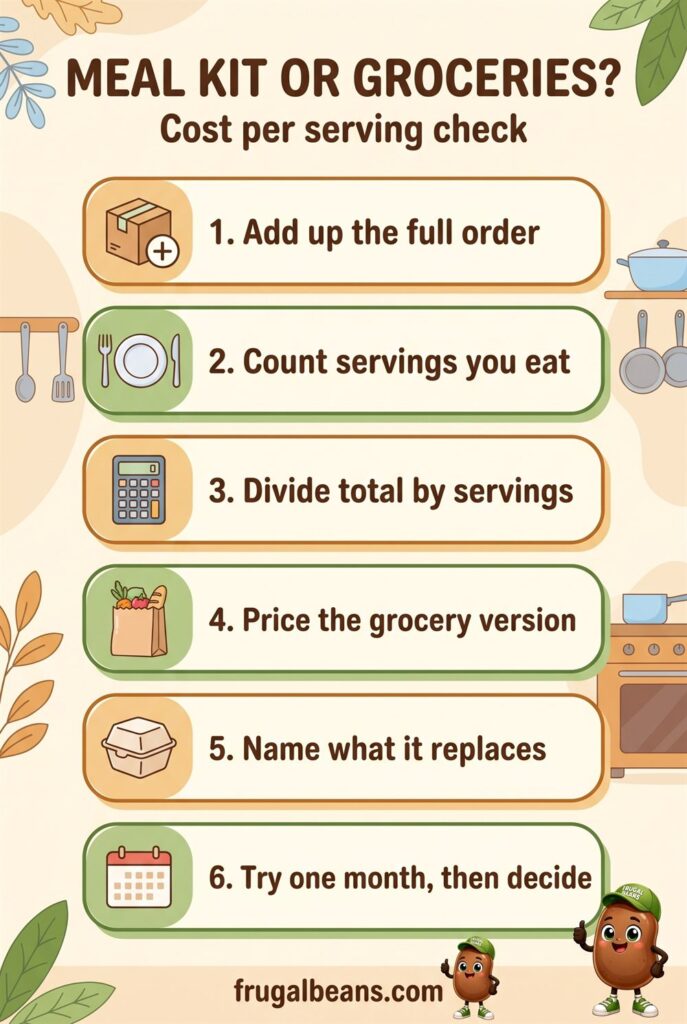
The one-month check is where the truth shows up. Record meal kit charges, grocery purchases, restaurant orders, convenience foods, and food thrown away. A service that replaces four takeout meals and reduces grocery waste may earn its cost. A service that replaces one planned grocery dinner while adding another charge probably does not.
Are Meal Delivery Services Worth It? 7 Smart Questions to Decide
Once you know your cost per serving, these seven questions turn the numbers into a decision about any meal kit subscription or prepared-meal plan. Answer them honestly, ideally with whoever else eats at your table.
1. Which Existing Spending Will It Replace?
This is the most important question. If your grocery bill stays the same and you keep ordering takeout, meal kit delivery becomes a new expense rather than a replacement. Name the specific spending it will cut, such as Friday takeout or the lunch you buy near work.
2. Will Your Household Eat Most of What Arrives?
Picky eaters, small appetites, and unexpected dinner invitations all reduce the servings you actually eat. Every uneaten serving raises the cost of the ones you do eat.
3. Does the Price Still Fit After the Discount Ends?
Judge the service on its regular price, not the welcome offer. If the full price only works by squeezing groceries or savings, it does not really fit.
4. Is Your Schedule Predictable Enough?
Weekly boxes work best for steady routines. Frequent travel, rotating shifts, or a busy social calendar make it more likely that food sits in the refrigerator until it spoils.
5. Do the Portions Match Your Appetites?
If one adult routinely eats one and a half servings, budget for that reality instead of trusting the label. Extra sides and second dinners quietly erase the advertised price.
6. Can You Skip, Pause, and Cancel Easily?
Read the skip deadlines and cancellation steps before you sign up. A meal kit subscription that is hard to control can turn convenience into recurring waste.
7. Is the Time You Save Worth the Premium?
You may decide that saving 30 minutes on a hard evening is worth $12 extra per serving. That can be a valid choice if it is planned and affordable. The problem is not paying for convenience; it is paying for it by accident, repeatedly, or with money you need for higher priorities.
A simple rule of thumb: if you can answer yes to most of these questions, try the service for one month and track it. If you answer no to two or more of the first three, the service is probably a lifestyle luxury rather than a useful part of your food budget.
When Are Meal Delivery Services Worth It? Who They Suit Best
Meal kit delivery and prepared meals are most worthwhile when they solve a specific, expensive problem. These are the situations where the numbers most often work.
Busy Households That Rely on Takeout
Suppose a couple spends $45 on takeout twice a week because nobody wants to plan dinner after work. That is $90 a week. A three-meal kit costing $75 may be cheaper if it reliably replaces those orders and all six servings are eaten. The kit is not cheaper than cooking from the least expensive ingredients, but it may be cheaper than the household’s real alternative.
People Who Overbuy Groceries
Meal kits may help households that regularly buy produce with good intentions and then throw it away. Buying ingredients for one or two planned recipes reduces the temptation to purchase a large bundle that spoils. The savings are not automatic, because packaging can be substantial and per-serving prices are usually higher than bulk grocery prices. Still, measured portions may cut waste for people who struggle to use full-size packages.
One-Person Households
Buying a wide range of ingredients for one person often means repeated leftovers or spoiled food. A prepared meal can be a reasonable middle ground when the alternative is a restaurant lunch or a skipped meal followed by convenience-store snacking.
Short, Demanding Seasons
A new baby, recovery from surgery, a move, or a stretch of long workdays can make cooking feel impossible. A short, deliberate run of meal kits or prepared meals during that season can be cheaper and calmer than a month of takeout. Set an end date when you start.
New Cooks Building Confidence
Meal kits can work like a paid cooking class. If a few weeks of kits teach you a handful of dinners you can then shop for yourself, the service may pay for itself in the skills you keep.
When Meal Delivery Services Are Probably Not Worth It
Meal delivery is less attractive when you already plan and cook efficiently. A household that buys affordable staples, uses leftovers, and enjoys cooking may pay a large premium for tasks it can do easily. The service may still be enjoyable, but treat it as a convenience purchase rather than a savings strategy.
Meal delivery services are also a poor fit for unpredictable schedules, as the questions above showed. Large households should look carefully at portion sizes, and households with allergies or strict diets may find that the affordable menu choices are limited. And if money is tight right now, a premium dinner subscription is usually one of the first things to pause. Our guide to saving money on a tight budget covers where to focus first.
Cheaper Ways to Get Meal Kit Convenience
Much of what meal kits sell is planning, not food. You can copy that planning at grocery prices with a few simple habits.

Build Your Own Kit
On the weekend, choose three dinners and write a list for just those meals. Bag or box the ingredients for each dinner together in the refrigerator, so weeknight cooking feels like opening a kit. Plan to cook the most perishable dinner first.
Keep Two Default Dinners
Keep the ingredients for two low-effort meals on hand at all times, such as pasta with frozen vegetables, eggs and toast, bean tacos, or rice bowls. These protect the budget on nights when you would otherwise order takeout. Our list of ways to save money at home includes more food habits like this.
Cook Once, Eat Twice
Double a recipe and freeze labeled portions. A freezer full of your own meals works much like a prepared-meal delivery, without the shipping fee. If you are new to this kind of planning, our frugal living for beginners guide is a gentle place to start.
Choosing a Meal Kit Subscription: How to Compare Top Meal Kit Services
Before you pick a top meal kit, compare meal kit delivery plans on the numbers that actually reach your statement, not on the photos or the first-box discount. A plan that looks cheapest per serving can cost more once delivery fees, minimum order sizes, and pantry add-ons are counted. Run the same cost-per-serving math for each option you are considering and line the results up side by side.
Then look at the features that decide whether the food actually gets eaten. Check how many meals and servings the smallest plan includes, how far ahead you must choose or skip a week, whether the recipes fit your household’s tastes and dietary needs, and how much prep time a typical recipe takes. Read the pause and cancellation steps before you enter payment details. The top meal kit for your household is the one that replaces a real expense and fits your schedule, which is not necessarily the most popular one.
Tips for Getting Better Value from Meal Kit Delivery
If you decide to try a meal kit subscription, these habits make meal kits and prepared meals more useful without turning them into a complicated project:
- Start with the smallest practical order. Try one or two weeks before committing to a large plan, and measure what your household eats, not what the menu promises.
- Set a calendar reminder before the menu deadline. Review the upcoming box, skip weeks you do not need, and check the final charge.
- Give each box a clear job. If Friday takeout is your regular splurge, choose a meal that works on Friday.
- Use every ingredient. Cook the most perishable produce first, and use leftover herbs, sauces, or vegetables in another meal.
- Keep basic pantry supplies on hand. Oil, salt, pepper, rice, and common seasonings prevent emergency grocery runs.
- Treat discounts as a trial, not the permanent price. Decide whether the regular price works before you continue.
- Pause or cancel promptly. Read the service’s rules for skips and cancellations, and keep a note of the date you canceled.
- Set a monthly ceiling. Treat delivery as part of the food budget. For example, you might allow two boxes a month while leaving room for groceries and an occasional restaurant meal.
For more ideas on trimming everyday costs without feeling deprived, browse our frugal living tips.
Are Meal Delivery Services Worth It? Frequently Asked Questions
Is meal kit delivery cheaper than buying groceries?
Usually not, when you compare it with cooking the same recipe from your own groceries. A meal kit can still save money if it replaces takeout or prevents you from buying groceries you would otherwise throw away. Price the grocery version of one favorite kit recipe to see the gap for yourself.
How do I calculate meal kit cost per serving?
Add up the final charge for the order, including delivery, tax, and any pantry items you had to buy. Then divide by the number of servings your household actually ate. That effective cost per serving is the number to compare with groceries and takeout.
What hidden costs come with meal delivery services?
The common ones are delivery fees, taxes added at checkout, boxes that ship because you missed a skip deadline, the jump from an introductory price to the regular price, pantry add-ons, extra sides for small portions, and servings that go uneaten.
Is meal delivery worth it for one person?
It can be. Cooking for one often leads to spoiled ingredients or repeated leftovers, so prepared meals or a small kit can be reasonable if they replace restaurant lunches or wasted groceries. Run the cost-per-serving check for a month before committing to a long plan.
The Bottom Line
Meal kit delivery and prepared-meal services are worth it for some households, but they are not automatically a money-saving solution. Their value comes from what they replace and how consistently the food gets eaten. A service can cut takeout, limit grocery waste, simplify a demanding week, or provide manageable portions for one person. It can also create forgotten charges, uneaten food, and a bigger monthly food bill.
So, are meal delivery services worth it for you? Calculate the full meal kit cost or delivered price, use realistic serving counts, and compare the result with your actual alternatives. Start small, track one month, and set a clear spending limit. If the service buys meaningful time without undermining your budget, keep it as a deliberate convenience. If it only adds another food expense, cancel it and put the money toward groceries, savings, or a meal plan that works better for your household.
Best Things to Resell: 15 Simple Steps to Flipping for Profit

Flipping for profit means buying an item for less than its realistic resale value, then cleaning, presenting, and selling it for more. The difference can become profit, but only after you subtract every cost and count your time. Some of the best things to resell are everyday objects: a used lamp, a bicycle, a set of tools, a piece of furniture, or a collectible. It can begin with a few dollars from a closet cleanout, and it becomes a small business when you buy inventory regularly and sell with a plan.
For an ordinary household, reselling works best as a controlled experiment, not a promise of quick money. You do not need a warehouse, a business degree, or a big starting budget. You do need patience, honest math, safe buying habits, and enough space to keep unsold items from taking over your home.
A good flip is not simply something bought cheaply. It is an item you understand, can sell to a buyer you can reach, and can move at a reasonable speed after all expenses. This guide walks through 15 simple steps: where to find items to flip, the best things to resell, which reselling websites to use, how to price using sold listings, how to do the real profit math, how to stay safe, and what to know about taxes.
What Flipping for Profit Really Involves
Every flip has four parts: sourcing, preparation, selling, and delivery. Sourcing is finding inventory at yard sales, thrift stores, clearance shelves, local listings, auctions, or from people you know. Preparation covers cleaning, testing, repairing, photographing, measuring, and writing an honest description. Selling means choosing a marketplace, setting a price, answering questions, and negotiating. Delivery may involve packing and shipping, meeting locally, or arranging pickup.
The purchase price is only one line in the calculation. Other costs can include marketplace fees, payment processing, fuel, packing materials, replacement parts, cleaning supplies, storage, returns, and taxes. Your time matters too. If a $25 item leaves you $18 after expenses but takes three hours of searching, cleaning, messaging, and arranging pickup, it may not be a good use of an evening.
Three terms keep the picture clear:
- Revenue is the money the buyer pays you.
- Profit is what remains after all costs.
- Cash flow is the timing of money moving in and out.
A flip can be profitable on paper and still uncomfortable for a household if money sits tied up in inventory for months. That is why this flipping for profit plan starts with your budget, not with shopping.
Your 15-Step Plan for Flipping for Profit
The steps are grouped by stage, so you can read straight through or jump to the part you need. Steps 1 to 3 happen before you spend a dollar.
Step 1: Set a Starting Budget and an Inventory Cap
Use money your household can afford to leave tied up for a while. Do not use rent money, emergency savings, or borrowed money to buy inventory. A small starting fund, such as $50 to $200, is enough to learn the ropes. If money is tight right now, our guide to saving money on a tight budget can help you find that starter fund without squeezing essentials.
Then set a cap on unsold inventory, either in dollars or in physical space, such as “one shelf and one corner of the garage.” When you hit the cap, you sell before you buy anything else. This one rule prevents most of the clutter and cash problems that sink people who are new to reselling.
Step 2: Choose a Lane Before You Buy
Beginners often lose money by treating every cheap object as an opportunity. A category, or lane, gives you a way to recognize quality, estimate demand, and spot problems quickly. The best things to resell are often in a category you already understand or genuinely want to learn about.
Before choosing a lane, ask three questions:
- Can you inspect the item well enough to find common defects?
- Can you estimate a selling price from recent, completed sales rather than hopeful listings?
- Can you store, transport, clean, and ship it without excessive effort?
Narrow beats broad. Instead of “all furniture,” you might start with solid-wood side tables that fit in your car. Instead of “electronics,” you might focus on one type of audio equipment you know how to test. Specialization builds pattern recognition: you learn which makers hold value, which flaws are expensive, and which questions buyers always ask.
Step 3: Learn to Research Sold Listings
Pricing research is the skill that separates reselling from guessing. Current listings show what sellers hope to get. Completed or sold listings show what buyers actually paid. Many online marketplaces let you filter search results to sold items; use that filter every time it exists.
When you compare, match the details: condition, size, color, maker, included accessories, and location. Look at several recent sales, not one outlier. Then take a conservative number from the middle or lower part of that range. That number, not the highest price you have ever seen, is what goes into your profit math.
Practice before you buy any items to flip. Pick ten objects in your home and look up what similar items sold for. You will quickly see which categories move, which sit unsold, and which might be the best things to resell where you live.
Where to Find Items to Flip
Steps 4 to 6 cover sourcing. The best places to find items to flip are usually local, because you can inspect before paying and avoid shipping costs on the way in.

Step 4: Start With Your Own Clutter
Your closets, garage, and basement are the cheapest inventory source you will ever have, because the purchase price is already paid. Selling things you no longer use is a low-risk way to practice reselling: photographing, listing, and shipping with almost no money at stake. It also clears space for future inventory, and you may find that some of the best things to resell were already in your house.
Make three piles: sell, donate, and keep. Be honest about the sell pile; an item worth a few dollars may not justify the time to list it. Decluttering this way pairs well with the habits in our frugal living tips, since owning less makes it easier to see what you already have.
Step 5: Shop Garage Sales, Yard Sales, and Estate Sales
Garage and yard sales often offer the lowest prices, and sellers are usually happy to bundle items or lower the price late in the day. Estate sales can have whole households of goods, including older tools, kitchenware, and furniture. Bring small bills, a tape measure, a flashlight, and a phone so you can check sold listings on the spot.
Be polite when negotiating. A fair offer on several items together often works better than haggling hard over one. And remember your lane when hunting for items to flip: a bargain outside your category is only a bargain if you know how to sell it.
Step 6: Check Thrift Stores, Clearance Shelves, and Curb Finds
Thrift stores provide steady chances to flip items for profit because new items arrive constantly. Learn which days your local stores restock, and visit regularly rather than making one long trip. Retail clearance shelves can also turn up new, boxed items, though margins there tend to be thinner.
Curbside finds can be free inventory, but follow local rules and only take items clearly left out for collection. Inspect them closely for damage, pests, and moisture before bringing them inside. Online local listings are convenient too, but a low price can disappear after a long drive, so ask for measurements, working status, missing parts, and clear photos before making a trip.
What Sells: The Best Things to Resell
No category is automatically easy, but some types of items to flip tend to be practical for beginners because they are common, easy to inspect, and easy to move. The point is not that every item in these categories is valuable. The point is that you can learn them quickly, which is what makes them some of the best things to resell when you are starting out.
Step 7: Inspect Before You Buy, and Know What to Avoid
The best things to resell for beginners often fall into these categories:
- Furniture: solid-wood pieces that clean up well and fit in a car.
- Tools and outdoor equipment: hand tools, power tools you can test, and garden gear.
- Kitchenware: durable cookware, small appliances that work, and complete sets.
- Sporting goods and bikes: items people want seasonally.
- Clothing and shoes: clean, well-made pieces in good condition.
- Books, media, and hobby supplies: easy to store and ship, though value varies widely.
- Home decor and lighting: lamps, mirrors, and frames with broad appeal.
Even with the best things to resell, inspect before paying. Check for pests, mold, strong odors, cracks, missing parts, and water damage. For electrical goods, look at cords and plugs, and test only in a safe way. Ask yourself whether you could describe every flaw in a listing.
Some categories are best avoided until you have real expertise. Counterfeit-prone luxury goods, safety-critical equipment such as car seats and helmets, recalled products, and complex electronics can create losses or liability. Never resell an item that is unsafe just because someone might pay for it. You can always expand later, after your records show your first lane is working.
Run the Numbers Before Flipping for Profit
Step 8 is the heart of the whole process. In flipping for profit, real profit is what is left after every cost, and the only way to know it is to write the numbers down before you buy.
Step 8: Do the True Profit Math
Use this simple formula:
Expected profit = conservative sale price − purchase price − selling fees − shipping − supplies and repairs − transport − a reserve for surprises.
Here is an illustrative example. The numbers below are made up to show the method; your fees, prices, and costs will differ. Suppose you find a wooden side table for $18 and recent sold listings suggest you could sell it for about $85 locally. You expect to spend $9 on sandpaper and finish, $4 in fuel, and you estimate $11 for marketplace and payment costs (check the current fee page of whichever platform you use). You add an $8 reserve for surprises.
|
Line item (illustrative) |
Amount |
|
Conservative sale price |
$85 |
|
Purchase price |
-$18 |
|
Marketplace and payment costs |
-$11 |
|
Cleaning and refinishing supplies |
-$9 |
|
Transport (fuel) |
-$4 |
|
Reserve for surprises |
-$8 |
|
Estimated profit before time |
$35 |
Now add your time. If the table takes three hours in total, from the trip to the final handoff, that $35 works out to about $11.67 per hour. Whether that is worth it is your call, but you should make it knowingly. If the table needs an unexpected $30 repair, the reserve is used up and the profit drops to $13 ($85 minus $18, $11, $9, $4, and $30). That second outcome is why inspection and a safety margin matter.
Shipping changes the picture fast. Imagine a second illustrative flip: a lamp bought for $8 that sells for $40. If you assume $6 in fees, pay $14 to ship it, and spend $3 on a box and padding, you keep $9. If it took an hour and a half to clean, photograph, list, and pack, that is $6 per hour. Small, heavy, or fragile items can look great until shipping is counted.
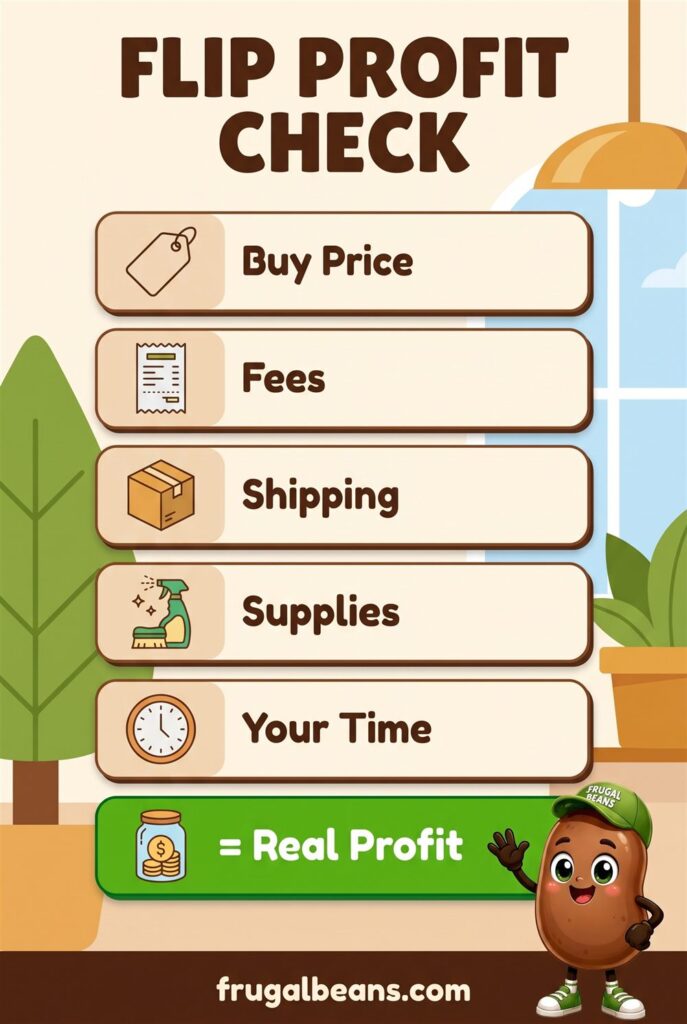
A beginner-friendly rule: buy only when the deal still looks worthwhile if the item sells for less than you hoped or takes longer to sell. The reserve is not a guaranteed expense; it is a reminder that used goods rarely behave perfectly. If the deal does not work after a reasonable reserve, pass. Another item will come along.
How to Flip Items for Profit: Prep, Photos, and Pricing
Steps 9 to 11 turn a purchase into a listing that sells. This is where you flip items for profit instead of just moving them from one garage to another.
Step 9: Clean, Test, and Repair Honestly
Preparation should make the item easier and safer to buy, not hide its history. Clean it in a way that suits the material. Test every function you advertise. Replace inexpensive missing hardware when it makes sense, and keep the receipt.
If you repair a flaw, say so in the listing. If a defect remains, photograph it clearly and describe it. Avoid projects with vague repair needs; “probably an easy fix” is not a cost estimate. The basic repair skills in our guide to saving money at home carry over well to small fixes on resale items.
Picked up a small appliance that won’t work?
JustAnswer lets you describe a coffee maker, mixer, vacuum or other small appliance to an appliance technician online, as a paid consultation, so you know whether a fix is realistic before you spend more on it.
Partner link. Frugal Beans may earn a commission if you buy a consultation, at no extra cost to you.
Step 10: Photograph and Write a Clear Listing

Good presentation builds both price and trust. Take photos in natural light against a plain, uncluttered background, such as a white sheet or a clean wall. Include the front, back, sides, labels, measurements, accessories, and any flaws. Photographing flaws first is a good habit; it keeps you honest and helps you price realistically.
Write a title that says what the item is, its most useful feature, and its condition. “Solid oak two-drawer side table, refinished, 24-inch wide” tells a buyer far more than “Nice table.” In the description, list dimensions, materials, what works, what does not, and how pickup or shipping will work. Accurate measurements prevent wasted conversations and costly returns.
Step 11: Price With a Three-Level Plan
Use your sold-listings research to set three numbers:
- Asking price: leaves room for normal negotiation.
- Target price: the amount you hope to receive.
- Floor price: the lowest amount that still protects your estimated profit.
If an item gets no serious interest after a reasonable period, review the photos, description, price, and marketplace before assuming buyers are wrong. Speed matters. Inventory sitting in a hallway is using space and cash. A $25 profit in two weeks can be more useful than a possible $50 profit after six months. Resellers call this inventory turnover: how quickly you convert purchases back into cash. For household reselling, reliable turnover usually matters more than one impressive win.
Reselling Websites: Where to List the Best Things to Resell
Before you choose an outlet in Step 12, it helps to know the main reselling websites and apps. Each one attracts a different kind of buyer, so the best things to resell on one site may sit untouched on another.
- eBay: a large national and international audience, with both auction and fixed-price listings. A good fit for collectibles, parts, tools, electronics, and niche items buyers search for by name.
- Facebook Marketplace: strong for local sales of furniture, appliances, and other bulky items, since buyers can pick up. Shipping is offered for some listings.
- Poshmark: focused on clothing, shoes, and accessories, with a social, follow-and-share style of selling.
- Mercari: a general, app-based marketplace where sellers ship items nationwide; popular for small household goods, toys, and clothing.
- OfferUp: mainly local buying and selling, with shipping on some items, and a good fit for furniture, tools, and larger goods.
Every platform charges its own mix of selling fees, payment processing, and sometimes shipping costs, and those rules change often, so check each site’s current fee page before you price an item. Many resellers list the same item on two or three sites to reach more buyers; if you do, remove the other listings as soon as it sells so you never sell one item twice.
Tips for Reselling on eBay
Reselling on eBay is a common next step once local sales are going well, because buyers nationwide search there for many of the best things to resell, from tools and parts to collectibles. A few habits help:
- Use the sold filter. Filter search results to sold items to see what buyers actually paid, as described in Step 3.
- Write searchable titles. Put the brand, model, size, and key feature in the title, using the words a buyer would type.
- Choose auction or fixed price on purpose. Auctions can help with rare items whose value is unclear; fixed-price listings that accept offers suit everyday goods.
- Price shipping before you list. Weigh and measure the packed item so the shipping cost is already built into your math.
- Protect your feedback. Ship quickly, describe flaws clearly, and answer questions promptly; good feedback makes buyers more comfortable.
Read eBay’s current seller fees and policies before you start reselling on eBay, since they change over time.
Sell, Ship, and Stay Safe While Reselling
Steps 12 and 13 cover getting the item to its buyer and protecting yourself along the way.
Step 12: Choose Where to Sell, and Ship Carefully
When you flip items for profit, you have several types of outlets, each with tradeoffs:
- Local classifieds and community marketplaces: good for bulky items like furniture; no shipping, but you handle meetups.
- National online marketplaces: a bigger audience on reselling websites such as eBay, Mercari, or Poshmark, but you pay fees and handle shipping and returns.
- Consignment and resale shops: less work for you, but you keep a smaller share and wait longer to be paid.
- Your own yard sale: a fast way to clear lower-value items in one day.
Fees, payment holds, and return rules differ by platform and change over time, so read each marketplace’s current fee page and seller rules before you list. Do not rely on a fee you remember from last year.

When you ship, weigh and measure the packed box before you set the price, so the shipping cost is already in your math. Use a sturdy box, plenty of padding, and tape every seam. Ship promptly, keep the tracking number, and photograph fragile items as you pack them in case a damage claim comes up.
Step 13: Stay Safe and Spot Scams
Safety is part of the financial plan. For local sales, meet in a busy public place during the day when possible, bring someone along or tell someone where you are going, and avoid deals that feel rushed or secretive. Some police stations offer a designated exchange spot; it is worth asking yours.
Watch for common warning signs:
- A buyer offers to pay more than your asking price and asks you to send back the difference.
- Someone asks you to share a verification code sent to your phone.
- A buyer wants to move the conversation or payment off the platform you listed on.
- You receive an email that claims to confirm payment, but the money is not in your account.
- A buyer pressures you to ship before payment has fully cleared.
When in doubt, slow down. A real buyer will wait while you confirm that payment has arrived. Losing one sale is far cheaper than losing both the item and the money.
Reselling Records and Taxes
Step 14 is the one many beginners skip, and it is the one that makes everything else measurable.
Step 14: Keep Records and Understand Taxes
Keep a simple record for every item: date bought, source, purchase price, supplies, travel estimate, listing date, sale price, fees, shipping, and final profit. Add the hours you spent if you want your effective hourly rate. A notebook or spreadsheet is enough. Keep receipts with your notes, because rebuilding costs months later is hard.
In the U.S., income from reselling may be taxable, and payment apps and online marketplaces may send you a Form 1099-K. According to the IRS page Understanding your Form 1099-K (last reviewed June 28, 2026, and checked October 2026), these platforms must report payments for goods or services when they exceed $20,000 in more than 200 transactions, and you may receive a form even below that threshold. The same page says you must still report income on your tax return whether or not you receive the form.
Tax treatment depends on your situation, such as whether you are selling personal belongings or running a regular resale activity. Rules can change, so check current IRS guidance or ask a qualified tax professional. Do not assume that a missing form means no tax is owed. Good records make filing easier and show your actual profit, not just your deposits.
Build a Repeatable Reselling Routine
The final step keeps flipping for profit from becoming an exhausting pile of half-finished projects.
Step 15: Review, Adjust, and Repeat
When an item enters your home, give it a status: to inspect, to clean, ready to list, listed, sold, or ready to deliver. Set one weekly time block for photos and listings, and another for packing, messages, and bookkeeping. Review unsold inventory every week: improve the listing, lower the price, move it to another outlet, or donate it.
Keep a small kit nearby: a tape measure, a scale, cleaning cloths, suitable boxes, labels, basic tools, a flashlight, and your record book. Add your own price history and a list of trusted repair contacts. The point is not to buy every gadget; it is to make inspection, preparation, and decisions consistent.
A few more practical tips for flipping for profit:
- Start with items you can test. Working knowledge is worth more than a bargain price.
- Buy one before buying a lot. A single test item can reveal hidden fees, weak demand, or a difficult shipping process.
- Offer bundles when it makes sense. Related low-value items often sell faster together.
- Protect your reputation. Prompt replies and accurate descriptions can be worth more than a few extra dollars.
- Give profits a job. Decide in advance how much goes back into inventory and how much goes to savings or debt.
That last point matters. Reselling income is most useful when it supports your bigger goals, whether that is an emergency fund or paying down a balance. Our list of ways to save money has ideas for where that extra cash can do the most good, and frugal living for beginners covers building the habits around it.
Flipping for Profit: Frequently Asked Questions
How much money do I need to start flipping for profit?
Very little. Many people start by selling things they already own, which costs nothing. After that, a small fund such as $50 to $200 is enough to learn. Use only money you can afford to have tied up for a while, never rent or emergency savings.
What are the best things to resell for beginners?
The best things to resell are ones you can inspect, test, and price confidently. Common starting categories include furniture, tools, kitchenware, sporting goods, clothing, and home decor. Pick one narrow lane, research sold listings, and expand only after your records show it is working.
Is reselling income taxable?
It can be. The IRS says you must report income on your tax return even if you do not get a Form 1099-K, and payment platforms may send one. How your sales are treated depends on your situation, so check current IRS guidance or talk with a tax professional, and keep records from day one.
How do I know if a flip is worth it?
Write down a conservative sale price based on sold listings, then subtract the purchase price, fees, shipping, supplies, transport, and a small reserve. Divide what is left by the hours you expect to spend. If the result still looks worthwhile at a lower sale price, it is probably a reasonable flip.
The Bottom Line
Flipping for profit is a practical way to build a small side income, but it rewards discipline more than excitement. Choose a manageable lane, inspect before buying, price from sold listings, and count every cost, including your time. Add value through cleaning and clear information, stay alert to scams, and keep records from the start. Over time, the best things to resell are the ones your own records prove you can sell again and again.
Your first goal should not be a dramatic score. It should be a repeatable process that leaves you with more money, more knowledge, and no regret about the purchase. Start small, learn from ordinary, everyday items to flip, and let your records guide what you buy next. When the numbers and the routine both make sense, reselling can become a useful, flexible part of your household’s financial plan.

Get the free Homeowner Repair Cost Playbook
Which systems fail first, what they cost, the warning signs, and the repair-or-replace rule. 15 printable pages.
Free. No spam.
Free tools
Got a quote? Check it in under a minute.
Ballpark a new furnace before the contractor visits.
Price a tank, tankless or heat pump model.
Warm air, ice or noise? See the likely part and price.