Emergency Fund Calculator
An emergency fund is the money that keeps a job loss, a hospital bill or a dead transmission from turning into credit card debt. The hard part is knowing how much is enough. This free emergency fund calculator works it out from your own essential monthly costs and how risky your income is, adds your biggest insurance deductible, and shows how long it will take to get there at the amount you can save each month.
Loading the emergency fund calculator… If it doesn’t appear, please make sure JavaScript is turned on.
How the Emergency Fund Calculator Works
- List your essential monthly costs. Rent or mortgage, utilities, groceries, transportation, insurance premiums, minimum debt payments, childcare, medical costs and any other bill you couldn’t pause. Leave out restaurants, streaming and other spending you would cut in a crisis.
- Describe your situation. How steady your pay is, how many people earn the household income, whether anyone depends on it, and how long it would take you to find similar work.
- Add your largest deductible. The biggest bill an insurance claim could hand you: your health plan’s deductible or out-of-pocket maximum, or your car or home insurance deductible.
- Enter what you have saved and what you can add each month.
Click “Calculate my emergency fund” to see your target, how many months your savings already cover, how long it will take to reach the target, and a line-by-line breakdown of how the months were chosen. The emergency fund calculator opens with example numbers so you can see how it works; replace them with your own. Your entries are saved only in your own browser.

How Much Should Be in an Emergency Fund?
The most common rule of thumb is three to six months of essential expenses. It is a useful starting range, but it says nothing about who should be at three months and who needs six or more. The Consumer Financial Protection Bureau’s guide to building an emergency fund makes a similar point: the right amount depends on your situation, and a good way to size it is to look at the unexpected expenses you have actually had.
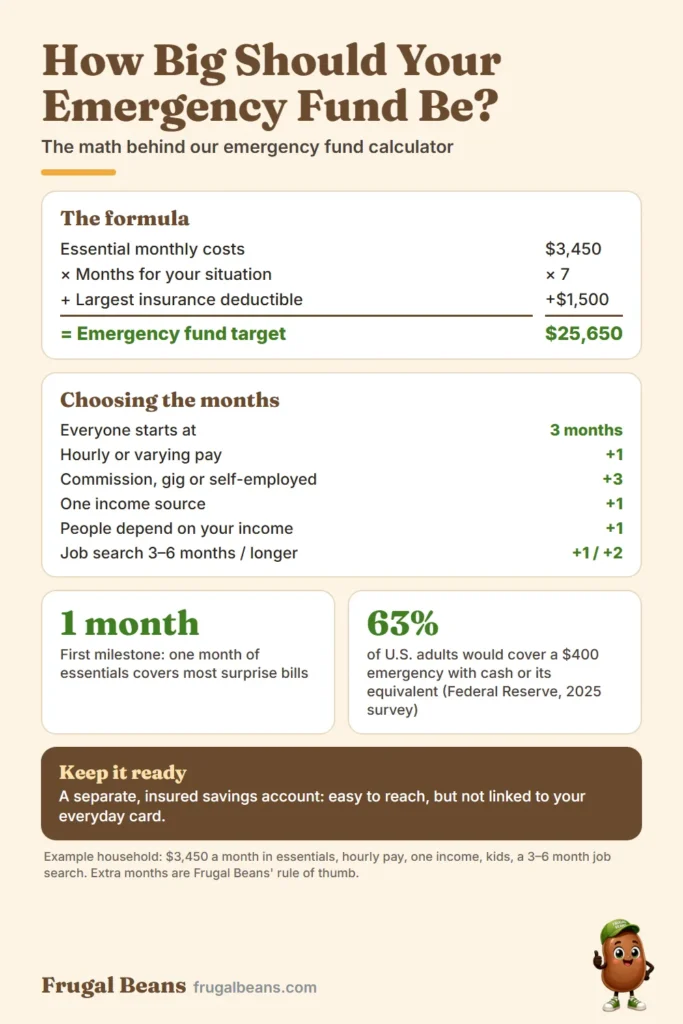
The emergency fund calculator turns that into a simple, visible rule. Everyone starts at three months. Then it adds months for the things that make an income shock longer or more painful:
- Pay that varies: +1 month for hourly work or pay that changes from month to month.
- Commission, gig or self-employed income: +3 months, because a slow stretch can last longer than a layoff and there is no unemployment insurance for most self-employed people.
- One income source: +1 month if one person earns the household income, or if two earners work for the same employer and could lose their jobs at the same time.
- People who depend on you: +1 month if children, a partner or a parent rely on your income.
- A long job search: +1 month if finding similar work would take three to six months, +2 if it would take longer.
These extra months are Frugal Beans’ own rule of thumb, not an official standard. The emergency fund calculator shows each one in the results table, so you can see why your number is what it is and adjust if you disagree.
Emergency Fund Calculator vs. the 3-to-6-Month Rule
The 3-to-6-month rule gives everyone the same range, and most people simply pick the middle. An emergency fund calculator does better because two households with the same rent can face very different risks. A nurse married to a teacher, with two steady paychecks from employers that rarely lay people off, may be comfortable near three months. A self-employed contractor who supports two kids on one income could need close to a year. The emergency fund calculator puts those differences into the number instead of leaving you to guess where in the range you belong.
It also works in dollars, not just months. “Six months of expenses” is easy to say and hard to picture. Seeing $25,650 on the screen, next to how much you have and how long it will take, turns the advice into a plan you can act on.
Why the Emergency Fund Calculator Adds Your Deductible
Many emergencies are not job losses. They are a trip to the emergency room, a car accident or a burst pipe, and insurance pays only after you cover the deductible. If your health plan has a $3,000 deductible, a single hospital visit can take $3,000 from your emergency fund in one go. Adding your largest deductible on top of your months of expenses means a medical bill or an insurance claim doesn’t leave you short if you lose your income the same year.
Essential Expenses: What to Count
An emergency fund calculator is only as good as the monthly number you give it. Count what you would still have to pay if your income stopped tomorrow:
- Housing: rent or your full mortgage payment, plus property tax, home insurance and HOA dues if they aren’t in the payment.
- Utilities and phone: power, gas, water, trash, internet and phone.
- Groceries: a lean grocery budget, not what you spend now including takeout.
- Transportation: car payment, insurance, gas and maintenance, or a transit pass.
- Insurance: health and life premiums you pay yourself. If your health coverage comes through work, a job loss can mean paying for it on your own, which often costs more.
- Debt minimums: only the minimum payments, so you stay current while you look for work.
- Childcare, child support and medical costs that keep going no matter what.
Leave out spending you would cut quickly: restaurants, subscriptions, travel, extra debt payments and saving for other goals. That keeps the target realistic and reachable.
A Worked Example
Here are the example numbers the emergency fund calculator loads when you open the page or click “Load an example.” They are an illustration, not a typical household.
- Essential costs: $1,400 rent, $300 utilities, $650 groceries, $450 transportation, $250 insurance, $200 debt minimums, $80 medical and $120 other bills, for $3,450 a month.
- Situation: hourly pay (+1 month), one income (+1), children at home (+1) and a job search of three to six months (+1), for 7 months in total.
- Deductible: $1,500.
- Target: 7 × $3,450 = $24,150, plus $1,500 = $25,650.
- Progress: $4,000 saved covers about 1.2 months of essentials. At $500 a month, the remaining $21,650 takes about 3 years and 8 months. Finishing in two years would take about $903 a month.
That is a big number, and seeing it can be discouraging. The next section is about why you don’t have to save all of it at once.
Start Small: Your First Milestone
Your full target can take years to reach, so the emergency fund calculator also marks a first milestone: one month of essential expenses. Reaching it changes a lot. Most surprise bills, such as a car repair, a vet visit or a broken appliance, cost less than one month of living expenses, so even this first step means many emergencies no longer go on a credit card.
It matters because so many households have no cushion at all. In the Federal Reserve’s survey of household finances for 2025, 63% of adults said they would cover a hypothetical $400 emergency expense using cash or its equivalent (Economic Well-Being of U.S. Households in 2025). The rest would need to borrow, sell something or couldn’t pay. A few hundred dollars set aside puts you on the right side of that line.
How to Build an Emergency Fund Faster
Once the emergency fund calculator shows the gap, these are the moves that close it fastest:
- Automate it. Set a transfer to savings for the day after payday, so the money moves before you can spend it.
- Save windfalls. Tax refunds, bonuses, raises and cash gifts can do in one month what a small transfer does in a year.
- Cut one big bill. Shopping for car insurance or switching phone plans can free up more money than many small cuts. Our list of ways to save money has more ideas.
- Sell what you don’t use. Furniture, electronics and tools can turn into a month of savings. See our guide to the best things to resell.
- Pause extra debt payments until you reach your first milestone, but keep paying the minimums. Without any savings, the next surprise usually goes straight back onto a card.
- Rerun the calculator every few months to see your progress and keep the target current.

Where to Keep Your Emergency Fund
Once the emergency fund calculator gives you a target, the next question is where to keep the money. An emergency fund needs to be safe and quick to reach, not invested for growth. The CFPB suggests keeping it in a separate account, so it’s easy to reach in an emergency but not so easy that you dip into it for everyday spending. A separate savings account at a bank or credit union works well, ideally one that pays a decent interest rate.
Bank deposits are insured by the FDIC up to $250,000 per depositor, per insured bank, for each account ownership category (FDIC deposit insurance). Credit union deposits have similar coverage through the NCUA. Avoid keeping your emergency fund in stocks, where it could be down 20% just when you need it, or in retirement accounts, where withdrawals can bring taxes and penalties.
What Counts as an Emergency?
The target from the emergency fund calculator only works if the money is saved for real emergencies. A simple test: is it unexpected, necessary and urgent? A job loss, a medical bill, an urgent car or home repair, or emergency travel for family all pass. A sale, a vacation or a holiday you knew was coming do not. Predictable costs, such as car registration, annual insurance premiums or holiday gifts, are better covered by saving a little each month in a separate pot.
Homeowners: Keep Repairs Separate
A new roof, furnace or water heater feels like an emergency when it fails, but over the years these replacements are predictable. If your emergency fund also has to cover them, one big repair can wipe it out. Our free home repair fund calculator works out a separate monthly set-aside for home repairs, and the home system lifespan tracker shows which systems are likely to need replacing first. Use the emergency fund calculator for income shocks and true surprises, and the repair fund for the house.
Emergency Fund Calculator for Different Situations
- Self-employed or freelance: income can drop for months without a layoff, so the emergency fund calculator adds three months. Keep your business and personal reserves separate, and set aside tax money as its own pot.
- Dual-income couples: two jobs at different employers are less likely to disappear at once, so the target can be lower. If both of you work in the same industry, consider choosing the one-income option anyway.
- Single parents: one income and dependents both add months. Start with the first milestone and build from there.
- Near retirement: a job search can take longer later in a career, so be honest in the job-search question.
- Paying off debt: build the first milestone before you pay extra on debt, then split extra money between the two.
Common Emergency Fund Mistakes
- Counting your full spending. If you enter what you spend today, including restaurants and extras, the emergency fund calculator gives a target that may feel out of reach. Enter the lean version you would actually live on.
- Forgetting health insurance. If coverage comes through your job, losing the job can mean paying the full premium yourself. Include a realistic figure.
- Keeping it in checking. Money that sits next to your everyday spending tends to get spent. A separate account adds a small, useful pause.
- Investing it. Higher returns are tempting, but an emergency fund’s job is to be there, at full value, on the worst day.
- Not refilling it. After you use the fund, rerun the emergency fund calculator and make rebuilding it your first saving goal.
- Waiting until you can save a lot. Small, automatic transfers add up. Twenty-five dollars a week is $1,300 in a year. Or turn it into a game with our free 100 envelope challenge tracker.
Frequently Asked Questions
How do I calculate my emergency fund?
Add up your essential monthly expenses, multiply by the number of months you want to cover, and add your largest insurance deductible. The emergency fund calculator above does this for you and picks the months based on your income and household.
Is three months of expenses enough?
The emergency fund calculator starts everyone at three months, and that can be enough if your pay is steady, two people earn the household income at different employers, nobody depends on you and you could find similar work quickly. The more of those that aren’t true, the more months you need.
Should I save an emergency fund or pay off debt first?
Build a small cushion first, such as one month of essentials, while making minimum payments. Then put extra money toward high-interest debt, and finish the full emergency fund afterwards or in parallel.
Does the calculator include unemployment benefits?
No. Unemployment insurance varies by state, usually replaces only part of your pay, and can take weeks to start. If you are sure you qualify, you can lower the target a little, but treat benefits as a bonus rather than a plan.
How often should I update my emergency fund?
Rerun the emergency fund calculator whenever your rent, job, household or insurance changes, and at least once a year. After you use the fund, rebuild it before saving for other goals.
Does the calculator save my numbers?
Only in your own browser, so you can come back to them. Nothing is sent to Frugal Beans or anyone else. Use “Clear everything” to remove them.
The Bottom Line
An emergency fund turns a crisis into an inconvenience. Use the free emergency fund calculator above to find your number, start with a first milestone of one month of essentials, and automate the rest. If you are new to managing money, our guide to frugal living for beginners is a good next step. Get our free Homeowner Repair Cost Playbook and see all of our free tools.
Sources: CFPB, An essential guide to building an emergency fund; Federal Reserve, Economic Well-Being of U.S. Households in 2025; FDIC, Deposit Insurance. The month rules are Frugal Beans’ own rule of thumb. This tool provides general information, not financial advice.

Get the free Homeowner Repair Cost Playbook
Which systems fail first, what they cost, the warning signs, and the repair-or-replace rule. 15 printable pages.
Free. No spam.
Free tools
Got a quote? Check it in under a minute.
Ballpark a new furnace before the contractor visits.
Price a tank, tankless or heat pump model.
Warm air, ice or noise? See the likely part and price.