Budgeting & Debt
How to build a budget that works and pay down debt.
Secured and Unsecured Debt: 8 Types of Debt Explained
The types of debt you carry, especially your mix of secured and unsecured debt, shape how much you pay, how flexible your payments are, and what you could lose if money gets tight. Debt is simply money you borrow now and promise to repay later, usually with interest or fees. Most households use some of it. A mortgage may make a home possible, an auto loan may get you to work, and a credit card may cover a bill before payday.
Debt is not automatically good or bad. The important questions are what it costs, what secures it, how flexible the payments are, and whether it fits your household budget. A credit card balance behaves differently from a fixed-rate mortgage. A medical bill may be negotiable, while a payday loan can become expensive within weeks.
This guide explains eight common types of household debt in plain language. It also covers good debt vs bad debt, the difference between secured and unsecured debt, and how to build a debt inventory so you can decide which balances deserve attention first. No judgment here: the goal is a clear list and a calm plan.
Types of Debt at a Glance: A Quick Comparison
Before digging into each one, here is how the eight most common types of debt compare. Use the table as a map, then read the sections below for the details that matter when you are planning a debt payoff.
|
Type of debt |
How it usually works |
Common cost pattern |
Main risk |
|
Credit card debt |
Borrow, repay, and borrow again up to a limit |
Variable interest; often high |
Minimum payments can prolong repayment |
|
Mortgage debt |
Long-term loan used to buy a home |
Fixed or adjustable interest |
The home secures the loan |
|
Auto loan debt |
Fixed loan used to buy a vehicle |
Regular payments for a set term |
The vehicle can be repossessed |
|
Student loan debt |
Borrowing for education |
Interest may accrue during pauses |
Payments can last for years |
|
Personal installment debt |
Lump sum repaid in installments |
Interest and possible fees |
Long terms can raise total cost |
|
Medical debt |
Balance owed for health care |
May start interest-free |
Billing errors and collections matter |
|
Payday or title debt |
Short-term loan based on income or a vehicle |
High fees and rollover costs |
A small emergency can become a cycle |
|
Buy now, pay later or retail debt |
Purchase split into several payments |
May be interest-free, with conditions |
Several plans can overwhelm cash flow |
Two ideas run through the whole table. First, which side of the secured and unsecured debt line does it fall on: is it backed by something you own? Second, is it revolving (reusable credit with no set end date) or installment (scheduled payments over a fixed term)? Once you can answer those two questions for every account, the rest of the plan gets much easier.
8 Types of Debt Explained
Here are the eight types of debt most U.S. households run into, with what each one is, how it costs you money, and what to check on your own statements.
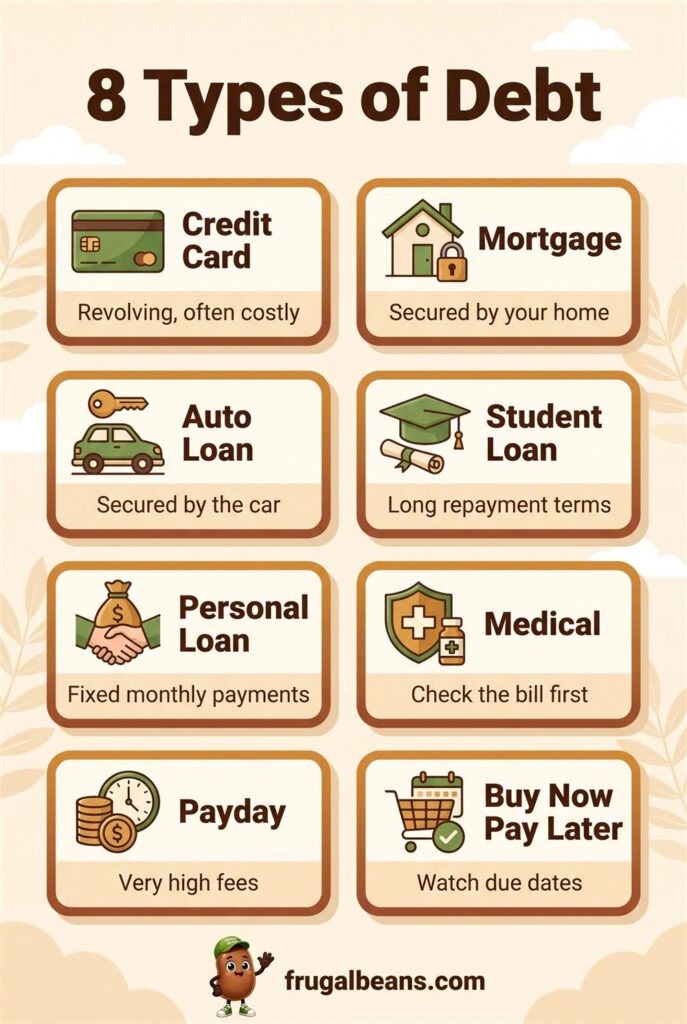
1. Credit Card Debt
Credit card debt is revolving debt. You receive a credit limit, spend against it, repay some or all of the balance, and regain available credit as you pay. Unlike an installment loan, it has no fixed payoff date unless you create one.
Credit cards can be useful when you pay the statement balance in full each month. Once you carry a balance, interest can make ordinary spending much more expensive. The annual percentage rate, or APR, is the yearly cost of borrowing shown as a percentage. Card APRs are often variable, so the rate can change.
Here is a simple illustration. If a card balance is $4,000 and the APR is 24%, interest alone works out to roughly $80 in the first month ($4,000 × 24% ÷ 12), depending on how the issuer calculates it. A minimum payment may keep the account current but stretch repayment over years. Charging new purchases while paying down the balance makes the job harder.
Review the balance, APR, minimum payment, due date, annual fee, promotional deadline, and penalty rate. A balance transfer can lower interest temporarily, but it may include a fee and an expiration date. Treat the lower rate as a chance to finish the balance, not as room for new spending.
2. Mortgage Debt
A mortgage is an installment loan used to buy or refinance real estate. It is secured debt because the home is collateral. If payments stop and the default is not resolved, the lender may eventually pursue foreclosure under applicable rules.
Mortgage payments commonly include principal and interest. Principal reduces what you borrowed. Interest is the cost of using the lender’s money. A payment may also include property taxes, homeowners insurance, mortgage insurance, or association charges, although those items are not all part of the loan itself.
A fixed-rate mortgage keeps its rate steady for the agreed term. An adjustable-rate mortgage can change after an initial period according to the contract. A lower starting payment is not necessarily a lower long-term cost, so check when adjustments occur and whether the future payment could fit your budget.
Mortgage debt often has a lower rate than credit card debt, but it is much larger and lasts longer. Paying extra principal can reduce total interest, yet a household should usually maintain an emergency reserve and address more expensive debt first. Be careful about using home equity to pay off ordinary spending balances: it blurs the line between secured and unsecured debt, because unsecured debt becomes debt backed by your home.
3. Auto Loan Debt
An auto loan finances a car, truck, or motorcycle and is usually secured by the vehicle. You make fixed payments over a set term while the lender holds a legal interest in the vehicle until repayment.
The monthly payment is not the whole cost. Consider the vehicle price, down payment, taxes, fees, rate, loan term, and total repayment. A longer term lowers the payment but increases interest and may leave you owing more than the vehicle is worth. This is called being upside down, or having negative equity. If the car is totaled or sold early, you may need extra money to cover the gap.
Include fuel, maintenance, insurance, registration, parking, and repairs in the transportation budget. If the payment works only when nothing goes wrong, the loan is probably too large.
4. Student Loan Debt
Student loans pay for tuition, fees, books, living costs, or other education expenses. They may come from a government program, school, bank, or private lender. Terms differ, so identify who owns and services each loan and read the current repayment notice. Federal repayment programs have changed several times in recent years, so rely on your servicer’s latest information rather than older articles.
Some student loans have fixed rates and structured repayment options. Interest may accrue while you are in school, during a grace period, or during certain pauses. If unpaid interest is added to the principal, future interest is charged on a larger balance. That process is called capitalization.
Student debt may limit choices such as changing careers, working fewer hours, or saving for a home. Record the balance, rate, payment, repayment plan, and special terms. A temporary pause does not necessarily freeze the balance.
If you have several loans, compare their rates and protections before making extra payments. The highest-rate loan may be the mathematical priority, while a loan with valuable flexibility may deserve a different approach. Cost and stability both matter.
5. Personal Installment Debt
A personal loan gives you a lump sum that you repay through scheduled installments. People use these loans for renovations, emergencies, moving costs, large purchases, or debt consolidation. The loan is commonly unsecured, so approval is based largely on credit history and income.
Personal loans may have a fixed rate and predictable payoff date, which can be easier to manage than a credit card. Check the origination fee, late fee, prepayment terms, total repayment, and whether the advertised rate requires excellent credit.
Consolidation can simplify payments and reduce interest if the new loan is genuinely cheaper. The plan fails if old cards are used again or if the new term raises total repayment. Compare total dollars, not only the monthly payment. Loans marketed for poor credit may include high rates, automatic withdrawals, or add-on products, so read the agreement first.
6. Medical Debt
Medical debt is money owed to a hospital, clinic, physician, laboratory, ambulance provider, or medical financing company. It can come from an emergency, deductible, coinsurance, denied claim, or service that insurance did not cover.
Review a medical bill before placing it on a credit card or taking a loan. Compare it with your insurer’s explanation of benefits. Look for duplicate charges, services you did not receive, incorrect insurance information, and payments not credited. Ask the billing office to explain unfamiliar items.
Providers may offer payment plans, discounts, financial assistance, or hardship reviews. Ask before accepting a high-interest account, and confirm whether a missed payment cancels a no-interest arrangement. Rules on medical debt and credit reports have also shifted: a federal rule that would have removed most medical bills from credit reports was struck down by a court in 2025, while some states have their own limits. Check the current rules where you live.
Medical debt often comes from a necessary service rather than optional spending. Keep copies of conversations and confirm a collections balance in writing before agreeing to payment terms.
7. Payday and Title Debt
Payday loans are small, short-term loans usually repaid from a future paycheck. Title loans use a vehicle title as security. Both may appear convenient during an emergency, but their fees can translate into extremely high annualized costs. The Consumer Financial Protection Bureau’s explainer on payday loans notes that a typical two-week loan with a fee of $15 per $100 borrowed equates to an APR of almost 400 percent.
The timing creates much of the danger. If the full balance is due in two to four weeks, there may not be enough income left after essentials. Rolling the loan over adds another fee without fixing the cash shortage. A borrower may repay the original amount and still need another loan for rent, food, or utilities. With a title loan, nonpayment can put the vehicle at risk.
Before using this debt, ask about a bill extension, utility hardship plan, employer advance, or community assistance. If you already have one, calculate the exact payoff and rollover charges, then request a written repayment option.
8. Buy Now, Pay Later and Retail Financing
Buy now, pay later (BNPL) plans, store cards, furniture financing, and appliance financing divide a purchase into installments. According to the CFPB’s guide to buy now, pay later loans, many BNPL loans don’t charge interest, but most charge late fees, and a common plan splits the cost into four payments. Other retail financing may charge interest, deferred interest, or a high rate after a promotion ends.
The main risk is fragmentation. Several small plans can create a substantial monthly obligation, and withdrawals on different dates can cause overdrafts.
Check whether the plan reports to credit bureaus, what happens after a missed payment, whether interest is charged retroactively, and whether a return cancels the obligation. List each plan, balance, and final payment date. Treat the full purchase price as debt before accepting a split-payment option.
Good Debt vs Bad Debt: Which Types of Debt Help You?
You will often hear the phrase good debt vs bad debt. The usual idea is that “good” debt helps you build something lasting, like a home or an education, while “bad” debt pays for things that lose value quickly at a high interest rate. It is a useful starting point, but real life is messier than two labels.
What usually makes debt “good”
Debt tends to work in your favor when the cost is reasonable, the payments fit comfortably in your budget, and the thing you bought keeps its value or raises your earning power. A mortgage on a home you can afford, or a modest loan for training that leads to steadier work, often fits this description.
What usually makes debt “bad”
Debt tends to work against you when the cost is high, the term drags on, or it pays for everyday spending that is gone long before the balance is. A credit card balance from last year’s groceries, a payday loan rolled over several times, or a stack of split-payment plans for small purchases usually lands here.
Why the labels are not the whole story
The good debt vs bad debt line can blur in real life. A “good” mortgage becomes a burden if the payment leaves no room for repairs. An expensive degree that does not lead to higher income can feel heavy for decades. And a credit card paid in full every month is a convenient tool, not bad debt at all. So when you weigh good debt vs bad debt, ask three plain questions: What does it cost in total? Can I make the payment in a bad month? Will I still be glad I borrowed once the money is spent? The honest answers matter more than the category.
Secured and Unsecured Debt: Two Types of Debt Compared

The split between secured and unsecured debt is one of the most practical ways to sort what you owe, because it tells you what is at stake if you fall behind.
What is secured debt?
Secured debt is backed by collateral, something of value the lender can claim if the loan is not repaid. Mortgages and home equity lines of credit, or HELOCs (backed by the home), auto loans (backed by the vehicle), and title loans (backed by the vehicle title) are the classic examples. Because the lender has that backup, secured loans often carry lower rates. The trade-off is serious: if payments stop and the default is not resolved, the lender may eventually foreclose on the home or repossess the vehicle.
What is unsecured debt?
Unsecured debt has no specific collateral. Most of the types of debt people juggle every month sit here: credit cards, most personal loans, medical bills, many student loans, and most BNPL plans fall in this group. Lenders rely on your credit history and income instead, so rates are often higher. Falling behind will not lead straight to repossession, but it can bring late fees, a damaged credit report, collection calls, and, in some cases, a lawsuit.
So, what is unsecured debt in practical terms? It is a promise to repay that is backed by your agreement and your credit, not by a house or a car. That does not make it optional. An unpaid unsecured balance can be sent or sold to a collection agency, reported to the credit bureaus as late or charged off, and taken to court. If a creditor wins a judgment, state law may allow it to garnish wages or levy a bank account. Federal student loans also have their own collection tools, such as withholding tax refunds.
Secured and unsecured debt examples
Here is how the types of debt in this guide usually sort into secured and unsecured debt. Terms vary by lender, so check your own agreements.
- Usually secured: mortgages, HELOCs and home equity loans, auto loans, and title loans.
- Usually unsecured: credit cards, most personal loans, medical bills, many student loans, most buy now, pay later plans, and payday loans (although a payday lender may have access to your bank account).
One common exception: a secured credit card is backed by a cash deposit, so it counts as secured debt even though most cards are unsecured.
Why secured and unsecured debt matter for your plan
Understanding secured and unsecured debt helps you set priorities when money is short. Keeping the mortgage or rent and the car you need for work current usually comes first, because losing those assets creates new, bigger problems. It also explains why turning unsecured debt into secured debt, such as using a home equity loan to pay off credit cards, deserves careful thought: a lower rate can help, but your home is now on the line for spending that used to be unsecured.
How Home Repairs Turn Into High-Interest Debt
One of the most common ways households slide into high-interest debt has nothing to do with shopping. It is the surprise repair, and it can push even careful households into the costliest types of debt. A furnace quits in January, the water heater leaks, or the roof starts dripping, and the bill lands on a credit card or a quick loan because there is no other option that week.
Before you borrow for a big repair, check whether the repair is worth making at all. Our free repair or replace calculator compares the quote with the cost of a new unit and the unit’s age, which can keep you from taking on new types of debt for a system that is about to fail anyway. To see which system is likely to need replacing next, so you can save for it instead of borrowing, try our free home system lifespan tracker.
Not sure the repair is really needed?
Before you put a big repair on a card, HomeFix.Expert lets you ask a home repair expert online, as a paid consultation, whether the quote makes sense.
Partner link. Frugal Beans may earn a commission if you buy a consultation, at no extra cost to you.
Those balances are easy to underestimate, and they can quietly stall a debt payoff plan you already started. The repair is necessary, so it does not feel like “spending,” yet it can sit on a card for months at a high rate. The best defense is knowing what is coming. Major home systems wear out on fairly predictable schedules, so a small monthly set-aside can turn a future emergency into a planned expense. Our free home repair fund calculator works out that monthly amount for each system you can see coming.
Our free Homeowner Repair Cost Playbook lists typical lifespans and repair costs for the big systems in a house, so you can see which ones are getting close and start a repair fund before they fail. For everyday ways to free up that money, see our guide on how to save money at home.
How to Identify the Types of Debt You Have
Knowing the definitions is helpful, but the real work is sorting your own accounts. Start a debt inventory using statements, loan portals, collection notices, and paper agreements. A notebook or simple spreadsheet is enough. For each account, record:
- The lender, provider, or collector, and the account type.
- The balance, interest rate, minimum payment, and due date.
- Whether the rate is fixed or variable, and when it can change.
- The remaining term and estimated payoff date.
- Any collateral, fees, promotional deadline, or late-payment consequence.
- Whether the account is current, past due, deferred, or in collections.
Next, run two tests on every line. Ask whether the debt is secured: if a home, vehicle, or title backs it, missed payments can put that asset at risk. Then ask whether it is revolving or installment. Revolving debt offers reusable credit and often no natural end date. Installment debt has scheduled payments and a defined term.
Once each account carries those two labels, you can see the shape of your debt at a glance. Sorting by secured and unsecured debt also shows you which accounts carry the most at stake. Many people find this step alone lowers their stress, because one confusing pile becomes a short list of specific accounts with specific rules. If your budget is already stretched, our tips for saving money on a tight budget can help you find room for extra payments.
Debt Payoff Priorities: Which Debt to Pay First
With the inventory done, you can choose a debt payoff order. Different types of debt call for different priorities. There is no single right answer, but there is a sensible sequence that protects your household while you make progress.
Step 1: Protect essentials
Sort your secured and unsecured debt first, then keep secured accounts current when losing the asset would threaten housing, transportation, or work. Cover the minimum payment on every current account before sending extra money anywhere, so you avoid late fees and credit damage while you plan.
Step 2: Deal with the most urgent costs
Payday and title loans, and any promotional balance about to switch to a high rate or deferred interest, usually deserve early attention because their costs climb fastest. Ask about written repayment options before the next rollover.
Step 3: Choose one payoff method
The avalanche method sends extra money to the highest-rate balance first and usually minimizes total interest. The snowball method targets the smallest balance first and builds momentum through quick wins. Either one beats repeatedly changing plans, because a steady debt payoff method is what actually shrinks balances. To compare both orders with your own balances, try our free debt snowball calculator.

Step 4: Keep going and roll payments forward
When one balance is gone, add its payment to the next target. That rolling effect is what makes a debt payoff plan speed up over time, whichever method you choose.
Practical Tips for Managing All Types of Debt
Protect cash flow. Set reminders or automatic minimum payments, but check the account before withdrawals. Keep a small buffer so one timing error does not create a fee.
Do not confuse consolidation with deletion. A new loan may simplify payments, but compare total repayment, fees, and the risk of running up old accounts again.
Ask questions early. Lenders, medical providers, and servicers are often more willing to discuss options before an account is seriously delinquent. Request changes in writing and keep records.
Build a small emergency reserve. Even a modest cushion can reduce the need for payday loans or credit card borrowing when a tire fails, a child needs care, or a utility bill arrives unexpectedly. Our list of ways to save money is a good place to find the first few dollars, and frugal living for beginners covers the habits that keep that cushion growing.
Stop adding to the pile, whatever types of debt you carry. While you pay down balances, pause new split-payment plans and keep cards out of easy reach for everyday spending. Progress is much faster when the balance is only moving in one direction.
Types of Debt: Frequently Asked Questions
What are the main types of debt?
The most common types of debt for U.S. households are credit cards, mortgages, auto loans, student loans, personal loans, medical debt, payday and title loans, and buy now, pay later or retail financing. They can also be grouped into secured and unsecured debt, and into revolving or installment debt.
Is a mortgage good debt?
A mortgage is often considered good debt because it is usually lower-cost and helps you build home equity. It stays “good” only if the payment, taxes, insurance, and repairs fit your budget with room to spare. A house that leaves no margin for emergencies can push other spending onto high-interest cards.
What is the difference between secured and unsecured debt?
Secured debt is backed by collateral, such as a home or car, that the lender can claim if you stop paying. Unsecured debt, like credit cards and most medical bills, has no collateral, so it often costs more, but falling behind does not lead directly to losing a specific asset. Knowing which of your accounts are secured and unsecured debt helps you decide what to protect first.
What is unsecured debt, and what happens if I stop paying it?
Unsecured debt is money you owe that is not tied to collateral, such as most credit cards, personal loans, and medical bills. If you stop paying, there is no house or car for the lender to take back, but the account can still go to collections, hurt your credit reports, and lead to a lawsuit. If you are falling behind, contact the lender early and ask about hardship or payment options.
How do I decide which debt to pay off first?
Keep essential secured accounts and all minimum payments current first. Then tackle the fastest-growing costs, such as payday loans or expiring promotions. After that, pick either the avalanche method (highest rate first) or the snowball method (smallest balance first) and stick with it.
The Bottom Line
The types of debt you have affect interest cost, payment flexibility, payoff timeline, and what you could lose after a default. Credit cards are revolving and often costly. Mortgages and auto loans are secured by property, which is the biggest practical difference between secured and unsecured debt. Medical bills may be negotiated, while payday, title, and split-payment plans carry their own distinct risks.
Whether you are weighing good debt vs bad debt or sorting secured and unsecured debt, make a complete list before choosing a debt payoff strategy. Know each balance, rate, payment, due date, and consequence. Keep essential accounts current, use extra money deliberately, and build a small cushion so the next surprise does not land on a card. Understanding your debt turns one confusing burden into a set of specific, manageable decisions.
How to Choose a Zero Based Budgeting App: 6 Questions to Ask
Learning how to choose a budgeting app, whether you want a simple tracker or a zero based budgeting app that gives every dollar a job, is easier when you know what can go wrong, and the story of Pocketbook is a useful place to start. Pocketbook was a free budgeting app built for Australian households. Its promise was simple: connect your bank accounts, let the app sort your transactions into categories, and use that clearer picture to make better decisions. For a busy family, that could be much easier than keeping a spreadsheet by hand.
Here is the important part up front: Pocketbook no longer exists. Its app and web service closed on August 5, 2022, and it is not available to new or existing users anywhere. It was also never really a U.S. product; it was designed around Australian banks. So instead of a review of an app you cannot download, this guide explains what Pocketbook was, what happened to it, and how to pick a budgeting app today that is active, affordable, safe with your data, and easy to leave if you ever need to.
The short version: a budgeting app is a visibility tool, not a complete financial plan. It can show you where money went and remind you about upcoming bills. It cannot agree on priorities with your partner or make choices for you. Keep that in mind and you will choose a better tool, and use it better, too. If you are still figuring out how to start a budget, we also explain zero-based budgeting and what to look for in a zero based budgeting app. Prefer something simpler than tracking every category? Start with our free 50/30/20 budget calculator.
What Happened to Pocketbook?
Pocketbook was founded in Sydney in 2012 by Bosco Tan and Alvin Singh as a free budget planner and personal finance app. In September 2016, the Australian buy-now-pay-later company Zip bought it, for about A$7.5 million according to Startup Daily. At the time of the closure, Zip said the app had more than 800,000 users.
In July 2022, Pocketbook announced that it would shut down on August 5, 2022. Users had until August 4 to export their categorized transactions as a CSV file, a plain spreadsheet format. After that, the company said it would delete users’ personal information and securely delete their financial and transaction data. Pocketbook’s own notice did not give a reason. News reports said Zip wanted to concentrate on its core business in Australia and New Zealand.
Was Pocketbook ever available in the U.S.?
Not in any practical sense. Pocketbook worked by connecting to Australian banks such as Westpac, Commonwealth Bank, ANZ, and NAB, and reviews always described it as an app for Australian accounts. A U.S. reader could not have linked an American checking account to it. Today the old Pocketbook web address shows unrelated content, so be wary of any download or website that claims to be Pocketbook.
Pocketbook is not the only budgeting app to close
Pocketbook’s closure was not unusual. In the U.S., Intuit shut down its popular free budgeting app Mint in March 2024 and pointed users toward Credit Karma, another Intuit service that did not offer the same budgeting features. Its users had to find a new tool and rebuild their categories. The lesson is the same in both countries: any app can change, be sold, or close, so choose one with that possibility in mind.
What Pocketbook Did Well (and What a Budgeting App Should Do)

Pocketbook’s central feature was account aggregation. In plain language, account aggregation means bringing information from several financial accounts into one view. A user could connect bank accounts and cards, then review spending without opening each bank app separately. Many budgeting apps work this way today, so its feature list is still a good checklist.
- Connected account viewing: balances and transactions from several accounts in one place. That helps couples, people with several cards, and anyone who loses track of which account pays which bill.
- Automatic categorization: transactions sorted into groups such as groceries, transportation, bills, and entertainment, so similar purchases can be totaled together.
- Budgets and spending limits: an expected amount for each category, compared with what you actually spent.
- Bill reminders: recurring payments highlighted so a subscription, utility bill, or annual charge does not sneak up on you.
- Spending analysis: summaries that show patterns over time, such as frequent takeout meals or unusually high gas costs.
Pocketbook’s approach was more about observation than control. A user could see that the household had spent $520 on groceries in a month, but the app could not stop another grocery trip. The user still had to decide whether the amount was reasonable and adjust next week’s shopping or move money from another category. Most budgeting apps work this way, and even a zero based budgeting app, which asks you to plan ahead, cannot make the decision for you. It informs; you decide.
Where automatic budgeting falls short
The categories were never perfect. A single big-box store receipt might include groceries, toiletries, and a birthday gift, yet show up as one grocery transaction. A transfer from savings to checking might be counted as spending if you did not mark it as a transfer. Automatic does not mean infallible. Checking and correcting a few transactions each week is part of using any budgeting app responsibly.
Data quality matters too. Bank connections can fail, transactions can arrive late, and duplicates can distort a total. An app that says $1,100 is available when a large card payment has not posted yet is not reassuring; it is misleading. Treat the dashboard as a helpful summary, not the final word on your bank balance.
What Is a Zero Based Budgeting App?
Zero-based budgeting is a simple idea: before the month starts, you give every dollar of expected income a job until your income minus your planned spending, saving, and debt payments equals $0. It does not mean your bank account hits zero. It means no money is left unassigned, so nothing drifts away without a decision. Savings, a small buffer, and fun money all count as jobs.
A zero based budgeting app is built around that method. Instead of only showing where money went, it asks you to plan where money will go, then helps you move dollars between categories when plans change. YNAB (You Need A Budget) and EveryDollar are two well-known examples of apps built around zero-based budgeting. Pocketbook mostly looked backward; a zero based budgeting app is designed to make you plan forward.
What to look for in a zero based budgeting app
- Manual or bank-linked: some apps have you enter transactions by hand, others import them from linked accounts, and many offer both. Manual entry shares less data; linking saves time.
- Categories that roll over: money left in a category such as car repairs or gifts should carry into next month instead of disappearing.
- Privacy: check how the app connects to your bank and what it does with your data, using the checklist below.
- Cost and free trials: many apps of this type charge a subscription after a free trial. Note the renewal date before you start.
Features and prices change often, so check each app’s current details before you sign up.
How to Choose a Budgeting App: 6 Questions to Ask
When you are deciding how to choose a budgeting app, these six questions cover what matters most. They mirror the lessons from Pocketbook and from other apps that have closed. Use the infographic as a quick checklist, then read the notes below.
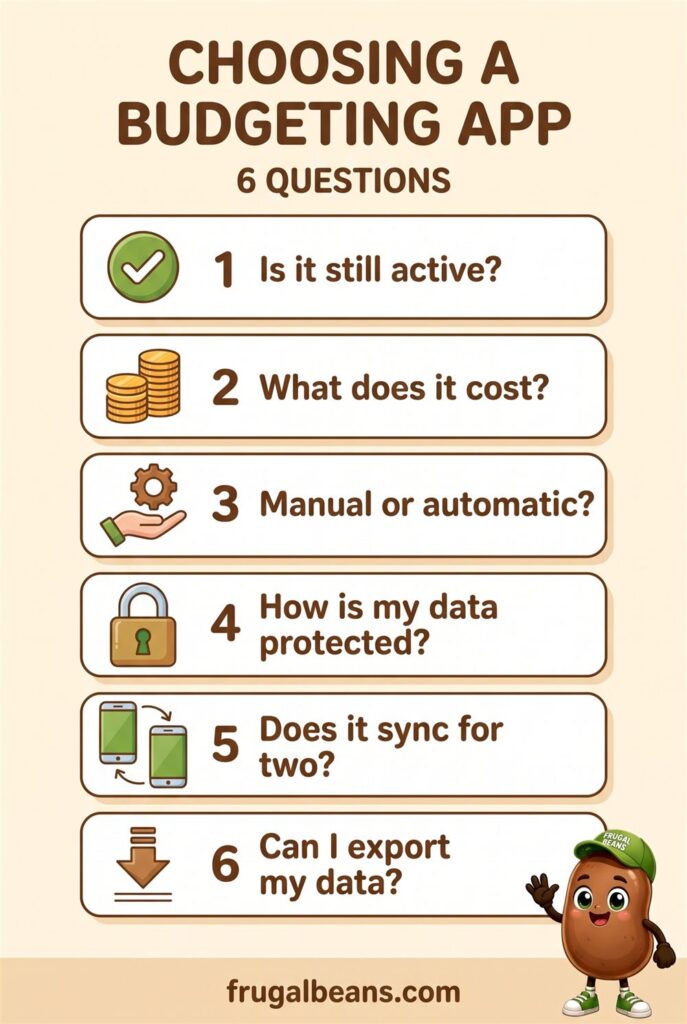
1. Is it still active?
This sounds obvious, but old review articles stay online for years after an app closes. Before you sign up, check that the app has been updated recently in your phone’s app store, that the company’s website is current, and that it supports U.S. banks if it connects to accounts. A budgeting app that has not been updated in a long time may be on its way out.
2. What does it cost?
Budgeting apps come in a few pricing styles: free with ads or upsells, a monthly or yearly subscription, or a one-time purchase. Free is not automatically cheaper. Pocketbook was free, and free services still need a way to make money, whether through advertising, selling other financial products, or eventually charging a fee. A paid subscription is not automatically better, either. Compare the yearly cost with what you expect to save, and watch for free trials that renew automatically.
3. Manual or automatic?
Automatic apps import transactions from linked accounts. They save time but need access to your financial data. Manual apps ask you to type in each purchase. That takes more effort, but many people find the act of entering a purchase makes them think twice about it, and no bank connection is required. Neither style is right for everyone; pick the one you will actually keep using.
4. How is my data protected?
This is the question most people skip. Read how the app connects to your bank, what it stores, whether it shares or sells data, and how to delete your account. We cover this in detail in the privacy section below.
5. Does it sync for two?
If you share finances with a partner or roommate, check whether two people can use the same budget on different phones, and whether changes sync quickly. A budget only one person can see tends to become one person’s job and the other person’s surprise.
6. Can I export my data?
Pocketbook users had a short window to download a CSV file before their data was deleted. Choose a budgeting app that lets you export your transactions and categories at any time, and do it every few months. Your budget history should belong to you, not to the app.
Budgeting App Privacy: Connecting Your Bank Accounts Safely

Connecting a budgeting app to a bank account requires careful thought. Even when an app uses strong security, you are still placing sensitive financial information with another company. Before linking anything, understand what information is collected, how access works, whether your login details are stored, and how to revoke access.
How budgeting apps connect to your bank
Pocketbook used a method called screen scraping, which typically required users to hand over their online banking password so the service could log in on their behalf. Many apps now connect through the bank’s own sign-in page or through a data-sharing service, so the app never sees your password. When you link an account, notice which screen asks for your password. If it is the app rather than your bank, think carefully before continuing.
The rules around this are still developing in the U.S. The Consumer Financial Protection Bureau’s page on personal financial data rights explains its rule on how banks must share your data with you and with apps you authorize, and notes that the agency has been reconsidering parts of that rule, including data security and privacy.
A simple privacy checklist
- Read the privacy policy’s sections on data sharing, selling, and deletion before you link an account.
- Link only the accounts you need for budgeting. A checking account and one credit card may be enough.
- Turn on two-step verification for both the app and your bank.
- Use a unique password for the budgeting app that you do not use anywhere else.
- Check your bank’s settings for a list of connected apps, and remove any you no longer use.
- Download only from your phone’s official app store, and double-check the developer name.
- When you stop using an app, delete your account inside the app rather than just removing it from your phone.
If you ever suspect your banking login has been misused, contact your bank right away. The FTC’s IdentityTheft.gov lets you report identity theft and get a personal recovery plan.
Paper, Spreadsheet, or Budgeting App?

Part of knowing how to choose a budgeting app is knowing when you do not need one. Pocketbook’s closure reminds us that the method matters more than the tool. Each option has real strengths.
|
Method |
Good for |
Watch out for |
|
Paper notebook |
People who think best with a pen; no data sharing at all |
Easy to skip a week; no automatic totals |
|
Spreadsheet |
Full control, free, easy to move anywhere |
Takes setup time; manual entry |
|
Your bank’s built-in tools |
Spending summaries with no extra app or data sharing |
Usually covers only that bank’s accounts |
|
Manual budgeting app |
Mindful tracking on your phone without linking accounts |
You must enter every purchase |
|
Automatic budgeting app |
Seeing several accounts in one place with little effort |
Data access, possible fees, and the risk the service changes or closes |
Many households combine methods: an app for day-to-day tracking and a simple spreadsheet for annual expenses, debt balances, and savings goals. If you are new to all of this, our guide to frugal living for beginners is a gentle place to start.
Tracking vs. Budgeting: The Biggest Lesson From Pocketbook
The biggest weakness of Pocketbook, beyond the fact that it closed, was how easily tracking could be confused with budgeting. Tracking records what happened. Budgeting decides what should happen next. Pocketbook was stronger at the first job than the second, and so are many apps today. A zero based budgeting app tries to handle the second job by asking you to plan each dollar before you spend it.
Here is how its strengths and limits compared:
|
Area |
What Pocketbook did well |
What users still had to handle |
|
Account overview |
Brought multiple accounts into one view |
Checking that balances and connections were current |
|
Spending categories |
Reduced manual entry |
Correcting misclassified or combined purchases |
|
Budget tracking |
Made category spending easy to compare |
Choosing realistic limits and responding to overspending |
|
Bill awareness |
Made recurring payments easier to notice |
Keeping enough cash available on the due date |
|
Cost |
Was free to use |
Accepting that free services can change or close |
|
Long-term planning |
Revealed day-to-day spending patterns |
Building savings, debt, and annual-expense plans separately |
A sample monthly plan
Whatever budgeting app you choose, it works best alongside a written plan. Consider a household with $5,000 of monthly take-home pay. It might have $2,100 for housing and utilities, $900 for groceries and transportation, $500 for debt payments, $400 for insurance and other regular costs, and $600 for personal and family spending. That adds up to $4,500, leaving $500 for savings and irregular expenses. In a zero based budgeting app, you would assign that last $500 to specific savings and irregular-expense categories too, so the plan balances to $0.
A good budgeting app makes it easy to notice if personal spending has reached $850 by the 20th of the month, leaving too little for the final ten days. The app spots the problem; the plan tells you what to do about it. For help setting realistic category amounts, see our budgeting tips for a tight budget.
How to Choose a Budgeting App You Will Actually Use
The best features in the world, whether in a simple tracker or a zero based budgeting app, do not help if you stop opening the app after two weeks. Try a short test before you commit.
- Test for two weeks. Use a free trial or free tier and pay attention to whether you open the app without being reminded.
- Time the weekly review. If catching up takes more than about ten minutes, the app may be too complicated for you.
- Check the categories. Can you rename them, split a transaction, and mark transfers easily?
- Look at the reminders. Bill alerts should help, not nag. Too many notifications get ignored.
- Try an export. Download your data once during the trial so you know it works.
- Decide before the trial ends. Set a calendar reminder a few days before any paid renewal.
How to Start a Budget and Stick With It
Although Pocketbook is gone, its basic workflow still works with a current app, your bank’s tools, or a spreadsheet. These steps help an ordinary household get value without turning budgeting into a daily chore.
Start with one month of observation
Do not change every habit on the first day. Review one normal month and identify the largest categories. This creates a baseline and reduces the chance of setting unrealistic targets. If takeout was $240 last month, a $180 target is a realistic first step; zero probably is not.
Separate needs, wants, and timing problems
A high expense is not automatically wasteful. A medical bill is different from an impulse purchase. A low balance may be a timing problem caused by an annual insurance premium rather than overspending. Label the reason before deciding what to cut.
Create an irregular-expense fund
Add up predictable annual costs and divide by twelve. If car registration, insurance, gifts, and school costs total $2,400 a year, setting aside $200 a month keeps those bills from becoming emergencies. Home repairs belong here too; our free Homeowner Repair Cost Playbook lists typical lifespans and repair costs for major home systems so you can plan ahead.
Review categories every week
A ten-minute weekly review is usually more useful than a stressful end-of-month investigation. Check new transactions, correct errors, and compare what is left in each category with the days left in the month.
Keep a small buffer
Even if a zero based budgeting app assigns every dollar, give a buffer its own job, because a plan with no slack can fail when a prescription, repair, or price increase appears. Keep a modest cushion in checking or a miscellaneous category. The right amount depends on your income and obligations.
Use app data as a prompt, not a verdict
If a category looks wrong, investigate. If the app says you are on target, still check pending card charges and upcoming bills. Technology should support your judgment, not replace it.
Keep your key records outside the app
Keep a simple file with your monthly budget, an annual-expense calendar, debt balances, savings goals, and contact details for your financial providers. That makes it easy to switch tools and helps a partner understand the plan. If Pocketbook users had kept a file like this, its closure would have been an inconvenience rather than a setback. For more ideas on trimming the categories your app reveals, see our practical ways to save money and tips on how to save money at home.
How to Choose a Budgeting App: Frequently Asked Questions
What happened to the Pocketbook budgeting app?
Pocketbook, an Australian budgeting app owned by Zip, closed on August 5, 2022. Users could export their transactions as a CSV file until August 4, after which the company said it would delete personal and financial data. It is not available anywhere today.
Is it safe to connect a budgeting app to my bank account?
It can be, but it is a real decision. Prefer apps that connect through your bank’s own sign-in page rather than asking for your banking password, turn on two-step verification, link only the accounts you need, and remove access in your bank’s settings when you stop using an app.
How do I choose a budgeting app if I have never budgeted before?
Start simple. Pick one that is actively updated, fits your price limit, and matches your style: manual if you want to think about each purchase, automatic if you want the least effort. Use it for a month to observe before you set strict limits.
Is a zero based budgeting app good for beginners?
It can be. If you are learning how to start a budget, a zero based budgeting app gives you a clear routine: list the income you expect, assign every dollar to a category, and adjust when plans change. Some people find that structure helpful from day one; others prefer to track spending for a month first. Try a free trial and notice which style you keep using.
Is a free budgeting app worth it?
A free budgeting app can work well, but understand how the company makes money, whether through ads, offers for other financial products, or paid upgrades. Free services can also change or close, as Pocketbook did, so export your data regularly.
The Bottom Line
Pocketbook was a good example of what a budgeting app can do: bring accounts together, sort spending into categories, flag bills, and turn vague worry into specific facts. It also showed the limits. Categories needed correcting, a dashboard did not create a plan, and when the service closed, users had a short window to save their history.
So when you think about how to choose a budgeting app, ask six questions: is it active, what does it cost, manual or automatic, how is my data protected, does it sync for two, and can I export my data? If you want a tool that plans ahead instead of only looking back, a zero based budgeting app is worth a trial. Then keep your key records somewhere you control and review your numbers every week. Whether your tool is a phone app, a spreadsheet, or a paper notebook, you still supply the decisions. A good budget will not make your spending perfect, but it gives you enough clarity to adjust before a small problem becomes a big one.
How to Budget When Money Is Tight: 11 Simple Tips
Learning how to budget is one of the best ways to save money on a tight budget, and it starts with a plan, not a punishment. A budget is simply a plan for using the money that comes into your household. It is not a test of willpower or a demand that you stop enjoying your life. When money is tight, a useful budget gives each dollar a job before it disappears into small purchases, surprise bills, and fees you never meant to pay.
Many people avoid budgeting because they think they need perfect records, a complicated spreadsheet, or a bigger paycheck first. In reality, learning how to budget can start with three numbers: what you bring home, what you must spend, and what you want your money to accomplish. The goal is not to predict every expense. The goal is to see where your money goes and make a few deliberate changes.
The 11 tips below show how to budget for real households: changing schedules, uneven paychecks, rising bills, and competing priorities. Use them as a system rather than a list of rules. Start with one or two, then build on what works.
What a Tight Budget Really Needs
A tight budget is one where income barely covers, or sometimes does not cover, the basics. In that situation, the usual advice to “cut back on lattes” misses the point. What you need first is stability: bills paid on time, no surprise overdrafts, and a little cash between you and the next emergency.
That changes the order of operations. On a tight budget, protecting essentials comes before investing, and avoiding fees comes before chasing small discounts. A single late fee or a string of overdraft charges can wipe out a month of careful grocery savings. Keep that in mind as you read: knowing how to budget when money is tight is often about timing and structure, not deprivation.
If you are new to living on less, our guide to frugal living for beginners covers the mindset behind these habits.
How to Budget: Budgeting for Beginners in Plain English
If budgeting for beginners sounds intimidating, it helps to know that every method answers the same question: where should this month’s money go before it arrives? A budget compares the money coming in with the money going out, and then you decide what to change. You do not need special software. A notebook, a free spreadsheet, or your bank’s spending summary is enough to start.
Most beginners do best with a simple order: list take-home pay, cover essentials, set aside something for savings and debt, and only then plan the extras. If you want more structure, the zero-based method in tip 5 gives every dollar a job. For a quicker rule of thumb, our free 50/30/20 budget calculator splits your take-home pay into needs, wants and savings. Either way, the first month is about learning, not getting every number right.
1. Set One Small Goal With a Number and a Date
“Save more” is a good wish but a weak plan. Turn it into a specific target, such as saving $1,200 for car repairs by December or paying off a $900 credit card balance in six months. A number tells you how much is needed, while a date tells you how quickly you must act.
When money is tight, start smaller. A first goal of $300 for a starter buffer is more motivating than a goal you cannot imagine reaching. Break any target into manageable pieces. A $1,200 goal over twelve months is $100 per month. If you are paid every two weeks, setting aside about $46 from each paycheck gets you close. Each deposit is visible proof that the plan is working.
2. Build a Bare-Bones Budget From Take-Home Pay
The first rule of how to budget is simple: use the money that actually reaches your bank account, not your salary before taxes and deductions. Take-home pay is the amount available for bills, spending, saving, and debt payments. If your income changes from month to month, build the plan on a cautious estimate based on a lower typical month, not your best one.
Then write a bare-bones budget: the minimum your household needs to get through a month safely. A tight budget works best when you know this number by heart.
What goes in a bare-bones budget
- Housing: rent or mortgage, plus required insurance.
- Utilities: power, heat, water, and a basic phone plan.
- Food: groceries for simple home meals, not takeout.
- Transportation: fuel, transit, and the car payment if you need the car for work.
- Minimum debt payments, so nothing goes late.
- Essential health costs, such as prescriptions.
Everything else is a choice. That does not make it wrong, but it does make it adjustable. Knowing the difference is what lets you make fast, calm decisions in a lean month.
3. Track Spending for Two Weeks on a Tight Budget
A budget based on guesses is hard to trust. For two to four weeks, record every purchase without criticizing yourself. Include cash, automatic payments, delivery fees, bank fees, and small items such as snacks or parking.
Group transactions into broad categories that make sense for your life: housing, utilities, groceries, transportation, insurance, health care, debt payments, savings, eating out, entertainment, and personal spending. If a category is too broad to guide a decision, split it. If it holds only one tiny expense, combine it with a related category.
After tracking, compare what you expected with what actually happened. You may find that groceries are reasonable but convenience meals are high, or that a forgotten annual fee is the real source of stress. On a tight budget, good information is worth more than good intentions.
4. Separate Fixed, Flexible and Occasional Costs in a Tight Budget
Fixed expenses are usually the same each month, such as rent or a loan payment. Flexible expenses change, such as groceries, fuel, or clothing. Occasional expenses arrive less often, but they are still predictable: car registration, school supplies, gifts, medical deductibles, or yearly insurance premiums.
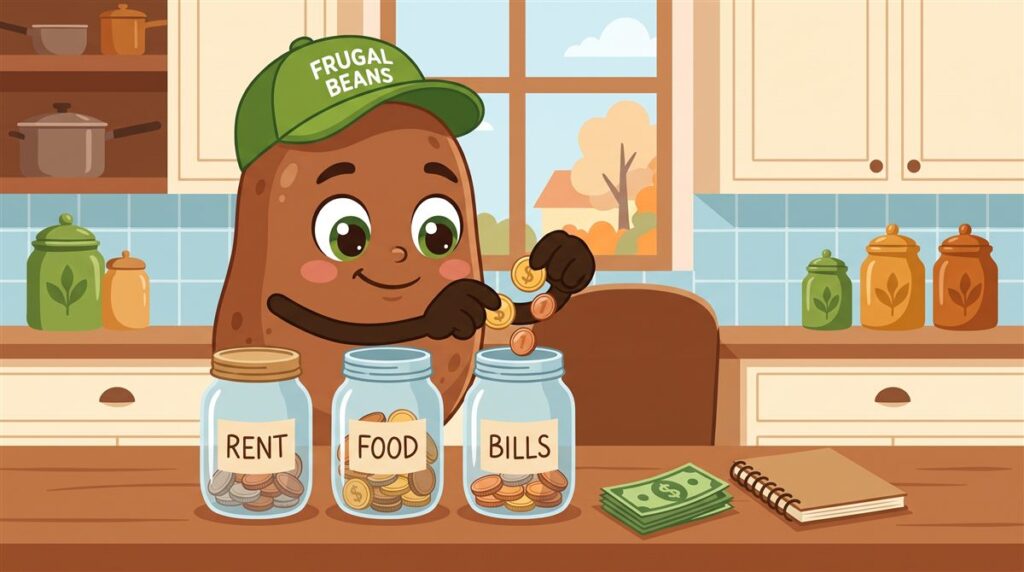
Occasional expenses are what break a tight budget, because they do not show up every month. Create a sinking fund, which is money set aside gradually for a known future cost. If a $600 insurance bill is due in six months, save $100 per month. The bill stops being a surprise and becomes part of the plan. Physical envelopes or labeled jars work for some households; separate savings labels in one account work for others.
|
Expense type |
Examples |
Tight budget approach |
|
Fixed |
Rent, loan payment, internet plan |
Pay first; renegotiate or shop around at renewal |
|
Flexible |
Groceries, fuel, dining out |
Set a range and check it weekly |
|
Occasional |
Repairs, gifts, annual fees |
Divide the cost by the months until it is due |
|
Irregular income |
Overtime, gig work, seasonal pay |
Cover the bare-bones budget from dependable income; assign extras on purpose |
5. Give Every Dollar a Job (Including a Little Fun)
A zero-based budget assigns a planned use to all expected income. “Zero-based” does not mean your bank account must reach zero. It means income minus planned spending, saving, and debt payments equals zero on paper. Unassigned money on a tight budget tends to vanish without a decision, which is why many people find this the clearest way to learn how to budget.
Still include a small amount for enjoyment. A modest allowance for coffee, a hobby, or a cheap night out keeps the plan livable. If the budget leaves no room for ordinary pleasures, you may follow it for a week and then abandon it completely. A planned $20 of personal spending is more useful than an unrealistic promise to spend nothing.
For couples or families, consider separate no-questions-asked amounts if that reduces friction. They do not need to be equal if incomes or responsibilities differ. What matters is agreeing on the system before the money is spent.
6. Automate Bills and Savings Without Risking Overdraft Fees
Automation moves money according to a decision you have already made. Schedule bills for the days right after payday, and set a small transfer to savings on payday too. Moving the money early keeps your goals from becoming “whatever is left at the end of the month.”
On a tight budget, timing matters as much as the amount. Start with a transfer you can sustain. If $75 per paycheck causes overdrafts, try $20 and increase it after two or three successful months. Keep a small cushion in checking for timing differences, because a payment that lands a day before your paycheck can trigger a fee.
Protect yourself from overdraft and late fees
- Ask your billers whether you can move due dates closer to payday. Some will.
- Turn on low-balance alerts in your banking app.
- Review whether you have opted in to overdraft coverage for debit card purchases. The Consumer Financial Protection Bureau explains how bank account fees and overdraft coverage work and what your choices are.
- If you know a payment will be late, call before the due date. Providers often have more options before an account falls behind.
Paying on time also protects your credit history, which affects what you pay for loans, insurance, and even some rentals. The CFPB’s guide to credit reports and scores explains how to check your reports for free and dispute errors.
7. Build a Small Emergency Buffer, Even on a Tight Budget
An emergency fund is cash reserved for an unexpected, necessary expense, such as a broken water heater, a cut in hours, or an urgent car repair. It is different from money for planned costs. A birthday gift is not an emergency, even if it was forgotten until the last minute. Our free emergency fund calculator shows how much to keep and how long it will take to save.
When you are trying to save money on a tight budget, the first milestone can be very small: $100, then $300, then $500. Even $10 a week adds up to $520 over a year. Once that first buffer is in place, consider building toward several weeks or months of bare-bones expenses. The right long-term amount depends on income stability, health needs, dependents, and other support you can count on.
Keep emergency money in a safe account you can reach quickly but do not see every time you buy groceries. The main benefit is not earning the highest return. It is having an alternative to a payday loan or a high-interest card when life goes wrong. If you own your home, our free Homeowner Repair Cost Playbook helps you estimate which repairs to plan for so the buffer is the right size. For predictable replacements such as a furnace or roof, a separate home repair fund keeps this buffer free for true emergencies, and our free home repair fund calculator shows how much to set aside each month.

8. Cut Fixed Costs: The Biggest Ways to Save Money on a Tight Budget
When a budget is tight, focus on the largest controllable costs first. Housing, transportation, insurance, phone plans, and debt interest usually matter more than eliminating every small treat. A $50 monthly cut to one fixed bill saves $600 a year, and it keeps saving without any extra effort from you.
Phone, internet, and insurance
Check whether a lower-cost plan would meet your needs, especially if you rarely use all your data or channels. Compare insurance at renewal rather than letting it roll over automatically. Ask your current providers whether they have a cheaper plan before you switch; sometimes a phone call is enough.
Paying too much for your phone?
Lyca Mobile is a prepaid, no-contract wireless plan with no credit check, running on a major national network. If you rarely use all your data, a prepaid plan like this can cut a fixed cost every month.
Partner link. Frugal Beans may earn a commission if you sign up, at no extra cost to you. Compare it with your current plan before you switch.
Subscriptions and automatic renewals
Review subscriptions together, at one sitting. Cancel what you no longer use, pause what you use seasonally, and ask whether a lower tier would do the same job. For larger costs, compare the full price over time rather than only the monthly payment. A small monthly charge can still be expensive when it runs for years.
Groceries and everyday spending on a tight budget
Groceries are flexible, not fixed, but they respond well to systems. Plan a few reliable meals, keep a short list, and compare unit prices on the shelf tag, which show the cost per ounce or per count. A bigger package is only a bargain if you will use all of it. If convenience meals are draining the budget, our look at whether meal delivery services are worth it walks through the real cost. When tags don’t match, the free unit price calculator converts the units for you.

Change systems, not willpower
Set a waiting period for nonessential purchases. A 48-hour pause can separate a genuine need from an impulse without forcing you to reject every want. Try a “replace, do not simply remove” approach: if takeout is the problem, keep one planned restaurant meal and prepare two quick alternatives at home. Practical substitutions last longer than shame. You will find more ideas like these in our list of simple ways to save money.
9. Hold a 15-Minute Tight Budget Check-In Each Week
A budget is a living plan, so check it before the month is over. Set aside 15 minutes once a week to review account balances, upcoming bills, recent spending, and progress toward your goal. That is long enough to catch problems and short enough to repeat.
Ask three questions: What has changed? What must be paid before the next check-in? What adjustment protects the most important goal? You might move $15 from entertainment to the car-repair fund, postpone a purchase, or simply confirm that everything is on track. On a tight budget, the weekly check-in is where overdrafts get prevented instead of discovered.
10. Plan for Irregular Income, Windfalls and Hard Months
If your pay varies, build the bare-bones budget around your lowest typical month. In better months, assign the extra on purpose: first to any bill that is behind, then to the emergency buffer, then to a sinking fund. Some households park extra income in a holding account and “pay themselves” a steady amount each month, which smooths out the ups and downs.
A windfall is money above your normal income, such as a tax refund, bonus, gift, or unusually strong freelance month. Decide in advance how to divide it. For example, a $900 tax refund might add $500 to the emergency buffer, $250 to debt repayment, and $150 to something your family enjoys.
Difficult months need a plan too. Identify expenses that can pause or shrink temporarily, such as extra debt payments, travel, or optional subscriptions. A short no spend challenge can turn that pause into a simple daily check-in. Protect housing, utilities, food, transportation, insurance, minimum debt payments, and essential health costs first. A flexible budget is not a failed budget. It is a budget that tells you which choices to make when conditions change.
11. Review and Adjust Your Tight Budget Every Month
Set a monthly appointment with your budget. Compare planned amounts with actual spending, notice your progress, and update categories that no longer fit. A raise, a new child-care cost, a move, a medical bill, or a paid-off loan can change the whole picture.
Do not change ten categories at once. If groceries ran over again, first ask whether the amount was unrealistic, prices changed, or meal planning needs attention. Then make one specific adjustment and watch the result. Small corrections compound over time, and that habit of adjusting is a big part of knowing how to budget well.
How to Budget in 5 Steps When Money Is Tight
If the 11 tips feel like a lot, start with this short version of how to budget. It mirrors the infographic and fits on a sticky note on the fridge.
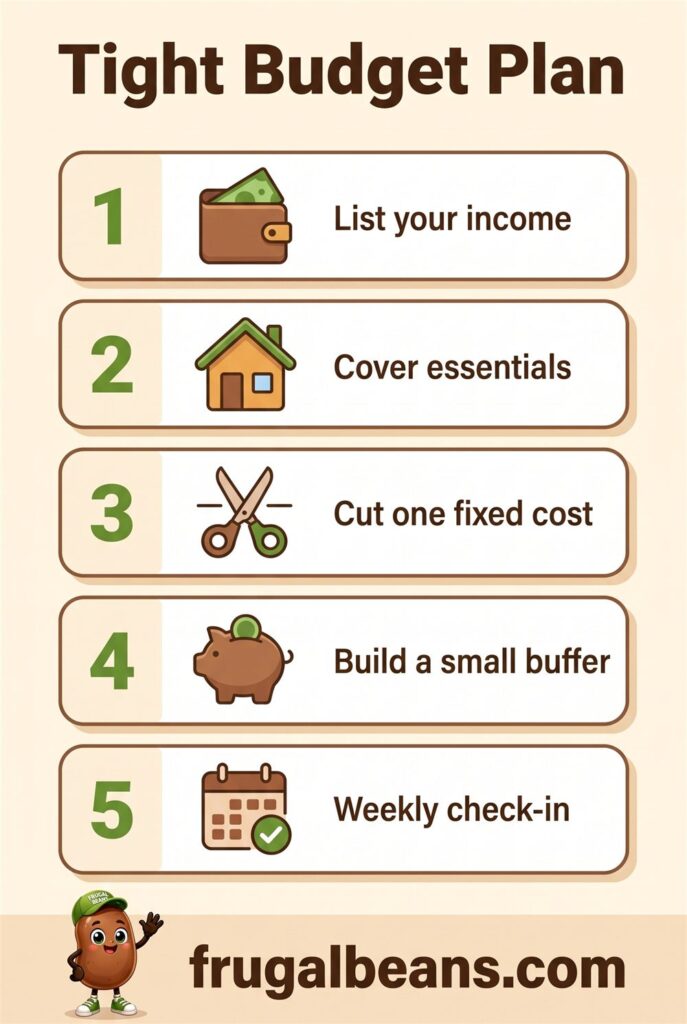
- List your income. Write down take-home pay for the month, using a cautious figure if it varies.
- Cover essentials. Fill in the bare-bones budget: housing, utilities, food, transportation, minimum payments, and health needs.
- Cut one fixed cost. Call one provider this week, such as your phone, internet, or insurance company, and ask for a lower plan.
- Build a small buffer. Automate a transfer you can sustain, even $10 a week, until you reach your first milestone.
- Hold a weekly check-in. Spend 15 minutes reviewing balances and upcoming bills so nothing catches you off guard.
More Ways to Save Money on a Tight Budget Without Feeling Deprived
The budgeting tips that last are the ones that are easy to see and easy to repeat. Keep the system visible. A one-page budget on paper, a basic spreadsheet, or a notes app is enough if you will actually use it. Choose the tool that makes your numbers easy to understand, not the one with the most features.
Use separate labels or accounts for goals when possible. Seeing “car repairs” and “holiday gifts” as distinct balances makes it less likely you will spend one goal’s money on another. If separate accounts create fees or confusion, use clear categories in one account instead.
Budget with ranges when precision would be false. Groceries might be planned at $400 to $450, while rent may be exactly $1,200. A range reflects real variation while still giving you a boundary. At the end of the month, learn from where the result landed.
Look at the house itself, too. Food waste, energy use, and small repairs left too long are quiet leaks in a tight budget. Our guide to how to save money at home walks through each room, and these frugal living tips add everyday habits that cost nothing to start.
Finally, connect the budget to something meaningful. A paid-off credit card can mean less stress. A small buffer can mean sleeping through the night when the car makes a strange noise. The budget is not the destination; it is the way everyday decisions support the life you want.
How to Budget on Less: Frequently Asked Questions
What are the best ways to save money on a tight budget?
Start with the biggest, most repeatable savings: lower one fixed bill, avoid overdraft and late fees by lining up due dates with payday, and plan simple meals so groceries stay predictable. Then automate a small transfer to an emergency buffer. These changes save more than cutting tiny treats.
What is the easiest way to start budgeting for beginners?
Start with one month of take-home pay and a list of essentials. Write down what must be paid, track spending for two weeks, and adjust one category at a time. The simplest version of how to budget is income, minus essentials, minus a small savings transfer, with a set amount left for everything else.
How much should I save if I live on a tight budget?
Any consistent amount counts. Start with what you can sustain without overdrawing your account, even $5 or $10 a week, and increase it after a few successful months. Ten dollars a week becomes $520 over a year, which is a real cushion for a minor emergency.
Is a budget still useful if my income changes every month?
Yes, and it may be even more useful. Build the bare-bones budget on your lowest typical month, cover essentials from dependable income, and assign extra income on purpose when it arrives. A holding account that pays you a steady amount each month can smooth out the swings.
How do I avoid overdraft fees on a tight budget?
Keep a small cushion in checking, turn on low-balance alerts, schedule bills right after payday, and review your overdraft coverage choices with your bank. A weekly check-in helps you spot a shortfall before a payment goes through.
The Bottom Line
Learning how to budget on less works best when your plan is specific, flexible, and connected to your priorities. Name one small goal, build a bare-bones budget from take-home pay, track real spending, and plan for both regular and occasional costs. Then automate what matters, protect a small emergency buffer, cut one fixed cost at a time, and check in weekly.
You do not need to follow all 11 budgeting tips at once, and you do not need to get every category right on the first try. The most reliable ways to save money on a tight budget are the ones you can repeat. Give your money clear jobs, leave room for ordinary enjoyment, and let each month move you a little closer to breathing room.
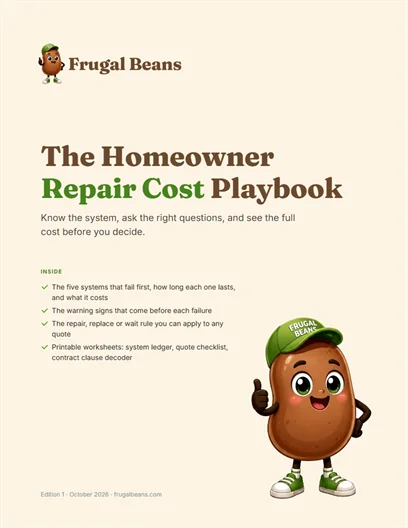
Get the free Homeowner Repair Cost Playbook
Which systems fail first, what they cost, the warning signs, and the repair-or-replace rule. 15 printable pages.
Free. No spam.
Free tools
Got a quote? Check it in under a minute.
Ballpark a new furnace before the contractor visits.
Price a tank, tankless or heat pump model.
Warm air, ice or noise? See the likely part and price.