Repair or Replace Calculator

This free repair or replace calculator helps you decide what to do when a technician hands you a quote for your furnace, air conditioner, heat pump, water heater or a major appliance. Enter the unit’s age, the repair price and the cost of a new one, and it runs the three rules of thumb that manufacturers and consumer publishers use, then shows its math so you can explain the decision to anyone.
Loading the repair or replace calculator… If it doesn’t appear, please make sure JavaScript is turned on.
How the Repair or Replace Calculator Works
No single formula settles a repair or replace decision. The calculator looks at the problem from three angles. When they agree, the answer is usually clear. When they disagree, the age of the unit tends to break the tie.
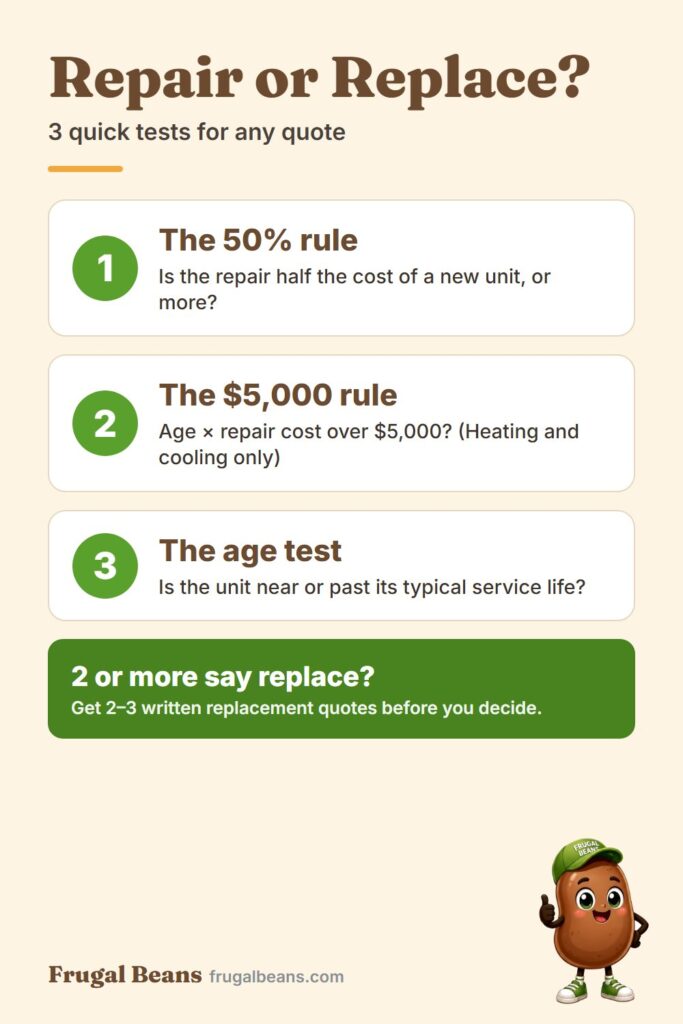
1. The 50% rule
If a repair costs half or more of what a comparable new unit would cost installed, replacing usually makes more sense. Rheem applies this rule to water heaters, HomeAdvisor uses it for furnaces around 10 years old, and Consumer Reports has used a similar guideline for appliances. The calculator divides your repair quote by the replacement cost and shows the percentage.
2. The $5,000 rule for heating and cooling
For furnaces, air conditioners and heat pumps, Trane suggests multiplying the age of the equipment by the repair cost. A result above $5,000 means replacement deserves a serious look. A 14-year-old furnace with a $600 repair scores $8,400, for example. The calculator only uses this rule for heating and cooling equipment.
3. Age compared with typical service life
Every system has a typical service life. A furnace commonly lasts 15–25 years, a central air conditioner 7–15, and a tank water heater 6–12, according to InterNACHI and Rheem. The calculator tells you whether your unit is early in its life, approaching the age when replacements usually start, inside that window, or past it. To see where all of your systems stand at once, use our free home system lifespan tracker. ENERGY STAR suggests considering replacement for air conditioners and heat pumps older than 10 years and furnaces older than 15.
How to Read Your Repair or Replace Result
- Repair: the repair is a small share of a new unit and the unit isn’t near the end of its typical life.
- Repair, then plan: the repair is reasonable today, but the unit is close to or past the usual replacement age. Fix it, then start comparing replacement quotes and setting money aside.
- Get a second quote: one rule points to replacing but the unit is still young. A second written quote that names the failed part is the cheapest way to settle it.
- Replace: two or more tests point to replacing. Get two or three written replacement quotes before you decide.
- Safety first: a gas smell, carbon monoxide alarm, cracked heat exchanger or scorched wiring overrides every cost rule. Leave the house and call your gas utility or 911 if you smell gas.
If you’ve already paid for repairs on the same unit in the last two years, add them in. The calculator shows what all the repairs add up to as a share of a new unit, which is often the clearest sign that it’s time to plan a replacement.
Typical Lifespans and Replacement Costs
These are the figures the repair or replace calculator uses. They are national ranges, so your local price and your unit’s real life can sit outside them. Use them to sanity-check a quote, not to replace one.
|
System |
Typical service life |
National installed replacement |
|
Furnace |
15–25 years |
$2,823–$6,897 (average $4,814) |
|
Central air conditioner |
7–15 years |
$3,887–$8,073 (average $5,978, 2024 data) |
|
Heat pump (air-source) |
10–15 years |
$4,500–$8,000, excluding ductwork |
|
Water heater (tank) |
6–12 years |
$882–$1,826 (average $1,348) |
|
Water heater (tankless) |
10–20+ years |
$1,400–$3,900 |
|
Refrigerator |
9–13 years |
Unit price plus $130–$250 installation |
|
Dishwasher |
About 9–10 years |
Unit price plus $110–$270 installation |
|
Washer / dryer |
5–15 years / about 13 years |
Unit price plus $50–$175 installation |
Service lives from InterNACHI and Rheem; costs from HomeAdvisor pages updated June 2026.
Repair or Replace: System by System
The same three tests apply to everything, but each system has its own quirks. Here is what to keep in mind for the most common repair or replace decisions.
Furnace: repair or replace?

Furnaces are long-lived, so a modest repair on a mid-life furnace is usually worth doing. Common repairs such as an igniter, flame sensor, control board or gas valve typically cost a few hundred dollars, while a blower motor can run much higher. The picture changes as the furnace passes 15 years: the $5,000 rule starts to flag even mid-sized repairs, and ENERGY STAR suggests considering replacement. A cracked heat exchanger is a safety issue, not a cost question, so never keep running a furnace that has one.
Air conditioner or heat pump: repair or replace?
Air conditioners have the shortest typical life of the big systems, so age matters more. A capacitor or a hard-start kit is a small repair worth making on almost any unit. A compressor or evaporator coil, which commonly cost well over a thousand dollars, is where the repair or replace calculator usually starts pointing toward replacement on an older system. If your system needs refrigerant topped up every season, ask where the leak is; refrigerant doesn’t get used up. Systems that use the older R-22 refrigerant are another reason manufacturers suggest replacement.
Water heater: repair or replace?

Parts like an anode rod, thermostat, heating element or thermocouple are usually inexpensive and worth replacing on a younger tank. A leak from the tank itself is different: a leaking tank can’t be repaired, so the answer is replacement regardless of what the tests say. Rusty water and rumbling or popping noises from sediment are common signs that a tank is near the end of its life.
Major appliances: repair or replace?
Appliances fail more often than the big systems but cost less each time. Consumer Reports notes that repairing a refrigerator is usually the cheaper choice when it is under 10 years old. For any appliance, compare the repair with the price of a comparable new model plus installation, and remember to check the manufacturer’s warranty and any coverage from the card you bought it with before paying.
When Repairing Usually Makes Sense
- The repair is a small share of the cost of a new unit.
- The unit is well inside its typical service life.
- This is the first significant repair, not the third in two years.
- The failed part is common and the rest of the unit is in good condition.
- The part is still under warranty.
When Replacing Usually Makes Sense
- The repair costs half or more of a new unit.
- The unit is at or past the end of its typical service life.
- Repairs on the same unit keep adding up.
- Parts are discontinued, or the system uses an outdated refrigerant.
- There is a safety problem that can’t be fixed reliably.
Plan the Replacement Before the Next Failure
The most expensive way to replace a system is in an emergency, when you can’t wait for a second quote or a better season. When the repair or replace calculator says “repair, then plan”, use that time well. Get two or three written replacement quotes, ask about rebates and incentives, and start setting money aside.
A simple way to plan: divide the replacement cost by the years of typical life left, then by twelve. A water heater that is 9 years old, with a typical life of 12 and a local replacement quote of $1,800, needs about $1,800 ÷ 3 ÷ 12 = $50 a month. The calculator does this math for you when it recommends planning ahead.
Questions to Ask Before You Decide
A technician’s answers to a few direct questions often matter more than any formula. Ask these before you agree to a large repair or a replacement:
- Which specific part failed, and can you write it on the quote?
- Is that failure a symptom of something else wearing out?
- Is the part still covered by the manufacturer’s warranty, and is the labor covered by the installer’s?
- Is the diagnostic or trip fee credited toward the repair if I go ahead?
- How much life is this unit likely to have left after the repair?
- If I replace it, what size and efficiency do you recommend, and how did you work that out?
- Which permits, code updates, or venting, electrical or ductwork changes are included in the price?
Write down the answers. They make it much easier to compare quotes and to run the repair or replace calculator with confidence.
Repair or Replace Mistakes to Avoid
Deciding under pressure
Unless there is a safety problem, you usually have time to get a second opinion. Be wary of a quote that must be signed today, a price given over the phone without an inspection, or a technician who won’t name the failed part.
Comparing a repair with the wrong replacement price
A repair or replace decision is only fair if the replacement cost includes everything: equipment, labor, permits, disposal of the old unit, and any changes to venting, wiring or ductwork. A low equipment-only price makes replacing look cheaper than it is.
Matching the old unit’s size without checking
For heating and cooling, the U.S. Department of Energy recommends sizing a new system with a load calculation (often called Manual J) rather than a rule of thumb. An oversized system can cost more, cycle on and off, and feel less comfortable.
Ignoring the repairs you’ve already paid for
One repair can look reasonable on its own while the total over two years tells a different story. That’s why the calculator asks about recent repairs on the same unit.
Forgetting that a repair buys time
A repair on an older unit is a decision to keep it for now, not forever. Use the time it buys to plan and save for the replacement, so the next failure doesn’t force a rushed, expensive choice.
What the Calculator Can’t See
The repair or replace calculator works only with the numbers you give it. It can’t see how well the unit has been maintained, whether parts are still available, how efficient the existing equipment is, or how long you plan to stay in your home. If you’re likely to move within a year or two, a reasonable repair may make more sense than a replacement. If you’re staying long term, a newer, more efficient unit may be worth more to you than the calculator can show. Treat the result as one well-reasoned input, alongside a licensed technician’s inspection and local written quotes.
Getting the Numbers Right
A repair or replace decision is only as good as the numbers you put in. A few minutes of checking makes the answer much more reliable.
- Find the real age. Look at the data plate on the unit. Many manufacturers hide the build year and month in the serial number, so search for your brand’s serial number format or call the manufacturer.
- Use a local replacement quote. The calculator offers a national average as a starting point, but labor, permits, ductwork and venting can push a local price well above or below it.
- Ask for an itemized repair quote. It should name the failed part and include labor, so you’re comparing like with like.
- Check warranties first. A part still under the manufacturer’s or installer’s warranty can change the answer completely.
Our guide to saving money at home covers the maintenance habits that help systems reach the top of their typical life, and the free Homeowner Repair Cost Playbook includes a printable repair, replace or wait worksheet and a quote checklist.
Repair or Replace Calculator: Frequently Asked Questions
Is the repair or replace calculator accurate?
It applies widely used rules of thumb to the numbers you enter and shows every step. It can’t inspect your equipment, so treat the result as a well-reasoned starting point and confirm it with a licensed technician and local written quotes.
What is the 50% rule for repair or replace?
If a repair costs 50% or more of what a new unit would cost installed, replacing is usually the better value, especially on an older unit. It’s a guideline used by manufacturers such as Rheem and by consumer publishers, not a law.
Should I repair or replace a 15-year-old furnace?
A 15-year-old furnace is at the start of its typical 15–25 year range. A small repair is often still worth doing, but it’s a good time to get replacement quotes and start setting money aside. Enter your quote above to see how the three tests come out for your numbers.
How old is too old to repair an air conditioner?
There’s no fixed cutoff, but central air conditioners typically last 7–15 years and ENERGY STAR suggests considering replacement after about 10. On an older unit, a large repair such as a compressor usually fails the $5,000 rule. Run your own numbers through the repair or replace calculator to see where yours lands.
Should I repair or replace a leaking water heater?
It depends on where the leak is. A leak from a valve, fitting or connection can usually be repaired. A leak from the tank itself means the tank has failed and the water heater needs replacing.
Is it cheaper to repair or replace an old furnace?
In the short term, a repair is almost always cheaper than a new furnace. Over several years it may not be, especially if the furnace is past 15 years old and repairs are adding up. The repair or replace calculator weighs the repair against the cost of a new unit and the furnace’s age, which is the comparison that matters over time. If it suggests planning a replacement, getting quotes in a mild season, before the next failure, usually gives you more choice and better prices.
Can I use the calculator for a heat pump or tankless water heater?
Yes. Choose the matching option at the top of the calculator. Heat pumps use the same three tests as furnaces and air conditioners, including the $5,000 rule. Tankless water heaters use the 50% rule and the age test, with a longer typical life than tank models.
Does the calculator save my information?
No. Everything is calculated in your browser. Nothing you enter is stored or sent anywhere.
The Bottom Line
A repair quote is a decision about the unit’s future, not just its price. Run the numbers through the repair or replace calculator, ask the technician the questions it suggests, and get local written quotes before any large decision. Planning the replacement before the next failure is almost always cheaper than replacing in an emergency.
Bookmark this page so it’s ready the next time a technician hands you a number. It takes less than a minute to run a quote, and the questions it suggests can save you from paying for a repair that won’t last or a replacement you don’t yet need.
Sources: service life from the InterNACHI Standard Estimated Life Expectancy Chart and Rheem; the 50% rule from Rheem and HomeAdvisor; the $5,000 rule from Trane; age guidance from ENERGY STAR; national cost ranges from HomeAdvisor pages updated June 2026, checked 15 October 2026. This tool provides general information, not professional, financial or contracting advice.

Get the free Homeowner Repair Cost Playbook
Which systems fail first, what they cost, the warning signs, and the repair-or-replace rule. 15 printable pages.
Free. No spam.
Free tool
Repair or replace?
Got a quote for your furnace, AC, water heater or an appliance? Check it in under a minute.
Free tool
What needs replacing next?
Enter the install years for your furnace, AC, water heater and appliances. See what is due first and what to save each month.