Retirement & Investing
Retiring early, investing basics and money learning.
9 Finance Podcasts to Help You Reach Financial Independence
Finance podcasts, and financial independence podcasts in particular, are one of the easiest ways to learn about money without sitting down with a textbook. Financial independence sounds like a distant, all-or-nothing destination. In practice, it is a household project built from ordinary decisions: spending a little less than you earn, protecting your income, paying down expensive debt, and investing for the future. You do not need a perfect budget or a high salary to begin. You need useful information and a way to turn that information into manageable actions.
Good finance podcasts bring personal-finance ideas into the parts of life where decisions actually happen. You can listen while walking, folding laundry, cooking dinner, or commuting. A good episode may explain an unfamiliar term, show how another family handled a tradeoff, or help you question a habit that no longer fits your goals. This list rounds up nine of the best personal finance podcasts for anyone working toward financial independence, but it is a collection of resources, not a ranking. Each of these podcasts has a different voice and emphasis, so the best choice depends on what your household needs right now.
Updated October 2026: We checked every show on this list against its official site and podcast feed. All nine were publishing new episodes in October 2026. An earlier version of this post listed Afford Anything twice and included a show we could not verify, so we replaced those two entries with How to Money and Catching Up to FI, both of which are active and easy to find in any podcast app.

What Financial Independence Means (and Why Finance Podcasts Help)
Financial independence usually means having enough savings and investments, or another reliable source of income, to cover your essential lifestyle without depending entirely on a paycheck. Some people want to leave full-time work early, which is the “RE” in FIRE (Financial Independence, Retire Early). Others want flexibility to change careers, work part time, care for family, or retire with less anxiety. The destination can vary. The useful first steps are similar.
That is where financial independence podcasts earn their place. They are free, they fit into time you already spend on chores, and they let you hear real people work through real decisions. Hearing a host explain a concept three different ways over a few months often sticks better than reading one article once.
Podcasts also have limits. A host does not know your taxes, your workplace benefits, your health, or your tolerance for risk. Treat every episode as a starting point for your own thinking, not personal advice. If you are brand new to managing money, our guide to frugal living for beginners is a gentle place to build the basics alongside your listening.
Finance Podcasts vs. Financial Independence Podcasts
“Finance podcasts” is a broad label. It covers everything from market news and stock-picking shows to business interviews and household budgeting. Financial independence podcasts are a narrower group: they focus on building enough savings, investments, or other income that work becomes more of a choice. Many of them also cover everyday personal finance, such as debt payoff, budgeting, and retirement accounts, because those habits are the foundation of FI.
For most households, that narrower focus is the more useful one. Daily market commentary can be interesting, but it rarely tells you what to do with your next paycheck. The shows on this list stick closer to decisions you control: what you spend, what you save, how you invest for the long term, and what you want the money to do.
How to Choose the Best Personal Finance Podcasts for Your Goals
Before you press play on any of these financial independence podcasts, identify the question you are trying to answer. If the question is “How do we stop overspending?” a show about behavior may be more useful than one about investing. If you have an emergency fund but do not know how to invest, choose a practical investing discussion. If money conversations cause tension at home, look for patient, judgment-free conversations.
It also helps to match a show to your stage. Some FIRE podcasts assume you already know what an index fund is. Others start from zero. Some lean toward real estate and side businesses, while others focus on mindset and behavior. Sample one or two episodes of any of these finance podcasts before deciding whether it fits.
The table below is a quick map of the nine finance podcasts on this list. Use the right-hand column as a question to carry while you listen.
|
Podcast |
Especially useful for |
A question to carry while listening |
|
ChooseFI |
Building a flexible FI plan |
Which lever can we improve first? |
|
Afford Anything |
Understanding tradeoffs |
What are we willing to exchange for freedom? |
|
The Stacking Benjamins Show |
Broad financial education |
Which basic topic needs attention? |
|
So Money with Farnoosh Torabi |
Mindset and money behavior |
What belief is shaping our choices? |
|
Money Guy Show |
Saving and investing systems |
What should happen to each dollar? |
|
BiggerPockets Money |
Real estate and alternative routes |
What risks would this strategy bring? |
|
Earn & Invest |
Income, investing and purpose |
What is all this money for? |
|
How to Money |
Everyday money decisions |
What can we apply this week? |
|
Catching Up to FI |
Starting later in life |
What can we still change from here? |
9 Essential Finance Podcasts for Financial Independence
Each of the financial independence podcasts below is listed with who hosts the show, what it is good for, who it suits, and its status when we checked in October 2026. Links go to each show’s official page.
1. ChooseFI (Brad Barrett and Jonathan Mendonsa)
ChooseFI is a strong starting point if you have heard “financial independence” but are unsure what it means in daily life. The show was founded by Jonathan Mendonsa and Brad Barrett, and Jonathan returned as Brad’s full-time co-host in early 2026. Its central idea is that progress comes from several levers, not one dramatic trick: earning more, spending intentionally, reducing recurring costs, and investing consistently.
The useful lesson for an ordinary household is flexibility. You do not have to copy an extreme savings rate or make every purchase a test of discipline. You might compare insurance, cancel unused subscriptions, or direct a modest raise toward a retirement account. The show helps you see these choices as connected parts of one plan.
Good for: learning the core FI framework, cutting big recurring costs, and hearing from a large community of listeners. Suits: beginners and intermediate listeners who want an optimistic, practical tone. May not suit: anyone who wants deep technical investing analysis every episode. Status: publishing new weekly episodes as of October 2026.
2. Afford Anything (Paula Pant)
Afford Anything focuses on the decisions behind money. Its name comes from host Paula Pant’s idea that you can afford anything, but not everything. That framing helps households discuss priorities without pretending a spreadsheet can choose their values. The show’s description says it covers financial psychology, increasing income, investing, real estate, and entrepreneurship, with new episodes on Tuesdays and Fridays. Joe Saul-Sehy joins Paula for regular listener Q&A episodes.
This is useful when you are balancing travel, a car replacement, family support, and retirement. The answer is not automatically to eliminate every enjoyable expense. Decide which goals deserve money now, which need a sinking fund, and which can wait. A sinking fund is money set aside gradually for a known future expense. Saving $100 a month for a $1,200 annual bill makes it predictable instead of an emergency.
When listening, ask whether a suggested tradeoff fits your values, time horizon, and responsibilities. A financially independent life should contain freedom, not just a larger account balance.
Good for: decision-making frameworks, economics explained plainly, and thoughtful expert interviews. Suits: listeners who like to think through the “why” before the “how.” May not suit: people who want quick tips in under ten minutes. Status: publishing new episodes as of October 2026.
3. The Stacking Benjamins Show (Joe Saul-Sehy and Josh “OG” Bannerman)
The Stacking Benjamins Show takes a conversational, often silly approach to serious personal-finance subjects. Hosts Joe Saul-Sehy, a former financial advisor, and Josh “OG” Bannerman, a Certified Financial Planner, present the show as a chat around a card table in Joe’s mom’s basement. That breadth and humor help listeners who need general education rather than one narrow strategy.
Think of it as a tour of the financial neighborhood: taxes, insurance, retirement accounts, investing, and behavior. You may not need every topic today, but you can notice which one deserves a closer look. If an episode introduces asset allocation, pause and define it. Asset allocation is the way investments are divided among categories such as stocks, bonds, and cash. The mix affects both growth potential and the size of possible losses.
Good for: broad money literacy with a light touch. Suits: people who find most personal finance podcasts dry. May not suit: listeners who want a strictly early-retirement focus or no banter. Status: publishing several new episodes a week as of October 2026.
4. So Money with Farnoosh Torabi
So Money is hosted by Farnoosh Torabi, a financial strategist, TV host and bestselling author. It mixes interviews with authors, entrepreneurs, and public figures with “Ask Farnoosh” episodes that answer listener questions. It fits listeners whose financial questions are partly emotional. Money can represent safety, status, independence, family loyalty, or past hardship, and those meanings affect spending and saving even when the arithmetic is clear.
Consider a couple who repeatedly overspends on takeout. The problem may not be a lack of cooking knowledge. They may be exhausted by work and caregiving, or they may never have agreed on a realistic food budget. A useful response could be preparing two easy meals on the weekend, setting aside a specific convenience-food amount, and removing shame from the discussion.
Use this kind of conversation to identify your money scripts, the repeated beliefs you inherited or developed. Examples include “debt is normal,” “talking about money is rude,” and “spending proves success.” Naming a belief gives you room to choose a different behavior.
Good for: money mindset, careers, couples, and big life transitions. Suits: listeners who want empathy along with strategy. May not suit: people who want a step-by-step FIRE roadmap. Status: publishing new episodes as of October 2026.

5. Money Guy Show (Brian Preston and Bo Hanson)
The Money Guy Show is helpful for people who want an organized order of operations. Hosts Brian Preston and Bo Hanson are financial advisors (yes, our mascot Bo approves of the name). Their signature framework, the “Financial Order of Operations,” is a nine-step sequence for deciding what to do with each dollar next.
Financial independence becomes easier when money has assigned jobs. A household can decide how much to keep in cash, how to handle high-interest debt, how to use workplace retirement benefits, and how to invest additional savings. Suppose your household receives a $300 monthly raise. You could let it disappear into general spending, or split it deliberately: $150 toward a car-repair fund, $100 toward retirement, and $50 for enjoyment. There is no universal split, but deciding before the money is absorbed gives the raise a lasting effect.
Good for: clear priorities and savings-rate thinking. Suits: people who like checklists and want to know “what next.” May not suit: listeners who prefer open-ended philosophical discussions. Remember that the hosts run an advisory firm, so weigh any service mentions as you would any business. Status: publishing new episodes as of October 2026.
6. BiggerPockets Money (Mindy Jensen and Scott Trench)
BiggerPockets Money is one of the best-known FIRE podcasts, hosted by Mindy Jensen and Scott Trench. Many episodes feature listeners walking through their own numbers on the way to early retirement, alongside discussions of real estate, entrepreneurship, and side businesses. These approaches can create income or ownership, but they also require time, knowledge, capital, and tolerance for uncertainty. The lesson is not that every household should become a landlord. It is that financial independence can have more than one route.
Keep a risk checklist nearby. Ask how much money could be lost, how much unpaid work is involved, whether income is dependable, and what happens if the market changes. Rental property is not simply “passive income.” It can involve repairs, vacancies, insurance, taxes, legal requirements, and difficult tenant conversations. If you are weighing property, our free Homeowner Repair Cost Playbook shows how big-ticket repairs can affect the math.
Good for: real-life FI case studies and real estate perspectives. Suits: people curious about multiple paths to FI who like hearing actual numbers. May not suit: anyone who wants to avoid investing and property talk entirely. Status: publishing new episodes several times a week as of October 2026.
7. Earn & Invest (Jordan Grumet, “Doc G”)
Earn & Invest is hosted by Jordan Grumet, a physician known as Doc G, who has worked in hospice care and wrote the book Taking Stock. According to the show’s description, Monday episodes are panel discussions on financial topics and Thursday episodes are interviews with experts. It suits households that have focused on cutting costs and now want to think about the other side of the equation: earning, investing, and what the money is ultimately for.
There is a limit to how much spending can be reduced, but earning capacity may grow through skills, career moves, business income, or better use of workplace benefits. Extra income is most powerful when converted into durable progress. A $5,000 raise can improve life immediately, but directing part of it toward retirement, debt reduction, or a business reserve can improve future choices.
Do not treat higher income as a cure for every problem. More income can bring taxes, work stress, or pressure to spend more. Pair every earning goal with a destination for the money: current needs, security, and meaningful enjoyment. Doc G often brings the conversation back to purpose, which is a helpful counterweight to pure number-crunching.
Good for: investing ideas, career and income, and the meaning behind money. Suits: mid-career listeners and anyone who already has the basics covered. May not suit: complete beginners looking for budgeting fundamentals. Status: publishing new episodes twice a week as of October 2026.
8. How to Money (Joel Larsgaard and Matt Altmix)
How to Money is hosted by best friends Joel Larsgaard and Matt Altmix and distributed by iHeartPodcasts. It replaces a show from our earlier list that we could not verify. The tone is friendly and practical, and the show regularly answers listener questions alongside interviews and news discussion. Among the podcasts on this list, it is one of the more approachable personal finance podcasts for people who want everyday decisions explained, from car buying to retirement accounts.
A daily or near-daily listening habit works well for single concepts such as opportunity cost, lifestyle inflation, or negotiating. Opportunity cost means what you give up when you choose one use for money, time, or attention over another. If you spend $80, the cost may include the emergency-fund contribution that $80 could have supported. Lifestyle inflation is the tendency for spending to rise as income rises. These ideas become useful when you notice them in ordinary decisions, like the ones in our list of simple ways to save money.
Good for: everyday money choices and listener Q&A. Suits: people in their 20s to 40s building good habits, and anyone who likes a relaxed, funny format. May not suit: listeners who want an exclusive focus on early retirement. Status: publishing new episodes several times a week as of October 2026.
9. Catching Up to FI (Bill Yount and Jackie Cummings Koski)
Catching Up to FI is a podcast for late starters of any age. Co-host Bill Yount is an emergency medicine physician who reached financial independence later in life, and Jackie Cummings Koski is a Certified Financial Planner and Accredited Financial Counselor who wrote F.I.R.E. for Dummies. It replaces the duplicate Afford Anything entry from our earlier list.
Like the best FIRE podcasts, this show can encourage listeners who learn from relatable stories. Financial progress is often invisible for months or years, and starting at 45 or 55 can feel discouraging after hearing stories of people who retired at 35. Hearing how others handle debt, saving, career changes, and setbacks later in life can make the process feel attainable.
Borrow the process, not the person’s numbers. Someone else’s rapid debt payoff may make you feel behind. A better comparison is whether your own debt balance, cash reserve, savings rate, or investments are improving. Net worth is what you own minus what you owe. It is one measure, not a measure of your character.
Good for: mindset, catch-up strategies, and realistic stories. Suits: anyone who feels “too late” for FIRE. May not suit: young listeners who want content aimed at their stage. Status: publishing new episodes as of October 2026.
How to Get the Most From Finance Podcasts
Listening alone will not change a balance sheet. The best financial independence podcasts give you ideas; your household turns them into results. Keep a note with three headings: idea, why it matters to us, and next step. This turns listening into learning instead of an endless stream of interesting advice.

Use this process to turn ideas into household practice:
- Choose one current problem. Start with credit-card debt, an inconsistent emergency fund, or uncertainty about retirement savings.
- Select two contrasting shows. Compare a behavior-focused episode with a systems-focused one, such as So Money and the Money Guy Show.
- Write down one action, not ten. Check an employer match, list annual bills, or set up a $25 automatic transfer.
- Test it for thirty days. If a transfer causes overdrafts, reduce it and repair the system rather than abandoning saving.
- Discuss the decision together. Ask, “What do we want this money to do?” rather than “Why did you spend that?”
- Verify recommendations. Product, investment, tax, and legal details require checking before you act. Podcast discussion is education, not individualized advice.
- Keep an idea parking lot. Revisit interesting strategies during a quarterly review instead of acting on impulse.
The infographic below sums up the five core steps. Print it, or save it on your phone next to your podcast app.

Check the math with free, neutral tools
Many FIRE podcasts talk about compound growth. Instead of taking a host’s example at face value, plug in your own numbers. The SEC’s Investor.gov site offers a free compound interest calculator that shows how regular contributions could grow under the assumptions you choose. For retirement-timing questions, the CFPB’s retirement planning tools are a neutral place to start.
Make listening fit your life
Pair podcasts with tasks you already do: a walk, the dishes, meal prep, or a drive. Speed up playback if one of your podcasts feels slow, and skip episodes that do not apply to you. There is no prize for finishing a back catalog. If you listen while cooking, you are already practicing one of the best habits in our guide to saving money at home.
Hold a monthly money meeting
Use an episode as a prompt for a short monthly check-in. Review cash savings, high-interest debt, and long-term investments. Then name one win and one adjustment. A $400 debt reduction, a new automatic transfer, or a calm partner conversation all count. If money is tight right now, our budgeting tips for a tight budget can help you find the first dollars to work with.
Financial Independence Podcasts vs. Other Ways to Learn
Podcasts are not the only tool, and they work best in combination. Books go deeper on a single idea. Free government resources offer neutral, non-commercial explanations. A fee-only advisor can look at your specific situation. Personal finance podcasts sit in the middle: they are free, regular, and good at keeping money on your mind week after week.
Have a question about your own situation?
JustAnswer lets you ask a finance expert online, as a paid consultation, when a podcast episode raises a question about your own budget, debt or savings plan.
Partner link. Frugal Beans may earn a commission if you buy a consultation, at no extra cost to you. An online consultation is general guidance, not a substitute for a fee-only advisor who reviews your full situation.
Be aware that many finance podcasts are supported by advertising. A sponsor mention is not an endorsement of that product for your household. Compare any product against alternatives, read the fees, and decide on your own timeline. The same caution applies to guests who are promoting a book, course, or business.
Finally, remember that frugality and financial independence are partners. Lower recurring costs reduce how much you need to save, and every dollar saved can work toward your goals. Our collection of frugal living tips pairs well with almost any show on this list.
Financial Independence Podcasts: Frequently Asked Questions
What are the best financial independence podcasts for beginners?
ChooseFI, How to Money, and The Stacking Benjamins Show are approachable starting points because they explain terms as they go and cover a wide range of topics. If you are starting later in life, Catching Up to FI speaks directly to that situation. Try one episode of each and keep the one whose tone you enjoy.
What are the best personal finance podcasts for everyday money questions?
The best personal finance podcasts are the ones that match your current problem. From this list, How to Money and The Stacking Benjamins Show cover a wide range of everyday topics, the Money Guy Show lays out a step-by-step order for saving and investing, and So Money focuses on money mindset and behavior. Broader finance podcasts can be useful too, but a show built around household decisions is usually easier to act on.
Are FIRE podcasts only for people who want to retire early?
No. FIRE podcasts focus on building enough savings and investments to give you choices, and many listeners never plan to stop working entirely. The same habits help with changing careers, working part time, caring for family, or simply feeling less anxious about money.
Is it safe to follow investment advice from podcasts?
Treat podcast content as education, not personal advice. Hosts cannot see your taxes, debts, or goals. Use episodes to learn concepts, check numbers with neutral tools such as Investor.gov, and talk with a qualified professional before making big decisions.
How many finance podcasts should I listen to?
One or two is plenty. Listening to many podcasts at once can create information overload and conflicting advice. Pick one show that matches your current problem and one with a contrasting viewpoint, then take one action at a time.
The Bottom Line
These nine financial independence podcasts offer different doors into the same goal. ChooseFI introduces the framework. Afford Anything clarifies tradeoffs. The Stacking Benjamins Show broadens your vocabulary. So Money examines behavior. The Money Guy Show supports systems. BiggerPockets Money explores real estate and alternative paths. Earn & Invest connects income, investing, and purpose. How to Money tackles everyday choices. Catching Up to FI shows that it is never too late to start.
You do not need to listen to all nine finance podcasts or follow every strategy. Start with one question, take one measured action, and review what happened. Financial independence is not a contest to imitate another household. It is the growing ability to make choices because your money supports your needs, priorities, and future.
Let the podcasts provide ideas. Let your household values set the direction. Let your own numbers decide the pace.
Barefoot Investor for Families Review: 7 Simple Lessons for Kids

This Barefoot Investor for Families review starts with a confession: an earlier version of this post mixed up two different books. Scott Pape’s first book, The Barefoot Investor, is about adult budgeting with “buckets” and bank accounts. The Barefoot Investor for Families is something else. It is a guide for parents on teaching children about money, built around jobs, pocket money and three simple jars. This rewrite fixes that and focuses on what the families book actually teaches.
Money is rarely just about money in a household. It is also about tired parents, children asking for treats at the checkout, and the quiet worry that kids are growing up without knowing what things cost. That is why a book about kids and money can be so appealing. It does not start with investment products or a lecture. It starts with a practical question: how can children learn the value of a dollar at home, one small habit at a time?
Below you’ll find the verified basics about the book, its seven key lessons in our own words, how a U.S. family might adapt them, a fair list of pros and cons, and who the book suits best. One thing to know up front: the book is Australian, so some details need translating for American readers.
Barefoot Investor for Families Review: What the Book Is
The Barefoot Investor for Families was written by Scott Pape, an Australian personal finance columnist best known for his 2016 bestseller The Barefoot Investor. The families book followed in 2018 and was published in Australia by HarperCollins. It is a paperback for parents (and grandparents), not a book for children to read on their own.
According to the author’s official books page, it covers ten things kids need to know about money before they leave home, and it presents a pocket money plan that is meant to take about three minutes a week. The same page lists an audiobook version. We could not find a newer revised edition of the families book; listings still point to the 2018 release.
Don’t confuse it with Pape’s later title, Barefoot Kids (2022). That one is written in a visual format for children themselves, with money stories from Australian kids. The 2018 families book is the parent’s playbook.
The Australian context
The book was written for Australian families. Its examples use Australian dollars, Australian banks, Australian schools and the Australian word “pocket money” where most American parents would say “allowance.” Some later lessons touch on superannuation, Australia’s compulsory workplace retirement savings system. The closest U.S. concept is an employer retirement plan such as a 401(k), although the rules are very different. Bank products mentioned in a 2018 book may also have changed since.
None of that makes the book less useful in the U.S. The core ideas are about behavior, not products. You just have to read it with a translator’s eye.
The Big Idea Behind the Barefoot Investor for Families
At its heart, the Barefoot Investor for Families argues that children learn about money by handling it, not by hearing about it. A child who earns a little money, divides it up, waits for something they want, and gives some away learns more than a child who is simply handed cash or told “we can’t afford that.”
The system has three working parts:
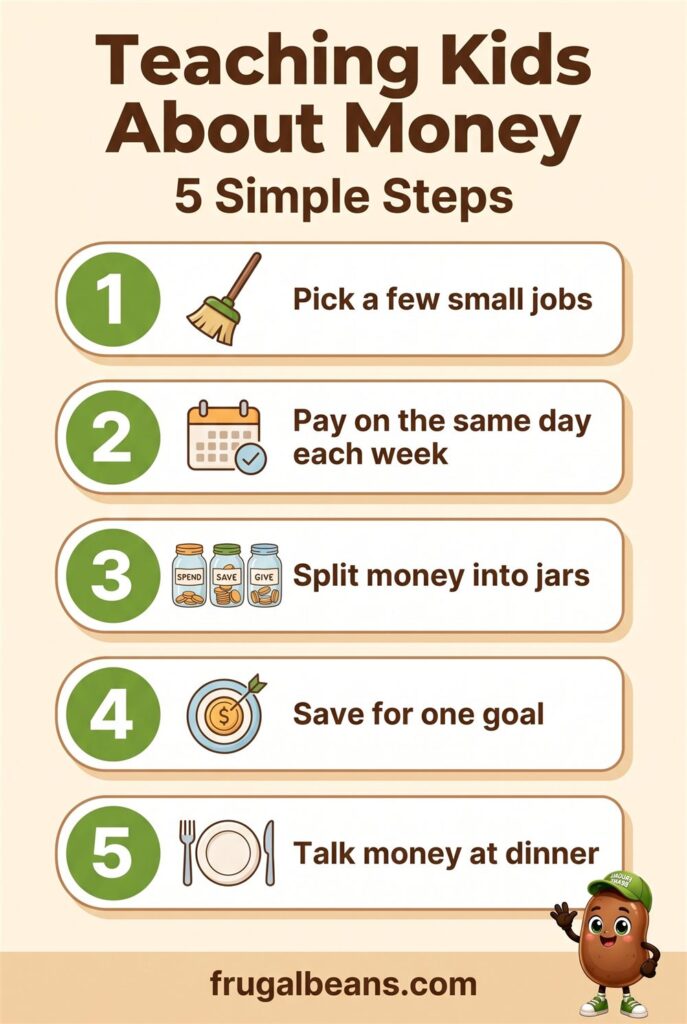
- Jobs: children do a few age-appropriate jobs around the house and are paid for them.
- Jars: the money goes into three physical jars, each with its own purpose.
- A weekly family money meal: a regular meal where parents check the jobs, pay the kids and talk about money.
The amount of pocket money is not the important part. The practice of earning, choosing and living with the result is the lesson. That idea carried over from the original version of this post, and it holds up well.
Barefoot Investor for Families Review: The 7 Simple Lessons
Here are the seven ideas that stood out most to us, summarized in our own words. They are not a list of the book’s chapters, and the book contains more detail, stories and age-by-age guidance than we cover here.
1. Pocket money should be earned
Pape’s position is that pocket money is pay for work, not a gift. Children are given a small number of age-appropriate jobs, and they are paid when the jobs are done. If a job is skipped, it isn’t paid. The point is to connect effort and money early, in a low-stakes setting where the “job” might be feeding the dog or unpacking the dishwasher.
2. Three jars give money a job
Each payday, children split their pocket money into three clear jars. The Splurge jar is for everyday spending. The Smile jar is for saving toward something bigger; Pape describes it as saving for “something that makes them smile.” The Give jar is for generosity toward people or causes in need.
This mirrors the adult idea of separating money by purpose. A child can see at a glance what is available to spend now and what is set aside for later.

3. Real cash comes before cards
The jars are physical for a reason. Watching coins and bills pile up, or disappear, makes money feel real in a way a balance on a screen does not. Moving to a bank account comes later, once the habit is in place.
4. Talk about money at a weekly family meal
The book’s routine centers on a weekly family meal where everyone sits down together. A few minutes go to checking jobs and paying the kids, and the rest of the time is simply family conversation, which naturally includes money stories and questions. Making money a normal dinner topic lowers the temperature. Children learn that money can be discussed calmly, not whispered about or argued over.
5. Waiting is a skill worth practicing
The Smile jar is really a lesson in delayed gratification. A child who wants a toy, a game or a day out has to save for it over weeks. That wait is the point. Kids learn to set a goal, track progress and decide whether the thing still matters by the time they can afford it.
6. Generosity is part of the plan
The Give jar builds kindness into the routine instead of leaving it to chance. Children choose where their giving goes, which turns generosity into something they own rather than something adults do on their behalf.
7. Aim for ten money milestones before kids leave home
The book frames the bigger goal as a set of ten milestones children should reach before adulthood. Reviewers’ summaries describe topics such as the value of hard work, opening a bank account, buying and selling second-hand items, cooking low-cost meals, volunteering and, for older teens, understanding Australian retirement savings. The milestones run from early childhood through the teen years, so the book grows with a family over time.

What the Book Does Especially Well
The first major strength is accessibility. The tone is direct, warm and energetic, and it is written for parents who may not feel financially confident themselves. You don’t need to understand compound interest to start; you need three jars and a few minutes a week.
The second strength is that it treats kids and money as a behavior problem rather than an information problem. A spreadsheet cannot teach a seven-year-old patience. Repeated small choices can. The jar system gives children those choices every single week.
The third strength is its permission to enjoy money. The Splurge jar exists on purpose. A child who never gets to spend anything learns that money is about guilt and restriction. A defined spending amount creates room for small pleasures without undermining the larger lessons.
Finally, the book treats financial capability as a family skill. Children participate in age-appropriate ways, and both parents can share responsibility. That makes money less mysterious at home and reduces the chance that one adult becomes the only person who understands it.
How U.S. Families Could Adapt the Barefoot Investor for Families
Important: this section is our Frugal Beans adaptation for American households. It is not advice from the book, and it is general information, not financial advice.
Most of the system translates easily. The jobs, the jars and the weekly meal work the same in Ohio as they do in Melbourne. The pieces that need adjusting are the Australian specifics: bank products, pocket money norms, and anything tied to superannuation or Australian tax rules.
Turn pocket money into a simple U.S. allowance
Call it an allowance, call it pocket money; what matters is consistency. Pick a fixed payday that matches your household rhythm, such as Sunday dinner or the day a parent gets paid. Keep the amount modest and predictable. A small, reliable amount teaches more than a large one that shows up only when a parent remembers.
Many American families also separate “helping because we live here” chores, like clearing your own plate, from paid jobs. That’s our suggestion, not a rule from the book, but it can stop kids from asking to be paid for every small task.

Choose your own jar labels
Some U.S. parents prefer plainer names such as Spend, Save and Give, especially with younger kids who may find “Splurge” confusing. The labels matter less than the separation. A clear jar, a strip of tape and a marker are all you need, which keeps this a genuinely frugal project.
Plan the step from jars to a bank account
When the jars are working, you can explore a youth savings account at a local bank or credit union. Look carefully at fees, minimum balances and who controls the account before opening anything. Product names and terms vary, so compare a few options rather than taking any one recommendation at face value.
Another option some U.S. families use for this step is a kids’ debit card and app, which lets parents pay an allowance, set savings goals and see what is spent. As with a bank account, compare fees and parental controls first, and keep the book’s cash-first lesson in mind for younger children.

Partner link: Acorns Early. Frugal Beans may earn a commission if you open an account, at no extra cost to you.
Use a U.S. resource for age-by-age milestones
If you want an American companion to the book, the Consumer Financial Protection Bureau’s Money as You Grow program offers free money milestones, activities and conversation starters for parents, organized for young children, school-age kids and preteens, and teens to young adults. It pairs well with the jar system and is written for U.S. families.
Swap superannuation lessons for U.S. basics
When the book gets to Australian retirement savings, translate the idea rather than the details. For a U.S. teen, the closest equivalent conversation might be what a first paycheck stub shows, why taxes and payroll deductions appear on it, and what an employer retirement plan is. Keep it descriptive; the goal is understanding, not picking investments.
Kids and Money: Lessons Parents Can Use Too
One quiet benefit of the book is that it nudges parents to look at their own habits. If you ask a child to split pocket money three ways, you may start wondering how your own paycheck is divided. That is a good question to ask.
The original version of this post included several family budgeting habits that are worth keeping, as long as we’re clear they are ours, not the book’s:
- Hold a short weekly check-in. Ten minutes is enough to cover what has been paid, what is coming up and what needs a decision. Keep it neutral; it is not a courtroom.
- Create an irregular-expense fund. Divide annual costs by twelve and set aside that amount monthly. If school supplies and car registration together cost $1,200 a year, saving $100 a month turns a surprise into a planned bill.
- Build a starter emergency buffer. Even a few hundred dollars can stop a minor repair from becoming expensive debt.
- Give kids controlled choices. Let children compare prices and wait for a goal. Avoid rescuing them from every poor choice, while still protecting essentials such as food, safety and education.
- Adjust after real spending. Watch what actually happens for two or three months, then increase, rename or combine categories.
If you are just starting out, our guide to frugal living for beginners covers the household side, and our budgeting tips for a tight budget help you set realistic amounts. Children notice when a family’s money system actually works, and they copy it.
Barefoot Investor for Families Review: Pros and Cons
No book is perfect for every household. Here is a balanced view.
|
Pros |
Cons |
|
Simple, concrete system kids can see and touch |
Written for Australia; banks, pocket money norms and retirement rules don’t match the U.S. |
|
Warm, encouraging tone for parents who feel unsure about money |
Product references date from 2018 and may be out of date |
|
Builds generosity and patience, not just saving |
Paying for jobs may not fit families who see all chores as shared duties |
|
Very low cost to start: jars and a weekly routine |
Some parents find the jar names or the strong opinions take getting used to |
|
Grows with children through milestones up to the teen years |
Less useful for older teens who already earn and bank on their own |
Where readers should use judgment
The book works best as a framework, not a rigid formula. Every household has different income, schedules and values. A system that runs smoothly for a family with a steady paycheck may need loosening for a parent with irregular shifts or freelance income. If a fixed weekly payday is not realistic, pick a rhythm you can keep.
Parents should also apply their own judgment about chores. Some families are comfortable paying for jobs; others prefer that everyone helps without payment and that pocket money is given separately. Neither approach is wrong. The deeper lesson, that money is limited and choices have trade-offs, can be taught either way.
Who Should Read This Book?
The book is particularly suitable for:
- Parents of children from preschool through early teens who want a ready-made system.
- Couples who want a shared starting point for teaching kids and money.
- Grandparents and caregivers who want to support the same habits.
- Parents who feel overwhelmed by financial jargon and want something practical.
It may suit you less if your children are older teens who already have jobs and bank accounts, if you strongly prefer unpaid chores, or if you want a detailed U.S. guide to accounts and taxes. In that last case, the book is still a good source of habits, but pair it with U.S. resources. For more money-saving ideas for the whole household, browse our frugal living tips and our list of ways to save money.
Barefoot Investor for Families Review: FAQ
What is the Barefoot Investor for Families about?
It is a 2018 book by Australian author Scott Pape that shows parents how to teach children about money. The system uses paid, age-appropriate jobs, three jars (Splurge, Smile and Give) and a weekly family money meal, along with ten money milestones for kids to reach before leaving home.
What are the three jars in the Barefoot Investor for Families?
The jars are Splurge for everyday spending, Smile for saving toward a bigger goal, and Give for helping others. Children divide their pocket money between the three each time they are paid.
Is the Barefoot Investor for Families useful outside Australia?
Yes, for the habits. Jobs, jars and family money talks work anywhere. The Australian-specific parts, such as banks and superannuation, need translating; U.S. readers can pair the book with the CFPB’s free Money as You Grow resources.
How much pocket money should kids get?
There is no single right amount. What matters more is that pocket money is predictable, paid on a regular day and small enough that children have to make choices. Start modestly and adjust as your child takes on more responsibility.
The Bottom Line
Our Barefoot Investor for Families review comes down to this: the book succeeds because it makes kids and money a normal part of family life. Jobs connect work and pay, the three jars give every dollar a purpose, and a weekly meal keeps the conversation going.
Use it selectively. Keep the principles of earning, separating, waiting and giving. Translate the Australian details for your own country and bank. Treat the specifics as suggestions, not commandments. A good pocket money system won’t make every week easy, but it gives children something better than a lecture: practice.
How to Retire Early With the FIRE Movement: 7 Simple Steps
The FIRE movement—short for Financial Independence, Retire Early—can sound like a club reserved for high earners, spreadsheet experts, or people willing to live on almost nothing. In practice, it is less about escaping work on a particular birthday and more about gaining control over your choices. You build enough financial strength that a job becomes a tool rather than your only source of security. If you have ever wondered how to retire early, or at least how to make work optional, this guide is the place to start.
Think of yourself as the pilot of an ordinary household financial plan. A good pilot does not stare only at the final airport. The pilot checks fuel, watches the instruments, adjusts for weather, and keeps everyone on board informed. Your household can use the same approach: a clear destination, reliable information, sensible controls, and a willingness to make small corrections before a minor problem becomes an emergency.
This guide lays out that system in plain language. You will learn what financial independence really means, how to estimate a FIRE number, how lean FIRE, fat FIRE, coast FIRE, and barista FIRE differ, and how to retire early in seven simple steps you can start this month. Nothing here is personal financial advice; it is a framework to help you ask better questions about your own situation.
A quick note on the name: this post was originally titled “Captain FI: The FIRE Personal Finance Pilot,” and “Captain FI” was our metaphor for a household steering its own money. There is also a real personal finance blog and podcast called Captain FI, run by an Australian pilot under that pen name, which is still publishing in 2026. This article is not about that creator, and we are not affiliated with it. We mention it in the resources section below for readers who go looking.

What the FIRE Movement Really Means
At its core, the FIRE movement is about financial independence: your essential life can be funded without depending entirely on a paycheck. That funding might come from investments, a pension, a business, rental income, or a combination of sources. Retiring early is only one possible use of that independence. You might leave a stressful career, work part time, care for family, study, volunteer, or start a less lucrative but more meaningful business.
Financial independence, retire early is therefore not a single finish line. It is a range of milestones. An emergency fund makes you less vulnerable to an unexpected bill. Paying off high-interest debt gives you breathing room. Saving enough to cover a year of expenses can let you take a sabbatical. Full independence provides the broadest set of options.
A useful distinction is between savings rate and net worth. Your savings rate is the portion of income you keep for future use. Net worth is what you own minus what you owe. A high savings rate helps, but a household also needs cash access, insurance, and a plan for near-term bills. Followers of the FIRE movement tend to watch both numbers, because one shows your habits and the other shows your progress.
Why Frugality Is the Engine
Every dollar you do not need to spend does two jobs at once. It can be saved and invested today, and it lowers the amount you will need to fund your life later. That double effect is why frugal habits sit at the heart of the FIRE movement and of any plan for how to retire early. You do not need to be extreme; you need to cut waste around the things you genuinely value. Our guide to frugal living for beginners is a good place to start if this part feels new.
Lean FIRE, Fat FIRE and Other Paths
People in the FIRE movement use a handful of informal labels to describe different destinations. These are community nicknames, not official categories, and the dollar lines between them are fuzzy. Still, they help you decide how to retire early in a way that fits the life you actually want.

Lean FIRE
Lean FIRE means reaching independence on a deliberately modest budget, roughly covering essentials with little room for extras. Because the spending target is lower, the savings target is lower too, so lean FIRE can be reached sooner. The trade-off is a thinner cushion: an unexpected health cost, a major home repair, or a long market slump can put real pressure on the plan.
Fat FIRE
Fat FIRE is the opposite end: independence that funds a comfortable or generous lifestyle, with travel, hobbies, and family support built in. It usually takes longer to reach, but it leaves more margin for surprises.
Coast FIRE: Save Early, Then Let Growth Do the Work
Coast FIRE describes a point where you have saved enough early that, if left to grow, your investments could plausibly cover a traditional retirement, so you only need to earn enough to pay current bills. In other words, you stop adding to retirement savings and let time and compound growth carry the balance the rest of the way.
Here is a simple illustration, not a forecast. Suppose a 35-year-old has $200,000 invested and expects to need about $1,000,000 at 65. If that money grew at 5.5% a year after inflation (an assumption for the math, not a prediction), it would roughly reach that target in 30 years with no new contributions. Real returns are never that smooth, so treat coast FIRE as a moving target and recheck it every year.
The appeal is clear: once you reach coast FIRE, you can take a lower-paying job you enjoy, cut back your hours, or take time off, as long as your income still covers today’s bills. It is one of the gentlest answers to how to retire early, because the hard saving happens up front.
Barista FIRE: Part-Time Work Plus Investments
Barista FIRE describes a mix: investments cover part of your costs and part-time or lower-stress work covers the rest, sometimes along with workplace benefits. Like coast FIRE, barista FIRE treats work as optional in intensity rather than eliminating it.
The name comes from the idea of a part-time job at a coffee shop, partly because some employers offer benefits to part-time staff, but the work can be anything: consulting, tutoring, seasonal jobs, or a small business. For U.S. households, access to health insurance before Medicare eligibility is often the deciding factor. Because part-time income covers some of your spending, your portfolio has to supply less, which can make barista FIRE reachable years sooner than full independence. The risk is that it depends on your ability and willingness to keep working, so keep a cushion in case that income dries up. To see your own numbers, try our free barista FIRE calculator, which shows the age you could switch to part-time work.
None of these paths is the single right answer to how to retire early. Lean FIRE suits people who truly enjoy simple living; fat FIRE suits people who would rather work longer for a wider margin. Most households in the FIRE movement end up somewhere in between, and many change their minds along the way.
How to Retire Early in 7 Simple Steps
The rest of this guide walks through how to retire early one step at a time. Here is the full flight plan at a glance:
- Define your destination with three versions of your future budget.
- Know your cash flow by tracking real spending.
- Build a strong cockpit: emergency reserves, debt control, and insurance.
- Raise your savings rate gradually.
- Invest simply and consistently.
- Estimate your FIRE number.
- Review the route every year and correct course.
Step 1: Define Your Destination
The first step in learning how to retire early is choosing a destination specific enough to guide decisions. “Be rich” is too vague. “Have the flexibility to work four days a week within eight years while keeping our current housing and health coverage” is far more useful.
Write down three versions of your future budget:
- Essential spending: housing, food, utilities, basic transportation, insurance, taxes, health care, and minimum debt payments.
- Comfortable spending: essentials plus ordinary travel, hobbies, gifts, dining out, clothing, and home maintenance.
- Abundant spending: comfortable spending plus larger goals such as frequent travel, generous family support, or an expensive hobby.
These categories prevent a common mistake: treating every current purchase as permanent while pretending future life will be free. A household might spend $4,500 per month today, but perhaps $3,600 is essential and $5,200 is the life it wants. Each number produces a different savings target, and roughly speaking, the essential budget is your lean FIRE line.
Review the plan with the people affected by it. A partner may value predictable travel more than an especially early retirement date, while children create changing costs. Include these preferences rather than labeling them as obstacles.
Step 2: Know Your Cash Flow
Cash flow is the movement of money into and out of your household. Track it for at least one ordinary month, preferably three that include irregular expenses. Use bank statements, credit card records, and annual bills. Do not rely on memory; people forget subscriptions, insurance premiums, school costs, and gifts.
Sort expenses into three groups. Fixed expenses are difficult to change quickly, such as rent or a mortgage. Flexible expenses can move up or down, such as groceries, restaurants, and entertainment. Irregular expenses arrive periodically, such as car repairs, property taxes, and holiday travel. Divide annual irregular costs by twelve and set that amount aside monthly. This turns surprises into planned bills.
A simple cash-flow review should answer four questions:
- How much income reliably arrives after taxes and payroll deductions?
- What must be paid before the next payday?
- Which expenses are recurring but not essential?
- How much can be directed automatically toward reserves and long-term goals?
The objective is not to judge every purchase. It is to make the route visible so you can reduce costs, increase income, or accept a longer timeline. If you need help setting category amounts, our budgeting tips for a tight budget walk through it step by step.
Step 3: Build a Strong Cockpit Before Investing
Before taking substantial investment risk, establish a basic safety structure. Keep a starter emergency reserve in an accessible account. Then expand it until it can cover several months of essential expenses, with the amount depending on job stability, health, dependents, and how quickly you could replace your income.
Pay particular attention to high-interest debt. Credit card balances and similar debt can grow faster than a reasonable investment return. Make minimum payments on every debt, direct extra money toward the highest interest rate, and then roll the freed payment toward the next balance. The smallest-balance-first approach can also work if it keeps you motivated and consistent.
Insurance is financial protection. Health, disability, auto, renters or homeowners, and liability coverage can prevent one event from undoing years of progress. Review coverage when income, housing, dependents, or assets change.
Homeowners should also plan for the big-ticket systems that eventually wear out, such as the roof, furnace, and water heater. Our free Homeowner Repair Cost Playbook lists typical lifespans and repair costs so you can build them into your budget instead of being surprised.
Keep short-term money separate from long-term investments. Money needed within the next few years generally deserves stability and access rather than exposure to a sharp market decline. The emergency reserve is not failing to grow; it is doing its job by being available.
Step 4: Raise Your Savings Rate
When you are working out how to retire early, your savings rate is the single lever that most shapes your timeline, because it affects both sides of the equation: how fast your investments grow and how much you will eventually need. Raising it does not have to mean deprivation. It usually means trimming waste, avoiding lifestyle creep, and directing new income on purpose.
Here is simple arithmetic to show why small changes matter. If a household takes home $5,000 a month and saves 10%, that is $500 a month. Raising the rate to 15% means $750 a month—an extra $3,000 a year directed at the future, without counting any investment growth.
Good places to look first are the everyday leaks: groceries that get thrown out, unused subscriptions, and convenience purchases made when you are rushed. Our list of practical ways to save money and our guide on how to save money at home are full of low-effort ideas. Earning more counts too: a raise, a side project, or a career move can lift the rate faster than cutting alone.
Step 5: Invest Simply and Consistently
Investing means putting money into assets that can grow or produce income over time. A diversified portfolio spreads money across many companies, bonds, or other assets instead of depending on one investment. Diversification cannot prevent all losses, but it reduces single-investment risk.
For many households, broad, low-cost funds are easier to maintain than individual stocks. The right mix depends on time horizon, risk tolerance, tax situation, and account types. Risk tolerance means how well you can stick to the plan after a large temporary decline, not merely how comfortable you feel when markets rise.
Use available tax-advantaged workplace and individual accounts when they fit your situation. These accounts may offer deductions, tax-deferred growth, or tax-free withdrawals under specific rules. Understand the contribution limits, withdrawal conditions, and employer matching policy before making decisions. Anyone planning how to retire early should learn the rules for accessing retirement accounts before the standard age, because some withdrawals can trigger taxes and penalties.
Automate contributions on payday. Automation removes a fresh monthly decision. Increase the amount after a raise, a debt payoff, or an ended expense. Rebalance occasionally if the mix drifts, but avoid constant tinkering. A boring plan you can follow is stronger than a clever plan that causes panic. To see how steady contributions can add up over time, the SEC’s compound interest calculator on Investor.gov lets you try your own numbers.
Step 6: Estimate Your FIRE Number
Your FIRE number is a rough estimate of how much you would need invested so that your portfolio could fund your yearly spending. The most commonly cited shortcut is to multiply your expected annual expenses by 25. That shortcut comes from the so-called 4% rule, because 4% is the same as one twenty-fifth.

Where the 4% Rule Comes From
The 4% rule traces back to research by financial planner William Bengen, published in the Journal of Financial Planning in the mid-1990s. Using historical U.S. market data, he looked at how much a retiree could withdraw in the first year, then adjust for inflation each year after, without running out of money over about 30 years. A 4% starting withdrawal held up across the historical periods he tested.
In 1998, three Trinity University professors—Philip Cooley, Carl Hubbard, and Daniel Walz—published a related analysis, often called the Trinity study, in the AAII Journal. You can read their article, “Retirement Savings: Choosing a Withdrawal Rate That Is Sustainable”, on the AAII website. Together, this research made the 4% figure a popular rule of thumb.
A Worked Example
Go back to the three budgets from Step 1 and turn each monthly figure into a yearly one, then multiply by 25:
|
Budget |
Monthly |
Yearly |
Yearly x 25 |
|
Essential (lean FIRE) |
$3,600 |
$43,200 |
$1,080,000 |
|
Current |
$4,500 |
$54,000 |
$1,350,000 |
|
Desired (comfortable) |
$5,200 |
$62,400 |
$1,560,000 |
These are illustrative examples, not targets. Notice how much the FIRE number moves with spending: every $100 of monthly spending you can comfortably live without lowers the target by $30,000 ($1,200 a year times 25). That is the frugality engine at work.
Why Your FIRE Number Is Only an Estimate
The 4% rule is a starting point, not a promise. The original research looked at roughly 30-year retirements, while someone who stops working at 40 may need money to last much longer, so some early retirees plan around a lower withdrawal rate and a larger target. Future returns, inflation, and taxes may also look different from the past.
Other income changes the math. Social Security, a pension, rental income, or part-time work can cover part of your spending, which lowers the amount your portfolio has to supply. Health insurance before Medicare eligibility is a major cost for U.S. early retirees and belongs in the essential budget. Treat your FIRE number as a direction on the map, revisit it every year, and consider getting help from a fee-only professional for complicated situations.
A Note on Australian FIRE Content
Much popular FIRE material comes from Australia, including the Captain FI blog. Australian guides often discuss superannuation, the compulsory workplace retirement system there, along with Australian brokers, taxes, and pension rules. The broad ideas carry over, but the details do not. U.S. readers should look at U.S. account types such as 401(k) plans and IRAs, U.S. tax rules, and Social Security instead of copying Australian strategies.
Step 7: Review the Route and Correct Course
A FIRE plan should change with reality. The following dashboard turns broad goals into manageable checks. The figures are examples, not universal rules.
|
Area |
Pilot’s question |
Example action |
|
Cash reserve |
Could we handle a large essential bill without new debt? |
Build a $12,000 reserve in stages |
|
Debt |
Which balance costs us the most each month? |
Pay extra toward a 24% credit card balance |
|
Savings rate |
What portion of take-home pay serves future goals? |
Raise saving from 10% to 15% after a raise |
|
Investing |
Is the portfolio diversified and suited to our timeline? |
Use a simple allocation and review annually |
|
Protection |
What event could damage our plan most? |
Check disability and liability coverage |
|
Lifestyle |
Which spending creates genuine value? |
Keep weekly family meals; cut unused subscriptions |
|
Flexibility |
What choice would money make possible? |
Build a six-month runway for a career change |
Review this dashboard monthly for cash flow and quarterly for larger decisions. A yearly review can cover insurance, beneficiaries, account fees, tax withholding, family changes, and an updated FIRE number.
Want a second opinion on your FIRE plan?
JustAnswer lets you ask a finance expert online, as a paid consultation, about your savings rate, FIRE number or next step, before you make a big change.
Partner link. Frugal Beans may earn a commission if you buy a consultation, at no extra cost to you. An online consultation is general guidance, not a substitute for a fee-only advisor who reviews your full situation.
How to Retire Early: The Simple Version
If seven steps feel like a lot, the whole question of how to retire early can be boiled down to five repeating habits. Print the infographic, stick it on the fridge, and work through one habit at a time.
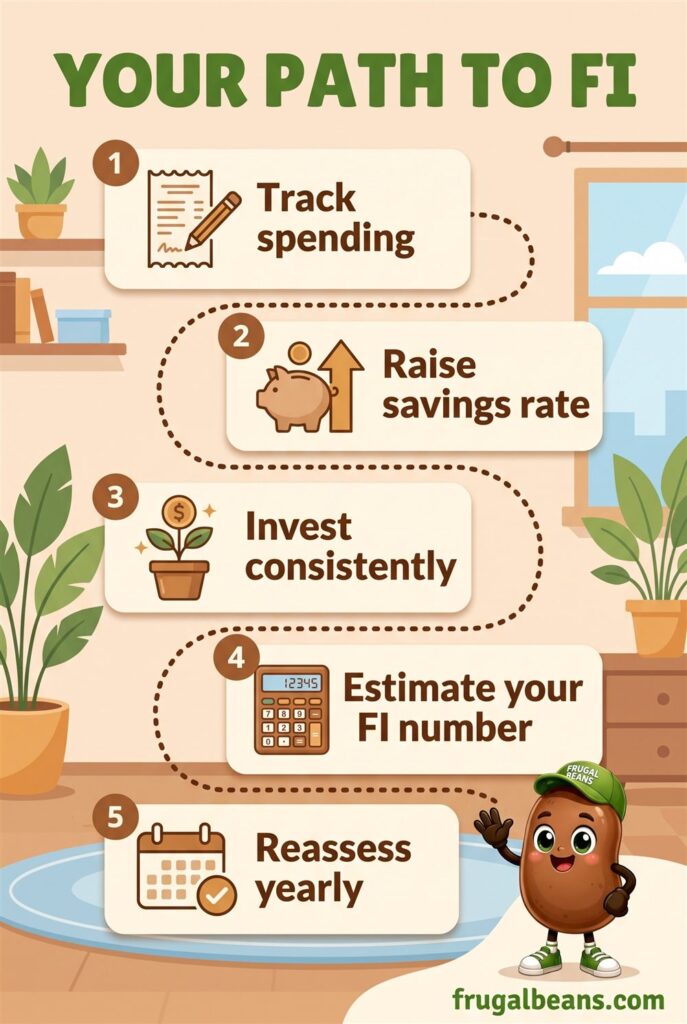
- Track spending. Know where the money actually goes before you try to change it.
- Raise your savings rate. Nudge it up after every raise, payoff, or canceled bill.
- Invest consistently. Automate contributions into simple, diversified investments.
- Estimate your FI number. Use yearly expenses times 25 as a rough starting point.
- Reassess yearly. Update your budget, your number, and your goals as life changes.
Practical Tips for Everyday Navigation
Give every irregular bill a runway. List annual costs and transfer one-twelfth of each amount into a separate sinking fund every month. When the bill arrives, the money is waiting.
Use a waiting period for nonessential purchases. For a costly item, wait a day or a week depending on the price. The pause separates a need from an emotional reaction and gives you time to compare.
Direct raises before they disappear. When income increases, assign part of the raise to investing or debt repayment before adjusting everyday spending. Keep some portion for enjoyment so progress does not feel like permanent deprivation.
Make convenience deliberate. Paying for delivery, prepared meals, or a closer home may be worthwhile if it buys time and fits the plan. Frugality is useful when it supports your values, not when it turns every decision into punishment. Our frugal living tips focus on that balance.
Measure progress with several gauges. Track savings, debt reduction, emergency-fund months, and the choices your money can support. Net worth may move unpredictably while your behavior steadily improves.
Schedule a calm money meeting. Partners can meet for thirty minutes with the same agenda each time: upcoming bills, account balances, one decision, and one positive result. Avoid meetings during arguments or right after stressful purchases.
Protect the downside first. Before seeking a higher return, ask what could force you to sell at the worst moment. Reserves, insurance, a diversified portfolio, and manageable fixed costs make the plan more durable.
Common Turbulence on the Way to Financial Independence
Job loss, illness, a new child, caregiving, divorce, relocation, or a major repair can require a temporary reduction in investing. Pausing contributions is not failure if it protects the household. Resume the previous rate when conditions stabilize.
Beware of extremes. Cutting every enjoyable activity can create burnout and make the plan impossible to sustain—a real risk for anyone chasing lean FIRE too hard. Chasing a very high return can expose essential money to unacceptable risk. Assuming expenses will fall dramatically in later life can create a misleading target. Model several futures, including higher health costs, a longer life, and a period of lower investment returns.
Taxes and account rules can influence the best order for saving, but complexity has a cost. If a strategy requires constant monitoring or creates anxiety, simplify it. For complicated situations, understand how a professional is paid before agreeing to advice.
The Many Resources in the Pilot’s Kit
A good financial plan is supported by a collection of resources rather than one perfect trick. Your kit can include a one-page net-worth statement, a spending tracker, a debt list, account statements, a short written investment plan, an insurance summary, and a calendar of annual bills. Keep the documents secure and tell a trusted household member where important information is stored.
Learning resources matter too. Read plain-language explanations of taxes, retirement accounts, investing, insurance, and consumer protections. Government sites such as Investor.gov are a good neutral starting point. Compare advice, especially when someone is selling a product. A useful resource explains costs, risks, trade-offs, and bad scenarios rather than promising certainty.
Blogs and podcasts from people pursuing financial independence and early retirement can be motivating. One example is the Captain FI blog and podcast mentioned at the top of this post, where an Australian pilot shares his own journey and interviews guests about investing and early retirement. Just remember that its account, tax, and pension details are written for Australians.
A community can provide encouragement, but never outsource judgment. Another household’s income, costs, health needs, and responsibilities may differ completely from yours. Use outside ideas as prompts, not instructions to copy.
FIRE Movement FAQ
What is the FIRE movement?
The FIRE movement is a personal finance approach built around financial independence, retire early. Followers spend deliberately, save a large share of their income, and invest it so that, eventually, investments and other income can cover their essential costs. “Retire early” is optional; many people use independence to work less or change careers rather than stop working.
How do you calculate your FIRE number?
A common rough method is to multiply your expected yearly expenses by 25, which reflects the 4% rule of thumb. For example, $40,000 a year times 25 is $1,000,000. Treat it as an estimate: longer retirements, taxes, health costs, and other income such as Social Security can all change the figure.
What is lean FIRE?
Lean FIRE means reaching financial independence on a modest, essentials-focused budget. Because spending is lower, the FIRE number is lower and can be reached sooner, but there is less margin for surprises such as medical bills or long market downturns.
What is coast FIRE?
Coast FIRE means you have already invested enough that, with time and growth, your savings could plausibly cover a traditional retirement on their own. You still work to pay current bills, but you no longer need to save aggressively for retirement.
What is the difference between barista FIRE and fat FIRE?
Barista FIRE pairs a smaller portfolio with part-time or lower-stress work that covers the rest of your costs. Fat FIRE means having enough invested to fund a comfortable or generous lifestyle without needing a paycheck at all, which usually takes longer to reach. Our barista FIRE calculator compares the two for your own savings and spending.
Where should I start if I want to learn how to retire early?
Start with your own numbers. Track a month or two of spending, build a starter emergency fund, and pay down high-interest debt. Then raise your savings rate a little at a time and invest consistently in simple, diversified funds. The seven steps above give you a practical order to follow.
Is the FIRE movement realistic on an average income?
Figuring out how to retire early is harder on an average income, but the habits still pay off. Tracking spending, raising your savings rate, and investing consistently can build an emergency fund, reduce debt, and create more choices over time, even if your timeline is longer than the headline stories.
The Bottom Line
The FIRE movement, and learning how to retire early in general, is not about never spending, never worrying, or predicting the market perfectly. It is about a household that knows its essential costs, protects against serious setbacks, saves automatically, invests with a clear purpose, and reviews the route without panic.
If you are still wondering how to retire early, start with one cockpit check this week. Find your true monthly essentials, cancel one unused expense, set up one automatic transfer, or list your debts and interest rates. Then repeat the process next month. Financial independence grows from ordinary decisions made consistently, not from a dramatic leap.
The most valuable destination is not simply an early retirement date. It is the ability to choose work, rest, generosity, learning, and family time with less fear. When your money supports those choices, you are practicing financial freedom along the way.

Get the free Homeowner Repair Cost Playbook
Which systems fail first, what they cost, the warning signs, and the repair-or-replace rule. 15 printable pages.
Free. No spam.
Free tools
Got a quote? Check it in under a minute.
Ballpark a new furnace before the contractor visits.
Price a tank, tankless or heat pump model.
Warm air, ice or noise? See the likely part and price.