No Spend Challenge Calendar
A no spend challenge is a set stretch of time, often a week or a month, when you buy only the essentials you agreed on in advance and nothing else. This free no spend challenge calendar sets it up for you: choose how long, tick the rules you’ll follow, then mark each day as you go. It counts your no-spend days and your streak, and estimates how much money you kept.
Loading the no spend challenge calendar… If it doesn’t appear, please make sure JavaScript is turned on.
How to Use the No Spend Challenge Calendar
- Choose a length. Pick 7, 14, 21 or 30 days, or a full calendar month such as a no spend January.
- Set the start date. Days still ahead stay greyed out until they arrive. If you started a few days ago, set the real start date and mark those days too.
- Enter your usual extra spending per day. This is what you’d normally spend on non-essentials like takeout, coffee and small online orders. The calendar uses it to estimate the money you keep.
- Open “Your rules” and tick what’s allowed. Bills, rent, groceries from a list, gas for work and medicine are ticked to start. Add one rule of your own if you like.
- Check in every evening. Tap “No-spend day” if you stuck to your rules, or “I spent today” if you didn’t. You can also tap any past day on the calendar: once for a no-spend day, twice for a spend day, three times to clear it.
Your calendar saves in your own browser, so it’s there when you come back. Nothing is sent to Frugal Beans. Click “Print my calendar” for a paper copy with your rules printed at the top, handy for the fridge.

What Is a No Spend Challenge?
A no spend challenge is a short, deliberate break from optional spending. You still pay your rent, bills and debts and buy the food you need. What you pause is everything else: eating out, impulse buys, new clothes, gadgets and little extras that add up without anyone noticing.
The point isn’t to suffer for a month. It’s to break the habit of spending on autopilot, see where your money really goes, and free up cash for a goal. Many people find the biggest benefit is what they learn: which purchases they missed and which ones they didn’t think about once.
No Spend Challenge Rules
There’s no single official set of rules. The best rules are the ones you write down before you start, so you aren’t deciding at the checkout. A common starting point:
| Usually allowed | Usually paused |
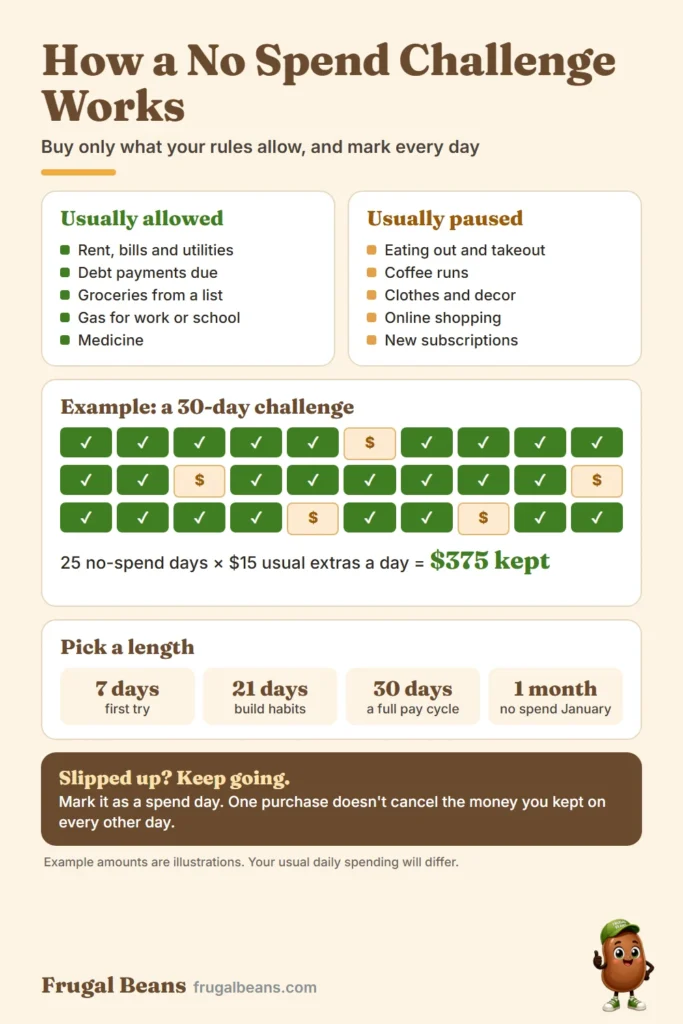
| Rent or mortgage, utilities and phone | Eating out, takeout and delivery |
| Bills and debt payments that are due | Coffee shop and snack runs |
| Groceries from a written list | Clothes, shoes and home decor |
| Gas and transit for work or school | Online shopping and impulse buys |
| Medicine and health care | New subscriptions, apps and games |
| Child care and school costs | Entertainment that costs money |
A few rules that make a no spend challenge easier to keep:
- Decide on gray areas in advance. Is a birthday gift allowed? A haircut? A replacement for something that breaks? Write it down.
- Use up what you have. The pantry, freezer, gift cards and the stack of unread books all count as free.
- Allow one planned treat if it helps you finish. A small budgeted treat each week beats quitting on day nine.
- Pay bills on time. A no spend challenge should never mean skipping a payment and paying a late fee.
Which No Spend Challenge Length Should You Pick?
- No spend weekend or week: a good first try. Weekends are when most spending happens, so a single no-spend weekend teaches a lot.
- 14 or 21 days: long enough to notice habits, short enough to stay motivated.
- 30-day challenge: the classic version. It covers a full pay cycle for most people, so you’ll meet every temptation once.
- No spend month: a calendar month, like a no spend January after the holidays or a no spend February to recover from them. Choose “A full calendar month” in the calendar and it starts on the 1st.
If you’ve never done one, start with a week. You can always start a longer no spend challenge right after.
How Much Can a No Spend Challenge Save?
It depends on how much you usually spend on extras. A quick way to estimate it is to look at the last month of card and bank statements and add up everything that wasn’t a bill, rent, groceries or gas, then divide by 30. If that comes to $15 a day, 25 no-spend days out of 30 would keep about $375 in your account. The calendar does this math as you go and shows what’s still possible if you finish strong.
Those savings matter. In the Federal Reserve’s latest survey of household finances, 63% of adults said they’d cover a $400 emergency expense using cash or its equivalent (Federal Reserve). A single no spend month can go a long way toward building that first $400 cushion.

Tips to Finish Your No Spend Challenge
- Plan meals for the week. Food is where most no spend challenges break. A simple plan and a list stop the “nothing to eat, let’s order” moment.
- Unsubscribe from store emails and log out of shopping apps. Fewer prompts, fewer purchases.
- Use a 48-hour wait. If you want something, write it on a list and look again after the challenge. Many items won’t feel important by then.
- Find free fun. Library books and movies, parks, free museum days, potlucks and game nights cost nothing.
- Tell someone. A partner, roommate or friend doing it with you makes it easier to say no.
- Don’t quit after a slip. Mark the day as a spend day and keep going. Your longest streak still counts.
What to Do With the Money You Save
Move it on the day you’d have spent it, or at least at the end of each week, so it doesn’t drift back into everyday spending. Good homes for it:
- An emergency fund. Our emergency fund calculator shows how much is enough for your household.
- A savings game. The 100 envelope challenge tracker pairs well with a no spend challenge: fill an envelope with each day’s savings.
- High-interest debt. An extra payment on a credit card saves interest every month after.
No Spend Challenge vs. No Buy Challenge
The two names are often used for the same thing, but a no buy challenge usually means something longer and narrower. Instead of no optional spending for a month, you stop buying one category, such as clothes, books or makeup, for several months or a year. A no spend challenge is shorter and covers every non-essential. You can use this calendar for either: set the length, then untick only the category you’re pausing.
After the Challenge
Look back at your calendar. Which days were hardest, and what did you buy on your spend days? Those are the habits worth changing for good. Keep the rules that were easy, budget for the things you truly missed, and consider a short no spend weekend once a month to stay in practice. Grocery prices are a good next target: our unit price calculator helps you pick the better buy on every trip.
Frequently Asked Questions
What counts as spending during a no spend challenge?
Anything outside the rules you set. Most people allow bills, rent, debt payments, groceries from a list, transportation to work and medicine, and pause everything else. Tick your allowed items in the calendar so they’re printed with your plan.
How long should a no spend challenge be?
Seven days is a good first try. Thirty days or a full calendar month is the most popular length because it covers a whole pay cycle.
Can I buy groceries during a no spend challenge?
Yes. Nearly every version allows groceries. Shop from a written list, eat what’s already in the pantry and freezer first, and compare prices with the unit price calculator.
What if I slip up?
Mark it as a spend day and carry on. One purchase doesn’t cancel the money you kept on every other day.
Is there a no spend challenge printable?
Yes. Set up your challenge above and click “Print my calendar.” It prints the calendar with your dates and allowed spending at the top.
Does the calendar save my progress?
Yes, in your own browser only. Use the same browser and device each time, and avoid private or incognito windows, which clear it.
The Bottom Line
A no spend challenge works because it’s short, simple and visible. Write your rules down, check in every evening, move the money you keep somewhere useful, and keep the habits that stick. For more everyday savings, read our frugal living tips and browse all of our free tools.
Sources: emergency expense figure from the Federal Reserve, Economic Well-Being of U.S. Households in 2025 (published May 2026). Savings estimates are simple arithmetic based on the amount you enter. This tool provides general information, not financial advice.

Get the free Homeowner Repair Cost Playbook
Which systems fail first, what they cost, the warning signs, and the repair-or-replace rule. 15 printable pages.
Free. No spam.
Free tools
Got a quote? Check it in under a minute.
Ballpark a new furnace before the contractor visits.
Price a tank, tankless or heat pump model.
Warm air, ice or noise? See the likely part and price.