AC Repair Cost by Part, From Capacitor to Compressor

AC repair cost for a central air conditioner usually runs $172 to $664, and most homeowners pay about $417, according to HomeAdvisor’s 2026 cost guide. The part that failed decides your bill: a capacitor or thermostat is a small repair, while a compressor or coil can cost thousands. Pick your symptom in the free tool below to see the free checks to try first, the parts that usually cause it and what each costs, then read on for how to judge a quote.
Loading the AC repair cost tool… If it doesn’t appear, please make sure JavaScript is turned on.
How Much Does AC Repair Cost?
Nationally, the typical AC repair cost for a central system is $172 to $664, with an average of about $417. That covers common fixes such as a capacitor, a blower part, a valve or a refrigerant recharge. HomeAdvisor reports a much wider full range, from about $90 for the simplest jobs to $3,800 for major part replacements, and a whole new duct system can cost far more.
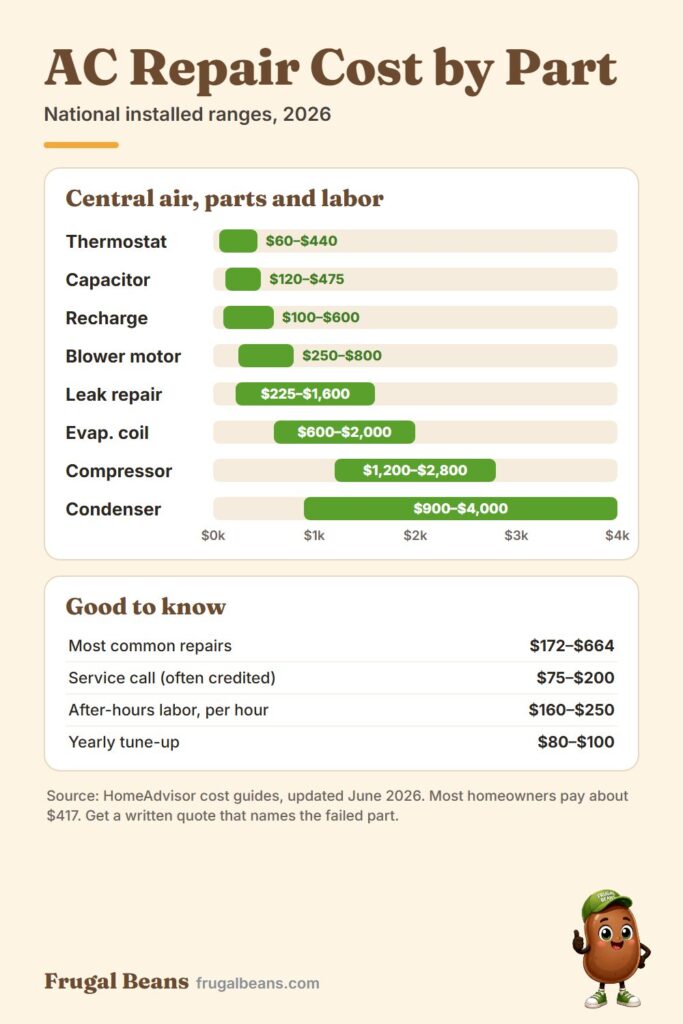
Most bills have two pieces: a service call to diagnose the problem, usually $75 to $200, and the repair itself. Many companies credit the service call toward the repair if you go ahead, so ask before the technician starts. Labor runs about $75 to $150 an hour during business hours and $160 to $250 an hour for after-hours or holiday visits, which is one reason a summer emergency costs more.
AC Repair Cost by Part
These are HomeAdvisor’s national ranges for parts and labor on central air conditioners. Your AC repair cost will usually be one of these lines.
|
Part or job |
National cost |
Common sign |
|
Fuse, breaker or relay |
$15–$300 |
AC won’t turn on |
|
Thermostat replacement |
$60–$440 |
Won’t start, short cycling |
|
Capacitor |
$120–$475 |
Outdoor unit hums but won’t start |
|
Hard start kit |
$100–$250 |
Struggles to start |
|
Circuit board |
$150–$700 |
Erratic or no operation |
|
Refrigerant recharge |
$100–$600 |
Warm air, ice on lines |
|
Find and fix a refrigerant leak |
$225–$1,600 |
Warm air that keeps coming back |
|
Expansion valve |
$100–$500 |
Warm air, frost |
|
Blower motor |
$250–$800 (up to $2,000) |
Weak airflow, noise |
|
Drain pan |
$200–$600 |
Water leaking indoors |
|
Evaporator coil |
$600–$2,000 |
Leaks, ice, weak cooling |
|
Compressor |
$1,200–$2,800 |
Warm air, loud start, won’t run |
|
Condenser |
$900–$4,000 |
Outdoor unit failure |
The pattern is clear: electrical and control parts are usually a few hundred dollars, while the sealed-system parts, meaning the compressor, coils and condenser, are the expensive ones. That is why the symptom matters so much. It points toward which end of the AC repair cost range you are likely to land on.
AC Repair Cost by System Type
The type of air conditioner also affects the bill. HomeAdvisor lists these average repair ranges by unit type:
|
System type |
Average repair cost |
|
Window unit |
$50–$125 |
|
Central air |
$100–$500 |
|
Swamp cooler |
$125–$500 |
|
Packaged HVAC unit |
$300–$500 |
|
Geothermal |
$200–$700 |
|
Ductless mini-split |
$750–$900 |
This page and the tool focus on central air, the most common whole-house system. A window unit is often cheaper to replace than to repair, while a ductless mini-split has its own specialized parts, so the AC repair cost runs higher per head.
AC Compressor Repair Cost
The compressor is the heart of the outdoor unit, and it is the repair most homeowners dread. HomeAdvisor puts the AC compressor repair cost, for a full replacement, at $1,200 to $2,800. A hard start kit, which helps a struggling compressor start, costs $100 to $250 and can sometimes buy time on an older unit.
Before you approve a compressor job, make sure that is really the problem. A failed capacitor can make a healthy compressor hum and refuse to start, and a capacitor is a fraction of the price. Ask the technician how they confirmed the compressor failed. On an older system, the AC compressor repair cost is often the point where replacing the whole outdoor unit, or the whole system, starts to make more sense, because the rest of the equipment is the same age.
AC Leak Repair Cost
Air conditioners do not use up refrigerant. If yours is low, it is leaking. HomeAdvisor puts the AC leak repair cost at $225 to $1,600 to find and fix the leak, and a recharge at $100 to $600 depending on the amount and type of refrigerant. Finding a small leak can take hours, which is why the range is wide.
Be wary of a technician who only adds refrigerant without looking for the leak. The cooling will come back, but so will the problem, and you will pay for another recharge next summer. A fair approach is to recharge now if you need cooling urgently, but plan to find and fix the leak. Paying the AC leak repair cost once is cheaper than paying for refrigerant every year.
Older systems and R-22 refrigerant
Systems installed before about 2010 may use R-22 refrigerant. According to the U.S. Environmental Protection Agency, U.S. production and import of R-22 ended on January 1, 2020. You can keep using an R-22 system, and the EPA does not require you to replace it, but recharges rely on reclaimed and previously made refrigerant, so they can cost more. A leak on an R-22 system is often the moment to compare replacement quotes. The EPA also warns that products sold as “R-22a” are not R-22 and contain flammable gases.
How the AC Repair Cost by Symptom Tool Works
The tool is built to help you understand a problem before the technician arrives, not to diagnose it for you.
- Pick the symptom, such as warm air, a unit that won’t turn on, short cycling, ice or water leaking indoors.
- See the free checks that sometimes solve the problem without a service call, such as a dirty filter, a tripped breaker or a thermostat setting.
- See the likely parts and their national costs, with major parts flagged so you know the worst case.
- Enter the system’s age to see whether a major repair would pass the 50% rule and the $5,000 rule of thumb.
- Tick the boxes if you need an after-hours visit or your system may use R-22.
You also get a short list of questions to ask the technician, and you can print the checklist. Nothing you enter is saved or sent anywhere.
Free Checks Before You Pay for an AC Repair
A surprising number of “broken” air conditioners are not broken at all. Before you pay a service call, try these safe checks:
- Thermostat. Make sure it is set to Cool, set below the room temperature, and has fresh batteries.
- Air filter. A clogged filter can cut airflow, cause ice on the coil and make the system seem weak. Replacing it costs a few dollars.
- Breaker and outdoor switch. Check for a tripped breaker and make sure the shut-off switch near the outdoor unit is on. If a breaker trips again right after you reset it, stop and call a professional.
- Outdoor unit. Clear leaves, grass clippings and anything within about two feet so the condenser can breathe.
- Vents. Open closed supply vents and move furniture off return grilles.
Leave anything involving refrigerant, electrical panels inside the unit or the sealed system to a licensed technician. Refrigerant work legally requires EPA certification, and the capacitor inside the outdoor unit can hold a dangerous charge even when the power is off.
Repair or Replace Your Air Conditioner?
A small repair on a mid-life system is almost always worth doing. The decision gets harder when the AC repair cost is large or the system is old. HomeAdvisor and the HVAC trade use a few rules of thumb:
- The 50% rule. If the repair costs half or more of a new system, replacement deserves a serious look. A new central AC averages about $5,978 nationally.
- The $5,000 rule. Multiply the system’s age by the repair cost. A result above $5,000 points toward replacing.
- Age. Central air conditioners typically last 7 to 15 years, according to InterNACHI. A major repair on a unit near or past that range buys time, not years.
- Frequent repairs or R-22. Repeated breakdowns or an R-22 system with a leak tip the balance toward replacing.
The tool runs the first two tests for the most expensive part linked to your symptom. For an exact answer, put the technician’s quote into our free repair or replace calculator, which runs all three tests and shows the math.
How to Avoid Overpaying for AC Repair
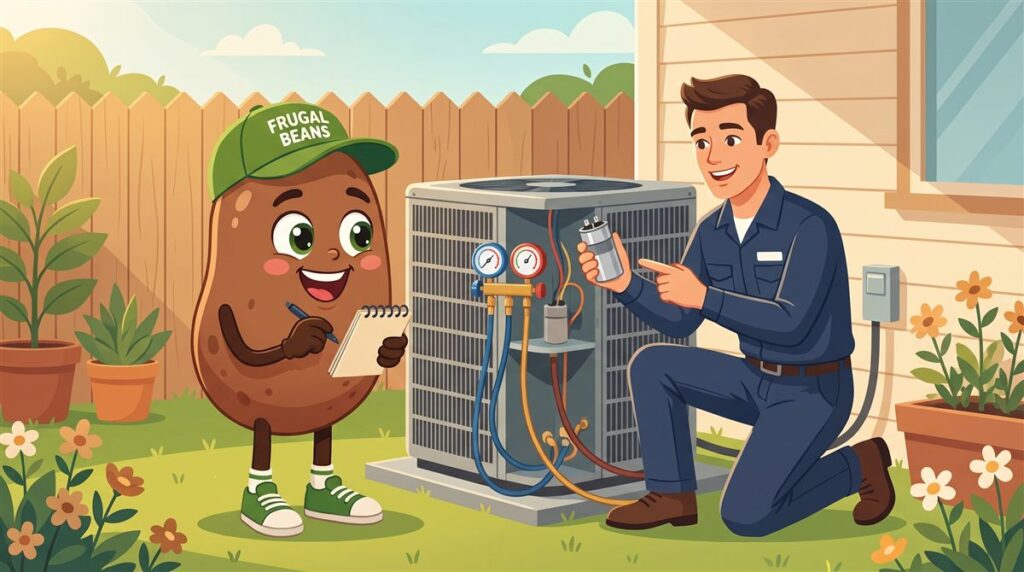
- Ask for the failed part by name, in writing. “Your system needs work” is not a quote you can compare.
- Ask how they confirmed it. A good technician will explain the test, such as measuring a capacitor or checking refrigerant pressures.
- Check the warranty. Many parts carry a manufacturer’s warranty of several years. If yours is covered, you may only pay labor.
- Get a second quote on big jobs. For a compressor, coil or condenser, a second opinion is cheap insurance against an unnecessary repair or replacement.
- Avoid emergency rates when you can. If the house is safe and only uncomfortable, a weekday appointment can save on labor.
- Keep up with a yearly tune-up. At about $80 to $100, regular maintenance catches small problems before they become a large AC repair cost.
How to Choose an AC Repair Company
The cheapest AC repair cost is the one done right the first time. When you call around, look for:
- A license and insurance that meet your state’s requirements.
- EPA Section 608 certification for any technician who handles refrigerant. HomeAdvisor suggests level two at a minimum, and universal certification is better.
- Technician certifications such as NATE, which show training beyond the basics.
- A written estimate before work starts, listing the part, labor and any service call credit.
- A clear warranty on parts and labor, and whether they are authorized to do warranty work on your brand.
A company that focuses on heating and cooling is usually a better choice for an AC repair than a general handyman, especially for refrigerant, electrical or sealed-system work.
Common AC Symptoms and What They Usually Mean
Air conditioner blowing warm air
If the outdoor unit is running but the air is warm, the most common causes are low refrigerant from a leak, a failing capacitor or a compressor problem. Check the filter and the outdoor unit first. If those are fine, the likely AC repair cost ranges from a few hundred dollars for a capacitor to well over a thousand for a leak repair or compressor.
Outdoor unit humming but not starting
A humming outdoor unit with a fan that does not spin is a classic sign of a failed capacitor, often one of the cheaper repairs. Turn the system off at the thermostat so the motor does not overheat, and have it checked soon.
AC turning on and off too often
Short cycling can come from a thermostat problem, low refrigerant, a control board or a system that is too large for the house. It wastes energy and wears parts out faster, so it is worth fixing even if the house stays cool.
Water leaking indoors
The most common cause is a clogged condensate drain line, which a technician can usually clear during a service visit. A cracked drain pan or a frozen coil that melts can also drip. Turn the system off to limit water damage.
Ice on the lines or coil
Ice usually means too little airflow or too little refrigerant. Turn the cooling off and run the fan only so it can melt, replace the filter and open the vents. Running the system frozen can damage the compressor and turn a small AC repair cost into a large one.
Frequently Asked Questions
What is the average AC repair cost?
About $417 nationally, with most central air repairs costing $172 to $664, according to HomeAdvisor’s 2026 data. Major parts such as a compressor ($1,200 to $2,800) or condenser ($900 to $4,000) cost much more.
How much does an AC compressor repair cost?
HomeAdvisor puts the AC compressor repair cost, for replacement, at $1,200 to $2,800. A hard start kit costs $100 to $250. Confirm the compressor really failed, since a bad capacitor can look similar and costs far less.
How much does it cost to fix an AC refrigerant leak?
The AC leak repair cost is typically $225 to $1,600 to find and fix the leak, plus $100 to $600 to recharge the system. Fixing the leak is usually cheaper over time than paying for repeated recharges.
Is it worth repairing a 15-year-old air conditioner?
A small repair can be, but a major one usually is not. A 15-year-old central AC is at the top of its typical 7 to 15 year life. Multiply the age by the repair cost: if the result is above $5,000, or the repair is half the price of a new system, compare replacement quotes.
Can I recharge my own AC?
No. Handling refrigerant legally requires EPA certification, and adding refrigerant without fixing a leak only delays the problem. The EPA also warns against products sold as “R-22a”, which are not R-22 and contain flammable gases.
How long does an AC repair take?
It depends on the part. HomeAdvisor notes that a capacitor replacement usually takes less than an hour and a thermostat less than two, while a compressor takes a few hours. An evaporator coil can take up to eight hours, and tracking down a refrigerant leak can take longer than that. Ask for a time estimate along with the price, especially if you are paying hourly labor, and confirm whether parts are in stock so the repair is not delayed in the middle of a heat wave.
Does a home warranty or insurance cover AC repair?
Homeowners insurance generally does not cover repairs from wear and tear. A home warranty, which is a service contract, may cover some AC repair cost, but plans usually charge a service fee per visit and have coverage limits and exclusions. Read the contract before counting on it.
How accurate is the AC repair cost tool?
It uses published national ranges and common causes, so treat it as a guide to what is likely, not a diagnosis. Only a technician can confirm which part failed, and local labor rates can put your price outside the national range.
The Bottom Line
A typical AC repair cost is a few hundred dollars, but the symptom tells you a lot about whether you are facing a capacitor or a compressor. Try the free checks first, get the failed part named in writing, and run any large quote through the repair or replace test before you approve it. To plan ahead for the next big bill, use our free home repair fund calculator, and for warning signs and costs for every major system, get the free Homeowner Repair Cost Playbook.
Sources: repair costs from HomeAdvisor’s AC repair cost guide (updated June 2026, checked 16 October 2026); replacement cost from HomeAdvisor’s central AC installation guide; R-22 information from the U.S. EPA; service life from the InterNACHI Standard Estimated Life Expectancy Chart. This tool provides general information, not professional advice.

Get the free Homeowner Repair Cost Playbook
Which systems fail first, what they cost, the warning signs, and the repair-or-replace rule. 15 printable pages.
Free. No spam.
Free tools
Got a quote? Check it in under a minute.
See which system is likely to need replacing next.
Turn upcoming replacements into one monthly number.
Ballpark a new furnace before the contractor visits.
Price a tank, tankless or heat pump model.
Warm air, ice or noise? See the likely part and price.