Unit Price Calculator
The bigger box isn’t always the better deal. A unit price calculator tells you what each item really costs per ounce, pound, fluid ounce or piece, so you can compare a 12-ounce box with an 18-ounce one, or a two-pack with a single, in seconds. Enter the price and size of two to six items below and this free unit price calculator converts the units, ranks the items and shows how much more you’d pay for the worse buy.
Loading the unit price calculator… If it doesn’t appear, please make sure JavaScript is turned on.
How to Use the Unit Price Calculator
- Enter each item’s price as shown on the shelf, after any sale price or coupon.
- Enter the size and unit printed on the package: ounces, pounds, grams, fluid ounces, liters, gallons or a count such as rolls, pods or diapers.
- Enter the number of packs if it’s a multi-pack. Twelve 12-ounce cans is size 12, unit fl oz, packs 12.
- Read the result. Each item shows its price per unit. The cheapest is marked “Best buy,” and the others show how much more they cost per unit.
Use “Show price” to switch between per ounce, per pound and per 100 grams for weight, or per fluid ounce, per liter and per gallon for liquids. You can add up to six items. Your last comparison is saved in your browser, so it’s still there when you come back.
How to Calculate Unit Price
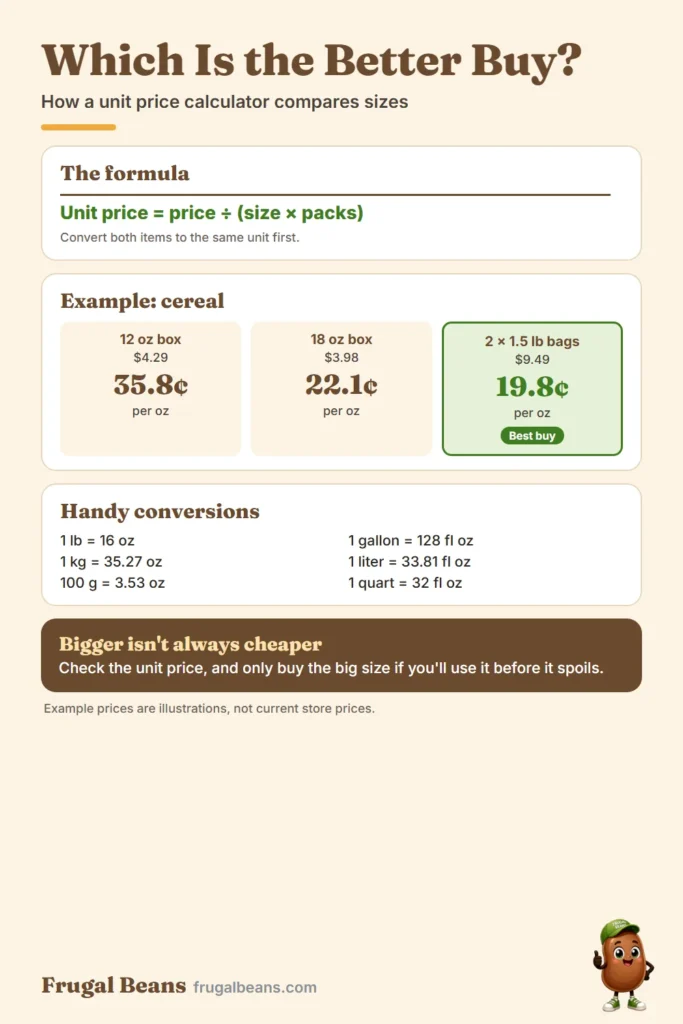
The unit price is the price divided by the quantity, after both are in the same unit:
Unit price = price ÷ (size × number of packs)
For example, an 18-ounce box of cereal for $3.98 costs $3.98 ÷ 18 = about 22.1¢ per ounce. A 12-ounce box for $4.29 costs about 35.8¢ per ounce. Even though the smaller box is “only” 31¢ more, every ounce in it costs 62% more.
When the sizes use different units, convert first. One pound is 16 ounces, so a 1.5-pound bag is 24 ounces. A two-pack of 1.5-pound bags is 48 ounces. If it costs $9.49, that’s about 19.8¢ per ounce, cheaper than either box. The unit price calculator does these conversions automatically, which is where most mental math goes wrong.
Unit Conversions the Calculator Uses
- Weight: 1 pound = 16 ounces; 1 kilogram = 35.274 ounces; 100 grams = 3.527 ounces.
- Volume: 1 gallon = 128 fluid ounces; 1 quart = 32; 1 pint = 16; 1 cup = 8; 1 liter = 33.814 fluid ounces.
- Count: items, rolls, sheets, pods, loads or servings, compared one for one.
Weight and volume can’t be compared directly. An ounce of weight and a fluid ounce of volume aren’t the same thing, so if one item is labeled in grams and another in milliliters, the unit price calculator flags it and asks you to match the units.
Unit Price Calculator Examples
Here are three everyday comparisons you can try in the unit price calculator above. Prices are illustrations, not current store prices.
Soda: 12-pack of cans vs. a 2-liter bottle
A 12-pack of 12-fluid-ounce cans for $6.99 holds 144 fluid ounces, about 4.9¢ per fluid ounce. A 2-liter bottle for $2.49 holds about 67.6 fluid ounces, about 3.7¢ per fluid ounce. Enter the cans as size 12, unit fl oz, packs 12, and the bottle as size 2, unit L. The unit price calculator shows the bottle is about 24% cheaper per ounce, though the cans may still win if the bottle goes flat before you finish it.
Paper towels: big rolls vs. regular rolls
Roll sizes vary so much that comparing by roll is misleading. Compare by sheets instead. A 6-pack of 120-sheet rolls for $8.99 is 720 sheets, about 1.25¢ per sheet. A 2-pack of 168-sheet rolls for $4.49 is 336 sheets, about 1.34¢ per sheet. Enter the sheets per roll as the size, choose “count” and enter the number of rolls as packs. If the sheets differ in size, compare by square feet when the package lists it.
Coffee: pods vs. a bag of grounds
Coffee is easiest to compare per cup. A box of 24 pods for $15.99 is about 67¢ a cup. A 12-ounce bag of ground coffee for $8.99 makes roughly 34 cups if you use about a third of an ounce per cup, so about 26¢ a cup. Your own brew strength changes the answer, so enter the number of cups you actually get from a bag as a count in the unit price calculator.
Price Per Ounce, Price Per Pound or Price Per Unit?
Use whichever unit makes the numbers easiest to read. A price per ounce calculator view works well for snacks, cereal, coffee and spices, where amounts are small. For meat, produce and bulk items, a price per pound calculator view gives friendlier numbers. For paper towels, diapers, batteries or detergent pods, compare by count. The best buy is the same whichever unit you choose; only the display changes.
Why Shelf Tags Aren’t Always Enough
Many stores print a unit price on the shelf tag, and it’s worth checking first. But tags have limits:
- Different units on neighboring tags. One product may be priced per ounce and the next per count or per 100 sheets.
- Sale prices. The unit price on the tag is often based on the regular price, not the sale price.
- Across stores and online. Comparing a warehouse club pack with a grocery store size, or an online subscription price, needs your own math.
- Not every store shows them. In the U.S., unit pricing isn’t required by federal law. The National Institute of Standards and Technology (NIST) publishes a model regulation that states can adopt; in 2015 NIST reported that nine states and the District of Columbia required unit pricing (NIST).
A unit price calculator on your phone fills those gaps in a few seconds.
Bigger Isn’t Always Cheaper
Stores price sizes independently, so the large package is sometimes the worse deal, especially when the smaller size is on sale. NIST’s own example is a 64-ounce bottle of ketchup that cost more per ounce than a 38-ounce bottle. Always check with a unit price calculator; don’t assume.
And even when the bigger size is cheaper per unit, it only saves money if you use it all. Bulk produce that spoils, coffee that goes stale or a giant bottle of sauce that expires half full can cost more than the small size you’d have finished.
Watch for Shrinking Packages
“Shrinkflation” is when a package gets smaller while the price stays the same. The shelf price looks unchanged, but the unit price went up. NIST points out that unit pricing helps shoppers spot this kind of downsizing. If a favorite product suddenly feels lighter, compare its unit price with the store brand or a different size.
Where Unit Pricing Saves the Most
These are the aisles where a quick check with the unit price calculator pays off most often:
- Cereal, snacks and crackers, where box sizes vary widely.
- Coffee and tea, especially pods vs. a bag of grounds.
- Meat and cheese, packaged vs. deli counter vs. family packs.
- Paper goods, where “mega rolls” and “double rolls” make counts hard to compare. Compare by sheets when the package lists them.
- Laundry and dish detergent, where comparing by loads is fairest.
- Drinks, such as a 12-pack of cans vs. a 2-liter bottle.
- Store brand vs. name brand, often the biggest single saving on a grocery list.
Using the Unit Price Calculator With a Grocery Budget
Unit prices help most when they become a habit. Pick the five or ten things you buy every week and check their unit price once at each store you use. Note the best option and stick with it until prices change. A few cents per ounce on staples adds up over a year of shopping. Then decide where that money goes. If you’re building savings, the 100 envelope challenge tracker turns it into a game, and our emergency fund calculator shows what to aim for.
Weighing meal kits against cooking from scratch? Our guide to meal kit delivery breaks down when they’re worth it, and you can compare a kit’s price per serving with your own ingredients in the unit price calculator using the count unit.
Frequently Asked Questions
How do you calculate unit price?
Divide the price by the quantity. If a 24-ounce jar costs $4.80, the unit price is $4.80 ÷ 24 = 20¢ per ounce. Convert both items to the same unit before comparing.
Is this a price per unit calculator for any product?
Yes. Choose a weight, volume or count unit. Count works for anything sold by the piece, roll, pod, load or serving.
Can it compare multi-packs?
Yes. Enter the size of one item and the number in the pack. A 6-pack of 16.9-ounce bottles is size 16.9, unit fl oz, packs 6.
Why can’t I compare grams with milliliters?
Grams measure weight and milliliters measure volume. Converting between them depends on the product’s density, which the label doesn’t give. Use matching units, usually the ones printed on both packages.
Should I always buy the item with the lowest unit price?
Usually, but only if you’ll use all of it and the quality is acceptable. The unit price calculator reminds you when the best buy is a bigger size, so you can decide whether you’ll really finish it.
Does the calculator save my items?
Only in your own browser. Nothing is sent to Frugal Beans. Click “Clear everything” to start a new comparison.
The Bottom Line
The price on the tag tells you what you pay today; the unit price tells you what you’re actually getting. Keep this free unit price calculator handy when you shop, check the staples you buy most, and watch for shrinking packages. For more ideas, see our ways to save money and all of our free tools.
Sources: unit pricing rules and examples from NIST, New Best Practices Guide Shows Unit Pricing Is a Great Deal (2015). Unit conversions are standard U.S. customary and metric equivalents. This tool provides general information only.
Get the free Homeowner Repair Cost Playbook
Which systems fail first, what they cost, the warning signs, and the repair-or-replace rule. 15 printable pages.
Free. No spam.
Free tools
Got a quote? Check it in under a minute.
Ballpark a new furnace before the contractor visits.
Price a tank, tankless or heat pump model.
Warm air, ice or noise? See the likely part and price.