100 Envelope Challenge Tracker
The 100 envelope challenge is a simple savings game: number 100 envelopes from 1 to 100, pick one, and put that many dollars in it. Fill them all and you have saved $5,050. This free 100 envelope challenge tracker does the bookkeeping for you. Tap each envelope as you fill it, let it draw the next one at random, and see your total, what is left and when you will finish at your own pace. It also runs the half-size, 50-envelope and 52-week versions.
Loading the 100 envelope challenge tracker… If it doesn’t appear, please make sure JavaScript is turned on.
How the 100 Envelope Challenge Tracker Works
- Choose your challenge. The classic 100 envelope challenge runs from $1 to $100. You can also pick a half-size version ($0.50 to $50), a 50-envelope version ($1 to $50) or the 52-week money challenge ($1 to $52).
- Set your pace. Enter how many envelopes you plan to fill each week. One a day is 7; twice a week is 2.
- Fill envelopes. Tap an envelope when you put the money in, or click “Pick an envelope for me” to draw one at random, then “Mark it filled.”
- Watch the numbers. The tracker shows what you have saved, what is left, how many envelopes remain, your likely finish date and the average you need each week.
Your progress saves automatically in your own browser, separately for each version of the challenge, so you can come back every day. Nothing is sent to Frugal Beans. Use “Print my tracker” for a paper copy of your chart.

What Is the 100 Envelope Challenge?
The 100 envelope challenge is a savings challenge that spread through social media because it turns saving into a game. You label 100 envelopes from 1 to 100, shuffle them, and each day (or on whatever schedule you choose) you pick one and put in the dollar amount written on it. Envelope 1 gets $1, envelope 37 gets $37 and envelope 100 gets $100.
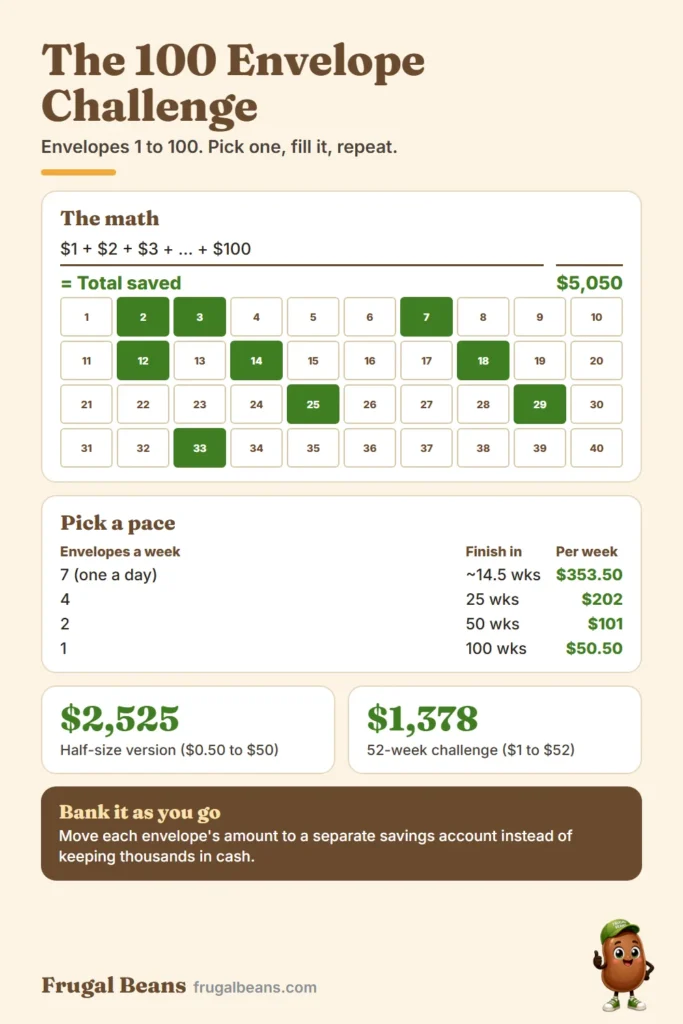
The total is fixed by simple arithmetic: 1 + 2 + 3 + … + 100 = $5,050. Because you choose the envelopes at random, some days cost a few dollars and some cost close to a hundred, which keeps it interesting. Many people let themselves skip the big numbers on a tight week and catch up after payday, which is fine as long as every envelope is eventually filled.
How Long Does the 100 Envelope Challenge Take?
The original version is one envelope a day for 100 days, a little over 14 weeks. That works out to about $353.50 a week, or roughly $1,535 a month. That is a lot for most budgets, so many people stretch it out. The tracker recalculates your finish date and weekly average as soon as you change your pace.
| Envelopes per week | Time to finish | Average saved per week |
| 7 (one a day) | About 14½ weeks | $353.50 |
| 4 | 25 weeks | $202 |
| 3 | About 33½ weeks | $151.50 |
| 2 | 50 weeks | $101 |
| 1 | 100 weeks | $50.50 |
Two envelopes a week finishes the 100 envelope challenge in just under a year, at about $101 a week. That is a much easier pace for most households, and you still end up with $5,050.
Is the 100 Envelope Challenge Realistic for You?
Before you start, compare the weekly average with what you can actually set aside. If $353 a week would mean skipping bills or using a credit card, the challenge is working against you. Pick a slower pace or a smaller version instead. The point of any savings challenge is to build a habit and a cushion, not to create stress or debt.
A quick test: add up what is left in your account after bills each month. If the monthly figure for your chosen pace is more than about half of that, slow down. You can always speed up later by filling extra envelopes when money comes in.
Versions of the 100 Envelope Challenge
| Version | Envelopes | Amounts | Total saved |
| Classic 100 envelope challenge | 100 | $1 to $100 | $5,050 |
| Half size | 100 | $0.50 to $50 | $2,525 |
| 50 envelope challenge | 50 | $1 to $50 | $1,275 |
| 52-week money challenge | 52 weeks | $1 to $52 | $1,378 |
All four are built into the tracker, and each keeps its own progress, so you can switch between them without losing your place.
52 Week Money Challenge vs. the 100 Envelope Challenge
The 52 week money challenge is the older cousin of the 100 envelope challenge. In week 1 you save $1, in week 2 you save $2, and so on up to $52 in the last week, for $1,378 over a year. It is gentler: the most you ever save in a week is $52. The downside is that the big weeks all land at the end of the year, around the holidays. A popular fix is to run it in reverse, or to pick weeks at random just like envelopes, which the tracker lets you do with “Pick a week for me.”
Choose the 52-week version if you want a smaller, steady goal. Choose the 100 envelope challenge if you want a bigger result and can handle more variation from week to week.
How to Do the 100 Envelope Challenge, Step by Step
- Decide on the version and pace using the tables above or the tracker.
- Pick a goal for the money, such as an emergency fund, a debt payoff or a planned purchase. A clear purpose makes it easier to keep going.
- Set up your envelopes, real or virtual. Paper envelopes in a box work, or you can use the tracker as your envelopes and move the money into a savings account.
- Fill one on your schedule. Draw at random, or choose a low number on tight days and a high one after payday.
- Mark it in the tracker right away so your total and finish date stay current.
- Bank the cash regularly. Don’t let thousands of dollars pile up at home.
Cash Envelopes or a Savings Account?
Real envelopes are satisfying, but cash at home can be lost, stolen or damaged, and it earns nothing. Money in a bank savings account is insured by the FDIC up to $250,000 per depositor, per insured bank, for each account ownership category (FDIC deposit insurance), and many savings accounts pay interest.
A good middle ground: draw and track the envelope in the 100 envelope challenge tracker, then transfer that amount to a separate savings account the same day. You keep the game and lose the risk. If you prefer real envelopes, deposit the cash every week or two.

Tips to Finish the 100 Envelope Challenge
- Front-load the small envelopes on hard weeks. Every envelope counts the same toward finishing, so save the big numbers for paydays and refunds.
- Automate a base amount. A small automatic transfer each payday covers several low envelopes without thinking about it.
- Use windfalls. A tax refund, bonus or side income can fill a handful of the big envelopes at once.
- Cut one recurring cost. Cancel an unused subscription or lower a bill and direct the savings to the challenge. Our list of ways to save money has plenty of ideas. A week or two on our no spend challenge calendar can free up cash for the big envelopes.
- Do it with someone. A partner or friend doing the same challenge keeps you both accountable.
- Don’t quit after a missed week. Lower your pace in the tracker and keep going. A slower finish still ends with the same total.
Printable 100 Envelope Challenge Chart
If you like a paper chart on the fridge, click “Print my tracker.” It prints a clean grid of all 100 envelopes with the ones you have filled shaded in, so you can cross off the rest by hand. Reprint it any time to bring the paper copy up to date with your online progress. It works the same way for the half-size, 50-envelope and 52-week versions.
Common 100 Envelope Challenge Mistakes
- Starting at a pace you can’t keep. One envelope a day sounds fun but costs about $1,535 a month. Choose a pace that fits.
- Using credit to fill envelopes. Saving with borrowed money costs more in interest than the challenge earns.
- Keeping thousands in cash. Bank it regularly.
- Raiding the envelopes. If you need the money for a real emergency, use it, but note it in the tracker by un-filling those envelopes, so your total stays honest.
- No goal for the money. Decide in advance where the $5,050 goes.
What to Do With Your $5,050
Finishing the 100 envelope challenge is a great moment to give that money a lasting job. For many households the best use is an emergency fund, the cushion that keeps a car repair or a job loss off a credit card. Our free emergency fund calculator shows how much is enough for your situation. Other good choices are paying down high-interest debt or saving toward a planned expense. If you are a homeowner, our home repair fund calculator works out a monthly set-aside for the repairs every house eventually needs.
Frequently Asked Questions
How much do you save with the 100 envelope challenge?
Exactly $5,050, because the envelopes hold $1 through $100 and 1 + 2 + … + 100 = 5,050. The half-size version saves $2,525 and the 50-envelope version saves $1,275.
Do I have to do one envelope a day?
No. One a day finishes in 100 days but averages about $353 a week. Two envelopes a week takes 50 weeks at about $101 a week. Set your own pace in the tracker and it will show your finish date.
Can I pick the envelopes in order instead of at random?
Yes. Random picks keep it interesting and mix big and small amounts. Going in order makes the early weeks cheap and the late weeks expensive. Either way you save the same total.
Is there a free 100 envelope challenge printable?
Yes. Click “Print my tracker” in the tool above to print a chart of all 100 envelopes, with the ones you’ve already filled shaded in.
Does the tracker save my progress?
Yes, in your own browser. It is stored on your device only, so it won’t appear on a different phone or computer. Use the same browser each time, and avoid private or incognito windows.
What is a good savings challenge for beginners?
The 52-week money challenge or the 50-envelope version are good first steps. They build the habit with smaller amounts. When those feel easy, move up to the full 100 envelope challenge.
The Bottom Line
The 100 envelope challenge works because it makes saving visible and a little fun. Pick a version and pace you can keep, track every envelope in the free 100 envelope challenge tracker above, bank the money as you go, and decide in advance what the $5,050 is for. For more ways to free up money, read our guide to frugal living tips, and see all of our free tools.
Sources: totals are simple arithmetic (the sum of the envelope amounts). Deposit insurance limits from FDIC, Deposit Insurance. This tool provides general information, not financial advice.

Get the free Homeowner Repair Cost Playbook
Which systems fail first, what they cost, the warning signs, and the repair-or-replace rule. 15 printable pages.
Free. No spam.
Free tools
Got a quote? Check it in under a minute.
Ballpark a new furnace before the contractor visits.
Price a tank, tankless or heat pump model.
Warm air, ice or noise? See the likely part and price.