Furnace Replacement Cost: What Homeowners Actually Pay
Furnace replacement cost usually lands between $2,823 and $6,897 installed, and most homeowners pay around $4,814, according to HomeAdvisor’s 2026 cost guide. Your own number depends mostly on the fuel your furnace burns, the size of your home, the efficiency you choose and the extras your job needs. Use the free estimator below to see where your home is likely to land, then read on for what drives each part of the price and how to compare quotes.
Loading the furnace replacement cost estimator… If it doesn’t appear, please make sure JavaScript is turned on.
How Much Does Furnace Replacement Cost?
Across all furnace types, the national furnace replacement cost runs from about $2,823 to $6,897, with an average of $4,814. That covers the new furnace and the labor to install it. Individual jobs can fall well outside that range: HomeAdvisor reports projects as low as a few hundred dollars for simple swaps and as high as $13,750 for complex installations.
The headline range hides a lot of variation. A small electric furnace in a mild climate and a high-efficiency gas furnace in a large northern home are very different jobs. The sections below break the furnace replacement cost into the pieces that actually move it, so you can tell whether a quote is reasonable for your house.
Furnace Replacement Cost by Fuel Type
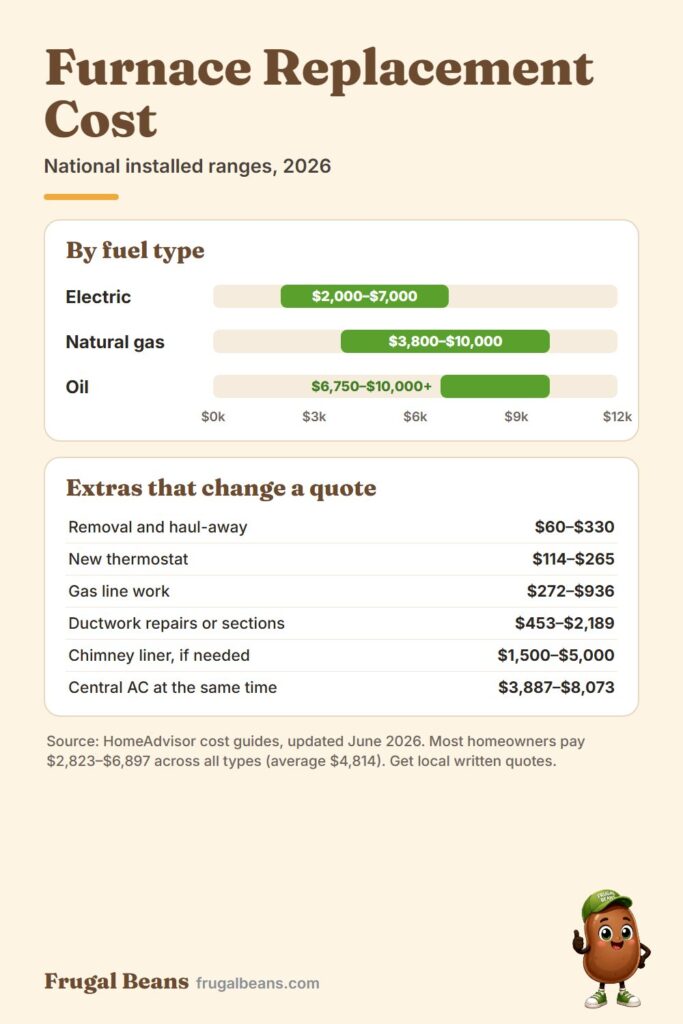
Fuel type sets the starting point. HomeAdvisor lists these national installed ranges:
|
Fuel type |
National installed range |
Good to know |
|
Electric |
$2,000–$7,000 |
Cheapest to install, usually most expensive to run |
|
Natural gas |
$3,800–$10,000 |
The most common type; high-efficiency models cost more |
|
Oil |
$6,750–$10,000+ |
Common in the Northeast; tank and chimney add risk |
Gas furnace replacement cost
Most American homes with a furnace burn natural gas. A gas furnace replacement cost of $3,800 to $10,000 reflects a wide spread of efficiency and features. A basic single-stage furnace sits near the bottom of that range; a high-efficiency, variable-speed model with new venting sits near the top. If your gas line, venting or chimney needs work, those costs come on top.
Electric furnace replacement cost
An electric furnace replacement cost of $2,000 to $7,000 is the lowest of the three, because there is no gas line, burner or flue to deal with. The catch is running cost: in most of the country, heating with electric resistance costs more each month than gas. If you are replacing an electric furnace in a moderate climate, it is worth asking for a heat pump quote at the same time, since a heat pump can heat with far less electricity.
Oil furnace replacement cost
Oil furnace replacement cost starts around $6,750 and can pass $10,000. Oil systems are concentrated in the Northeast, where many older homes were built around them. Ask the installer to check the oil tank and the chimney, because a tank near the end of its life or a flue that needs a liner can add thousands. Many oil homeowners price a gas furnace or heat pump alongside a new oil furnace before deciding.
How Home Size and Sizing Affect the Price
Bigger homes need furnaces with more heating capacity, measured in BTUs, and larger furnaces cost more. HomeAdvisor’s rule of thumb is about 30 to 60 BTUs per square foot, depending on climate, so a 2,000-square-foot home might need anything from 60,000 to 120,000 BTUs. That wide range is exactly why sizing should not be guessed.
A correctly sized furnace comes from a load calculation, often called a Manual J, which looks at insulation, windows, air leaks and local weather. The U.S. Department of Energy recommends sizing heating equipment this way rather than simply matching the old unit. An oversized furnace costs more to buy, cycles on and off too often, and wears out sooner. An undersized one runs constantly on the coldest days. Ask every contractor whether their quote is based on a load calculation.
Standard vs. High-Efficiency Furnaces
Furnace efficiency is rated in AFUE, the share of fuel that becomes heat for your home over a typical year. A furnace rated 80% AFUE turns about 80 cents of every fuel dollar into heat; a 95% AFUE furnace turns about 95 cents. New gas furnaces must meet a federal minimum of about 80% AFUE.
High-efficiency furnaces, usually 90% AFUE and above, are called condensing furnaces. They pull extra heat out of the exhaust, which cools it enough that it can vent through plastic pipe out a wall instead of up a chimney. They also need a drain for the water they produce. That extra hardware is part of why they raise the furnace replacement cost, and why the estimator moves your range up when you choose high efficiency.
Whether the extra cost pays off depends on how much you heat. ENERGY STAR sets different furnace efficiency levels for northern and southern parts of the country because furnaces run so much more in cold climates. In a long northern winter, the savings from a high-efficiency furnace add up faster. In a mild climate, a standard furnace may be the more frugal choice.
The orphaned water heater
One detail catches many homeowners. If a gas water heater shared the chimney with the old furnace and the new high-efficiency furnace vents out the side of the house, the water heater may be left alone in a chimney that is now too large for it. Some installers will recommend a chimney liner or a new vent for the water heater. Ask about this before you sign, so it is in the price rather than a surprise.
Single-Stage, Two-Stage and Variable-Speed Furnaces
Beyond efficiency, furnaces differ in how they deliver heat, and that also shows up in the furnace replacement cost.
- Single-stage furnaces run at full blast or not at all. They cost the least and are the simplest to repair.
- Two-stage furnaces run at a lower setting most of the time and switch to high only on the coldest days. They heat more evenly and quietly, for a moderate price premium.
- Variable-speed or modulating furnaces adjust their output in small steps. They are the most comfortable and often the most efficient, and they sit at the top of the price range.
For many homes, a two-stage furnace is the sweet spot between comfort and cost. If the quotes you receive are all for the top model, ask for a price on a simpler one too.
What a Typical Furnace Replacement Includes
A standard replacement usually covers removing the old furnace, setting the new one, connecting it to the existing ducts, gas or electric supply and venting, and starting and testing it. A good installer will also check the gas pressure, the airflow and the temperature rise across the furnace, and walk you through the new thermostat and filter. Ask whether the price includes the permit and the inspection that follows, because in many areas a furnace replacement legally requires both, and the permit protects you if something is installed incorrectly.
Extras That Change a Furnace Quote
Two quotes for “a new furnace” can describe very different jobs. These are the common extras and their national ranges from HomeAdvisor’s cost guides:
|
Extra |
National range |
When it comes up |
|
Removal and haul-away |
$60–$330 |
Almost every replacement |
|
New thermostat |
$114–$265 |
Old thermostat is incompatible or worn |
|
Gas line work |
$272–$936 |
New location, larger furnace or code updates |
|
Ductwork repairs or new sections |
$453–$2,189 |
Leaky, damaged or undersized ducts |
|
Chimney liner |
$1,500–$5,000 |
Old flue unsafe or wrong size for the new equipment |
Permits and electrical work also vary widely by city, so ask each contractor whether they are included. A quote that leaves them out is not comparable with one that includes them.
Furnace and AC Replacement Cost Together
Furnaces and central air conditioners are often installed together, so they often wear out together. Central AC replacement runs about $3,887 to $8,073 nationally, so the furnace and AC replacement cost for both systems commonly lands in the high four figures to the mid five figures, depending on fuel, size and extras. If your AC needs a repair rather than a replacement, see our free AC repair cost by symptom tool.
Replacing both in one visit means one crew, one set of ductwork and electrical checks, and equipment designed to work together, which can trim labor compared with two separate jobs. It also means one large bill instead of two smaller ones. Use the “replace the central air conditioner at the same time” option in the estimator to see a combined ballpark, and ask contractors to price the pair and each unit on its own so you can decide.
How the Furnace Replacement Cost Estimator Works
The estimator is built to explain a quote, not replace one.
- Fuel type sets the national installed range from HomeAdvisor.
- Home size narrows that range to where a home your size usually lands. This placement is a Frugal Beans estimate, shown as a green band on the range so you can see it.
- Efficiency, for gas furnaces, shifts the band down for a standard furnace or up for a high-efficiency one.
- Extras you tick are added at their national ranges, and the air conditioner option adds a central AC replacement.
The result is a ballpark range with a line-by-line breakdown, notes on what drives your number, and a list of questions tailored to your fuel type. You can print it and take it to contractor visits. Nothing you enter is saved or sent anywhere.
How to Compare Furnace Replacement Quotes
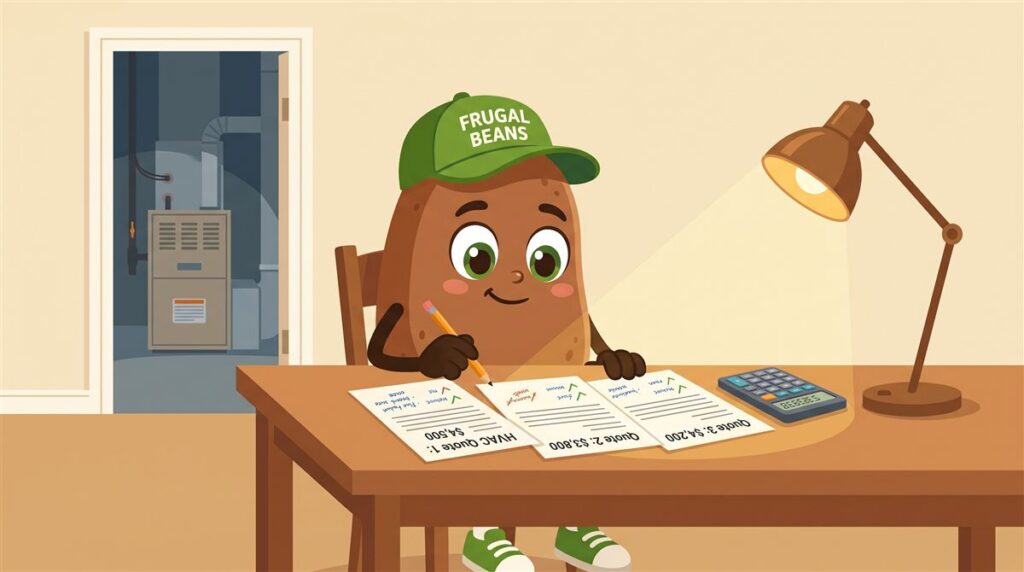
Get at least three written quotes for any furnace replacement. Then line them up on the same items:
- The exact equipment. Brand, model number, AFUE rating and BTU capacity. Look the model up so you know what you are buying.
- How it was sized. A quote based on a load calculation is worth more than one that simply matches the old furnace.
- What is included. Removal, permit, thermostat, venting, gas line and duct work. Mark each as included or extra.
- Warranties. The manufacturer’s parts warranty and the installer’s labor warranty, in years, and whether the installer registers the product for you.
- Timing and payment. Start date, how long the job takes and the payment schedule. Be wary of large deposits.
A much lower quote often leaves something out. A much higher one may include upgrades you did not ask for. Once each quote is broken into the same pieces, the furnace replacement cost difference usually makes sense.
Ways to Lower Your Furnace Replacement Cost
- Replace on your schedule, not in an emergency. A furnace that fails in January leaves you little room to compare. If yours is past 15 years old, start collecting quotes in spring or early fall, when contractors are less busy.
- Check rebates first. Many utilities offer rebates for efficient furnaces and heat pumps. Federal tax credit rules have changed in recent years, so confirm current eligibility with a tax professional before counting on one.
- Don’t oversize. A load calculation can show that a smaller, cheaper furnace will heat your home well.
- Fix the house too. Sealing air leaks and duct leaks can reduce the size of furnace you need and lower bills for its whole life.
- Repair if it makes sense. Not every quote should become a replacement. Check a repair with our repair or replace calculator before you commit.
- Plan the money ahead. Our home repair fund calculator turns your estimate into a monthly savings number, and the home system lifespan tracker shows when your furnace is likely to be due.
Signs It Is Time to Replace Your Furnace

Furnaces typically last 15 to 25 years, according to InterNACHI, and ENERGY STAR suggests considering replacement once a furnace passes 15 years. Other signs include rising heating bills, rooms that won’t warm up evenly, frequent cycling, new banging or rattling noises, visible rust or cracks, and repairs that keep coming back. A cracked heat exchanger or any sign of carbon monoxide is a safety problem, not a budgeting one: stop using the furnace and have a licensed technician confirm the issue.
Frequently Asked Questions
What is the average furnace replacement cost?
Nationally, most homeowners pay between $2,823 and $6,897 to replace a furnace, with an average of about $4,814, according to HomeAdvisor’s 2026 data. Gas furnaces typically cost $3,800 to $10,000 installed, electric $2,000 to $7,000, and oil $6,750 to $10,000 or more.
How much does it cost to replace a furnace and AC together?
Add the furnace range for your fuel type to a central air conditioner replacement of about $3,887 to $8,073. For many homes that puts the furnace and AC replacement cost somewhere from the high four figures to the mid five figures. The estimator above calculates a combined ballpark when you tick the AC option.
Why is oil furnace replacement cost so high?
Oil furnaces are less common, so equipment and specialized labor cost more, and oil homes often need extra work on the tank or chimney. HomeAdvisor puts oil furnace replacement cost at $6,750 to $10,000 or more.
Is an electric furnace cheaper to replace?
Yes, an electric furnace replacement cost of $2,000 to $7,000 is usually the lowest up front. It often costs more to run, though, so compare the yearly heating bill as well as the installed price, and ask about a heat pump.
Is a high-efficiency furnace worth the extra cost?
It depends on your climate and how long you will stay. In cold regions where the furnace runs for months, the fuel savings add up faster. In mild climates, a standard-efficiency furnace may pay off better. Ask each contractor to estimate your yearly fuel cost for both options.
How long does a furnace replacement take?
Most straightforward replacements are finished in a single day. Jobs that add new venting, ductwork, a gas line or a chimney liner can take longer, especially if a permit inspection has to be scheduled. Ask each contractor for the expected start and finish dates in writing, and whether you will have heat overnight.
When is the best time to replace a furnace?
Before it fails, and outside the peak of winter. Spring and early fall are usually quieter for heating contractors, which gives you time to collect several quotes and schedule the work on your terms. If your furnace is past 15 years old, start planning now rather than waiting for a breakdown.
How accurate is the furnace replacement cost estimator?
It uses published national ranges, so treat it as a ballpark for planning and for checking quotes, not a price. Local labor rates, permits, access and your home’s specific needs can put a real quote outside the national range. Always get written quotes from licensed local contractors.
The Bottom Line
A furnace replacement cost of about $4,800 is typical nationally, but your fuel type, home size, efficiency choice and extras can move it by thousands in either direction. Use the estimator to understand the range before contractors arrive, get three written quotes that list the same items, and replace on your schedule rather than in a cold-weather emergency. For warning signs, repair costs and a printable quote checklist, get our free Homeowner Repair Cost Playbook.
Sources: national cost ranges from HomeAdvisor’s furnace replacement, thermostat, ductwork, gas line and chimney liner cost guides (updated June 2026, checked 16 October 2026); furnace efficiency regions from the U.S. Department of Energy; service life from the InterNACHI Standard Estimated Life Expectancy Chart; replacement timing from ENERGY STAR. This tool provides general information, not professional, financial or contracting advice.

Get the free Homeowner Repair Cost Playbook
Which systems fail first, what they cost, the warning signs, and the repair-or-replace rule. 15 printable pages.
Free. No spam.
Free tools
Got a quote? Check it in under a minute.
See which system is likely to need replacing next.
Turn upcoming replacements into one monthly number.
Ballpark a new furnace before the contractor visits.
Price a tank, tankless or heat pump model.
Warm air, ice or noise? See the likely part and price.