How to Save Money at Home: 25 Easy Habits That Really Work

Learning how to save money at home starts with a simple idea: a frugal home is not a home where every purchase is a struggle or every room feels deprived. It is a home designed to use money, time, energy, and possessions with care. Frugality means choosing what matters most and reducing waste around it. That might mean cooking a simple meal instead of ordering takeout, repairing a dripping tap before it damages a cabinet, or waiting a day before buying something that only looked appealing in a shop.
The goal is to make your spending support your life reliably. A household that saves on routine expenses can redirect money toward debt payments, an emergency fund, family activities, a future move, or simply less financial pressure at the end of each month. Small decisions compound because they repeat. Saving $12 on a weekly grocery trip is not just a $12 win; over a year, it can become more than $600.
A practical frugal home begins with observation rather than guilt. Notice where money leaves the household, decide which comforts matter, and build systems that make good choices easier. This guide walks through the habits that work best, room by room, and ends with 25 easy changes you can try this month.
What Frugality Really Means at Home
Frugality is the practice of getting useful value from the money and resources you already have. It is different from being cheap. Being cheap focuses only on the lowest price, even when a low-quality item fails quickly or creates more work. Frugality considers the full cost, including repairs, replacements, time, energy, and stress.
For example, buying a $15 pair of shoes that falls apart in two months may cost more than buying a durable $60 pair that lasts two years. The durable pair is not automatically the right choice, but it deserves comparison. A frugal decision asks, “What will this cost me over its useful life, and will it solve a real problem?”
Frugality also leaves room for generosity and enjoyment. A household can spend freely on a favorite tradition while cutting waste elsewhere. If Saturday breakfast at a local café is important to you, keep it and examine unused subscriptions or poorly planned grocery trips instead. A sustainable budget is one you can follow. For more ways to save money at home with this mindset, see our frugal living tips, or start with frugal living for beginners.
Start with a Home Money Map
The first step in learning how to save money at home is to create a simple map of household spending. Review the last month of bank and card activity and group purchases into broad categories such as housing, utilities, food, transportation, household supplies, health, entertainment, and unexpected costs. The purpose is to see patterns.
Mark each expense as essential, useful, optional, or wasteful. Essential covers rent, basic food, and medication. Useful covers spending that saves time or supports health. Optional covers choices you value but could pause. Wasteful covers forgotten memberships, duplicate purchases, late fees, and discarded food.
Then choose one or two categories for a first adjustment. Trying to change everything at once often creates enthusiasm followed by fatigue. Reducing food waste and canceling two unused subscriptions may accomplish more than an overhaul of every expense.
A home money map might look like this:
|
Area |
Question to ask |
First useful action |
|
Food |
What do we buy and fail to use? |
Plan three flexible dinners before shopping |
|
Utilities |
Which usage is automatic or unnoticed? |
Check heating, cooling, and standby power |
|
Household goods |
Do we own duplicates? |
Make a “use before buying” shelf |
|
Subscriptions |
What did we use last month? |
Cancel or pause anything unused |
|
Repairs |
What is becoming more expensive? |
Schedule one small repair this week |
|
Convenience |
Which purchase happens when we are rushed? |
Prepare a low-effort backup option |
How to Save Money at Home on Food
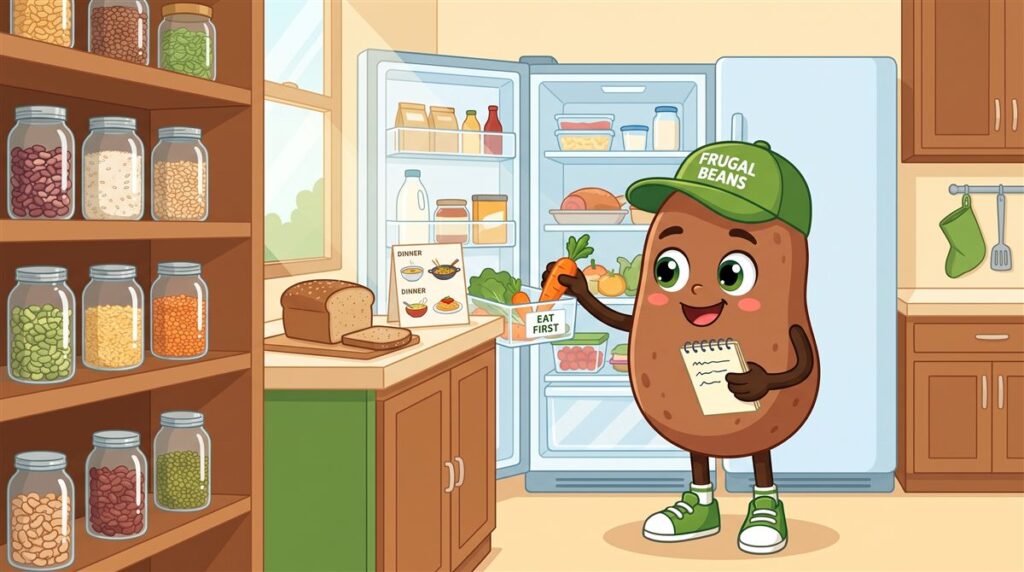
Food is where most people first learn how to save money at home, because small planning changes affect many meals. Start by checking what you already have. A pantry, freezer, and refrigerator inventory prevents the common cycle of buying ingredients for a new recipe while older food quietly expires. A clear “eat first” bin in the fridge keeps the food that needs attention in plain sight.
Plan meals around ingredients that can appear in more than one dish. A roast chicken might become dinner, sandwiches, and soup. A pot of beans can serve as filling for wraps, a base for chili, or part of a rice bowl. Freeze extra portions in labeled containers rather than hoping everyone will want leftovers on the fourth day.
Keep a short list of reliable, low-effort meals for busy nights. Pasta with vegetables, eggs and toast, bean tacos, rice with frozen vegetables, or soup from leftover ingredients can protect the budget from expensive last-minute orders. Convenience is not a character flaw; it is a predictable need. The frugal solution is to plan affordable convenience before you are exhausted. If you are weighing paid convenience, our look at whether meal delivery services are worth it walks through the real cost.
Shop with a list, but allow substitutions. If the planned vegetable is expensive, choose a similar one on sale. Compare unit prices, which show the cost per standard amount. A larger package is not a bargain if part will be discarded. Saving money never requires eating food that looks or smells unsafe.
Save Money at Home on Utilities

When you save money at home on utilities, the savings usually come from behavior and maintenance. Turn off lights in empty rooms, but remember that heating, cooling, water heating, and large appliances often have a greater effect. Use a schedule when practical, close doors to rooms that do not need the same temperature, and wash full loads.
Hot water deserves special attention. Shorter showers, fixing a dripping faucet, and using cold water for suitable laundry loads can reduce both water and energy use. Air-dry clothing when convenient. Clean appliance filters and vents according to their instructions because blocked airflow can make equipment work harder.
Do not spend $200 on a gadget to save $20 without checking the numbers. A low-cost draft stopper may be worthwhile, while a costly upgrade may take years to repay. For rented homes, ask the landlord before changing wiring, plumbing, windows, or heating equipment. ENERGY STAR keeps a practical list of energy savings at home, and its heating and cooling guide covers thermostats, filters, and when equipment is worth replacing.
Save Money at Home by Maintaining What You Own
Many household purchases are responses to inconvenience. A drawer is messy, so a person buys an organizer. A shirt is missing a button, so a person buys another shirt. A meal feels difficult, so a person buys specialized equipment. Before buying, pause and ask whether the problem can be solved with something already in the home.
Create a waiting rule for nonessential purchases. A 24-hour pause may be enough for a small item, while a 30-day list suits expensive purchases. During the pause, write down the problem, storage location, and expected use. If you cannot answer, the purchase may be responding to advertising rather than need.
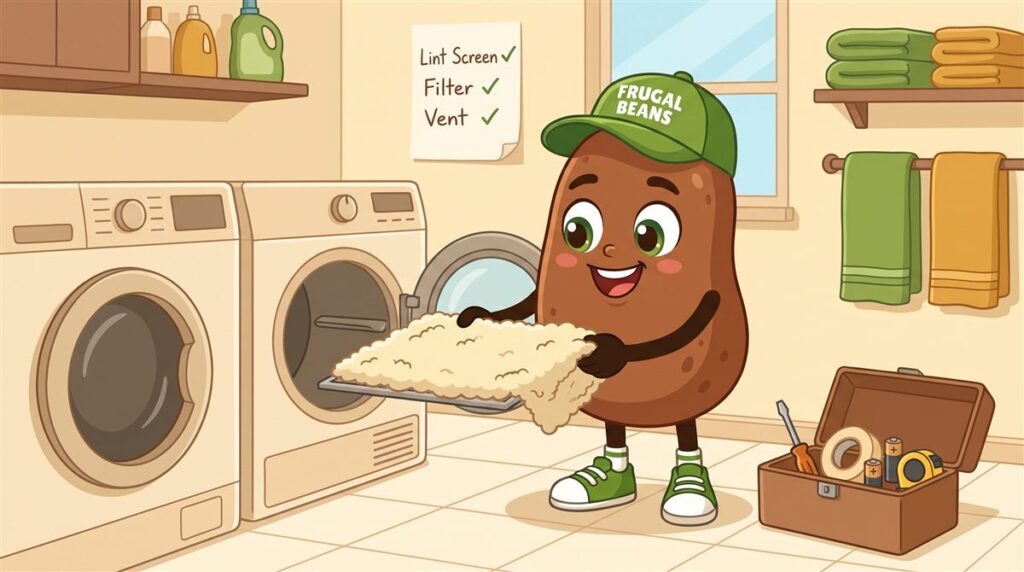
Maintenance is one of the quietest ways to save money at home. Clean dryer lint, replace worn seals, and follow appliance care instructions. Keep basic screwdrivers, tape, spare batteries, thread, and a measuring tape. Learn which repairs are safe to do yourself and which require a qualified professional. A frugal home does not treat safety as an experiment.
The biggest maintenance bills come from the systems that run the house: the furnace, air conditioner, water heater, and major appliances. Knowing their age and warning signs lets you plan a replacement instead of paying emergency rates. Our free home system lifespan tracker shows which one is likely to need replacing first and how much to set aside each month. Our free Homeowner Repair Cost Playbook lists typical lifespans and repair costs for each one.
When a technician quotes a big repair, run the numbers through our free repair or replace calculator before you agree. Knowing whether to fix or replace a major system is one of the quickest ways to save money at home.
Borrowing and sharing can also reduce ownership costs. A library, tool-lending program, neighborhood group, or collection of resources among friends can provide occasional-use items without requiring every household to store and maintain them. Agree in advance about return dates and responsibility for damage so that saving money does not create conflict.
Ways to Save Money at Home, Room by Room
For a frugal home, walking through the house one room at a time is one of the simplest ways to save money at home, because each room has its own habits and its own leaks. Use the infographic as a checklist, then read the notes below for the reasoning behind each habit.
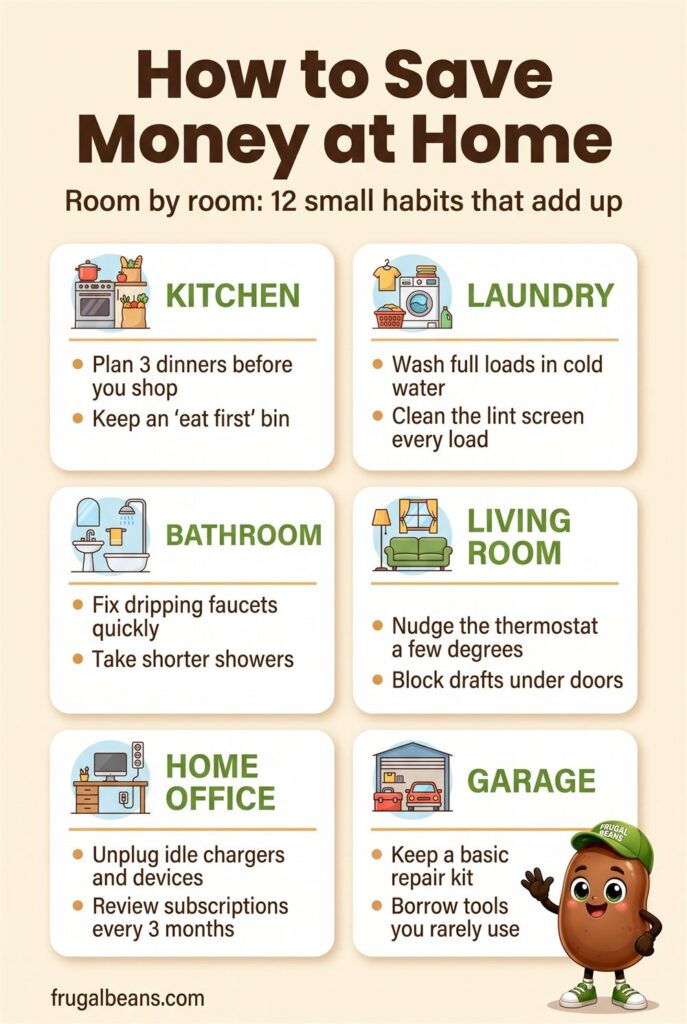
Kitchen
Plan three dinners before you shop and build the list from what is already in the cupboards. Keep an “eat first” bin so leftovers and soft produce get used before they spoil. Food you throw away is money you already spent.
Laundry
Wash full loads and use cold water for everyday clothes when the care label allows it. Clean the dryer lint screen after every load; it keeps air moving, shortens drying time, and reduces a common fire risk.
Bathroom
Fix dripping faucets and running toilets quickly, since a small leak runs all day, every day. Shorter showers cut both the water bill and the energy used to heat that water.
Living Room
Nudge the thermostat a few degrees toward the outdoor temperature and dress for the season. Block drafts under exterior doors with a simple draft stopper or a rolled towel before considering larger upgrades.
Home Office
Unplug idle chargers and switch off devices at a power strip when you finish for the day. Set a reminder to review subscriptions every three months and cancel anything you did not use.
Garage and Storage
Keep a basic repair kit so small fixes do not turn into service calls. Borrow tools you rarely use instead of buying them, and store what you own where you can find it, so you never buy a duplicate.
Make a Frugal Home Budget That Is Easy to Use
A budget is a plan for money, not a punishment for spending. Begin with reliable income, then list fixed costs, flexible costs, savings, and debt payments. Include irregular expenses such as insurance, school costs, gifts, maintenance, and travel. Divide an annual cost by twelve and set aside that monthly amount when possible.
Give every category a realistic amount. If groceries usually cost $500, writing down $250 will not make the difference disappear; it will only make the budget look unsuccessful. Use recent spending as a starting point, then reduce one area gradually. A budget helps you decide before the money is gone, and it turns small habits into a steady plan to save money at home. Our 11 budgeting tips cover how to set those amounts.
Try a weekly household check-in that lasts fifteen minutes. Review upcoming bills, meals, appointments, and any planned purchases. Confirm what is in the checking account and what must remain available. Keep the discussion neutral. The question is not “Who spent too much?” but “What does the household need to prepare for next?”
25 Easy Habits to Save Money at Home
These are the most practical ways to save money at home. Use them as experiments rather than rules. Pick three, try them for a month, and keep the ones that stick.
- Keep a visible “eat first” box in the refrigerator for food that needs attention soon.
- Plan three flexible dinners before every grocery trip.
- Make one weekly grocery trip and use a short top-up list for genuinely missing essentials.
- Compare unit prices instead of package prices.
- Prepare one inexpensive meal component, such as cooked rice, washed vegetables, or boiled eggs, for the next few days.
- Freeze extra portions in labeled containers.
- Keep two default low-cost dinners for nights when you are too tired to cook.
- Wash full loads and use cold water when the care label allows.
- Clean the dryer lint screen after every load.
- Air-dry clothing when it is convenient.
- Fix dripping faucets and running toilets quickly.
- Take shorter showers.
- Nudge the thermostat a few degrees and dress for the season.
- Block drafts under exterior doors.
- Turn off lights and unplug idle chargers in empty rooms.
- Clean or replace HVAC and appliance filters on schedule.
- Store cleaning products together and check existing supplies before buying replacements.
- Use a 24-hour pause for small nonessential purchases and a 30-day list for big ones.
- Set a calendar reminder to review subscriptions every three months.
- Turn off automatic renewal when starting a trial, then decide deliberately whether to continue.
- Keep a basic repair kit and learn the safe, simple fixes.
- Borrow tools you rarely use instead of buying them.
- Place a donation box in a closet and remove items when it is full instead of letting clutter spread.
- Use cloths, towels, and washable containers when practical, without buying a whole new set of products to pursue zero waste.
- Keep a small emergency fund for home repairs so a broken appliance does not automatically become high-interest debt.
The best habits remove decisions. A labeled freezer, a default low-cost dinner, and an automatic transfer to savings reduce willpower. If a system fails, adjust it rather than blaming its users.
How to Save Money at Home When You Rent or Share
Renters and roommates can still create a frugal home without replacing windows or installing major equipment. Focus on reversible actions: efficient lighting, draft control that does not damage surfaces, sensible thermostat settings, careful water use, and organized shared supplies. Ask about utility billing rules before changing habits that affect other residents.
In a shared home, agree on systems. Decide how groceries, shared replacements, and repairs will be handled. A shared list can prevent three people from buying dish soap in one week. If one roommate uses most of an item, a contribution rule may be fairer than an equal split.
Do not sacrifice privacy, safety, or basic comfort to meet an arbitrary target. A cheaper home may not be cheaper if it creates a long commute, poor sleep, or frequent emergency expenses. Consider total housing cost, not just advertised rent.
Use Savings for Security First
Once you start to save money at home and frugal changes create room in the budget, give the savings a job. A small starter emergency fund can cover a minor repair or urgent trip without relying on a credit card. After that, work toward several weeks or months of essential expenses, depending on your income stability and responsibilities. High-interest debt may deserve priority because interest can grow faster than ordinary savings.
Keep savings separate from spending money but accessible for real emergencies. Track progress clearly. Paying off a $300 balance or setting aside the first $500 is meaningful even if the long-term goal is much larger.
Avoid turning every saving into permission for immediate consumption. Some rewards are healthy, but decide in advance how much of a windfall or monthly surplus will go to security, goals, and enjoyment. This balance helps frugality feel like progress rather than permanent restriction.
How to Save Money at Home: Frequently Asked Questions
What is the fastest way to save money at home?
The fastest way to save money at home is to start with food waste and unused subscriptions. Both can be fixed in an afternoon: take a fridge and pantry inventory, plan three dinners from what you have, and cancel anything you did not use last month. These changes need no equipment and no upfront cost.
How much can a household save with frugal habits?
It depends on your starting point, so track your own numbers rather than chasing a headline figure. Small repeat savings add up: trimming $12 from a weekly grocery trip is more than $600 over a year, before counting any utility or subscription changes.
Is it worth buying energy-saving gadgets to save money at home?
Only when the numbers work. Habits such as shorter showers, full laundry loads, and thermostat adjustments cost nothing. Before buying a device, compare its price with a realistic monthly saving and check how many years it would take to pay for itself.
How can renters save money at home?
Focus on reversible changes: draft stoppers, careful thermostat use, efficient bulbs you can take with you, shorter showers, and shared-supply systems with roommates. Ask the landlord before changing anything permanent.
The Bottom Line
A frugal home is built through ordinary choices that protect what the household values. It starts with seeing the flow of money clearly, then reducing waste in food, utilities, purchases, and convenience spending. It uses maintenance, planning, and shared systems to make savings repeatable. It also recognizes that the cheapest option is not always the best option when quality, safety, time, and stress are included.
Choose one small change today: inspect the pantry, cancel an unused subscription, plan a low-effort dinner, or schedule a repair. Keep what works and revise what does not. If you want to know how to save money at home without feeling deprived, this is the answer: start small and keep going. Over time, these decisions can turn a home into a steadier financial base—one that supports comfort, resilience, and the life you actually want to live.
Leave a Reply

Get the free Homeowner Repair Cost Playbook
Which systems fail first, what they cost, the warning signs, and the repair-or-replace rule. 15 printable pages.
Free. No spam.
Free tool
Repair or replace?
Got a quote for your furnace, AC, water heater or an appliance? Check it in under a minute.
Free tool
What needs replacing next?
Enter the install years for your furnace, AC, water heater and appliances. See what is due first and what to save each month.
2 Responses to How to Save Money at Home: 25 Easy Habits That Really Work