Frugal Living Tips: 21 Simple Ways to Live Well on Less

The best frugal living tips are not about making life small; they are about making your money useful on purpose. Ms Frugal Quaker, the plain-spoken voice behind the original version of this post, would put it simply: before you spend, ask whether the purchase supports the life you are trying to build. That one question can help a household spend less without turning every grocery trip or family outing into a test of willpower.
Frugal living means using what you have carefully, choosing value over appearance, and leaving room for the future. It is not a contest to see who can spend the least. It is a set of habits that keeps money flowing toward what your household actually values and away from waste, impulse, and forgotten charges.
This guide collects the habits that work best in real households. You will find the mindset behind them, a simple spending map, practical ideas for food, clothing, repairs, and borrowing, a numbered list of 21 tips you can try this month, and a short plan for the months when money is tighter than usual.
What Frugal Living Really Means
Frugality is different from being cheap. Being cheap focuses only on the lowest price, even when a poor-quality item costs more over time. Frugal living considers the total cost of a choice: the price, how long it lasts, what it costs to maintain, and the effect it has on your household’s peace of mind.
A $20 pair of work boots that splits in three months is not a bargain if a sturdier pair would have lasted for years. The sturdier pair is not automatically the right answer either, but it deserves a fair comparison. The frugal question is, “What will this cost me over its useful life, and does it solve a real problem?”
Enough Before More
The heart of a frugal lifestyle is learning to define “enough.” Enough does not mean refusing every improvement. It means recognizing when something already meets your needs.
A phone that makes calls, runs the apps you need, and holds a charge may be enough even if a newer model has a better camera. A packed lunch may be enough even if coworkers order delivery. A clean, well-fitting jacket may be enough for another winter after a small repair. When you notice “enough,” the pressure to upgrade loses much of its pull.
Frugal, Not Deprived
People who live frugally for years usually keep a few things they love. If Saturday breakfast out is a family tradition, keep it, and trim the subscriptions nobody opens instead. A plan you can follow beats a perfect plan you abandon in two weeks. If you are just getting started, our guide to frugal living for beginners walks through the first steps in more detail.
Start With a Clear Reason to Live Frugally
It is much easier to live frugally when you know what the savings are for. A budget is easier to follow when it serves a purpose. “Spend less” is vague and discouraging. “Save $600 for car repairs by December” gives every small choice a connection to a real need.
Write down three priorities for the next six to twelve months. One might be an emergency fund, which is money set aside for an unexpected cost such as a broken appliance or a short stretch without work. Another might be paying down a credit card. A third could be something positive, such as a family visit or replacing an unreliable laptop.
Next, list your monthly take-home income and your essential expenses: housing, utilities, basic food, transportation, insurance, minimum debt payments, and necessary medical costs. Then list flexible spending, such as restaurants, subscriptions, clothing, hobbies, and convenience purchases. Do not criticize the list. Accuracy is more useful than shame.
A short weekly check-in keeps the plan realistic. Look at what was spent, compare it with the plan, and adjust the next week. If the household spent too much on takeout because everyone was exhausted, the fix may be two easy freezer meals, not a lecture about discipline.
Build a Household Spending Map for Frugal Living
Many budgets fail because their categories do not match real life. A household might have a “food” category but no way to see the difference between groceries, coffee runs, school lunches, and delivery fees. A spending map should be detailed enough to reveal patterns but simple enough to keep up.
Here is an illustrative monthly map for a household with $4,000 in take-home income. The amounts are examples, not rules.
|
Spending group |
Example amount |
Frugal focus |
|
Housing and basic utilities |
$1,450 |
Review renewals and reduce avoidable energy use |
|
Transportation and insurance |
$600 |
Combine errands and maintain the vehicle |
|
Groceries and household supplies |
$600 |
Plan meals around what is already on hand |
|
Debt payments |
$400 |
Pay minimums first, then target one balance |
|
Savings and future needs |
$450 |
Automate a manageable amount each payday |
|
Health, school, and necessary care |
$250 |
Plan for recurring costs before they arrive |
|
Personal spending and fun |
$250 |
Spend freely within a visible limit |
|
Total |
$4,000 |
Adjust categories to fit your priorities |
The point of a table like this is not to make every month identical. It is to reveal tradeoffs. If there is no cushion for irregular costs, an unexpected $300 repair has to come out of another category or go on a credit card. Seeing that risk in writing is often the motivation a household needs to make a gradual change. For more ideas on trimming each line, see our list of practical ways to save money.
Frugal Living Tips for Food Without the Misery
Food is one of the easiest places to put frugal living tips to work because small routines repeat many times a month. The goal is not to eat the cheapest possible meals. The goal is to waste less and make convenient, satisfying food easy to reach at home.
Keep a Use-First Shelf
Choose one shelf in the refrigerator for leftovers, opened produce, and items close to their date. Plan one flexible meal each week that can absorb them, such as fried rice, soup, pasta, grain bowls, or omelets. This turns random odds and ends into dinner instead of trash.
Cook With Overlapping Ingredients
Pick a few dependable meals that share ingredients. A roast chicken can become dinner, sandwiches, and soup. A pot of beans can fill tacos, top a salad, or start a simple stew. Frozen vegetables make it easier to cook when fresh produce has run out.
Store brands are often a sensible choice, but compare the unit price rather than the package price. The unit price shows the cost per ounce, pound, or item, which makes different package sizes easier to compare. A bigger package is not a bargain if half of it ends up in the bin.
Plan for Tired Nights
Keep a short list of backup meals: oatmeal with fruit, eggs and toast, canned soup with a sandwich, or pasta with frozen vegetables. They may not be exciting, but they can prevent a costly delivery order. Frugal living works best when it prepares for tired days instead of pretending they will not happen. If you are weighing paid convenience, our look at whether meal delivery services are worth it breaks down the real cost.
Frugal Living Tips for Clothes, Laundry and Repairs

Clothing and household goods rarely blow up a budget in one purchase, which is why these frugal living tips focus on small, repeat savings. They leak money through small replacements, and that is exactly where steady frugal habits pay off. Before buying, check what you already own. Many households discover they have three of something they thought they needed.
Wash Smarter, Dry for Free
Wash full loads, use cold water for everyday clothes when the care label allows, and air-dry when the weather and your schedule cooperate. A clothesline or a folding drying rack costs little and can take some of the load off the dryer. Clothes that are not tumbled every week also tend to keep their shape and color longer, which means fewer replacements.
Mend Before You Replace

The same thinking applies to the big systems in your home. When a furnace, air conditioner or appliance breaks, our free repair or replace calculator shows whether fixing it is the frugal choice for a unit that age, one of the most practical frugal living tips for homeowners. To see which system is likely to need replacing next, and what to save for it, try our free home system lifespan tracker.
A missing button, a loose hem, or a small seam tear is often a ten-minute fix with a needle and thread. Keep a small sewing kit with a few colors of thread, spare buttons, safety pins, and small scissors. If sewing is not your thing, a local tailor or a handy friend may still cost less than a new garment.
The same thinking applies around the house. Tighten the loose cabinet hinge, replace the worn washer in a dripping faucet, and clean the dryer lint screen after every load. Small maintenance keeps small problems from becoming expensive ones. For larger systems such as the furnace, water heater, and major appliances, our free Homeowner Repair Cost Playbook lists typical lifespans and warning signs so you can plan instead of paying emergency rates.
Know When to Call a Pro
Frugality never means treating safety as an experiment. Electrical work, gas appliances, and anything structural belong with a qualified professional. Get more than one estimate, and ask whether a safe temporary fix exists while you save for the full job.
Borrow Before You Buy: A Frugal Living Tip That Adds Up

Borrowing is one of the most overlooked frugal living tips. Ms Frugal Quaker liked to talk about building a collection of “many resources”: the places and people that help a household solve problems before spending money. That collection might include a public library, a community swap group, a tool-lending program, a free local events calendar, a food pantry, workplace benefits, or a trusted neighbor.
A library can offer books, movies, classes, internet access, and in some areas, museum passes or even tools. A community group may help someone find a used crib, spare moving boxes, or a recommendation for an honest repair person. A pantry can support a tight month so a household does not have to choose between food and another bill. Using available help is not a personal failure. These resources exist to make communities stronger and household money less fragile.
Make a note on your phone or a page in a household folder. Add each resource’s name, what it offers, opening hours, any eligibility rules, and the date you last checked. Include informal resources too, like a neighbor who lends a ladder or a friend who trades babysitting. The list is most valuable when it is ready before you need it.
21 Frugal Living Tips to Try This Month
These 21 frugal living tips are grouped into six themes: plan, cook, repair, borrow, wait, and save. Do not try them all at once. Pick two or three, use them for a month, and keep the ones that fit your household.
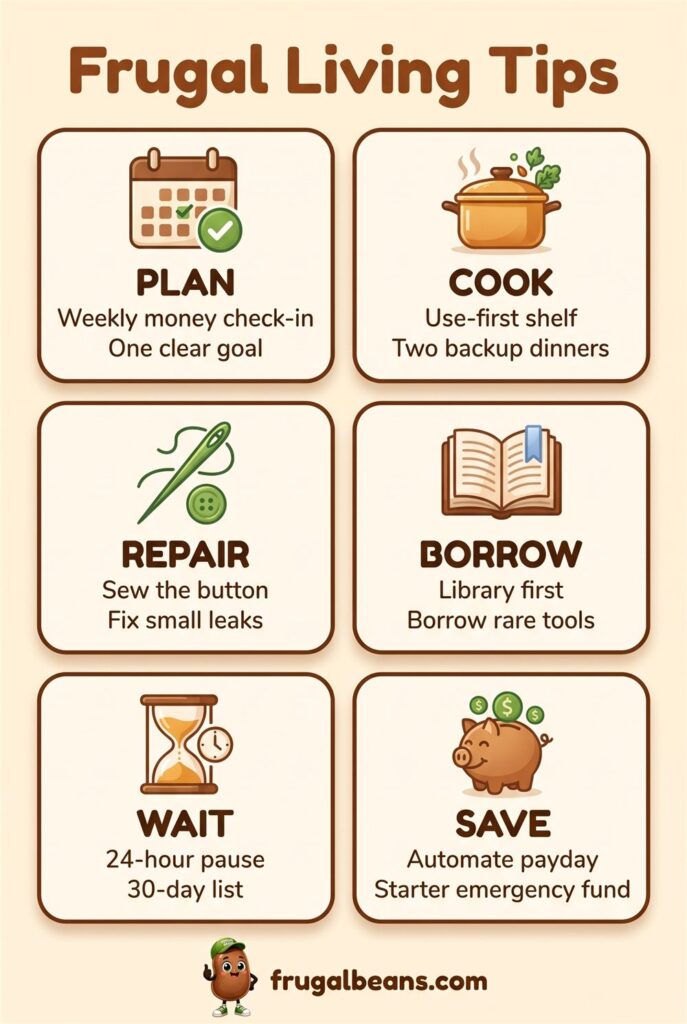
- Hold a weekly money check-in. Spend fifteen minutes reviewing upcoming bills, meals, and planned purchases.
- Name one clear savings goal. Give it a dollar amount and a date so small choices have a purpose.
- Review the last 30 days of transactions. Circle the three purchases that surprised you most.
- Combine errands into one trip. Fewer trips mean less fuel, less time, and fewer impulse stops.
- Keep a use-first shelf in the fridge. Put leftovers and soft produce where everyone sees them.
- Plan dinners from what you already have. Check the pantry and freezer before writing a grocery list.
- Keep two backup dinners on hand. Simple meals for tired nights protect the budget from takeout.
- Pack a drink and snack before you leave home. Small convenience purchases add up quickly.
- Sew the button and fix the hem. A basic sewing kit extends the life of clothes you already like.
- Fix small leaks quickly. Dripping faucets and running toilets waste water every hour they run.
- Wash full loads in cold water and air-dry when you can. Follow care labels and let the sun do some of the work.
- Check the library first. Books, movies, classes, and sometimes passes or tools are free to borrow.
- Borrow rare-use tools instead of buying them. Ask a neighbor, a tool library, or a community group.
- Use swap groups for kids’ gear and seasonal items. Children outgrow things long before they wear out.
- Use a 24-hour pause for small extras. If you still want it tomorrow, it may be a planned choice.
- Keep a 30-day list for big purchases. Write down the problem it solves and compare alternatives.
- Review subscriptions every three months. Cancel anything you did not use and note annual renewal dates.
- Automate a small transfer on payday. Even $10 a paycheck builds the habit before the amount grows.
- Build a starter emergency fund. A few hundred dollars can keep a minor surprise off a credit card.
- Call one provider about a lower rate. Ask about a cheaper plan, a fee waiver, or a better renewal price.
- Give every adult a no-questions allowance. A small, guilt-free amount keeps the whole plan sustainable.
These actions are deliberately modest. A habit that survives a busy week is worth more than an ambitious plan that lasts three days.
Frugal Living Tips That Survive a Bad Month
Every household has months when the paycheck is short, a medical bill arrives, or the car needs work at the worst possible time. The frugal living tips that matter most are the ones that still function when you are stressed and tired.
Protect the Essentials First
List the bills that keep the household safe and running: housing, utilities, food, transportation to work, insurance, and necessary medicine. Pay those first. If something has to slip, call the company before the due date and ask about a payment plan or a later date. Many will work with you if you ask early.
Switch to a Bare-Bones Budget for a While
Pause the flexible categories, not forever, just for this stretch. Eat from the pantry and freezer, skip nonessential shopping trips, and lean on the resource list you built earlier. A library card, a pantry, and a neighbor with a ladder are exactly what a bad month calls for. Our guide to saving money on a tight budget has more ideas for these weeks.
Use Savings Without Guilt
If you built an emergency fund, this is what it is for. Using it is not failure; it is the plan working. Once the month passes, restart the automatic transfer, even at a smaller amount, and rebuild gradually.
Keep One Small Comfort
Cutting everything at once often leads to a rebound spending spree. Keep one inexpensive comfort, such as a favorite coffee at home or a free outing with family, so the tight stretch feels survivable rather than punishing.
Use a Frugal Lifestyle to Pay Down Debt and Grow Savings
When money is tight, saving and paying debt at the same time can feel impossible. A balanced plan usually protects a small starter emergency fund while making every required debt payment. After that, direct extra money toward one priority at a time.
A starter fund of even a few hundred dollars can stop a minor emergency from becoming new credit card debt. The Consumer Financial Protection Bureau’s guide to building an emergency fund explains how to set a goal and make saving automatic.
Once that buffer exists, choose a debt strategy. The debt avalanche sends extra money to the balance with the highest interest rate, which can reduce the total interest you pay. The debt snowball sends extra money to the smallest balance first, which can create faster emotional wins. Either method works if payments are made consistently.
When a frugal lifestyle change frees up money, give it a job right away. If you cancel a subscription, move the same amount to savings or a debt payment that day. Money without a job tends to drift back into everyday spending.
Keep Your Frugal Lifestyle Kind and Sustainable
The people who live frugally for the long haul tend to share one trait: they leave room for joy. A household budget should include some enjoyment. If every purchase is treated as evidence of failure, people tend to abandon the plan and spend reactively. Set a reasonable personal allowance for each adult and, when it fits, a small amount for children. Money inside that boundary can be spent without debate.
Do not use frugality as a reason to ignore health, safety, or dignity. Skipping needed medicine, driving on worn tires, or refusing necessary professional help is not a bargain. The lowest price today can create a much bigger cost later. A sustainable plan protects essentials first and looks for savings around them.
Households also move through seasons. A new baby, a job change, or caring for a parent may require spending in new ways for a while. That is not failure. The purpose of a financial plan is to help you respond calmly, not to produce a perfect record. Many of the habits in this guide also work room by room; our guide on how to save money at home covers the kitchen, laundry room, and more.
Frugal Living Tips: Frequently Asked Questions
What are the easiest frugal living tips to start with?
Start with food waste and unused subscriptions. Both can be handled in an afternoon: check the fridge and pantry, plan a few dinners from what you have, and cancel anything you did not use last month. Neither change requires any upfront cost.
How do I live frugally without feeling deprived?
Keep a few things you truly value and cut waste around them. Give each adult a small allowance that can be spent without explanation, and focus first on spending that brings little joy, such as late fees, forgotten subscriptions, and food that spoils.
Is frugal living the same as being cheap?
No. Being cheap looks only at the lowest price. Frugal living looks at the total cost, including how long something lasts, what it takes to maintain, and whether it solves a real problem. Sometimes the frugal choice costs more up front.
How much money can frugal living save?
It depends on where you start, so track your own numbers rather than chasing a headline figure. Small repeat savings add up: cutting $10 a week from takeout is $520 over a year, before counting any subscription or utility changes.
The Bottom Line
A frugal lifestyle is thoughtful use, not constant deprivation. Start with a reason for saving, map the money you already spend, and change a few defaults that create repeat costs. Plan food for tired days, mend and maintain what you own, borrow before you buy, and give your savings a clear job.
Pick two or three of these frugal living tips today and try them for a month. Keep what works and adjust what does not. Over time, a pause before buying, a dinner made from what is on hand, and a small automatic transfer add up to breathing room: more control, fewer emergencies, and a clearer path toward the life your household values.
Leave a Reply

Get the free Homeowner Repair Cost Playbook
Which systems fail first, what they cost, the warning signs, and the repair-or-replace rule. 15 printable pages.
Free. No spam.
Free tool
Repair or replace?
Got a quote for your furnace, AC, water heater or an appliance? Check it in under a minute.
Free tool
What needs replacing next?
Enter the install years for your furnace, AC, water heater and appliances. See what is due first and what to save each month.
One Response to Frugal Living Tips: 21 Simple Ways to Live Well on Less