Frugal Living for Beginners: 15 Simple Money Habits to Start
Frugal living for beginners is not a contest to see who can live with the least. It is the practical habit of directing limited money toward what matters most. Done well, it helps an ordinary household keep more of its income, cut avoidable costs, prepare for surprises, and move toward goals that are bigger than this month’s bills.
This guide is for people with paychecks, irregular income, children, caregiving responsibilities, debt, rising bills, or simply a wish to feel less financial pressure. You do not need a finance degree or a perfect spreadsheet. You need a clear view of your choices and a system simple enough to use when life is busy.
Below you will find where to start, a simple plan for your first 30 days, and 15 money habits that cover every major part of household finances. Work on one habit at a time. Each one is a stream of attention pointed at one part of your financial life, and together they form a complete beginner’s system.
What Frugal Living Really Means
Frugal living means getting real value from the money, time, and things you already have. It is different from being cheap. Cheap focuses only on the lowest price, even when a flimsy item breaks quickly or creates more work. Frugality looks at the full cost, including repairs, replacements, interest, time, and stress.
It also leaves room for enjoyment. A frugal household can spend happily on a favorite tradition while cutting waste somewhere else. The point is not to remove every pleasure; it is to stop paying for things you do not use, do not value, or did not really choose.
For a beginner, the most useful shift is this: frugality is a system, not a mood. Willpower runs out at the end of a long day. A bill calendar, an automatic transfer, and a short shopping list keep working when you are tired. That is why this guide focuses on money habits rather than one-time cuts, and why frugal living for beginners works best when you build one habit at a time.
Where to Start with Frugal Living for Beginners
Most people who try frugal living for the first time make the same mistake: they try to change everything in one weekend. They cancel every subscription, start a strict grocery budget, and promise never to order takeout again. By week three, the plan feels like punishment and the old habits return.
A better start has three steps:
- See your money clearly. Look at the last month of bank and card activity. Group spending into broad categories such as housing, food, transportation, bills, debt, and “everything else.” You are looking for patterns, not passing judgment.
- Protect the basics first. Make sure shelter, utilities, food, essential transportation, and minimum debt payments are covered before you set any savings target.
- Pick one or two habits. Choose the areas below that would make the biggest difference right now. Small, repeated wins build confidence faster than a dramatic overhaul.
The table below gives you a one-glance view of all 15 money habits, the question each one answers, and a first action that takes less than an hour.
|
Habit |
Question it answers |
First useful action |
|
1. Budgeting and cash flow |
Where will money go before it arrives? |
Map income and bills by date |
|
2. Emergency savings |
How will we handle an unexpected cost? |
Open a separate savings space |
|
3. Debt repayment |
Which balances should get extra money? |
List rates, balances, and minimums |
|
4. Banking fees and interest |
Is our bank charging us unnecessarily? |
Check fees and account rates |
|
5. Insurance and recurring bills |
Are we paying for the right things? |
Audit policies and subscriptions |
|
6. Groceries and household goods |
How can routine purchases cost less? |
Set a realistic category limit |
|
7. Utilities and home costs |
Which home expenses can be lowered? |
Review usage and services |
|
8. Housing affordability |
Is our housing cost sustainable? |
Calculate the full housing cost |
|
9. Transportation |
What does getting around really cost? |
Add payments, fuel, repairs, and insurance |
|
10. Mindful spending |
How can we interrupt impulse buys? |
Add a waiting period for wants |
|
11. Secondhand buying and selling |
When can used goods save cash? |
Build a safe buying checklist |
|
12. Family money routines |
How can the household decide together? |
Create one weekly check-in |
|
13. Earning extra income |
Can we improve the income side? |
Identify one sellable skill or asset |
|
14. Investing basics |
How can money grow over time? |
Learn account, risk, and fee basics |
|
15. Meaningful goals |
What is the money meant to make possible? |
Name one specific, measurable goal |
The habits overlap, but they are not interchangeable. Cutting spending cannot replace emergency savings. A higher income cannot fix borrowing for routine expenses. Investing is valuable, but it should rest on accessible savings and manageable debt. If you want a longer list of quick wins to pair with this system, our frugal living tips collect dozens of small, practical ideas.
Frugal Living for Beginners: Your First 30 Days
For a beginner, a month is long enough to see real results and short enough to stay motivated. This 30-day plan touches the habits that matter most for a beginner, two small actions per week. Nothing on it costs money to start.
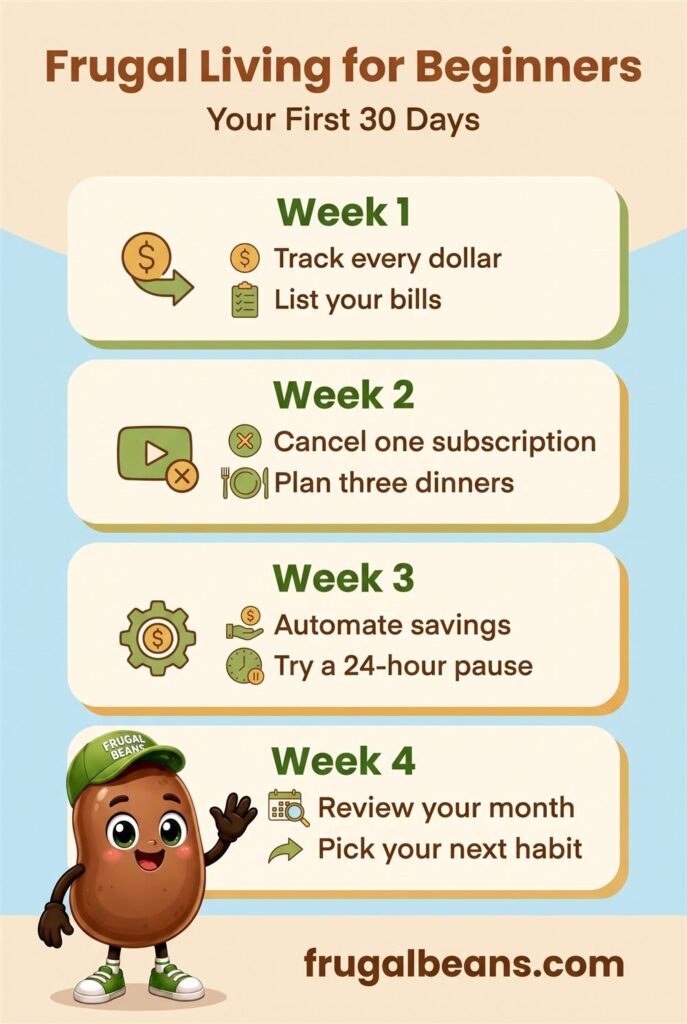
Week 1: Track Every Dollar and List Your Bills
Write down every purchase for seven days, including small ones like coffee, snacks, and app charges. At the same time, list every bill with its amount and due date. By Sunday you will know where money actually goes and which week of the month is tightest.
Week 2: Cancel One Subscription and Plan Three Dinners
Look through your statements for recurring charges and cancel or pause one you did not use last month. Then plan three simple dinners before your next grocery trip, built around what is already in the pantry. These two moves attack the two most common beginner leaks: forgotten charges and last-minute food spending.
Week 3: Automate Savings and Try a 24-Hour Pause
Set up an automatic transfer to a separate savings account the day after payday, even if the amount is small. Then adopt a 24-hour pause on any nonessential purchase. If you still want the item tomorrow and it fits the plan, buy it without guilt.
Week 4: Review Your Month and Pick Your Next Habit
Compare this month’s spending with your Week 1 notes. Celebrate what worked, adjust what did not, and choose the next habit from the list below. Frugal living for beginners is a cycle: notice, decide, act, and review.

15 Simple Money Habits for Frugal Living Beginners
These are the core money habits of frugal living for beginners. Each habit below explains what it covers, why it matters, what to do first, and a mistake to avoid. The small examples use simple numbers so you can see the arithmetic. Your own numbers will differ, and that is fine.
1. Budgeting and Cash-Flow Planning

Budgeting assigns income to needs, goals, debt, and flexible spending. Cash-flow planning adds timing, showing when pay arrives and when bills leave. A household can have enough income for the month and still come up short during one week, so the calendar matters as much as the totals.
Start here: List reliable take-home income, record bills by due date, and divide annual expenses into monthly “sinking fund” amounts. Give the remainder a job, including a modest amount for enjoyment. Review weekly and adjust without treating changes as failure.
Avoid: Budgeting from an ideal month, forgetting irregular expenses, and creating so many categories that the plan becomes exhausting.
Example: If rent is due on the first and insurance on the twentieth, a calendar budget reserves part of the first paycheck for the later bill, preventing a credit card balance even when monthly income is adequate.
2. Emergency Savings
Emergency savings is cash for unplanned, necessary costs such as a car repair, urgent travel, a short income gap, or a major home problem. It is separate from predictable annual expenses. A reserve keeps a shock from becoming expensive credit, a missed payment, or a forced sale of long-term investments.
Start here: Begin with a small starter goal, such as $500 or one week of essential expenses, then build toward several months of core costs as your situation allows. Keep the money separate but accessible, automate a transfer after payday, and refill the account after you use it. The Consumer Financial Protection Bureau’s guide to building an emergency fund walks through setting a goal and finding money to save.

Avoid: Investing emergency money, counting a credit limit as savings, or setting a target so large you never begin. A reserve being used does not mean it failed.
Example: Jordan saves $35 each payday. Six months later, a $420 water-heater repair is paid from savings instead of a card, and the automatic transfer restarts afterward.
3. Debt Repayment
This habit covers credit cards, personal loans, medical balances, vehicle loans, and student debt, plus the routines that keep new debt from replacing old debt. Interest turns yesterday’s purchase into tomorrow’s obligation, and every minimum payment is part of a future paycheck that is already spent.
Start here: List each balance, rate, minimum, and due date. Pay every minimum on time, then send extra money using either the avalanche method, which targets the highest rate first, or the snowball method, which targets the smallest balance first. Keep a small cash buffer, and contact lenders early if payments are becoming unmanageable.
Avoid: Switching methods every month, treating a balance transfer as repayment, and sending every spare dollar to debt while leaving nothing for predictable expenses.
Example: Maya pays all minimums and sends an extra $150 to the highest-rate card. When it is paid off, she rolls that payment into the next balance instead of increasing lifestyle spending.
4. Banking Fees and Interest
Banking includes checking and savings accounts, overdraft charges, ATM fees, account minimums, transfer fees, card interest, and the rate paid on your cash. Fees may be small, but they repeat. Interest earned on safe cash and interest avoided on debt both improve results without extra work hours.
Start here: Review two or three months of statements for fees. Choose accounts whose requirements fit your habits, set low-balance and due-date alerts, and compare savings rates once in a while. Pay card balances in full when you can; otherwise follow a clear repayment plan.
Avoid: Chasing a high rate without understanding access rules, and ignoring repeated small fees because each one looks minor.
Example: Priya pays two $15 overdraft fees each month. An alert and a small buffer stop the fees, returning $360 a year to her budget.
5. Insurance and Recurring Bills
Recurring charges are easy to forget: subscriptions, memberships, software, service contracts, and automatic renewals. Insurance belongs here too, because it protects against losses that would overwhelm a household. The goal is the right protection at a fair price, with no paid-for services you never use.
Start here: Inventory recurring charges at least once a year. For insurance, understand limits, deductibles, and exclusions. Compare quotes after life changes, cancel unused services, and set reminders before promotional rates expire.
Avoid: Dropping essential coverage to save a few dollars, paying for duplicate protection, or assuming an automatic renewal is still the best price.
Example: A household finds three subscriptions and an old roadside membership totaling $62 a month. It keeps the most useful service and redirects $50 to savings.
6. Groceries and Household Goods
Groceries, cleaning supplies, personal-care items, and paper goods are small purchases that repeat constantly. That makes them one of the best places for a beginner to practice frugal living, because a weekly change adds up without touching rent or your job.
Start here: Set a limit based on your actual history, keep a short inventory, compare unit prices, shop with a list, choose store brands when quality is acceptable, and plan for busy nights so takeout does not become the default.
Avoid: Buying bulk without storage space, chasing every discount, and confusing the lowest price with the lowest total cost. An unused cheap item is not a bargain.
Example: A household finds $90 a month going to duplicate toiletries and forgotten cleaning products. A quick inventory before shopping cuts that category by $40.
7. Utilities and Home Costs
This habit covers electricity, heating, water, internet, phone service, and home maintenance. A lower bill, a better service plan, or a timely repair saves money month after month, and preventive care can head off expensive damage. Our guide on how to save money at home goes room by room through the details.
Start here: Compare bills across seasons, investigate unusual increases, seal drafts, change filters, and remove services you do not need. Ask providers about lower plans when promotions end, and keep maintenance records. If you own your home, our free Homeowner Repair Cost Playbook shows typical repair costs and lifespans for major systems so you can plan ahead instead of paying emergency rates.
Avoid: Spending hundreds on an upgrade without calculating payback, or cutting heating and cooling so far that it creates a health risk.
Example: A family drops an unused premium internet feature and changes a phone plan. The $48 monthly reduction goes into a home-repair fund.
8. Housing Affordability
Housing affordability includes rent or mortgage payments, property taxes, insurance, utilities, maintenance, required fees, and the commuting a location creates. Housing is usually the largest fixed expense. If it is too high, small frugal tactics cannot fully repair the budget.
Start here: Calculate the total monthly cost rather than the advertised payment, and stress-test it against income changes and repairs. When comparing homes, include moving costs and commuting. If you are thinking about selling, count the full costs of selling a house before deciding a move will save money.
Avoid: Stretching for a bigger home because the payment is technically possible, ignoring maintenance, and treating a temporary raise as permanent affordability.
Example: A home costs $250 less each month but adds $130 in commuting. The true saving is $120, and the move only makes sense if it does not require another vehicle.
9. Transportation Costs
Transportation means vehicle payments, fuel, maintenance, repairs, registration, parking, insurance, depreciation, transit, and the occasional rental. The payment is only one part of the cost. A car may be essential for work or caregiving, but transportation debt can crowd out every other goal.
Start here: Add up a year of transportation spending and divide by twelve. Keep up with maintenance, compare insurance, combine errands, and use transit, walking, biking, or car-sharing where practical. Before replacing a vehicle, compare repair costs with the full cost of owning the replacement.
Avoid: Shopping by monthly payment, skipping maintenance, and assuming a newer vehicle is automatically cheaper.
Example: Sam’s $410 payment hides another $260 a month for fuel, insurance, repairs, and registration. Seeing the $670 total encourages maintenance and delays an upgrade.
10. Mindful Spending and Impulse Purchases
Mindful spending connects each purchase to a real need, value, or goal. It applies to online shopping, convenience spending, upgrades, social pressure, and emotional purchases. Budgets rarely fail because of one dramatic mistake; they fail through many small unplanned decisions.
Start here: Use a 24-hour or seven-day waiting rule, remove saved payment details from shopping sites, unsubscribe from promotional emails, and keep a running want list. Set aside a small amount of fun money so enjoyment is allowed rather than forbidden.
Avoid: Relying on willpower while keeping triggers everywhere, and labeling every pleasure irresponsible. Mindfulness should support satisfaction, not eliminate joy.
Example: Alex puts a $120 purchase on a seven-day list. A week later, Alex realizes it duplicates something already owned and moves the money to a travel goal.
11. Secondhand Buying and Selling
Secondhand habits include buying used furniture, tools, clothing, electronics, and vehicles, and selling things you no longer need. Used goods can lower purchase prices and keep useful items in circulation. Selling can turn clutter into cash, though skipping the purchase entirely is often the bigger win.
Start here: Decide on required features before browsing, research typical prices, inspect condition, check safety recall information, and count transport and repair costs. When selling, describe items honestly, protect personal information, and use safe meeting and payment practices.
Avoid: Buying something only because it is cheap, ignoring missing parts, and spending hours selling an item worth very little.
Example: Noor buys a sturdy used desk for $70, pays $20 for transport, and saves $190 compared with a $280 new desk, after confirming its condition and dimensions.
12. Family Money Routines
Family routines are shared practices that make good money behavior normal: a weekly planning talk, a repair-first rule, a library habit, or an agreement about gifts. One person cannot carry every financial decision forever. Shared routines reduce conflict and teach children that money is a tool rather than a secret.
Start here: Hold a 15-minute weekly check-in about upcoming bills and plans. Give age-appropriate responsibilities, build low-cost traditions, and agree on spending limits and how to handle exceptions.
Avoid: Making frugality feel like punishment, criticizing a partner’s every purchase, or passing adult money stress on to children.
Example: Every Sunday, a family checks the calendar, picks two free activities, and confirms upcoming bills. Fifteen minutes prevents several last-minute purchases.
13. Earning Extra Income
Frugal living is not only about cutting. There is a limit to how far expenses can fall, while a useful skill or asset can bring in more money. This habit covers raises, job changes, freelance work, small services, and selling skills.
Start here: Begin with a skill, asset, or available hour you already have. Calculate net income after taxes, supplies, travel, platform fees, and time. Ask for a raise with evidence of results, and set aside part of any irregular income for taxes.
Avoid: Treating revenue as profit, underpricing your time, or buying expensive equipment before testing demand. Extra work also has a health and family cost.
Example: Lee earns $300 from tutoring but spends $45 on travel and supplies. The $255 net amount goes toward debt, with a tax reserve set aside.
14. Investing Basics and Long-Term Wealth
Investing puts money into assets that may grow or produce income over time. For a beginner, the essentials are time horizon, diversification, risk, account types, fees, and the difference between investing and speculation. Consistent contributions often matter more than trying to predict short-term prices.
Start here: Build emergency savings and deal with high-interest debt before taking on significant risk. Learn each account’s purpose, fees, tax treatment, and withdrawal rules. Match investments to your time horizon, diversify, and automate a contribution you can afford.
Avoid: Investing emergency money, following unverified tips, trading often, ignoring fees, and expecting guaranteed returns. Do not invest in something you cannot explain plainly.
Example: After building a cash reserve, Elena sets up a modest automatic contribution to a diversified long-term option and reviews it twice a year instead of reacting to daily market news.
15. Financial Independence and Meaningful Goals
Financial independence means having enough control over income, savings, and expenses to make important choices without being trapped by every paycheck. The goal might be a career change, caregiving, fewer work hours, school, travel, or simply a calmer buffer. Frugal habits are much easier to keep when they serve a clear purpose.
Start here: Write three goals with a time frame, an amount, and a reason. Separate short-term goals from long-term ones, track progress, celebrate milestones, and revise plans when work, health, or family changes.
Avoid: Copying someone else’s definition of success, postponing all enjoyment, or chasing a savings rate that harms your health or relationships.
Example: Instead of saying “retire early,” Chris aims to work four days a week in five years. The specific target makes saving, debt, and skill-building decisions concrete.
Turn the 15 Money Habits into a Simple Routine
You do not need to work on all 15 habits every day. Each week, spend 15 to 30 minutes checking balances, due dates, flexible spending, and one chosen habit. Write down one action, one decision, and one question. A system that produces decisions is more useful than paperwork that produces guilt.
- Weekly: Check balances, upcoming bills, and the next seven days of plans.
- Monthly: Compare spending with the budget, move money to savings, update debt balances, and question one recurring cost.
- Quarterly: Review insurance, transportation, income opportunities, and your main goals.
- Annually: Recalculate fixed costs and decide which habits deserve more attention next year.
Rotate the deeper topic each month: transportation one month, insurance the next, family routines after that. Over a year, every habit gets a proper look without any single week feeling overloaded.
Adapting Frugal Living to Your Income and Household
Frugal living for beginners looks different in every household, so adjust these money habits to fit your situation. On a low or unstable income, start with cash-flow visibility, essential bills, assistance programs, and protection from high-cost debt. A budget is not a moral judgment when income is not enough. It can show whether the real solution is benefits, negotiation, community resources, or a job change rather than another tiny cut. Our guide to saving money on a tight budget focuses on exactly that situation.
For a moderate-income household, the largest gains usually come from fixed costs, debt strategy, insurance, transportation, and automatic savings. Send part of every raise to goals before lifestyle creep absorbs it.
For a higher-income household, focus on intentional spending, appropriate risk, taxes, fees, and long-term goals. A bigger paycheck can hide waste, but it does not remove the need for a reserve or a plan.
Single adults may want a larger reserve because one income carries more risk. Couples should talk about shared and separate money without turning differences into a scorecard. Families with children need room for care, school, and activities. Older adults and caregivers may put more weight on health costs, housing safety, and reliable cash flow. The right version of frugality protects your household’s actual weak spots.
How to Choose Trustworthy Money Advice
Prefer information that explains its assumptions, separates facts from opinions, discloses costs, and admits risk. Be cautious when a claim promises fast wealth, guaranteed returns, effortless debt elimination, or a product that is right for everyone.
Compare more than one credible source before a major decision, and favor sources that encourage questions rather than pressure you to act today. Government resources are a good neutral starting point; the CFPB’s Start Small, Save Up page has free tools for building a savings habit. For major tax, legal, insurance, or investment decisions, consider qualified professional advice and ask what it costs up front.
Frugal Living for Beginners: Frequently Asked Questions
What is the first step in frugal living for beginners?
Track your spending for one week and list every bill with its due date. You cannot cut what you cannot see. Once you know where money goes and when bills land, choose one habit, such as canceling an unused subscription or planning three dinners, and build from there.
How much money can a beginner save with frugal living?
It depends entirely on your starting point, so track your own numbers instead of chasing a headline figure. Small repeated changes add up: stopping two $15 overdraft fees a month returns $360 a year, before counting any grocery, subscription, or utility savings.
Is frugal living the same as being cheap?
No. Being cheap focuses only on the lowest price, even when that item breaks quickly or costs more over time. Frugal living looks at total cost and value, and it leaves room to spend on the things you truly care about.
How long does it take to build frugal money habits?
Most people notice a difference within the first month if they focus on one or two habits at a time. Use the 30-day plan above, then add a new habit each month. Expect setbacks; a missed week is information, not failure.
The Bottom Line
The 15 money habits in this guide are not 15 rules for living a smaller life. They are 15 ways to make your money more intentional. Budgeting gives income direction. Emergency savings absorbs shocks. Debt repayment frees future paychecks. Smarter choices about bills, food, home, housing, and transportation protect the biggest parts of the budget. Mindful spending, family routines, extra income, investing, and clear goals turn today’s decisions into long-term freedom.
The best approach to frugal living for beginners is to start small: pick one habit this week, follow the 30-day plan, and give each new habit a place in your monthly routine. You do not need to be perfect. You need a system that helps you notice, decide, and act before small problems become expensive ones. For more everyday ideas once you have the basics in place, browse our full list of ways to save money.
This guide is for general education and planning. Apply the ideas to your own circumstances and verify important account and policy details.
Leave a Reply

Get the free Homeowner Repair Cost Playbook
Which systems fail first, what they cost, the warning signs, and the repair-or-replace rule. 15 printable pages.
Free. No spam.
Free tool
Repair or replace?
Got a quote for your furnace, AC, water heater or an appliance? Check it in under a minute.
Free tool
What needs replacing next?
Enter the install years for your furnace, AC, water heater and appliances. See what is due first and what to save each month.
5 Responses to Frugal Living for Beginners: 15 Simple Money Habits to Start