How Long Do Appliances Last? Free Home System Lifespan Tracker

How long do appliances last, and which one in your home is going to need replacing first? This free home system lifespan tracker answers both. Enter the year each major system or appliance was installed, and it lines them up on a timeline, flags anything in or past its typical replacement window, warns you when two big replacements are likely to land close together, and works out a monthly amount to set aside so the next one isn’t a surprise.
Loading the lifespan tracker… If it doesn’t appear, please make sure JavaScript is turned on.
How Long Do Appliances Last? The Short Answer
Most major appliances last about 9 to 17 years, and most heating, cooling and water heating systems last about 7 to 25 years. That’s a wide spread, and where your own equipment lands inside it depends on how hard it works, how well it’s maintained, the quality of the installation, your water and your climate. The chart below shows the typical appliance lifespan ranges the tracker uses.
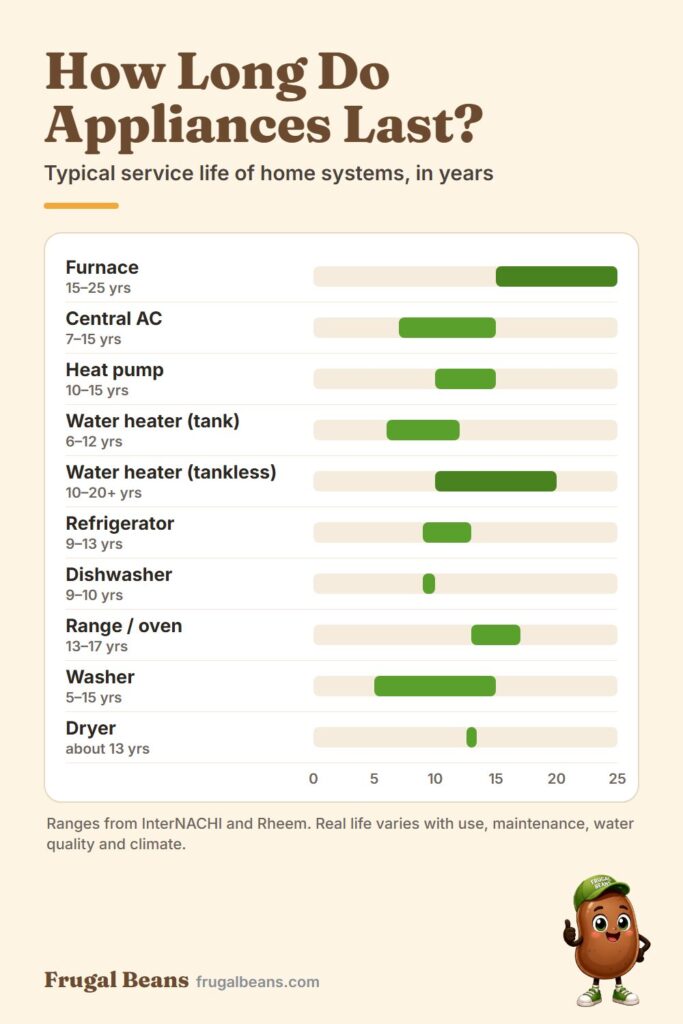
The numbers come mainly from the InterNACHI Standard Estimated Life Expectancy Chart, which home inspectors use to estimate the remaining life of the systems they inspect, and from Rheem for water heaters. They describe normal service life with normal care. A unit can fail early, and plenty of well-kept units run for years past the top of their range.
Typical Appliance Lifespan and Replacement Cost
This appliance lifespan table pulls together how long appliances last and what replacing the big systems usually costs nationally. The lifespan tracker uses these same figures. Local prices can be higher or lower, so treat them as a way to sanity-check a quote, not a replacement for one.
|
System |
Typical service life |
National installed replacement |
|
Furnace |
15–25 years |
$2,823–$6,897 (average $4,814) |
|
Central air conditioner |
7–15 years |
$3,887–$8,073 (average $5,978) |
|
Heat pump (air-source) |
10–15 years |
$4,500–$8,000, excluding ductwork |
|
Water heater (tank) |
6–12 years |
$882–$1,826 (average $1,348) |
|
Water heater (tankless) |
10–20+ years |
$1,400–$3,900 |
|
Refrigerator |
9–13 years |
Unit price plus installation |
|
Dishwasher |
9–10 years |
Unit price plus installation |
|
Range or oven |
13–17 years |
Unit price plus installation |
|
Clothes washer |
5–15 years |
Unit price plus delivery |
|
Clothes dryer |
About 13 years |
Unit price plus delivery |
For kitchen and laundry appliances, the tracker shows the timeline but leaves the dollar amount out, because the price depends so much on the model you choose. Heating, cooling and water heating replacements are where the big, hard-to-absorb bills come from, so those are the ones it builds a savings plan around.
Appliance Lifespan by Type: Reading the Ranges
A single number for appliance lifespan hides a lot. Here is what the ranges mean for each group of equipment, and why some are so much wider than others.
Heating and cooling
Furnaces have the longest home system lifespan of the big mechanical systems because most of their parts don’t move much. A gas furnace that gets a yearly tune-up often reaches 20 years. Central air conditioners and heat pumps work harder, with a compressor and outdoor coil exposed to weather, so their appliance lifespan is shorter. A heat pump that heats and cools runs year-round, which is why its range tops out at about 15 years.
Water heaters
A tank water heater holds hot water against steel all day, every day, so corrosion eventually wins. The anode rod inside the tank slows that down, and replacing it every few years can add life. Tankless models have no tank to rust, which is why their range runs to 20 years or more, but they still need descaling in hard-water areas.
Kitchen and laundry
Ask how long do appliances last in the kitchen and the answer is usually 9 to 17 years. Ranges last longest because they’re mostly a box, a heating element or burner and a few controls. Dishwashers and washers have pumps, seals and electronics that wear with every cycle. Washers show the widest home system lifespan range on the chart because a basic top-loader and a heavily used front-loader age very differently.
Whatever the type, the lifespan tracker treats the ranges the same way: the low end is when to start planning, and the high end is when a failure should no longer surprise you.
How the Home System Lifespan Tracker Works
The tracker compares the age of each system with its typical service life and sorts everything into four stages.
- Plenty of life: the system is well short of the age when replacements usually start.
- Approaching window: it has reached about 80% of the low end of its range. Nothing needs to happen yet, but this is when to start setting money aside.
- In replacement window: it’s between the low and high end of its typical life. Many units fail in this stretch, and some keep going.
- Past typical life: it has outlived the top of its range. It may still run fine, but a failure shouldn’t come as a shock, and a large repair is harder to justify.
Then it looks ahead. For each heating, cooling or water heating system it picks a target year to have the money ready, usually the middle of the replacement window or next year if the system is already past its typical life, and divides the national average replacement cost by the months left. Add those together and you get one monthly figure for your whole home.
The double-hit warning
The most expensive surprise isn’t one old system. It’s two. Homes often get their furnace and air conditioner installed at the same time, so they age together, and a water heater put in a few years later can end up in the same window. If two costed systems are due within two years of each other in the next five years, the tracker flags a possible double hit and suggests planning the money for them together. Replacing a furnace and AC in the same visit can also cost less in labor than two separate jobs, so it’s worth asking a contractor to quote both.
Your entries stay on your device
The lifespan tracker saves your install years in your own browser so they’re there when you come back. Nothing is sent to Frugal Beans or anyone else. Use Forget my entries to clear them, or Print my ledger to keep a paper copy with your house records.
How to Find the Age of Your Furnace, Water Heater and Appliances
The tracker needs one number for each system: the year it was installed. If you don’t have the paperwork, the data plate on the unit usually has the answer.
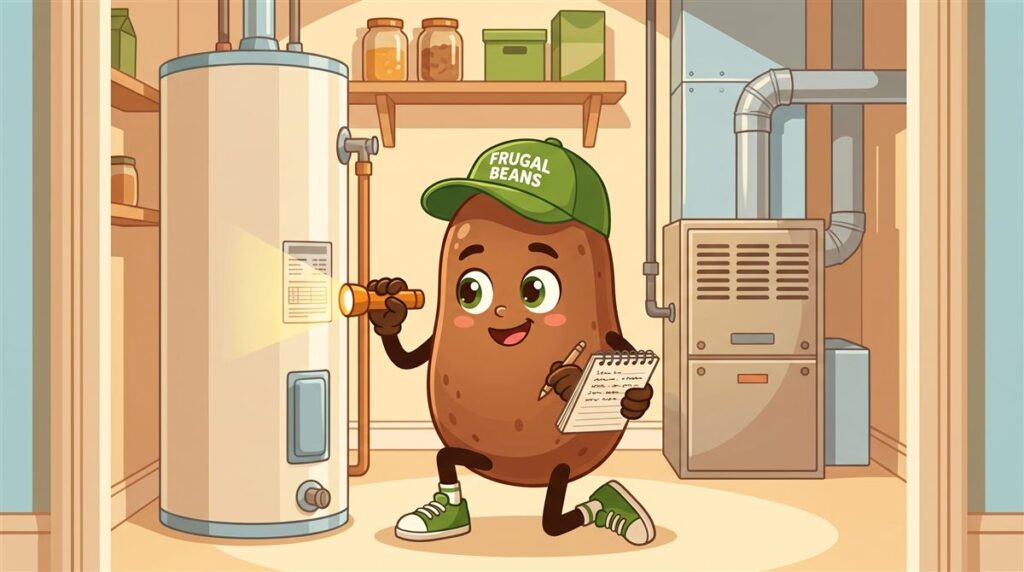
- Look for the data plate or rating label. On a furnace it’s usually inside the lower access door. On an outdoor AC or heat pump unit it’s on the side panel. On a tank water heater it’s a large sticker on the side of the tank. Refrigerators keep it inside the fresh food compartment, dishwashers on the edge of the door or the tub, and washers and dryers inside the door or lid, or on the back.
- Find the manufacture date. Many labels print it plainly. If they don’t, the date is usually coded into the serial number. Common patterns use two digits for the year and two for the week or month, or a letter that stands for the month followed by the year. Rheem and many other manufacturers explain their serial codes on their websites, so search the brand name plus “serial number date”.
- Check your records. Home inspection reports, closing documents, permits, receipts and warranty registrations often list the install date. Your HVAC company may also have it on file if they’ve serviced the unit.
- Estimate if you have to. If nothing turns up, use the year the house was built or the year you know the system was last replaced. A rough year is far better than leaving it out.
Manufacture and installation are usually within a year of each other, so the manufacture year is close enough for planning. Once you have a year for each system, enter it in the lifespan tracker above.
What Makes Appliances Last Longer or Wear Out Sooner
So how long do appliances last in your own home? It comes down to a handful of factors you can partly control, and each one can move a system toward the top or bottom of its appliance lifespan range.
Maintenance
This is the biggest one. Changing the furnace filter on schedule, having heating and cooling equipment serviced once a year, and keeping the outdoor AC unit clear of leaves and grass all reduce strain on motors and compressors. Draining sediment from a tank water heater once a year helps it heat efficiently and can extend its life. Cleaning the dryer lint screen every load and the vent once a year cuts drying time and reduces fire risk. Refrigerator coils that are vacuumed once or twice a year let the compressor run less.
Water quality
Hard water leaves mineral scale inside water heaters, dishwashers and washers. In a tank water heater it settles as sediment, which makes the burner or elements work harder. In a tankless heater it coats the heat exchanger. If you have hard water, regular flushing matters more, and a water softener can be worth pricing.
How hard the equipment works
An air conditioner in Phoenix runs far more hours each year than the same unit in Seattle, and a washer in a family of six runs more loads than one used by a single person. Equipment that’s sized wrong for the house also wears faster, because an oversized unit turns on and off constantly while an undersized one barely stops.
Installation quality
Poor ductwork, the wrong refrigerant charge, a badly vented water heater or a dryer pushing air through a long, crushed vent will all shorten the life of otherwise good equipment. When you replace a major system, the installer matters as much as the brand.
Signs a System Is Near the End
Age tells you when to expect a replacement, which is what the home system lifespan tracker shows. These signs tell you it may be getting close.
- Furnace: frequent cycling, uneven heat between rooms, rising gas bills, a yellow instead of blue burner flame, or repeated repairs in the last two winters.
- Air conditioner or heat pump: longer run times, warm air on hot days, higher summer bills, ice on the refrigerant lines, or a refrigerant leak on an older system.
- Tank water heater: rust-colored hot water, rumbling or popping from sediment, water pooling around the base, or running out of hot water sooner than it used to. A leaking tank can’t be repaired and should be replaced.
- Refrigerator: food spoiling early, frost building up in a frost-free freezer, the motor running constantly, or condensation on the outside.
- Dishwasher, washer and dryer: leaks, loud grinding, dishes or clothes that don’t come out clean or dry, or error codes that keep coming back.
A gas smell, a carbon monoxide alarm, scorched wiring or a cracked heat exchanger is a safety issue, not a planning issue. Leave the house and call your gas utility or 911 if you smell gas.
Turning the Timeline into a Savings Plan
The point of knowing how long appliances last is to pay for the next replacement out of savings instead of a credit card. Here is how to use what the lifespan tracker tells you.

- Start with the next system in line. The tracker names it at the top. If it’s already in its replacement window, start getting a rough price now, while there’s no emergency.
- Set up an automatic transfer. Move the monthly figure into a separate high-yield savings account labeled for home repairs. Keeping it separate makes it less tempting to spend.
- Plan double hits together. If the tracker flags two systems due close together, save for both from the same fund and ask contractors whether combining the jobs saves on labor.
- Revisit once a year. Open the tracker each fall before heating season, update anything you replaced, and adjust the transfer.
- When something breaks, run the numbers. If a repair quote arrives for a system in or past its window, put it through our repair or replace calculator before you say yes.
Even a partial fund changes the decision. With half the cost saved, you can choose the replacement you actually want, get several quotes and schedule the work for a mild week, instead of taking whatever is available on the coldest night of the year.
Frequently Asked Questions
How long do appliances last on average?
Most major kitchen and laundry appliances last about 9 to 17 years. Dishwashers sit near the bottom of that range at about 9 to 10 years, refrigerators run about 9 to 13, and ranges about 13 to 17. Washers vary the most, from about 5 to 15 years, depending on use and quality.
Which home system usually needs replacing first?
In many homes it’s the tank water heater, with a typical life of 6 to 12 years, followed by the central air conditioner at 7 to 15. Furnaces tend to last longest of the major systems, often 15 to 25 years. The lifespan tracker sorts your own systems by which is due first.
Should I replace an appliance just because it’s old?
Not usually. A system past its typical life that runs well and doesn’t need repairs can keep going. Age matters most when a repair is needed. That’s when the remaining life of the unit decides whether the repair is worth paying for. Our repair or replace calculator weighs both.
Does a home warranty cover old appliances?
Many home warranty plans cover systems regardless of age, but they often limit what they’ll pay, exclude certain failures and charge a service fee per visit. Read the coverage limits closely. Setting aside the monthly figure from the tracker is a useful comparison against the yearly cost of a plan.
How accurate is the home system lifespan tracker?
It uses published national ranges, so it’s a planning tool, not a prediction for your specific unit. It can’t see how well your system has been maintained or how hard it works. Use it to know what’s coming and how much to save, and rely on an inspection or a technician’s assessment for the condition of a particular system.
Does the tracker save my information?
Only in your own browser. Your install years are stored on your device so they’re there when you return, and nothing is sent to Frugal Beans or anyone else. You can clear them at any time with Forget my entries.
The Bottom Line
Every system in your home has a typical lifespan, and most replacements can be seen coming years in advance. Knowing the answer to how long do appliances last turns a surprise bill into a planned one. Enter your install years in the lifespan tracker, start a monthly transfer for the next system in line, and come back each fall to keep the timeline current. For more ways to plan the cost of the big repairs, get our free Homeowner Repair Cost Playbook.
Sources: service life from the InterNACHI Standard Estimated Life Expectancy Chart and Rheem; maintenance and replacement guidance from ENERGY STAR; national cost ranges from HomeAdvisor pages updated June 2026, checked 15 October 2026. This tool provides general information, not professional, financial or contracting advice.

Get the free Homeowner Repair Cost Playbook
Which systems fail first, what they cost, the warning signs, and the repair-or-replace rule. 15 printable pages.
Free. No spam.
Free tool
Repair or replace?
Got a quote for your furnace, AC, water heater or an appliance? Check it in under a minute.
Free tool
What needs replacing next?
Enter the install years for your furnace, AC, water heater and appliances. See what is due first and what to save each month.