Grocery Budget Calculator
How much should you spend on groceries? This free grocery budget calculator answers that with USDA’s official food plan costs. Add everyone in your household, pick one of the four USDA food plans, and you’ll get a monthly and weekly grocery budget, plus an easy comparison with what you spend today.
Loading the grocery budget calculator… If it doesn’t appear, please make sure JavaScript is turned on.
How to Use the Grocery Budget Calculator
- Add each person you buy groceries for. Choose their age group and sex. USDA’s costs differ by age because a teenager eats more than a toddler.
- Pick a food plan. The four USDA plans run from Thrifty to Liberal. Each card shows your household’s monthly cost, so you can compare them at a glance.
- Read your budget. The grocery budget calculator shows the monthly, weekly and yearly amount, and the cost per person. It applies USDA’s household-size adjustment for you.
- Compare with your real spending (optional). Enter what you spend on groceries in a typical month. You’ll see where you fall among the four plans and how much a step down would save.
Your household is saved in your own browser, so it’s ready next time. Nothing is sent to Frugal Beans.
What Are the USDA Food Plans?
The U.S. Department of Agriculture publishes four food plans, each a healthy diet at a different cost: the Thrifty, Low-Cost, Moderate-Cost and Liberal plans. Every plan assumes that all meals and snacks are prepared at home, and USDA updates the costs every month for inflation. The Thrifty Food Plan is also the basis for maximum SNAP benefits (USDA).
- Thrifty: USDA’s lowest-cost healthy diet. Achievable with careful planning, cooking from scratch and few convenience foods.
- Low-Cost: a tight but more comfortable budget, with a bit more variety.
- Moderate-Cost: close to what many middle-income households actually spend.
- Liberal: more variety, premium items and convenience foods.
The grocery budget calculator uses USDA’s October 2026 U.S. average costs. Your local prices may be higher or lower, especially in Alaska, Hawaii and high-cost cities.
Average Grocery Bill by Household Size
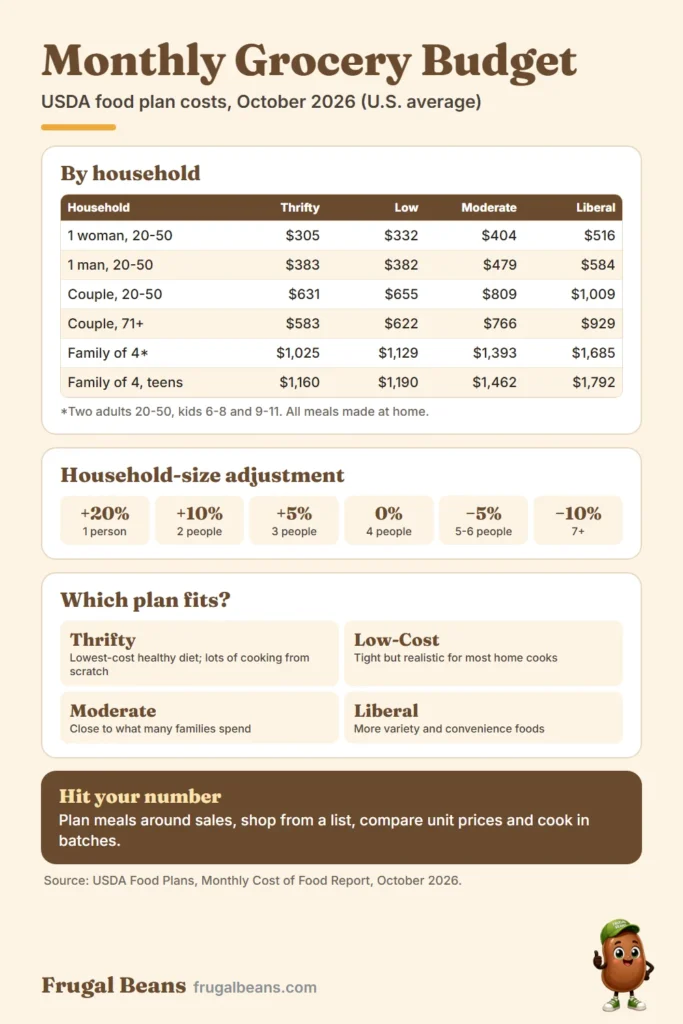
Here’s what the USDA food plans work out to for common households (October 2026, monthly, rounded):
| Household | Thrifty | Low-Cost | Moderate | Liberal |
| 1 woman, 20-50 | $305 | $332 | $404 | $516 |
| 1 man, 20-50 | $383 | $382 | $479 | $584 |
| Couple, 20-50 | $631 | $655 | $809 | $1,009 |
| Couple, 71+ | $583 | $622 | $766 | $929 |
| Couple + toddler (2-3) | $783 | $808 | $991 | $1,228 |
| Family of 4 (kids 6-8 and 9-11) | $1,025 | $1,129 | $1,393 | $1,685 |
| Family of 4 with teens (14-19) | $1,160 | $1,190 | $1,462 | $1,792 |
| Family of 5 (kids 4-5, 6-8, 9-11) | $1,152 | $1,243 | $1,534 | $1,856 |
For your exact household, use the grocery budget calculator above. Small differences in ages change the total.
Grocery Budget for a Family of 4
For USDA’s reference family of four (two adults aged 20 to 50 and two children aged 6 to 8 and 9 to 11), the Thrifty plan costs $1,024.60 a month, about $237 a week. The Low-Cost plan is about $1,129 a month and the Moderate plan about $1,393. So a reasonable grocery budget for a family of 4 falls somewhere between about $1,000 and $1,400 a month, depending on how much you cook from scratch. A family with teenagers will need more; one with toddlers, less.
How the Grocery Budget Calculator Works
USDA lists a monthly cost for each age and sex group, assuming they live in a four-person household. The grocery budget calculator adds up the cost for each person, then applies USDA’s household-size adjustment, because small households pay more per person and large ones less:
- 1 person: add 20%
- 2 people: add 10%
- 3 people: add 5%
- 4 people: no change
- 5 or 6 people: subtract 5%
- 7 or more: subtract 10%
Weekly figures are the monthly cost divided by 4.333, the same factor USDA uses.
One quirk: for some age groups, the Thrifty plan costs a little more than the Low-Cost plan. That’s because USDA rebuilt the Thrifty plan in 2021, while the other three plans are still based on 2007 market baskets. The calculator shows a note when this happens for your household.
What a Grocery Budget Doesn’t Include
USDA’s costs cover food and drinks prepared at home only. They leave out restaurant meals, takeout, coffee shops, alcohol, and household items like paper towels, cleaning supplies and toiletries that many people buy at the grocery store. Budget those separately. Our 50/30/20 budget calculator treats dining out as a want and groceries as a need.
How to Lower Your Grocery Bill
- Plan meals and shop from a list. Build the week’s meals around sales and what’s already in your pantry.
- Compare unit prices. Bigger isn’t always cheaper. Our unit price calculator shows the better buy per ounce or per item.
- Try store brands. They’re often noticeably cheaper for similar quality.
- Cook in batches. A big pot of soup, chili or beans becomes several meals and lunches.
- Cut food waste. Use leftovers on purpose, freeze extras, and check the fridge before you shop.
- Buy seasonal produce and use frozen fruit and vegetables, which are often cheaper and keep longer.
- Limit convenience foods. Pre-cut, pre-marinated and single-serve items carry a premium.

Is a Grocery Budget Calculator Better Than the Average Grocery Bill?
National averages mix households of every size and every eating habit. A grocery budget calculator built on USDA’s food plans is more useful because it reflects your household’s ages and size and a healthy diet at a cost level you choose. If your current spending is well above the Moderate plan, there’s likely room to save. If it’s below the Thrifty plan, make sure everyone is getting enough healthy food.
Weighing meal kits against cooking from scratch? Our guide to meal kit delivery compares their per-serving cost with groceries.
Frequently Asked Questions
How much should I spend on groceries a month?
Use the grocery budget calculator above for your household. As a guide, USDA’s October 2026 costs put one adult at roughly $305 to $584 a month across the four plans, and a family of four at about $1,025 to $1,685.
What is a good grocery budget for 2 people?
For a couple aged 20 to 50, USDA’s plans range from about $631 a month on the Thrifty plan to $1,009 on the Liberal plan, including USDA’s 10% adjustment for a two-person household.
Which USDA food plan should I use?
If you’re trying to save, start with the Low-Cost plan; it’s realistic for most households that cook at home. The Thrifty plan takes more planning. If you’re unsure, enter what you spend now and see where you fall.
Does the grocery budget include eating out?
No. USDA’s food plans assume every meal and snack is made at home. Add restaurant meals and takeout as a separate line in your budget.
How often are the costs updated?
USDA publishes new costs every month. This grocery budget calculator uses the October 2026 report, and we update it periodically.
Is my information saved?
Only in your own browser. Nothing is sent to Frugal Beans.
The Bottom Line
A realistic grocery budget starts with your household’s ages and size, not a national average. Use the free grocery budget calculator to find your number on USDA’s four food plans, compare it with what you spend, and then plan meals, compare unit prices and cut waste to hit it. For more ideas, see our ways to save money and all of our free tools.
Sources: USDA Food Plans: Monthly Cost of Food Reports, U.S. average, October 2026, Thrifty Food Plan and Low-Cost, Moderate-Cost and Liberal Food Plans, including USDA’s household-size adjustments (USDA). This tool provides general information, not nutrition or financial advice.

Get the free Homeowner Repair Cost Playbook
Which systems fail first, what they cost, the warning signs, and the repair-or-replace rule. 15 printable pages.
Free. No spam.
Free tools
Got a quote? Check it in under a minute.
Ballpark a new furnace before the contractor visits.
Price a tank, tankless or heat pump model.
Warm air, ice or noise? See the likely part and price.