Debt Snowball Calculator
The debt snowball pays off your smallest balance first, then rolls that payment into the next one. The debt avalanche goes after the highest interest rate first. This free debt snowball calculator runs both plans side by side with your real balances, so you can see your debt-free date, the total interest you’ll pay and exactly which debt to attack first.
Loading the debt snowball calculator… If it doesn’t appear, please make sure JavaScript is turned on.
How to Use the Debt Snowball Calculator
- List every debt you want to pay off: credit cards, store cards, personal loans, car loans, medical bills and student loans. Leave out your mortgage unless you’re paying it off early on purpose.
- Enter the balance, interest rate (APR) and minimum payment for each one. All three are on your latest statement or in your lender’s app.
- Enter the extra amount you can pay each month on top of the minimums. Even $50 makes a visible difference.
- Compare the results. The debt snowball calculator shows the debt-free date and total interest for the snowball, the avalanche and minimum payments only, plus a chart of your total balance over time.
- Follow your plan. Switch between the snowball and avalanche tabs to see the payoff order, with the month each debt disappears.
Your debts are saved in your own browser so you can update them each month. Nothing is sent to Frugal Beans.

How the Debt Snowball Method Works
The debt snowball method is simple. You keep a fixed total amount going to debt every month, and you aim the extra at one debt at a time:
- List your debts from the smallest balance to the largest, ignoring interest rates.
- Pay the minimum on every debt.
- Put every extra dollar toward the smallest balance.
- When it’s paid off, add its whole payment to the next-smallest debt. The payment “snowballs” as each debt disappears.
Because the payment you roll forward keeps growing, the last and largest debts go faster than you might expect. The Consumer Financial Protection Bureau notes that the snowball shows progress quickly, though you may pay more in interest over time (CFPB).
How the Debt Avalanche Method Works
The debt avalanche follows the same steps with one change: you list debts from the highest interest rate to the lowest. Extra money goes to the most expensive debt first. Mathematically, that’s the cheapest way to pay off debt, because every extra dollar stops the highest rate from compounding. Use the debt snowball calculator’s avalanche tab to see that order with your own numbers.
Debt Snowball vs. Avalanche: An Example
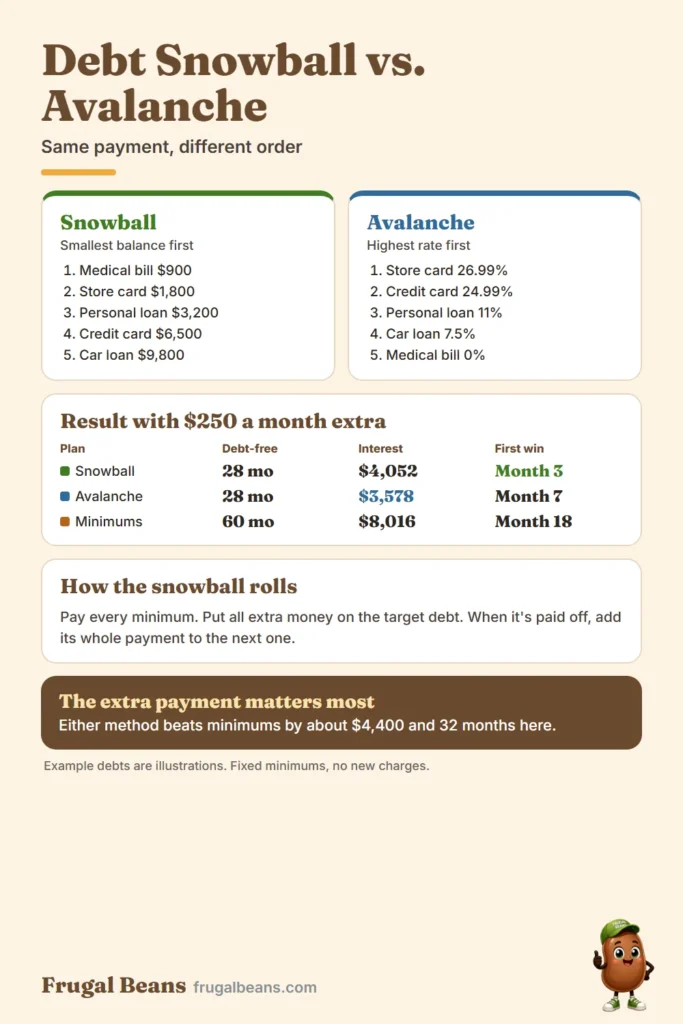
Here’s the example built into the debt snowball calculator, with $250 a month extra on top of $695 in minimums ($945 a month in total):
| Debt | Balance | APR | Minimum |
| Medical bill | $900 | 0% | $50 |
| Store card | $1,800 | 26.99% | $55 |
| Personal loan | $3,200 | 11% | $105 |
| Credit card | $6,500 | 24.99% | $195 |
| Car loan | $9,800 | 7.5% | $290 |
| Plan | Debt-free in | Total interest | First debt gone |
| Snowball | 28 months | $4,052 | Month 3 |
| Avalanche | 28 months | $3,578 | Month 7 |
| Minimums only | 60 months | $8,016 | Month 18 |
The avalanche saves $474 in interest. The snowball wipes out the medical bill in month 3, and the store card follows in month 9, giving two quick wins early on. Both plans finish in the same month here, and either one saves about $4,400 in interest and 32 months compared with paying only the minimums. The biggest win isn’t the method; it’s the extra $250 a month.
Which Is Better: Snowball or Avalanche?
If you’ll stick with either plan, the avalanche costs less. But a plan only works if you finish it. Researchers at Northwestern University’s Kellogg School studied nearly 6,000 people in a debt settlement program and found that the number of accounts they closed predicted whether they finished the program better than the dollars they repaid, which suggests small wins help people keep going (Kellogg Insight).
- Choose the snowball if you’ve tried and stalled before, if you have several small balances, or if the interest gap between methods is small in the debt snowball calculator.
- Choose the avalanche if you’re motivated by numbers, if one large balance carries a very high rate, or if the calculator shows a big interest difference.
- Mix them if it helps: knock out one or two tiny balances for momentum, then switch to the avalanche.
Want a second opinion on your payoff plan?
JustAnswer lets you ask a finance expert online, as a paid consultation, about which debt to pay first, whether consolidation or a balance transfer makes sense, or how to fit a bigger payment into your budget.
Partner link. Frugal Beans may earn a commission if you buy a consultation, at no extra cost to you. An online consultation is general guidance, not a substitute for a nonprofit credit counselor or a fee-only advisor who reviews your full situation.
Tips to Pay Off Debt Faster
- Find a bigger extra payment. Our 50/30/20 budget calculator shows how much of your pay goes to wants, and every dollar you redirect shortens the plan.
- Stop adding new debt. Take cards out of your wallet and online stores while you pay them down. A no spend challenge is a good way to start.
- Keep a starter emergency fund. Without one, a car repair goes straight back on a card. The emergency fund calculator suggests a starter amount.
- Put windfalls on the target debt. Tax refunds, bonuses and side income can wipe out a whole balance at once.
- Ask for a lower rate. A call to your card issuer can sometimes lower the APR, which helps under either method.
- Celebrate each payoff in a small, free way, then roll the payment forward the same day.
Update your balances in the debt snowball calculator every month or two. Watching the debt-free date move closer is its own motivation.

What About Debt Consolidation or Balance Transfers?
A lower-rate consolidation loan or a 0% balance transfer card can cut the interest you pay, but only if you stop using the paid-off cards and pay the new balance before any promotional rate ends. Check balance transfer fees, which are often a percentage of the amount moved. Enter the new loan’s balance, rate and payment in the debt snowball calculator to compare it with your current plan before you apply.
If you can’t keep up with your minimum payments, talk to a nonprofit credit counseling agency before missing payments. The U.S. Trustee Program keeps a list of approved credit counseling agencies, and our guide to secured and unsecured debt explains how different debts work.
Frequently Asked Questions
How does a debt snowball calculator work?
It simulates your debts month by month. Each month interest is added, every debt gets its minimum payment, and the rest of your monthly debt budget goes to the target debt. When a debt is paid off, its payment rolls into the next one until everything is paid.
Is this also a debt avalanche calculator?
Yes. The debt snowball calculator runs the avalanche at the same time, so it works as a debt avalanche calculator too. Switch to the “Avalanche plan” tab to see the highest-rate-first order and payoff dates.
Debt snowball vs. avalanche: which saves more?
The avalanche almost always saves more interest. How much depends on your rates and balances; with similar rates the gap can be tiny, and the debt snowball calculator shows the exact difference for your debts.
Does the debt snowball method include mortgages?
Usually not. Most people use the snowball for consumer debt like credit cards, personal loans, car loans and medical bills, and treat paying off a mortgage early as a separate goal.
Should I stop saving for retirement while I pay off debt?
Many people keep contributing at least enough to get any employer match, because that’s an immediate return. The rest of your extra money can go to debt.
What if a minimum payment doesn’t cover the interest?
Then that balance grows on minimums alone. The debt snowball calculator flags it. Paying extra, asking for a lower rate or talking to a credit counselor can help.
Why might my real payoff date differ?
The calculator assumes fixed minimum payments and no new charges. Card issuers often lower your minimum as the balance falls, and rates can change. Keep your payment the same even if the required minimum drops, and update your numbers every few months.
Is my information saved?
Only in your own browser. Nothing is sent to Frugal Beans. Click “Start over” to clear your debts.
The Bottom Line
The best way to pay off debt is the one you’ll keep doing. The avalanche saves the most interest; the snowball builds momentum with quick wins. Use the free debt snowball calculator to compare both with your real numbers, pick a plan, and put every extra dollar to work. For more ways to free up cash, see our ways to save money and all of our free tools.
Sources: method descriptions from the Consumer Financial Protection Bureau, Reducing debt worksheet. Research on small wins from Gal and McShane, Journal of Marketing Research (2012), as summarized by Kellogg Insight. Example figures are illustrations calculated by this tool. This tool provides general information, not financial advice.

Get the free Homeowner Repair Cost Playbook
Which systems fail first, what they cost, the warning signs, and the repair-or-replace rule. 15 printable pages.
Free. No spam.
Free tools
Got a quote? Check it in under a minute.
Ballpark a new furnace before the contractor visits.
Price a tank, tankless or heat pump model.
Warm air, ice or noise? See the likely part and price.