Home Repair Fund Calculator: How Much to Save for Home Repairs

How much should you save for home repairs? This free home repair fund calculator turns the big replacements you can see coming, such as a furnace, air conditioner, water heater or roof, into one monthly number. Enter a cost, the years until you expect to need it and what you have already saved. It shows what to set aside each month, which replacement comes first, and whether the amount you can afford covers everything on time.
Loading the home repair fund calculator… If it doesn’t appear, please make sure JavaScript is turned on.
How Much to Save for Home Repairs: The Short Answer
There are two simple ways to answer how much to save for home repairs, and the calculator uses both. The first plans for each big replacement on its own: take the cost, subtract what you have saved, and divide by the months until you expect to need it. The second is a rule of thumb from Fannie Mae: budget 1% to 4% of your home’s value each year for maintenance, repairs and replacements.
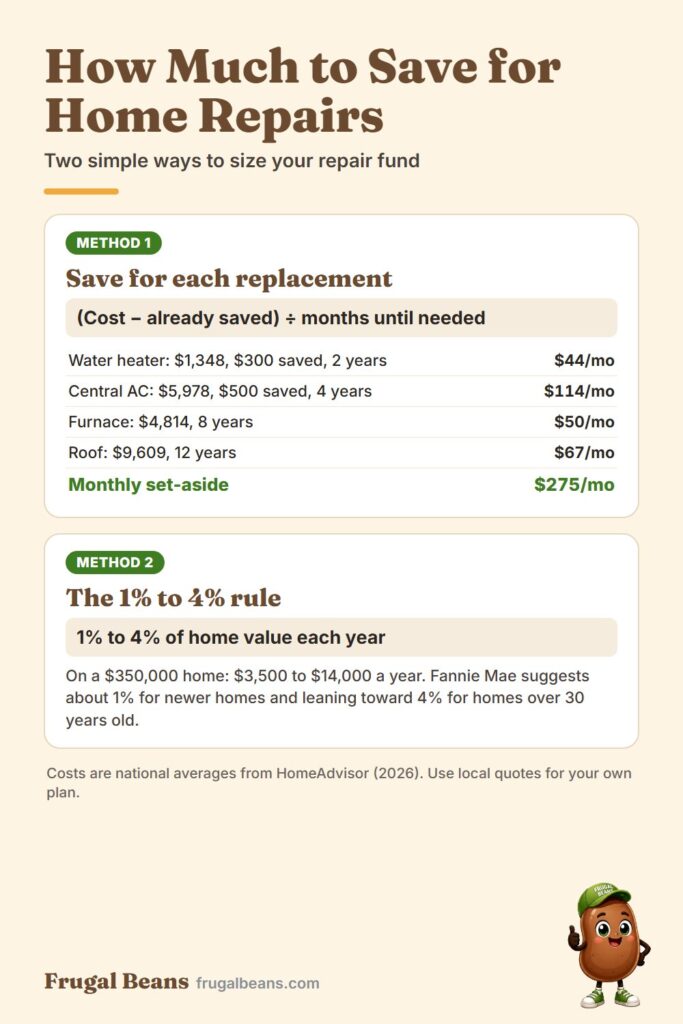
The first method is more precise for the big-ticket systems because it uses your own timeline. The second is a useful check on your whole home maintenance budget, because it also covers the smaller jobs no one can predict, such as a leaking faucet, a broken garage door spring or a fence panel after a storm. Most households end up using the item-by-item number for the home repair fund and treating the 1% to 4% rule as a ceiling for total upkeep.
How the Home Repair Fund Calculator Works
The home repair fund calculator does four things with the numbers you enter.
- Sets a monthly amount for each replacement. For each row it subtracts what you have already saved from the cost and spreads the rest evenly over the months until the replacement is due. Add the rows together and you get one monthly set-aside.
- Shows the shared-fund minimum. If you keep one home repair fund instead of a separate pot for each system, money saved for later replacements can pay for the earlier ones first. The calculator works out the lowest steady monthly amount that still covers every replacement on its due date, and explains the trade-off.
- Tests your real budget. Enter what you can actually save each month and it checks, replacement by replacement, whether the fund would be big enough on time. If it would fall short, it tells you where, by how much, and what monthly amount would close the gap.
- Checks the 1% to 4% rule. Add your home’s value and age, and it shows the yearly and monthly range from Fannie Mae’s rule of thumb next to your own plan.
If you have already used our home system lifespan tracker in the same browser, the calculator offers to import your install years and work out the years until each system is likely due.
Why the calculator ignores interest
Savings accounts pay interest, and it helps. The calculator leaves it out on purpose. Rates change, and replacement prices usually rise over time too, so the two roughly offset each other. Leaving interest out keeps the monthly figure slightly conservative, which is the safer mistake to make when the bill is a new roof.
Your numbers stay on your device
The calculator saves your entries in your own browser so your plan is there when you come back. Nothing is sent to Frugal Beans or anyone else. Use Forget my entries to clear them, or Print my plan to keep a copy with your house records.
Method 1: Save for Each Big Replacement
Planning one replacement at a time is the clearest way to work out how much to save for home repairs, because it ties every dollar to a real bill. Financial planners call this a sinking fund: money set aside on a schedule for an expense you know is coming. The formula is short.
Monthly amount = (replacement cost − amount already saved) ÷ months until it is needed
Here is the example home the calculator starts with. The water heater is due in two years and has $300 saved. The air conditioner is due in four years with $500 saved. The furnace has about eight years left, and the roof about twelve.
|
Replacement |
Cost |
Saved |
Years left |
Monthly |
|
Water heater (tank) |
$1,348 |
$300 |
2 |
$44 |
|
Central air conditioner |
$5,978 |
$500 |
4 |
$114 |
|
Furnace |
$4,814 |
$0 |
8 |
$50 |
|
Roof |
$9,609 |
$0 |
12 |
$67 |
|
Total |
$21,749 |
$800 |
$275 |
Notice where the pressure sits. The air conditioner costs less than the roof, but it needs the biggest monthly amount because it is due much sooner. That is the main lesson of a home repair fund: the deadline matters as much as the price.
Separate pots or one shared fund?
In the example, keeping one shared home repair fund would need only about $145 a month to pay for each replacement on its due date. The money set aside for the roof pays for the air conditioner first, then gets rebuilt over the following years. The catch is that the shared fund runs close to empty right after each replacement, so a second surprise in the same year could leave you short. If you can manage the full item-by-item amount, it gives you a real cushion. If you can’t, the shared-fund minimum tells you the least you can save and still stay on schedule.
Method 2: The 1% to 4% Home Maintenance Budget Rule
Fannie Mae’s rule of thumb is to budget 1% to 4% of your home’s value each year for maintenance costs, including repairs and replacements. On a $350,000 home, that is $3,500 to $14,000 a year, or about $292 to $1,167 a month. Fannie Mae suggests 1% should be enough for a newer home, and that leaning toward 4% may make sense for a home more than 30 years old.
The rule is a good starting point for a total home maintenance budget, but it has limits. It is tied to the value of the home rather than its condition, so two houses worth the same amount can need very different budgets. A home in an expensive market may not need more repairs just because it is worth more, and an older, modest home can need far more than 1%. Use the rule as a range to check against, and let your own list of replacements set the real number.
Fannie Mae also suggests tracking what you spend on regular upkeep through the year, such as landscaping, fixing leaks, painting and refinishing floors. After a year or two you will know what your own house actually costs to run, which is better than any rule of thumb.
Typical Replacement Costs for Your Home Repair Fund
These are the national figures the calculator uses as defaults. They are averages, and local prices can be well above or below them. When you have a written quote, use it instead.
|
Replacement |
National installed cost |
Typical service life |
|
Furnace |
$2,823–$6,897 (average $4,814) |
15–25 years |
|
Central air conditioner |
$3,887–$8,073 (average $5,978) |
7–15 years |
|
Heat pump (air-source) |
$4,500–$8,000, excluding ductwork |
10–15 years |
|
Water heater (tank) |
$882–$1,826 (average $1,348) |
6–12 years |
|
Water heater (tankless) |
$1,400–$3,900 |
10–20+ years |
|
Roof replacement |
$5,902–$13,377 (average $9,609) |
Varies by material |
Roof life depends heavily on the material, the climate and how well the attic is ventilated, so the calculator asks for the years left rather than guessing. A roofer’s inspection or your home inspection report is the best guide.
Where to Keep Your Home Repair Fund

A home repair fund works best when it is easy to add to and a little harder to spend on anything else.
- Keep it separate. A dedicated savings account, ideally a high-yield one at a federally insured bank or credit union, keeps the money visible and out of your everyday checking balance.
- Keep it apart from your emergency fund. Fannie Mae suggests one fund for home maintenance and another for emergencies, so a job loss, medical bill or car repair doesn’t have to compete with a new furnace.
- Automate it. Set up a transfer on payday for the monthly amount the calculator gives you. Money that moves before you see it is much easier to save.
- Name it. Many banks let you nickname an account. “Furnace and roof” is harder to raid than “Savings 2”.
How to Build a Home Repair Fund When Money Is Tight
If the monthly figure looks impossible, don’t skip the plan. A partial fund still changes what happens when something breaks.
- Start with the first deadline. The calculator names the replacement due soonest. Fund that one first, even if the others wait.
- Use the shared-fund minimum. It is the least you can save and still cover each replacement on time, as long as nothing fails early.
- Add windfalls. Tax refunds, bonuses and the money from selling things you no longer use can jump-start the fund.
- Stretch what you safely can. A well-maintained system may run past the middle of its typical life. Annual servicing, clean filters and a flushed water heater can buy time, though they can’t stop the clock.
- Revisit every year. Update your costs and years each fall before heating season, and raise the transfer when another bill goes away.
Even half the cost saved means you can choose the replacement you want, get several quotes and schedule the work for a mild week, instead of taking whatever is available on the coldest night of the year.
How to Estimate the Years Left on Each System

The calculator needs a number of years for each replacement. If you don’t know it, these sources help:
- The install year. Our free home system lifespan tracker turns install years into a likely replacement year using published service-life ranges, and this calculator can import the result.
- Your home inspection report. Inspectors usually note the age and condition of the roof, furnace, air conditioner and water heater.
- A service visit. Ask your HVAC technician or plumber how much life they think a system has left, and why.
- Warning signs. Rising energy bills, repeated repairs, rust on a water heater tank or curling shingles all suggest moving a replacement earlier in your plan.
When a repair quote arrives for a system that is already old, run it through our repair or replace calculator before you pay. Sometimes the frugal choice is to put the repair money toward the replacement instead.
Common Home Repair Fund Mistakes
A home repair fund is simple, but a few habits make it much less useful than it could be.
- Planning only for the most expensive item. The roof is the biggest number, but the water heater or air conditioner is often due first. Sort by deadline, not by price.
- Using national averages forever. Defaults are a starting point. Once you have a written quote for a system, replace the average with your local price, which can be much higher in some markets.
- Borrowing from the fund for non-repair spending. A vacation or a new couch can feel affordable when the balance looks large. That balance already has a job.
- Forgetting to refill after a replacement. Once the water heater is paid for, the next replacement still needs money. Keep the transfer running and point it at the next deadline.
- Ignoring two replacements that land close together. Systems installed at the same time tend to age together. If the furnace and air conditioner are due within a year or two of each other, plan the money for both at once.
- Treating the 1% rule as the whole plan. A home maintenance budget based only on home value can miss an old roof on an otherwise modest house. Use the rule as a check, not a substitute for knowing your own systems.
Avoiding these mistakes matters more than finding the perfect number. A steady, automatic transfer that you revisit once a year will do more for your home than a precise plan you never fund.
What a Home Repair Fund Covers, and What Insurance Doesn’t
A home repair fund is for wear and tear: the furnace that reaches the end of its life, the roof that ages out, the water heater that finally rusts through. Standard homeowners insurance is generally designed for sudden, accidental damage, such as a fire or a tree falling on the house, and policies typically exclude damage from wear and tear or lack of maintenance. Check your own policy, but don’t count on insurance to replace an old system.
Home warranties, which are service contracts rather than insurance, can cover some system and appliance failures, but they come with service fees, coverage limits and exclusions. Whatever you decide about a warranty, a home repair fund is the one plan that pays for anything, with no claim to file.
Frequently Asked Questions
How much should I have in a home repair fund?
Enough to pay for the next big replacement when it is due, and a cushion for smaller repairs. A practical target is the monthly amount from the calculator for your big replacements, checked against Fannie Mae’s guideline of 1% to 4% of your home’s value each year for total maintenance and repairs.
How much to save for home repairs on an older house?
More than on a new one. Fannie Mae suggests leaning toward 4% of the home’s value each year for homes more than 30 years old. Older homes are more likely to have several systems near the end of their lives at the same time, so plan for each one and watch for replacements that fall close together.
Is a home repair fund the same as an emergency fund?
No. An emergency fund covers sudden events such as a job loss or medical bill. A home repair fund covers predictable home costs that just haven’t arrived yet. Keeping them separate means one doesn’t drain the other.
Should I include appliances in my home repair fund?
You can. Use the two “something else” rows in the calculator for a refrigerator, washer, septic pump or deck, using a local price. Major appliances cost less than heating, cooling or roofing, so many households cover them from the general part of their home maintenance budget instead.
Does the calculator include interest?
No. It leaves interest out so the monthly number is slightly conservative. Any interest your savings earn is a bonus that helps cover price increases.
Does the calculator save my information?
Only in your own browser, so your plan is there when you return. Nothing is sent to Frugal Beans or anyone else. You can clear it at any time with Forget my entries.
The Bottom Line
Big home repairs are rarely true surprises. Most of them can be seen coming years in advance, and a home repair fund turns them into a steady monthly transfer instead of a credit card balance. Use the calculator to work out how much to save for home repairs, start with the replacement due first, and check your total against the 1% to 4% rule. For typical costs, warning signs and a printable replacement ledger, get our free Homeowner Repair Cost Playbook.
Sources: maintenance budget rule of thumb and separate-fund guidance from Fannie Mae; national replacement costs from HomeAdvisor’s furnace and roof replacement cost guides (updated June 2026, checked 16 October 2026); service life from the InterNACHI Standard Estimated Life Expectancy Chart. This tool provides general information, not professional, financial or contracting advice.

Get the free Homeowner Repair Cost Playbook
Which systems fail first, what they cost, the warning signs, and the repair-or-replace rule. 15 printable pages.
Free. No spam.
Free tool
Repair or replace?
Got a quote for your furnace, AC, water heater or an appliance? Check it in under a minute.
Free tool
What needs replacing next?
Enter the install years for your furnace, AC, water heater and appliances. See what is due first and what to save each month.