50/30/20 Budget Calculator
The 50/30/20 rule is one of the simplest ways to budget: put about half of your take-home pay toward needs, 30% toward wants and 20% toward savings and paying off debt. This free 50/30/20 budget calculator turns your monthly pay into those three dollar targets, then lets you add what you really spend to see where your budget fits and where it doesn’t.
Loading the 50/30/20 budget calculator… If it doesn’t appear, please make sure JavaScript is turned on.
How to Use the 50/30/20 Budget Calculator
- Enter your monthly take-home pay. That’s the amount that reaches your bank account after taxes. If you’re paid every two weeks, multiply one paycheck by 26 and divide by 12.
- Add retirement money taken out of your paycheck, if any. A 401(k) or 403(b) contribution comes out before you see your pay, but it’s still money you’re saving, so the 50/30/20 budget calculator counts it as both income and savings.
- Choose a split. The classic is 50/30/20. You can also pick 60/20/20 or set your own percentages, for example to model a 70/20/10 budget.
- Read your targets. The calculator shows how much to spend on needs and wants, and how much to save, each month and each year.
- Compare with your real spending (optional). Open the comparison section and enter last month’s spending by category. The 50/30/20 budget calculator shows how each bucket compares with its target and what’s left unassigned.
Your numbers are saved in your own browser, so you can come back next month and update them. Nothing is sent to Frugal Beans.

What Is the 50/30/20 Rule?
The 50/30/20 rule divides your after-tax income into three buckets. It was popularized by Elizabeth Warren and her daughter, Amelia Warren Tyagi, in their book All Your Worth: The Ultimate Lifetime Money Plan. Instead of tracking dozens of categories, you only check three numbers:
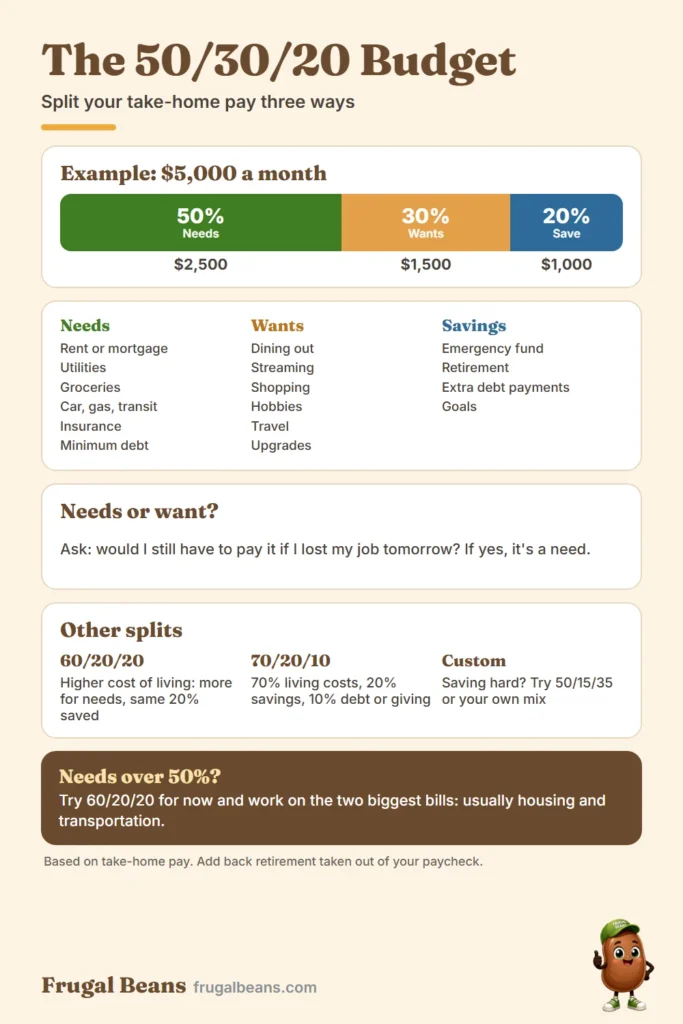
- 50% for needs: the bills you must pay to live and work.
- 30% for wants: the things that make life enjoyable but that you could cut back if you had to.
- 20% for savings and debt payoff: money that improves your future, such as an emergency fund, retirement savings and extra debt payments. Use the debt snowball calculator to decide which debt gets the extra first.
The appeal is its simplicity. A 50/30/20 budget gives you a clear limit for essentials, room to enjoy your money without guilt, and a built-in savings habit.
50/30/20 Budget Example
Here’s how the 50/30/20 budget calculator splits a few common take-home incomes:
| Monthly take-home pay | Needs (50%) | Wants (30%) | Savings (20%) |
| $3,000 | $1,500 | $900 | $600 |
| $4,000 | $2,000 | $1,200 | $800 |
| $5,000 | $2,500 | $1,500 | $1,000 |
| $6,500 | $3,250 | $1,950 | $1,300 |
| $8,000 | $4,000 | $2,400 | $1,600 |
Take someone bringing home $5,000 a month whose rent, utilities, groceries, car, insurance, phone and minimum debt payments add up to $3,520. That’s 70% of their pay, well above the 50% target. With $920 of wants and $350 of savings, the 50/30/20 budget calculator shows needs $1,020 over target and savings $650 short. The quickest fix isn’t cutting coffee: it’s housing or transportation, or switching to a 60/20/20 split while those costs come down.
What Counts as Needs, Wants and Savings?
| Needs (about 50%) | Wants (about 30%) | Savings and debt (about 20%) |
| Rent or mortgage | Dining out and takeout | Emergency fund |
| Utilities | Streaming and subscriptions | Retirement contributions |
| Groceries | Shopping and clothes beyond the basics | Extra debt payments |
| Car payment, gas, transit | Entertainment and hobbies | Saving for a home or other goals |
| Insurance | Travel and vacations | College savings |
| Minimum debt payments | Upgrades you could skip |
A useful test for needs vs. wants: would you still have to pay it if you lost your job tomorrow? Rent and the electric bill, yes. A premium streaming plan or dinners out, no. Gray areas are normal. Basic groceries are a need, but fancy extras are a want. A basic phone plan is a need; the newest phone is a want.
Debt can sit in two buckets. The minimum payment on a loan or card is a need, because you have to pay it. Anything you pay above the minimum goes in the savings and debt bucket, because it improves your future.
50/30/20 vs. 60/20/20 vs. 70/20/10 Budgets
The 50/30/20 rule is a starting point, not a requirement. In expensive cities, or on a tight budget, needs can easily take more than half of your pay. That’s why the 50/30/20 budget calculator includes other splits:
- 60/20/20 budget: 60% needs, 20% wants, 20% savings. Keeps the savings target but accepts higher fixed costs by cutting wants.
- 70/20/10 budget: 70% for all living expenses, 20% for savings and 10% for paying off debt or giving. To try it here, choose Custom and set needs and wants so they add up to 70%, with 30% for savings and debt payoff.
- Custom split: if you’re aggressively saving, for example, 50/15/35 may fit better. Enter your own percentages; they should add up to 100%.
Whichever split you choose, the goal is the same: a clear limit for spending and a fixed share for your future.
How to Fix a Budget That Doesn’t Fit
- Needs over 50%: look at your two biggest needs first, usually housing and transportation. A roommate, refinancing, a cheaper car or a move can change your budget more than dozens of small cuts. Shopping smarter helps too: our unit price calculator trims the grocery line.
- Wants over 30%: cancel subscriptions you didn’t use last month and set a weekly cap for dining out. A no spend challenge is a quick way to reset habits.
- Savings under 20%: set up an automatic transfer on payday, even a small one, and raise it whenever you get a raise.
- Money left unassigned: give every dollar a job. Unassigned money tends to drift into wants.
After each change, run the 50/30/20 budget calculator again with your new numbers so you can see the progress.
Budget still not adding up?
JustAnswer lets you ask a finance expert online, as a paid consultation, about where to cut, which debt to pay off first or how to fit savings into a tight budget.
Partner link. Frugal Beans may earn a commission if you buy a consultation, at no extra cost to you. An online consultation is general guidance, not a substitute for a nonprofit credit counselor or a fee-only advisor who reviews your full situation.

Where Should the 20% Go First?
Once the 50/30/20 budget calculator shows your savings target, decide where it goes. A common order is to build a small emergency fund first, then take any employer retirement match, then pay down high-interest debt, then grow your emergency fund to several months of expenses while saving more for retirement and other goals. Our emergency fund calculator shows how much is enough for your household. If you like a little motivation, the 100 envelope challenge turns saving into a game.
Is the 50/30/20 Rule Right for You?
The 50/30/20 rule works well if you want a simple budget without tracking every purchase. It’s less of a fit if your income changes a lot from month to month, or if your needs are far above 50% for reasons you can’t change quickly. In those cases, use the 50/30/20 budget calculator to find your baseline, then budget from your lowest typical month’s income or switch to a split that matches your situation. If you prefer more detail, the Consumer Financial Protection Bureau offers free spending trackers and budget worksheets in its Your Money, Your Goals toolkit, and our guide to how to budget walks through the basics.
Frequently Asked Questions
Is the 50/30/20 rule based on gross or net income?
It uses net, or take-home, income: what you get after taxes. If retirement contributions come out of your paycheck, add them back in, because they count as savings.
How much should I spend on rent with the 50/30/20 budget?
Rent shares the 50% needs bucket with utilities, groceries, transportation, insurance and minimum debt payments, so it usually needs to be well under 50% of your take-home pay. Enter your other needs in the 50/30/20 budget calculator to see how much room is left for housing.
What if my needs are more than 50%?
That’s common. Try the 60/20/20 split for now and work on your biggest fixed costs over time. Keeping savings at 20% matters more than hitting exactly 50% for needs.
Does paying off debt count as savings?
Payments above the minimum do. The minimum payment counts as a need, because you’re required to pay it.
Can I use the 50/30/20 rule with irregular income?
Yes, but budget from a cautious income figure, such as your lowest month in the past year, and save any extra in good months.
Is this 50/30/20 budget calculator free?
Yes. The 50/30/20 budget calculator is free to use, with no sign-up, and works on phones as well as computers.
Is my budget saved?
Only in your own browser. Nothing is sent to Frugal Beans. Use “Clear my spending” to start fresh.
The Bottom Line
The 50/30/20 rule gives you a simple, flexible budget: half for needs, 30% for wants and 20% for your future. Use the free 50/30/20 budget calculator to see your targets, compare them with what you really spend, and adjust the split if your costs call for it. For more ways to free up money, see our ways to save money and all of our free tools.
Sources: the 50/30/20 rule as popularized by Elizabeth Warren and Amelia Warren Tyagi in All Your Worth. Budget worksheets from the Consumer Financial Protection Bureau. Example figures are illustrations. This tool provides general information, not financial advice.

Get the free Homeowner Repair Cost Playbook
Which systems fail first, what they cost, the warning signs, and the repair-or-replace rule. 15 printable pages.
Free. No spam.
Free tools
Got a quote? Check it in under a minute.
Ballpark a new furnace before the contractor visits.
Price a tank, tankless or heat pump model.
Warm air, ice or noise? See the likely part and price.