Costs of Selling a House: 12 Essential Expenses to Budget For

The costs of selling a house add up to far more than most owners expect, because the sale price is not the amount you take home. Selling a house can turn years of mortgage payments and upkeep into a large amount of cash, but along the way you may pay for preparation, marketing, professional help, closing costs, taxes, a loan payoff, and the final move.
Some of those costs are easy to predict. Others appear only after a buyer’s inspection or in the last week before closing. Understanding the full picture helps you set a realistic asking price, compare offers fairly, and avoid being surprised by a much smaller check than you planned on.
This guide walks through the 12 essential expenses in plain language, shows a worked example of where the money goes, and ends with a seller’s checklist you can use before you list. It is general information, not legal or tax advice, so confirm the details for your own sale with the professionals handling it.

The Basic Math: Sale Price Is Not Net Proceeds
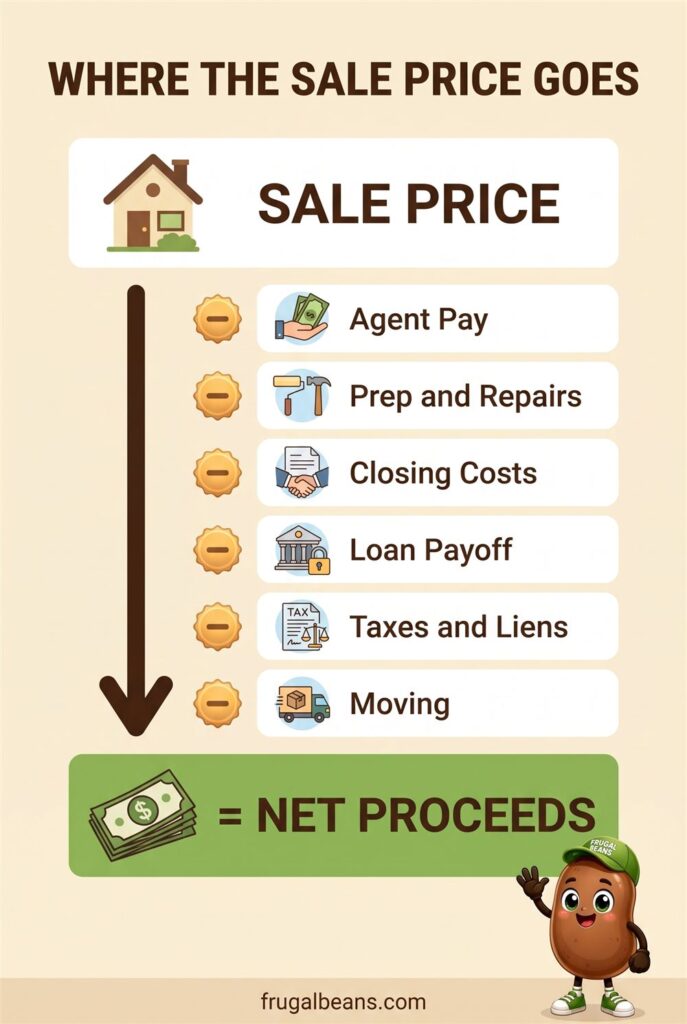
Your net proceeds are the money left after the sale price is reduced by every required and agreed expense. Before you look at any single fee, it helps to see the whole equation:
Estimated net proceeds = sale price − selling costs − loan payoff − other liens − moving and related costs
For example, imagine a house sells for $425,000. The seller pays $25,500 in agent compensation, $4,250 in other closing charges, $3,000 for repairs and preparation, and $6,000 to move. If the mortgage and other liens total $300,000, the seller’s approximate remaining cash is $86,250:
$425,000 − $25,500 − $4,250 − $3,000 − $6,000 − $300,000 = $86,250
That is still a meaningful sum, but it is about one-fifth of the sale price. Keeping this formula in front of you is the simplest way to keep the cost to sell a house from being a guess.
The 12 Costs of Selling a House at a Glance
Every sale is different, and not every seller will pay all of these. Still, it is smart to budget for each one until you know it does not apply to you:
- Agent compensation for the listing agent and, in some deals, money connected to the buyer’s agent.
- Pre-listing repairs such as fixing leaks, broken fixtures, or safety problems.
- Cleaning, paint, and yard work to make a strong first impression.
- Staging and temporary storage to make rooms look larger and easier to picture.
- Marketing and listing extras such as photography, floor plans, or video tours.
- A pre-listing inspection, if you choose to get one.
- Buyer-requested repairs or credits after the buyer’s inspection.
- Settlement, escrow, and attorney fees for handling the documents and money.
- Title, recording, and transfer charges tied to ownership changing hands.
- Prorated property taxes and association dues through the closing date.
- Mortgage payoff, liens, and possible taxes on the gain.
- Moving and carrying costs, including any overlap between two homes.
The sections below explain each group, what changes the amount, and where you have room to negotiate.
Agent Commissions: Often the Biggest Cost to Sell a House
For many households, the largest single cost to sell a house is compensation for real estate professionals. A listing agent usually helps price the property, prepares the marketing, arranges showings, communicates with buyers, and guides the transaction toward closing. In some transactions, a buyer’s agent may also receive compensation connected to the sale.
There is no single standard rate. The structure and amount of agent pay vary by market, by brokerage, and by contract, and they are negotiable. Practices for how buyer-agent pay is offered and agreed also differ, so ask your agent to explain in writing how it works in your area and who is expected to pay what.
Why every percentage point matters
When pay is quoted as a percentage of the sale price, small differences become large dollar amounts. On a $400,000 sale, every one percentage point equals $4,000. On a $300,000 sale, it equals $3,000. Run the numbers in dollars before you sign, not just in percentages.
Read the listing agreement carefully. It may include a cancellation fee, an administrative or transaction charge, or a different rate if the same agent represents both sides. Ask what is included in the fee, such as photography, staging advice, or open houses, and what will be billed separately.
Selling a house without a listing agent
Some owners choose to sell without a traditional listing agent. This can reduce agent compensation, but it does not make selling a house free. The owner may pay for photographs, listing exposure, signs, scheduling tools, legal help, and professional negotiation. The owner also spends time answering inquiries, showing the house, reviewing offers, and coordinating inspections.
Consider the value of that time and the risk of mistakes before assuming the savings are substantial. A buyer who is still working with an agent may also expect that agent to be paid by someone, which can become part of the negotiation.
Repair and Inspection Costs of Selling a House

Preparation is the part of the costs of selling a house you control most directly, and it can range from almost nothing to a major renovation. The most useful work usually improves cleanliness, safety, function, and first impressions rather than adding expensive personal features. Buyers notice deferred maintenance because it raises questions about what else may be wrong.
Pre-listing repairs and cleanup
Common preparation expenses include:
If the furnace, air conditioner or water heater needs work before you list, our free repair or replace calculator shows whether fixing it or replacing it makes more sense for a unit that age. That keeps one of the bigger costs of selling a house in proportion.
- Deep cleaning, carpet cleaning, and removal of excess belongings.
- Painting walls or touching up visible scuffs.
- Lawn care, trimming, seasonal planting, and exterior cleanup.
- Minor plumbing, electrical, roofing, heating, or cooling repairs.
- Replacing damaged fixtures, loose handles, broken screens, or burned-out lights.
Before spending, separate repairs that could stop a buyer from getting financing from improvements that are merely attractive. A leaking roof, unsafe wiring, or a failed heating system may deserve priority. A luxury countertop may not recover its cost. Ask for several estimates and decide whether each repair is needed for safety, disclosure, negotiation, or presentation.
If you are not sure what a fair repair price looks like, our free Homeowner Repair Cost Playbook lists typical lifespans and repair costs for the major systems in a house, which helps you judge quotes before you list.
Should you pay for a pre-listing inspection?
A pre-listing inspection is optional. It costs money up front, but it can reveal problems on your schedule rather than the buyer’s. You can then fix an issue, get a quote to share, or price the home with the problem in mind. The trade-off is that what you learn may need to be disclosed, so ask your agent or attorney how disclosure works where you live.
Repairs and credits after the buyer’s inspection
Most buyers order their own inspection, and the report often leads to a request. The buyer may ask you to complete repairs, lower the price, or give a credit at closing. Any of these choices reduces your proceeds, so it belongs in your budget even though you cannot know the exact amount in advance. A reserve for inspection surprises is one of the most practical lines on a seller’s worksheet.
Staging, Marketing, and Listing Extras
Marketing is a smaller part of the cost to sell a house, but it adds up. Some marketing expenses are included in an agent’s service, while others are separate. Confirm this rather than assuming. Possible charges include professional photography, measured floor plans, printed materials, online advertising, open-house supplies, signage, video tours, and virtual staging.
Professional staging or rented furniture can make rooms easier to understand, especially if the house is empty. Temporary storage can also help, because clutter makes rooms look smaller. These costs are flexible: you can often get much of the effect by decluttering, rearranging what you own, and borrowing a few pieces. The habits in our guide on how to save money at home apply here too, since every box you donate before the move is one you do not pay to store or haul.
Closing Costs Paid by the Seller

Closing is the final stage, when ownership changes and money is distributed. Seller closing costs are a group of transaction charges, and which party pays each one depends on local practice, the purchase contract, and negotiation. That is why closing costs vary so widely from one sale to the next.
|
Possible seller expense |
What it covers |
What can change the amount |
|
Settlement or escrow fee |
Administrative work to coordinate documents and money |
Company, location, and complexity of the sale |
|
Attorney or conveyance fee |
Legal review and preparation of required documents |
Local rules and attorney rates |
|
Title-related charge |
Research, insurance, or transfer work connected with ownership |
Property history and regional custom |
|
Recording or transfer charge |
Government filing or transfer of ownership |
Sale price and local rules |
|
Inspection-related credit |
Money offered to address issues found by the buyer |
Inspection results and negotiation |
|
Home warranty or service plan |
Optional coverage offered to reassure a buyer |
Coverage selected and contract terms |
|
Prorated property taxes or fees |
Seller’s share through the closing date |
Closing date and billing schedule |
Buyer credits and concessions
A seller may also agree to give the buyer a closing credit. This is an amount deducted from the seller’s proceeds to help the buyer pay certain approved closing costs or to address an issue. For example, a seller might offer a $5,000 credit instead of completing a repair. A credit can keep a transaction moving, but it reduces your net proceeds just as surely as a direct payment.
Prorated property taxes
At closing, property taxes are often prorated so that the seller pays the portion covering the days before the sale and the buyer pays the portion after it. This is an allocation of an existing bill, not an extra cost created by selling. It still shows up on the settlement statement, so expect to see it. Association dues and some utility charges may be handled the same way.
Mortgage Payoff, Liens, and Other Debts
Your mortgage lender must be paid from the sale proceeds. The payoff amount is not always the same as the balance on your monthly statement. It may include interest through a future date, a processing fee, or a prepayment charge. Request a formal payoff quote early enough for your closing team to use an accurate figure.
Other debts attached to the property can also reduce your proceeds. Examples include a second mortgage, a home-equity line of credit, an unpaid contractor claim, a judgment, an association balance, or a property-tax debt. These claims may be called liens, meaning a legal right connected to the property that must be resolved before clear ownership can transfer.
If the sale price may be close to what you owe, calculate the numbers before accepting an offer. A seller who owes $390,000 on a property that sells for $400,000 has only $10,000 of room, and could still need thousands more for commissions, closing costs, repairs, and the move. In some cases, the owner must bring money to closing or obtain lender approval for a short sale. Do not wait until the final week to learn that the proceeds are not enough.
Taxes When Selling a House
Selling a home can create tax questions, especially when the property was not your main residence the whole time. The result can depend on how long you owned and lived in the home, your purchase price, documented improvements, selling expenses, any past use as a rental, and state or local rules.
According to IRS Publication 523, Selling Your Home, many owners can exclude up to $250,000 of gain from the sale of a main home, or up to $500,000 for married couples filing jointly, if they meet ownership and use tests. In general, that means owning the home and living in it as your main home for at least 2 of the 5 years before the sale. The same publication explains that selling expenses, such as agent commissions, advertising, and legal fees, are subtracted from the sale price when figuring the amount realized.
That is one more reason to keep every receipt. Routine repairs and ordinary maintenance are not always treated like lasting improvements, so keep invoices and records rather than relying on memory. If your situation includes a rental, a home office, an inherited property, or a short ownership period, talk with a tax professional before you sign a contract.
Moving and Carrying Costs After Closing
Moving expenses are often left out of the costs of selling a house because they are paid after the transaction. Include them anyway. You may pay movers, packing help, boxes, storage, transportation, cleaning at the new home, utility connection fees, temporary lodging, or pet care.
The timing of two homes can create a larger cost. If you buy before the old house closes, you may carry two mortgages or two housing payments, plus insurance and utilities on both. If the sale closes before your next home is ready, you may need short-term storage or a hotel. Build a cash reserve for timing problems, even when the sale itself looks profitable.
Smaller moves cost less. Selling or donating furniture you will not use, collecting free boxes, and packing yourself are classic ways to save money on a tight budget, and they fit a move well.
Where the Sale Price Goes: A Worked Example of the Costs of Selling a House
Here is a worked example that pulls the costs of selling a house together. The numbers below are illustrative only, chosen to make the arithmetic easy to follow. They are not averages or typical rates, and your own figures could be higher or lower.
Suppose a household sells a home for $400,000 and estimates the following:
|
Item |
Illustrative amount |
|
Sale price |
$400,000 |
|
Agent compensation |
− $20,000 |
|
Pre-listing repairs, paint, and cleaning |
− $4,000 |
|
Staging, storage, and marketing extras |
− $1,500 |
|
Settlement, title, and recording charges |
− $3,500 |
|
Credit to the buyer after inspection |
− $3,000 |
|
Prorated property taxes |
− $2,000 |
|
Mortgage payoff |
− $260,000 |
|
Moving costs |
− $5,000 |
|
Estimated net proceeds |
$101,000 |
The selling costs alone, before the mortgage payoff and the move, come to $34,000 in this example. Add the $260,000 payoff and the $5,000 move, and $299,000 of the $400,000 sale price is spoken for. The household walks away with $101,000, about a quarter of the sale price.
Now picture the same household planning a $70,000 down payment and closing costs on its next home. The remaining cushion is $31,000, and an unplanned $10,000 repair request or a few months of carrying two homes could eat a large share of it. This is why the cost to sell a house deserves a written worksheet, not a rough guess.
Seller’s Checklist: How to Lower the Costs of Selling a House
Use this checklist before you list, and update it each time you receive an offer. Each step either lowers the cost to sell a house or keeps a surprise from shrinking your check:
- Write down a conservative expected sale price, not the best-case number.
- Get agent compensation and any extra fees in writing, in dollars.
- Request a mortgage payoff quote and check for liens or unpaid balances.
- List needed repairs and get at least two estimates for each.
- Decide whether a pre-listing inspection makes sense for your home.
- Declutter and donate early to cut staging, storage, and moving costs.
- Ask a settlement professional for a preliminary seller estimate of closing costs.
- Set aside a reserve for buyer-requested repairs or credits.
- Gather purchase records and improvement receipts for tax purposes.
- Price out the move, temporary housing, and any overlap between homes.
- Compare offers by estimated net proceeds, not by price alone.
- Review the settlement statement before closing day.
Get the numbers early
Request a mortgage payoff quote and a preliminary seller estimate before listing. Early information gives you time to clear a lien, find a missing document, or reconsider a sale that would leave too little cash.
Prioritize visible and important repairs
Fix safety problems and defects that can derail financing. Clean thoroughly and improve the entry, lighting, and basic function. Avoid remodeling just because a trend is popular unless local advice and comparable sales suggest it is worth it.
Read the estimated settlement statement
Do not wait for the closing table. Check the sale price, credits, payoff amounts, prorations, fees, and your expected proceeds. Ask for corrections in writing and make sure the final version matches the agreed terms.
Negotiate the whole offer
The highest offer is not always the strongest offer. Compare the price, financing, inspection terms, closing date, requested credits, included personal property, and the likelihood of closing. A slightly lower offer with fewer concessions may leave you with more money.
Once the sale closes, give the proceeds a plan before they disappear into the move. Our list of ways to save money can help you rebuild your cushion in the new home.
Costs of Selling a House: Frequently Asked Questions
What is usually the biggest cost of selling a house?
For most sellers who use an agent, agent compensation is the largest expense after the mortgage payoff. Because it is often figured as a percentage of the sale price, every point is worth $3,000 on a $300,000 sale, so negotiate it and get the terms in writing.
How much are closing costs for a seller?
There is no single answer. Seller closing costs depend on where you live, local custom about who pays what, the sale price, and what you negotiate with the buyer. Ask a settlement or escrow professional for a preliminary estimate before you list, then update it when you accept an offer.
Is it worth making repairs before selling a house?
Repairs that affect safety, financing, or obvious first impressions are often worth doing. Big cosmetic upgrades may not pay for themselves. Get estimates, ask your agent what local buyers expect, and compare the repair cost with offering a price reduction or credit instead.
What costs can I deduct when I sell my home?
IRS Publication 523 explains that selling expenses such as commissions, advertising, and legal fees reduce the amount realized from a home sale, which can lower any taxable gain. Many owners also qualify to exclude some or all of the gain. Rules depend on your situation, so check the publication or ask a tax professional.
The Bottom Line
The costs of selling a house include far more than the agent’s fee. Preparation, marketing, closing costs, buyer credits, loan payoffs, liens, taxes, moving, and the timing between homes can all shrink the amount you keep.
Start with a realistic sale price and subtract every likely expense, including the ones that show up after closing. Get written estimates, keep records, question unfamiliar fees, and leave room for surprises. If you are new to running a household budget this way, our guide to frugal living for beginners is a good next step. When you know the difference between the sale price and your net proceeds, you can choose repairs wisely, judge offers clearly, and move into your next home with confidence.

Get the free Homeowner Repair Cost Playbook
Which systems fail first, what they cost, the warning signs, and the repair-or-replace rule. 15 printable pages.
Free. No spam.
Free tool
Repair or replace?
Got a quote for your furnace, AC, water heater or an appliance? Check it in under a minute.
Free tool
What needs replacing next?
Enter the install years for your furnace, AC, water heater and appliances. See what is due first and what to save each month.
Leave a Reply