Home Sale Calculator: Estimate Your Net Proceeds

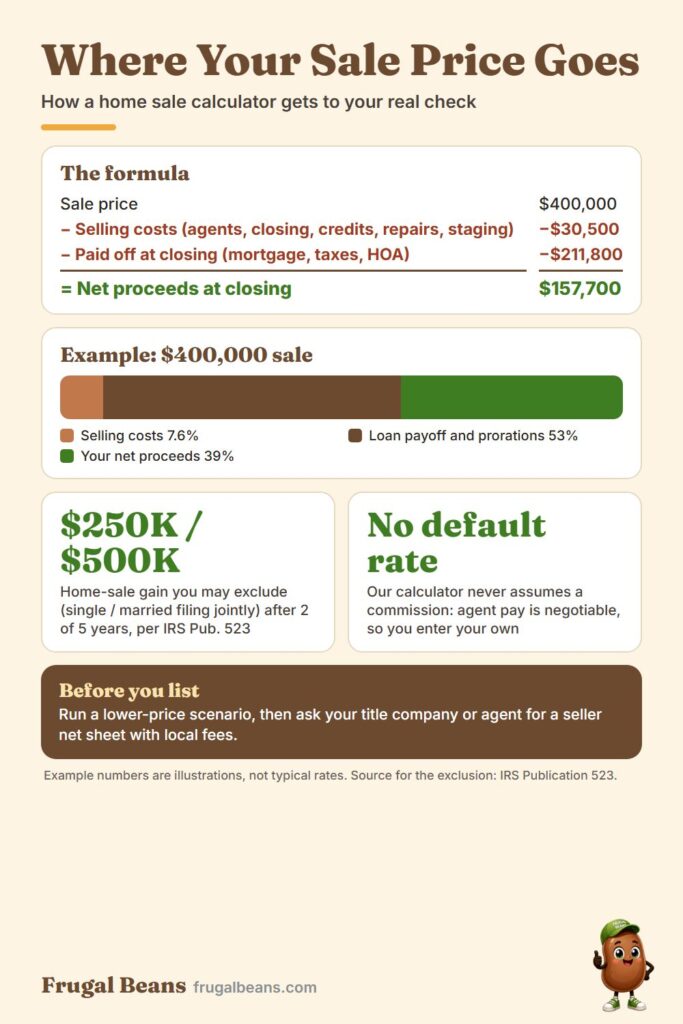
The sale price of a house is not the amount you take home. Agent pay, closing costs, credits to the buyer, repairs and your mortgage payoff all come out first, and moving costs follow soon after. This free home sale calculator adds them up for you and shows the check you can expect to walk away with, what selling costs as a share of the price, and a rough capital gains check based on IRS Publication 523. It uses only the numbers you enter; it never assumes a commission rate.
Loading the home sale calculator… If it doesn’t appear, please make sure JavaScript is turned on.
How the Home Sale Calculator Works
- Enter the expected sale price. Use a realistic number based on recent sales of similar homes nearby or your agent’s estimate, not your hopes.
- Add your selling costs. Listing agent pay, any buyer’s agent pay you agree to cover, seller closing costs, credits or concessions to the buyer, repairs, and staging, cleaning and photos. Agent pay can be entered as a percent of the price or a dollar amount.
- Add what you owe at closing. Your mortgage payoff, any second mortgage or HELOC, other liens or prepayment penalties, and prorated property taxes or HOA dues.
- Add moving costs if you want to see what is left once you are settled.
- Optionally run the capital gains check by entering what you paid for the home, your improvements, your filing status and whether you meet the 2-out-of-5-year test.
Click “Calculate my net proceeds” to see your net proceeds at closing, total selling costs and their share of the price, what is left after moving, a bar showing where every dollar of the sale price goes, and a line-by-line table you can print. Click “Load an example” to see it with sample numbers first. Your entries are saved only in your own browser.

What Comes Out of Your Sale Price
A home sale calculator is only as good as the costs you remember to include. These are the usual deductions between the price on the contract and the money in your account.
Agent pay
Real estate commissions are negotiable, and since 2024 sellers in many markets decide separately whether to offer anything toward the buyer’s agent. Enter the listing agent’s pay from your listing agreement, and enter what, if anything, you agree to pay the buyer’s agent. The home sale calculator deliberately has no default rate, because the right number is whatever you negotiate.
Seller closing costs
These usually include title or escrow fees, attorney fees in states that require them, transfer taxes, recording fees and any owner’s title policy the seller customarily pays for in your area. They vary a lot by state and county. Your title company, closing attorney or agent can prepare a seller net sheet with local figures.
Credits and concessions
Buyers often ask for a credit after the inspection or help with their own closing costs. A $5,000 credit is $5,000 less in your pocket, so it belongs in the home sale calculator just like a commission.
Repairs, staging and preparation
Pre-sale repairs, painting, cleaning, staging and photography cost money before you see a single offer. Our guide to how much does it cost to sell a house covers which ones tend to pay for themselves.
Loan payoffs and liens
Your mortgage balance is not the same as your payoff amount. The payoff includes interest up to the payoff date and sometimes fees, so ask your lender for a payoff statement. Add any second mortgage or HELOC, judgment liens, and any prepayment penalty your loan carries.
Prorated taxes and HOA dues
Property taxes and HOA dues are usually split at closing so you pay for the days you owned the home. Depending on when your taxes are due, this can be a cost or a small credit back to you; if you are not sure, enter your best estimate of what you owe.
Moving and overlap costs
Movers, storage, a deposit on the next place, or a month of paying for two homes all come out of the same money. The home sale calculator shows them after closing so you can see both numbers.
Home Sale Proceeds Calculator vs. Seller Net Sheet
A home sale proceeds calculator like this one gives you a planning estimate in minutes, before you have listed. A seller net sheet is the version your agent, title company or closing attorney prepares using local fee schedules and your actual loan payoff. Use the calculator early to decide whether selling makes sense and what price you need, then ask for a seller net sheet once you have an offer, and compare the two. If the seller net sheet shows a cost you did not expect, ask what it is.
Is This a Home Sale Profit Calculator Too?
Yes, in two ways. The net proceeds tell you how much cash the sale produces after costs and payoffs. The optional capital gains check works like a home sale profit calculator for tax purposes: it estimates your gain as the sale price minus selling expenses, minus what you paid for the home and your improvements. Cash proceeds and taxable profit are different numbers. You can walk away with a big check and owe no tax, or have a modest check and still have a large gain, depending on how much of the price went to paying off loans.
The Capital Gains Check, Explained
Under IRS Publication 523, if you owned the home and lived in it as your main home for at least two of the five years before the sale, you can generally exclude up to $250,000 of gain from income, or up to $500,000 if you are married filing jointly. The home sale calculator applies that rule in a simplified way:
- Amount realized is the sale price minus selling expenses such as agent pay, closing costs, credits and staging. Pre-sale repairs are left out, because the IRS generally does not treat them as selling expenses.
- Basis is what you paid for the home plus improvements, such as an addition or a new roof. Routine repairs do not count.
- Gain is the amount realized minus your basis. If it is more than your exclusion, the difference may be taxable.
If you do not meet the two-year tests, Publication 523 describes a partial exclusion for moves due to a change in work, health or certain unforeseen circumstances. There are also rules on when you must report the sale. Treat the check as a rough estimate and talk to a tax professional before you rely on it.
A Worked Example
Here are the sample numbers the home sale calculator loads when you click “Load an example.” They are illustration only, not typical rates.
- Sale price: $400,000.
- Selling costs: listing agent pay of 2.5% ($10,000), buyer’s agent pay of 2.5% ($10,000), $4,000 of closing costs, a $2,000 credit to the buyer, $3,000 of repairs and $1,500 of staging and photos, for $30,500 in total, or 7.6% of the price.
- Owed at closing: a $210,000 mortgage payoff and $1,800 of prorated taxes and HOA dues.
- Net proceeds at closing: $157,700, about 39% of the sale price.
- After $3,500 of moving costs: $154,200.
The capital gains check, using a $250,000 purchase price, $30,000 of improvements and married filing jointly, shows an amount realized of $372,500, a gain of $92,500, and no expected tax because the gain is well under the $500,000 exclusion.

Selling Costs People Forget
When you fill in the home sale calculator, check whether any of these apply to you. They are small one by one, but together they can move your net proceeds by thousands of dollars.
- A home warranty for the buyer. Sellers sometimes pay for the buyer’s first year of a home warranty as a sweetener. Add it to credits if you agree to one.
- HOA transfer and document fees. Many associations charge for the resale documents and the transfer, and who pays depends on your contract and state.
- A pre-listing inspection. Optional, but some sellers pay for one to find problems before a buyer does.
- Utilities and insurance until closing. You keep paying for the house until the day it closes, and longer if it sits on the market.
- Mortgage payments while you wait. Each month on the market costs another mortgage payment, plus taxes and insurance.
- Price reductions. If you have to cut the price, rerun the home sale calculator, because every other cost stays the same while the price falls.
Special Situations
The home sale calculator is built for selling the home you live in. A few situations work differently, especially for taxes:
- An inherited home. Your basis is generally the home’s fair market value when the owner died, not what they paid for it, which often makes the taxable gain much smaller. Enter that value as “what you paid” in the capital gains check and confirm it with a tax professional.
- A home you rented out. Time as a rental can reduce the exclusion, and depreciation you claimed or could have claimed is generally taxable when you sell. Publication 523 explains the rules for business or rental use.
- Divorce or separation. Special rules can let a spouse count the other’s ownership or use time. Get advice before you sell.
- Selling within two years of buying. You may not qualify for the full exclusion, though a partial exclusion can apply for qualifying reasons such as a job change or health.
Should You Sell or Rent It Out?
If the net proceeds look small, renting the home out can seem appealing. Run both sides before you decide. Selling gives you a known amount now. Renting brings rent, but also repairs, vacancies, landlord insurance, possible property management fees and the work of being a landlord, and it can change the tax picture when you eventually sell. The home sale calculator handles the selling side; for the renting side, list the monthly costs honestly, including a repair reserve, before you compare.
When the Numbers Come Out Negative
If what you owe plus your selling costs is more than the sale price, the home sale calculator shows how much you would need to bring to closing instead of a check. That can happen with a recent purchase, a falling local market or a large second loan. Before listing, talk to your lender and a real estate attorney or a HUD-approved housing counselor. Options can include waiting, refinancing or modifying the loan, renting the home out, or, as a last resort, a short sale.
How to Use a Net Proceeds Calculator to Choose a Price
A net proceeds calculator also works backward. Decide how much cash you need for your next down payment or your savings, then raise or lower the sale price until the net proceeds reach that amount. If the price you need is far above what similar homes sell for, it is better to know before you list than after weeks on the market. Run a few scenarios: one at your agent’s suggested price, one a little lower, and one with a larger buyer credit, so a lower offer does not catch you off guard.
Ways to Keep More of Your Sale Price
- Negotiate agent pay and decide deliberately what you will offer the buyer’s agent.
- Get two or three listing presentations and compare the services and pay, not just the suggested price.
- Fix what buyers will flag, such as leaks, safety issues and obvious damage, and skip big remodels that rarely pay back at sale.
- Price it right from the start. An overpriced home that sits often sells for less, after more months of mortgage, taxes and utilities.
- Keep improvement receipts so you can document your basis for the capital gains calculation.
- Time the move to avoid paying for two homes at once if you can.
Selling to Buy Your Next Home
If the proceeds are funding your next home, remember that the next house comes with its own costs: closing costs on the purchase, moving, and the repairs and replacements every home needs. Our free home repair fund calculator works out a monthly set-aside for the new place, and the home system lifespan tracker shows which systems in it are likely to need replacing first.
It also helps to decide in advance how the proceeds will be split: how much goes to the next down payment, how much to closing costs on the purchase, and how much stays in savings as a cushion for the move and the first year in the new home. Running the home sale calculator with a conservative price makes that plan safer.
Frequently Asked Questions
How do I calculate net proceeds from selling a house?
Start with the sale price, subtract your selling costs (agent pay, closing costs, credits, repairs and staging), then subtract everything paid off at closing (mortgage, HELOC, liens, and prorated taxes or dues). What is left is your net proceeds. The home sale calculator above does the math and shows each line.
Does the home sale calculator use a standard commission rate?
No. Commissions are negotiable, so the calculator has no default. Enter the rates or dollar amounts from your own agreements, or use “Load an example” to see how it works with sample numbers.
Is my mortgage payoff the same as my loan balance?
Usually not. The payoff includes interest up to the payoff date and sometimes fees. Ask your lender for a payoff statement for the most accurate number.
Will I owe capital gains tax when I sell my house?
Many homeowners don’t, because IRS rules let you exclude up to $250,000 of gain, or $500,000 if married filing jointly, when you meet the ownership and use tests. The optional check in the calculator gives a rough estimate; see IRS Publication 523 or a tax professional for your situation.
How accurate is a home sale calculator?
It is exactly as accurate as the numbers you put in. The math is simple subtraction, so the uncertainty comes from the estimates: the final sale price, the buyer’s requests after inspection, and your local closing costs. Use realistic figures, run a lower-price scenario, and replace estimates with real quotes as you get them.
What is a seller net sheet?
A seller net sheet is an estimate of your proceeds prepared by your agent, title company or closing attorney, using local fees and your actual payoff. It is the more exact version of what this calculator does.
Does the calculator save my numbers?
Only in your own browser, so you can come back to them. Nothing is sent to Frugal Beans or anyone else. Use “Clear everything” to remove them.
The Bottom Line
Before you list, know the number that matters: what you will actually walk away with. Run your figures through the free home sale calculator above, try a few prices, and then ask for a seller net sheet once you have an offer. For every selling cost explained in detail, read our guide to how much it costs to sell a house, get our free Homeowner Repair Cost Playbook, and see all of our free home tools.
Sources: home sale exclusion, amount realized, basis and reporting rules from IRS Publication 523, Selling Your Home. All cost figures come from the user’s own entries; the example numbers are illustrations, not typical rates. This tool provides general information, not legal, tax or real estate advice.

Get the free Homeowner Repair Cost Playbook
Which systems fail first, what they cost, the warning signs, and the repair-or-replace rule. 15 printable pages.
Free. No spam.
Free tools
Got a quote? Check it in under a minute.
Ballpark a new furnace before the contractor visits.
Price a tank, tankless or heat pump model.
Warm air, ice or noise? See the likely part and price.