FIRE Movement Explained: 7 Simple Steps to Financial Independence
The FIRE movement—short for Financial Independence, Retire Early—can sound like a club reserved for high earners, spreadsheet experts, or people willing to live on almost nothing. In practice, it is less about escaping work on a particular birthday and more about gaining control over your choices. You build enough financial strength that a job becomes a tool rather than your only source of security.
Think of yourself as the pilot of an ordinary household financial plan. A good pilot does not stare only at the final airport. The pilot checks fuel, watches the instruments, adjusts for weather, and keeps everyone on board informed. Your household can use the same approach: a clear destination, reliable information, sensible controls, and a willingness to make small corrections before a minor problem becomes an emergency.
This guide lays out that system in plain language. You will learn what financial independence really means, how to estimate a FIRE number, how lean FIRE differs from other versions, and seven simple steps you can start this month. Nothing here is personal financial advice; it is a framework to help you ask better questions about your own situation.
A quick note on the name: this post was originally titled “Captain FI: The FIRE Personal Finance Pilot,” and “Captain FI” was our metaphor for a household steering its own money. There is also a real personal finance blog and podcast called Captain FI, run by an Australian pilot under that pen name, which is still publishing in 2026. This article is not about that creator, and we are not affiliated with it. We mention it in the resources section below for readers who go looking.

What the FIRE Movement Really Means
At its core, the FIRE movement is about financial independence: your essential life can be funded without depending entirely on a paycheck. That funding might come from investments, a pension, a business, rental income, or a combination of sources. Retiring early is only one possible use of that independence. You might leave a stressful career, work part time, care for family, study, volunteer, or start a less lucrative but more meaningful business.
Financial independence, retire early is therefore not a single finish line. It is a range of milestones. An emergency fund makes you less vulnerable to an unexpected bill. Paying off high-interest debt gives you breathing room. Saving enough to cover a year of expenses can let you take a sabbatical. Full independence provides the broadest set of options.
A useful distinction is between savings rate and net worth. Your savings rate is the portion of income you keep for future use. Net worth is what you own minus what you owe. A high savings rate helps, but a household also needs cash access, insurance, and a plan for near-term bills. Followers of the FIRE movement tend to watch both numbers, because one shows your habits and the other shows your progress.
Why Frugality Is the Engine
Every dollar you do not need to spend does two jobs at once. It can be saved and invested today, and it lowers the amount you will need to fund your life later. That double effect is why frugal habits sit at the heart of the FIRE movement. You do not need to be extreme; you need to cut waste around the things you genuinely value. Our guide to frugal living for beginners is a good place to start if this part feels new.
Lean FIRE, Fat FIRE and Other Paths
People in the FIRE movement use a handful of informal labels to describe different destinations. These are community nicknames, not official categories, and the dollar lines between them are fuzzy. Still, they help you decide what kind of independence you are aiming for.

Lean FIRE
Lean FIRE means reaching independence on a deliberately modest budget, roughly covering essentials with little room for extras. Because the spending target is lower, the savings target is lower too, so lean FIRE can be reached sooner. The trade-off is a thinner cushion: an unexpected health cost, a major home repair, or a long market slump can put real pressure on the plan.
Fat FIRE
Fat FIRE is the opposite end: independence that funds a comfortable or generous lifestyle, with travel, hobbies, and family support built in. It usually takes longer to reach, but it leaves more margin for surprises.
Coast FIRE and Barista FIRE
Coast FIRE describes a point where you have saved enough early that, if left to grow, your investments could plausibly cover a traditional retirement, so you only need to earn enough to pay current bills. Barista FIRE describes a mix: investments cover part of your costs and part-time or lower-stress work covers the rest, sometimes along with workplace benefits. Both versions treat work as optional in intensity rather than eliminating it.
None of these paths is better than the others. Lean FIRE suits people who truly enjoy simple living; fat FIRE suits people who would rather work longer for a wider margin. Most households in the FIRE movement end up somewhere in between, and many change their minds along the way.
The FIRE Movement in 7 Simple Steps
The rest of this guide walks through the steps one by one. Here is the full flight plan at a glance:
- Define your destination with three versions of your future budget.
- Know your cash flow by tracking real spending.
- Build a strong cockpit: emergency reserves, debt control, and insurance.
- Raise your savings rate gradually.
- Invest simply and consistently.
- Estimate your FIRE number.
- Review the route every year and correct course.
Step 1: Define Your Destination
Start with a destination specific enough to guide decisions. “Be rich” is too vague. “Have the flexibility to work four days a week within eight years while keeping our current housing and health coverage” is far more useful.
Write down three versions of your future budget:
- Essential spending: housing, food, utilities, basic transportation, insurance, taxes, health care, and minimum debt payments.
- Comfortable spending: essentials plus ordinary travel, hobbies, gifts, dining out, clothing, and home maintenance.
- Abundant spending: comfortable spending plus larger goals such as frequent travel, generous family support, or an expensive hobby.
These categories prevent a common mistake: treating every current purchase as permanent while pretending future life will be free. A household might spend $4,500 per month today, but perhaps $3,600 is essential and $5,200 is the life it wants. Each number produces a different savings target, and roughly speaking, the essential budget is your lean FIRE line.
Review the plan with the people affected by it. A partner may value predictable travel more than an especially early retirement date, while children create changing costs. Include these preferences rather than labeling them as obstacles.
Step 2: Know Your Cash Flow
Cash flow is the movement of money into and out of your household. Track it for at least one ordinary month, preferably three that include irregular expenses. Use bank statements, credit card records, and annual bills. Do not rely on memory; people forget subscriptions, insurance premiums, school costs, and gifts.
Sort expenses into three groups. Fixed expenses are difficult to change quickly, such as rent or a mortgage. Flexible expenses can move up or down, such as groceries, restaurants, and entertainment. Irregular expenses arrive periodically, such as car repairs, property taxes, and holiday travel. Divide annual irregular costs by twelve and set that amount aside monthly. This turns surprises into planned bills.
A simple cash-flow review should answer four questions:
- How much income reliably arrives after taxes and payroll deductions?
- What must be paid before the next payday?
- Which expenses are recurring but not essential?
- How much can be directed automatically toward reserves and long-term goals?
The objective is not to judge every purchase. It is to make the route visible so you can reduce costs, increase income, or accept a longer timeline. If you need help setting category amounts, our budgeting tips for a tight budget walk through it step by step.
Step 3: Build a Strong Cockpit Before Investing
Before taking substantial investment risk, establish a basic safety structure. Keep a starter emergency reserve in an accessible account. Then expand it until it can cover several months of essential expenses, with the amount depending on job stability, health, dependents, and how quickly you could replace your income.
Pay particular attention to high-interest debt. Credit card balances and similar debt can grow faster than a reasonable investment return. Make minimum payments on every debt, direct extra money toward the highest interest rate, and then roll the freed payment toward the next balance. The smallest-balance-first approach can also work if it keeps you motivated and consistent.
Insurance is financial protection. Health, disability, auto, renters or homeowners, and liability coverage can prevent one event from undoing years of progress. Review coverage when income, housing, dependents, or assets change.
Homeowners should also plan for the big-ticket systems that eventually wear out, such as the roof, furnace, and water heater. Our free Homeowner Repair Cost Playbook lists typical lifespans and repair costs so you can build them into your budget instead of being surprised.
Keep short-term money separate from long-term investments. Money needed within the next few years generally deserves stability and access rather than exposure to a sharp market decline. The emergency reserve is not failing to grow; it is doing its job by being available.
Step 4: Raise Your Savings Rate
In the FIRE movement, your savings rate is the single lever that most shapes your timeline, because it affects both sides of the equation: how fast your investments grow and how much you will eventually need. Raising it does not have to mean deprivation. It usually means trimming waste, avoiding lifestyle creep, and directing new income on purpose.
Here is simple arithmetic to show why small changes matter. If a household takes home $5,000 a month and saves 10%, that is $500 a month. Raising the rate to 15% means $750 a month—an extra $3,000 a year directed at the future, without counting any investment growth.
Good places to look first are the everyday leaks: groceries that get thrown out, unused subscriptions, and convenience purchases made when you are rushed. Our list of practical ways to save money and our guide on how to save money at home are full of low-effort ideas. Earning more counts too: a raise, a side project, or a career move can lift the rate faster than cutting alone.
Step 5: Invest Simply and Consistently
Investing means putting money into assets that can grow or produce income over time. A diversified portfolio spreads money across many companies, bonds, or other assets instead of depending on one investment. Diversification cannot prevent all losses, but it reduces single-investment risk.
For many households, broad, low-cost funds are easier to maintain than individual stocks. The right mix depends on time horizon, risk tolerance, tax situation, and account types. Risk tolerance means how well you can stick to the plan after a large temporary decline, not merely how comfortable you feel when markets rise.
Use available tax-advantaged workplace and individual accounts when they fit your situation. These accounts may offer deductions, tax-deferred growth, or tax-free withdrawals under specific rules. Understand the contribution limits, withdrawal conditions, and employer matching policy before making decisions. Early retirees in particular should learn the rules for accessing retirement accounts before the standard age, because some withdrawals can trigger taxes and penalties.
Automate contributions on payday. Automation removes a fresh monthly decision. Increase the amount after a raise, a debt payoff, or an ended expense. Rebalance occasionally if the mix drifts, but avoid constant tinkering. A boring plan you can follow is stronger than a clever plan that causes panic. To see how steady contributions can add up over time, the SEC’s compound interest calculator on Investor.gov lets you try your own numbers.
Step 6: Estimate Your FIRE Number
Your FIRE number is a rough estimate of how much you would need invested so that your portfolio could fund your yearly spending. The most commonly cited shortcut is to multiply your expected annual expenses by 25. That shortcut comes from the so-called 4% rule, because 4% is the same as one twenty-fifth.

Where the 4% Rule Comes From
The 4% rule traces back to research by financial planner William Bengen, published in the Journal of Financial Planning in the mid-1990s. Using historical U.S. market data, he looked at how much a retiree could withdraw in the first year, then adjust for inflation each year after, without running out of money over about 30 years. A 4% starting withdrawal held up across the historical periods he tested.
In 1998, three Trinity University professors—Philip Cooley, Carl Hubbard, and Daniel Walz—published a related analysis, often called the Trinity study, in the AAII Journal. You can read their article, “Retirement Savings: Choosing a Withdrawal Rate That Is Sustainable”, on the AAII website. Together, this research made the 4% figure a popular rule of thumb.
A Worked Example
Go back to the three budgets from Step 1 and turn each monthly figure into a yearly one, then multiply by 25:
|
Budget |
Monthly |
Yearly |
Yearly x 25 |
|
Essential (lean FIRE) |
$3,600 |
$43,200 |
$1,080,000 |
|
Current |
$4,500 |
$54,000 |
$1,350,000 |
|
Desired (comfortable) |
$5,200 |
$62,400 |
$1,560,000 |
These are illustrative examples, not targets. Notice how much the FIRE number moves with spending: every $100 of monthly spending you can comfortably live without lowers the target by $30,000 ($1,200 a year times 25). That is the frugality engine at work.
Why Your FIRE Number Is Only an Estimate
The 4% rule is a starting point, not a promise. The original research looked at roughly 30-year retirements, while someone who stops working at 40 may need money to last much longer, so some early retirees plan around a lower withdrawal rate and a larger target. Future returns, inflation, and taxes may also look different from the past.
Other income changes the math. Social Security, a pension, rental income, or part-time work can cover part of your spending, which lowers the amount your portfolio has to supply. Health insurance before Medicare eligibility is a major cost for U.S. early retirees and belongs in the essential budget. Treat your FIRE number as a direction on the map, revisit it every year, and consider getting help from a fee-only professional for complicated situations.
A Note on Australian FIRE Content
Much popular FIRE material comes from Australia, including the Captain FI blog. Australian guides often discuss superannuation, the compulsory workplace retirement system there, along with Australian brokers, taxes, and pension rules. The broad ideas carry over, but the details do not. U.S. readers should look at U.S. account types such as 401(k) plans and IRAs, U.S. tax rules, and Social Security instead of copying Australian strategies.
Step 7: Review the Route and Correct Course
A FIRE plan should change with reality. The following dashboard turns broad goals into manageable checks. The figures are examples, not universal rules.
|
Area |
Pilot’s question |
Example action |
|
Cash reserve |
Could we handle a large essential bill without new debt? |
Build a $12,000 reserve in stages |
|
Debt |
Which balance costs us the most each month? |
Pay extra toward a 24% credit card balance |
|
Savings rate |
What portion of take-home pay serves future goals? |
Raise saving from 10% to 15% after a raise |
|
Investing |
Is the portfolio diversified and suited to our timeline? |
Use a simple allocation and review annually |
|
Protection |
What event could damage our plan most? |
Check disability and liability coverage |
|
Lifestyle |
Which spending creates genuine value? |
Keep weekly family meals; cut unused subscriptions |
|
Flexibility |
What choice would money make possible? |
Build a six-month runway for a career change |
Review this dashboard monthly for cash flow and quarterly for larger decisions. A yearly review can cover insurance, beneficiaries, account fees, tax withholding, family changes, and an updated FIRE number.
Your Path to FI: The Simple Version
If seven steps feel like a lot, the whole FIRE movement can be boiled down to five repeating habits. Print the infographic, stick it on the fridge, and work through one habit at a time.
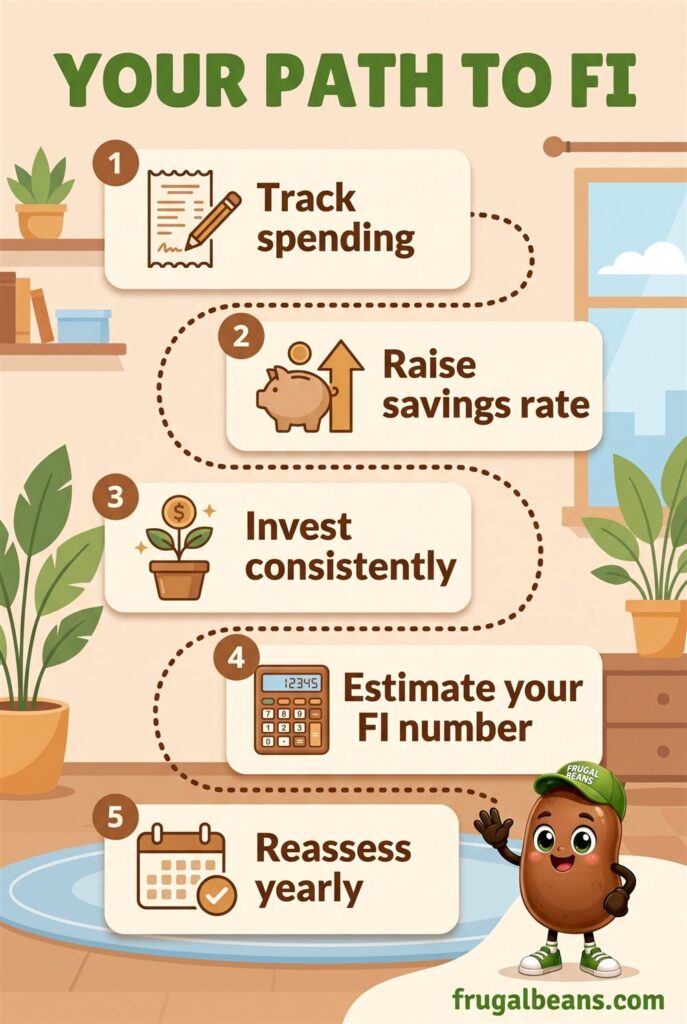
- Track spending. Know where the money actually goes before you try to change it.
- Raise your savings rate. Nudge it up after every raise, payoff, or canceled bill.
- Invest consistently. Automate contributions into simple, diversified investments.
- Estimate your FI number. Use yearly expenses times 25 as a rough starting point.
- Reassess yearly. Update your budget, your number, and your goals as life changes.
Practical Tips for Everyday Navigation
Give every irregular bill a runway. List annual costs and transfer one-twelfth of each amount into a separate sinking fund every month. When the bill arrives, the money is waiting.
Use a waiting period for nonessential purchases. For a costly item, wait a day or a week depending on the price. The pause separates a need from an emotional reaction and gives you time to compare.
Direct raises before they disappear. When income increases, assign part of the raise to investing or debt repayment before adjusting everyday spending. Keep some portion for enjoyment so progress does not feel like permanent deprivation.
Make convenience deliberate. Paying for delivery, prepared meals, or a closer home may be worthwhile if it buys time and fits the plan. Frugality is useful when it supports your values, not when it turns every decision into punishment. Our frugal living tips focus on that balance.
Measure progress with several gauges. Track savings, debt reduction, emergency-fund months, and the choices your money can support. Net worth may move unpredictably while your behavior steadily improves.
Schedule a calm money meeting. Partners can meet for thirty minutes with the same agenda each time: upcoming bills, account balances, one decision, and one positive result. Avoid meetings during arguments or right after stressful purchases.
Protect the downside first. Before seeking a higher return, ask what could force you to sell at the worst moment. Reserves, insurance, a diversified portfolio, and manageable fixed costs make the plan more durable.
Common Turbulence on the Way to Financial Independence
Job loss, illness, a new child, caregiving, divorce, relocation, or a major repair can require a temporary reduction in investing. Pausing contributions is not failure if it protects the household. Resume the previous rate when conditions stabilize.
Beware of extremes. Cutting every enjoyable activity can create burnout and make the plan impossible to sustain—a real risk for anyone chasing lean FIRE too hard. Chasing a very high return can expose essential money to unacceptable risk. Assuming expenses will fall dramatically in later life can create a misleading target. Model several futures, including higher health costs, a longer life, and a period of lower investment returns.
Taxes and account rules can influence the best order for saving, but complexity has a cost. If a strategy requires constant monitoring or creates anxiety, simplify it. For complicated situations, understand how a professional is paid before agreeing to advice.
The Many Resources in the Pilot’s Kit
A good financial plan is supported by a collection of resources rather than one perfect trick. Your kit can include a one-page net-worth statement, a spending tracker, a debt list, account statements, a short written investment plan, an insurance summary, and a calendar of annual bills. Keep the documents secure and tell a trusted household member where important information is stored.
Learning resources matter too. Read plain-language explanations of taxes, retirement accounts, investing, insurance, and consumer protections. Government sites such as Investor.gov are a good neutral starting point. Compare advice, especially when someone is selling a product. A useful resource explains costs, risks, trade-offs, and bad scenarios rather than promising certainty.
Blogs and podcasts from people pursuing financial independence and early retirement can be motivating. One example is the Captain FI blog and podcast mentioned at the top of this post, where an Australian pilot shares his own journey and interviews guests about investing and early retirement. Just remember that its account, tax, and pension details are written for Australians.
A community can provide encouragement, but never outsource judgment. Another household’s income, costs, health needs, and responsibilities may differ completely from yours. Use outside ideas as prompts, not instructions to copy.
FIRE Movement FAQ
What is the FIRE movement?
The FIRE movement is a personal finance approach built around financial independence, retire early. Followers spend deliberately, save a large share of their income, and invest it so that, eventually, investments and other income can cover their essential costs. “Retire early” is optional; many people use independence to work less or change careers rather than stop working.
How do you calculate your FIRE number?
A common rough method is to multiply your expected yearly expenses by 25, which reflects the 4% rule of thumb. For example, $40,000 a year times 25 is $1,000,000. Treat it as an estimate: longer retirements, taxes, health costs, and other income such as Social Security can all change the figure.
What is lean FIRE?
Lean FIRE means reaching financial independence on a modest, essentials-focused budget. Because spending is lower, the FIRE number is lower and can be reached sooner, but there is less margin for surprises such as medical bills or long market downturns.
Is the FIRE movement realistic on an average income?
Full early retirement is harder on an average income, but the habits still pay off. Tracking spending, raising your savings rate, and investing consistently can build an emergency fund, reduce debt, and create more choices over time, even if your timeline is longer than the headline stories.
The Bottom Line
The FIRE movement is not about never spending, never worrying, or predicting the market perfectly. It is about a household that knows its essential costs, protects against serious setbacks, saves automatically, invests with a clear purpose, and reviews the route without panic.
Start with one cockpit check this week. Find your true monthly essentials, cancel one unused expense, set up one automatic transfer, or list your debts and interest rates. Then repeat the process next month. Financial independence grows from ordinary decisions made consistently, not from a dramatic leap.
The most valuable destination is not simply an early retirement date. It is the ability to choose work, rest, generosity, learning, and family time with less fear. When your money supports those choices, you are practicing financial freedom along the way.

Get the free Homeowner Repair Cost Playbook
Which systems fail first, what they cost, the warning signs, and the repair-or-replace rule. 15 printable pages.
Free. No spam.
Free tool
Repair or replace?
Got a quote for your furnace, AC, water heater or an appliance? Check it in under a minute.
Free tool
What needs replacing next?
Enter the install years for your furnace, AC, water heater and appliances. See what is due first and what to save each month.
Leave a Reply