Home Warranty Cost: Plans, Fees and What Moves It

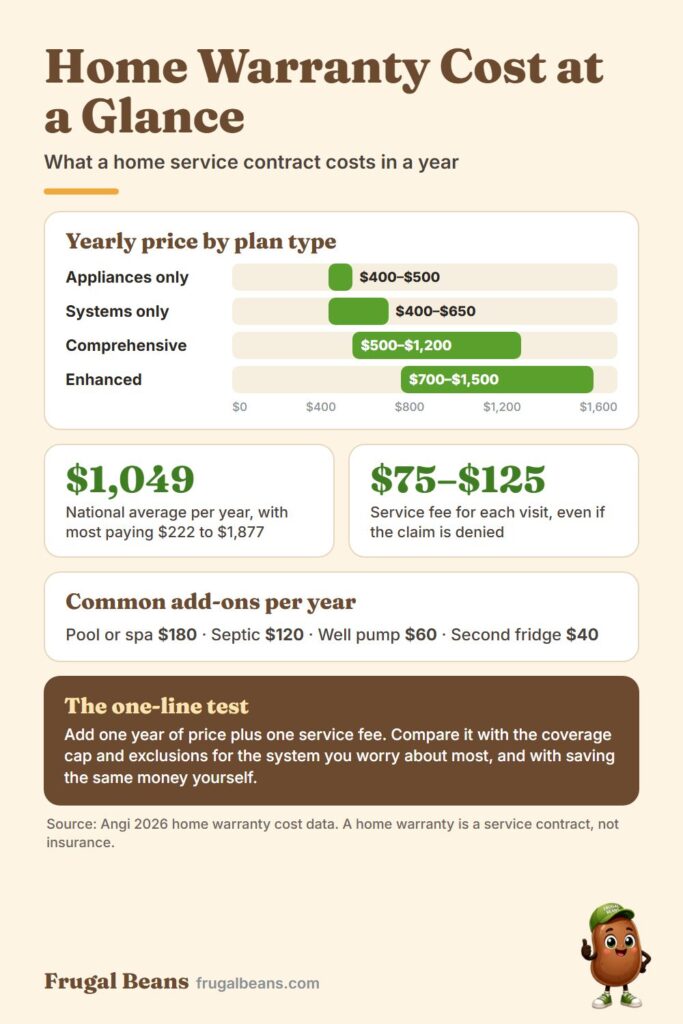
The average home warranty cost in 2026 is about $1,049 a year, according to Angi’s cost data, with most homeowners paying between $222 and $1,877. On top of that you pay a service fee of roughly $75 to $125 every time a technician comes out. The price is only half the story, though. What matters is what the contract would actually pay when the system you worry about fails. This free home warranty value checker adds up the full home warranty cost for a year, applies the coverage cap, and compares it with simply saving the same money yourself.
Loading the home warranty value checker… If it doesn’t appear, please make sure JavaScript is turned on.
How Much Is a Home Warranty?
How much is a home warranty depends mostly on the plan you choose. Angi’s 2026 figures, based on 1,697 projects reported by its pros, break the yearly home warranty cost down by plan type:
- Appliances only: $400 to $500 a year. Covers kitchen and laundry appliances.
- Systems only: $400 to $650 a year. Covers heating and cooling, plumbing and electrical.
- Comprehensive: $500 to $1,200 a year. Covers both appliances and systems.
- Roofing: $350 to $600 a year where it is offered as its own plan.
- Enhanced: $700 to $1,500 a year. Adds specialty or high-end items.
Most people asking how much is a home warranty are really asking about a comprehensive plan, so that is the default in the checker above. Leave the price box blank to use the typical midpoint, or type in the quote you were given, per year or per month.

What Makes Up the Full Home Warranty Cost
The sticker price is the part companies advertise. The full home warranty cost has four parts, and the checker adds them all:
- The contract price. Paid yearly or monthly. Angi notes that monthly payments can cost more over a year, and that renewal prices may go up year over year.
- Add-ons. Angi lists pool or spa equipment at about $180 a year, a septic system at $120, a well pump at $60 and a second refrigerator at $40. Tick any that apply.
- Service fees. A fixed fee each time a technician visits, typically $75 to $125. The fee is owed even if the claim is then denied.
- What the contract won’t pay. Anything above the coverage cap, plus anything excluded. This is the part most comparisons leave out, and it can be the biggest number.
Add the first three and you have the real yearly home warranty cost. Two service calls on a $900 plan, for example, bring the year to about $1,100 before a single claim is approved.
How the Home Warranty Value Checker Works
- Enter the contract. Pick the plan type, enter the price you were quoted (or leave it blank for the typical midpoint), the service fee per visit, how many service calls you expect, and any add-ons.
- Pick the system you worry about most. A gas furnace, central air conditioner, tank or tankless water heater, or something else. The replacement cost fills in from our own cost estimators; replace it with your quote if you have one.
- Enter the coverage cap. The most the contract pays for that item, from the sample contract. If you don’t know it yet, leave it blank and the checker shows the best case.
- Add a typical repair. A past repair bill or your own estimate.
- Choose how many years to compare and any price rise at renewal.
Click “Check the contract” and you get the total home warranty cost for the year, a table of three cases (nothing breaks, one repair, a full replacement) showing what you would pay with the contract and without it, how much of a replacement the cap covers, and what saving the same money would build over the years you picked. Your numbers are saved only in your own browser.
Home Warranty Cost vs. What It Pays: The Coverage Cap
A home warranty, also called a home service contract, is a service contract, not insurance. It pays toward the repair or replacement of covered items that fail from normal wear, on the terms in the contract. The single most important term is the coverage cap: the most the company will pay per item, per claim or per year.
Angi gives the example of a plan that might pay only $1,500 for ductwork repairs, or that sets an annual cap on all claims combined. If the cap on a furnace is $2,000 and a new furnace costs $6,900, a covered replacement still leaves you paying about $4,900 plus the service fee. The home warranty cost for that year is then the contract price, plus the fee, plus that gap.
That is why the checker asks for the cap on the one system you worry about most. A plan can look cheap and still leave the biggest bill with you.

A Worked Example
Here is how the numbers play out for a typical comprehensive plan quoted at $850 a year with a $100 service fee, one expected service call, and a $2,000 cap on a gas furnace that would cost $6,900 to replace:
- Total home warranty cost for the year: $850 plus one $100 fee, or $950. That is about $79 a month.
- If nothing covered breaks: you pay $850 with the contract and $0 without it.
- If you need one $500 repair: you pay $950 with the contract and $500 without it.
- If the furnace needs replacing: you pay $850, plus the $100 fee, plus $4,900 over the cap, or $5,850 with the contract, against $6,900 without it.
- Saving instead: putting the same $79 a month aside builds $2,850 in three years, about 41% of that furnace.
The contract comes out ahead in a year when covered repairs cost more than the year’s home warranty cost, as long as the claims are approved. Saving comes out ahead in quiet years, and the money stays yours. The checker shows both sides with your own numbers and never tells you which to choose.
Is a Home Warranty Worth the Cost?
There is no single answer, and we don’t give a verdict. It depends on the age of your systems, the cap and exclusions in the specific contract, and how much you already have set aside. Here is how to think about it:
- A contract can help when several older systems could fail before you have savings to cover them, or when you would rather pay a fixed amount than face a surprise bill. Some households use a contract for a year or two while they build a repair fund.
- Saving can help when your systems are newer, when the caps are low compared with replacement prices, or when you can set the money aside reliably. A repair fund has no cap, no exclusions and no service fee, and it pays any contractor you choose.
The Federal Trade Commission makes the same point about service contracts in general: some consumer advocates suggest skipping them and putting the money in a savings account instead, so you have it when repairs come up. To plan that reserve for every system in your home, use our free home repair fund calculator.
What Affects Your Home Warranty Cost
Angi lists the factors that move a home warranty cost up or down:
- Coverage level. The biggest driver. Appliance-only and systems-only plans cost less than comprehensive or enhanced plans.
- Home size and type. Larger homes have more systems and appliances to cover. Condos and smaller homes sit at the low end; luxury and multi-unit properties at the high end.
- Payment frequency. Paying yearly usually costs less than paying monthly, and some companies discount multi-year contracts.
- Service fee level. Some companies let you choose a higher fee for a lower price, or the reverse.
- Coverage caps. Plans with higher limits cost more, because the company takes on more risk.
- Location. Local labor rates, climate and storm risk all affect pricing.
- Add-ons and luxury items. Pools, septic systems, well pumps and high-end appliances each add to the home warranty cost.
Service Fees: The Cost That Adds Up
The service fee is easy to overlook when you compare plans by price alone. At $100 a visit, three calls in a year add $300 to your home warranty cost. Because the fee is charged for the visit, you can pay it and still have the claim denied. The FTC lists per-visit fees as one of the hidden costs to check before buying any service contract.
Set the number of service calls in the checker to what you realistically expect. If you are not sure, one or two is a reasonable starting point for an older home. Then try a lower fee with a higher price, or the reverse, to see which combination costs less for your situation.
What to Check in the Contract Before You Sign
The FTC’s advice on service contracts comes down to a few questions. Find each answer in the sample contract before you compare one home warranty cost with another:
- What is excluded? Pre-existing conditions, age limits, code upgrades, removal of the old unit and missing maintenance records are common exclusions. The FTC says that if something isn’t listed as covered, assume it isn’t.
- How do the caps work? Per item, per claim or per year, and does a replacement count as one claim?
- Can coverage be denied for skipped maintenance? The FTC notes some contracts allow this. Keep your maintenance records.
- When does coverage start? Many contracts have a waiting period after you buy.
- How do you cancel, and what refund do you get?
- Who actually backs the contract? The FTC warns that a contract is only as good as the company behind it. Check its complaint record with your state consumer protection office.
Our free home warranty contract decoder walks you through each of these clauses and prints a one-page summary, and the Homeowner Repair Cost Playbook has a printable version. Write down what your contract says next to each clause, then enter the numbers in the checker.
Matching the Plan to Your Home
The cheapest home warranty cost is the plan that covers what is likely to break in your home, and nothing else. A few common situations:
- Older furnace, AC or water heater, newer appliances. A systems-only plan covers the expensive equipment without paying for appliances that are still under their manufacturer warranty. Check the cap on the furnace and air conditioner first.
- Newer systems, older appliances. An appliance-only plan may fit, but compare the yearly price with what a typical appliance repair costs. A $450 plan plus fees covers a lot of small repairs before it pays for itself.
- Everything is getting old at once. This is where a comprehensive plan has the best case, because several failures in one year can add up faster than savings. It is also where caps and age exclusions matter most.
- Everything is new. Manufacturer warranties already cover much of the risk. The FTC advises comparing any service contract with the warranty you already have before paying for more coverage.
Not sure how old your systems are or how long they usually last? Our free home system lifespan tracker shows where each one sits in its expected life, which tells you which cap to look up first.
Home Warranty Cost When You Buy or Sell a House
Home warranties often come up during a sale. Sellers sometimes offer one to reassure buyers, and buyers sometimes ask for one as part of the deal. If the seller pays, the first year’s home warranty cost is not coming out of your pocket, but the service fees and the caps still are. Read the contract the same way you would if you were paying for it, and note the renewal price, since year two is yours.
If you are a seller deciding whether to offer one, treat the home warranty cost as part of your selling costs alongside agent fees and repairs. Our guide to the costs of selling a house lists the rest.
Home Warranty vs. Home Insurance
They pay for different things. Homeowners insurance covers sudden damage from events such as fire or storms. A home warranty is a service contract that pays toward repairs of covered systems and appliances that wear out, on its own terms. A home warranty does not replace insurance, and your insurance usually won’t pay for a furnace that simply reaches the end of its life. Keep that difference in mind when you weigh the home warranty cost against what you already pay for insurance.
Ways to Lower Your Home Warranty Cost
- Compare several companies using the same plan type and the same cap on the system you care about.
- Cover only what you need. A systems-only plan may be enough if your appliances are new.
- Pay yearly instead of monthly where it saves money.
- Weigh the service fee against the price. Fewer expected calls favor a higher fee and a lower price.
- Keep up with maintenance so claims aren’t denied for skipped service.
- Check the renewal price before you renew, and enter any increase in the checker to see the multi-year home warranty cost.
Frequently Asked Questions
What is the average home warranty cost?
Angi puts the 2026 national average at $1,049 a year, with most homeowners paying $222 to $1,877. Add a service fee of about $75 to $125 per visit to get the full home warranty cost.
How much is a home warranty per month?
At the $1,049 average, a home warranty is about $87 a month, before service fees. Monthly plans can cost more over a year than paying once, so compare both.
Do I pay a service fee if my claim is denied?
Usually yes. The fee is for the technician’s visit, so it is typically owed whether or not the repair is covered. Check your contract’s terms.
Does a home warranty pay for a full replacement?
Only up to the coverage cap, and only if the failure is covered. If the cap is below the replacement price, you pay the difference. Enter the cap in the checker to see that gap.
Can I lower my home warranty cost?
Often, yes. Choose only the coverage you need, pay yearly instead of monthly, and compare a higher service fee with a lower price. Angi also suggests asking about seasonal promotions and renewal discounts. Run each option through the checker to see the full home warranty cost for your home.
Is a home warranty the same as insurance?
No. A home warranty is a service contract, not insurance. What it pays depends entirely on the contract terms in your state.
Does the checker save or share my numbers?
Your entries are saved only in your own browser so you can come back to them. Nothing is sent to Frugal Beans or to any company. Use “Clear everything” to remove them.
The Bottom Line
The real home warranty cost is the yearly price, plus add-ons, plus every service fee, plus whatever the cap and exclusions leave you to pay. Run your quote through the checker above, find the cap on the system you worry about most, and compare the result with saving the same money. For the clause decoder, typical repair costs and a reserve worksheet, get our free Homeowner Repair Cost Playbook, and see all of our free home repair tools.
Sources: 2026 home warranty price ranges, add-on prices and service fees from Angi; coverage limit example from Angi’s guide to home warranties and HVAC; service contract guidance from the Federal Trade Commission; replacement prices from the Frugal Beans furnace, AC and water heater cost estimators (HomeAdvisor data). A home warranty is a service contract, not insurance. This tool provides general information, not legal, financial or insurance advice.

Get the free Homeowner Repair Cost Playbook
Which systems fail first, what they cost, the warning signs, and the repair-or-replace rule. 15 printable pages.
Free. No spam.
Free tools
Got a quote? Check it in under a minute.
Ballpark a new furnace before the contractor visits.
Price a tank, tankless or heat pump model.
Warm air, ice or noise? See the likely part and price.