What Does a Home Warranty Cover, and What It Does Not

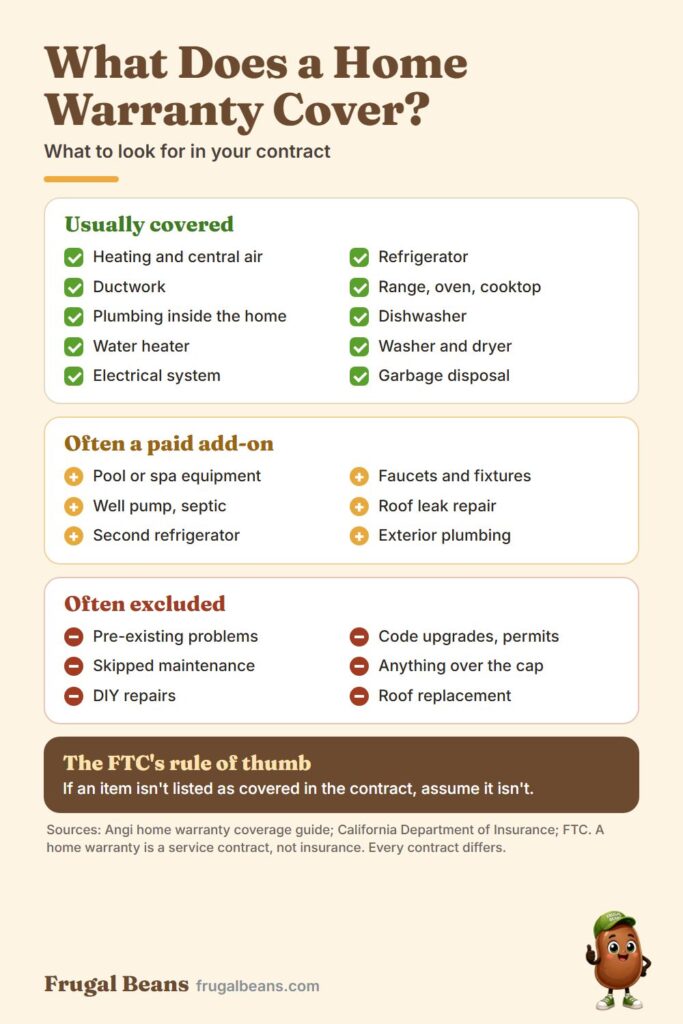
What does a home warranty cover? Usually the major systems that run your home, such as heating, air conditioning, plumbing and electrical, plus big appliances like the refrigerator, oven, dishwasher, washer and dryer, when they fail from normal wear and tear. What it does not cover is just as important: roof leaks, pipes outside the walls, fixtures, pre-existing problems and anything above the coverage cap are common gaps. Every contract is different, so the only reliable answer to what does a home warranty cover is what your own contract says. This free decoder walks you through it clause by clause and prints a one-page summary.
Loading the home warranty contract decoder… If it doesn’t appear, please make sure JavaScript is turned on.
What Does a Home Warranty Cover? The Short Answer
A home warranty, also called a home service contract, is a service contract, not insurance. It pays toward the repair or replacement of covered items that break down from normal use, on the terms written in the contract. The California Department of Insurance, which licenses these companies in that state, describes them as covering repairs or replacement of home systems and appliances for wear and tear, deterioration or defects.
So what does a home warranty cover in practice? Angi’s guide to home warranty coverage groups it into three kinds of plans:
- Systems plans cover things like heating, air conditioning and ductwork, plumbing, electrical and water heaters.
- Appliance plans cover things like refrigerators, ranges and ovens, dishwashers, washers and dryers, garbage disposals and built-in microwaves.
- Combination plans cover both, usually for less than buying the two separately.
Items such as pools and spas, well pumps, septic systems, extra refrigerators, faucets and fixtures, and roof leaks are usually add-ons with their own price, if they are offered at all.

How the Home Warranty Contract Decoder Works
To find out what does a home warranty cover in your own contract, have the sample open next to this page. Most companies post one on their website, and you can ask for it before you buy. Then:
- Pick what you want covered. Tick the systems and appliances that matter in your home, from the furnace to the garage door opener.
- Record what the contract says about each one. Listed as covered, only as a paid add-on, excluded, or not mentioned at all. Add the cap for that item if the contract gives one. Each item shows what coverage typically looks like, so you know what to look for.
- Fill in the money clauses. The annual price, whether it can rise at renewal, the service fee per visit and any total yearly cap.
- Tick the exclusions the contract lists, such as pre-existing conditions, improper maintenance or code upgrades.
- Fill in the fine print. The waiting period, maintenance records, who decides repair or replace, contractor choice, response time, cancellation and who actually backs the contract.
Click “Decode my contract” and you get a one-page summary of what your contract says, the gaps to know about, what each exclusion means for you, and a list of questions to ask the company before you sign. Print it, or send your price, fee and cap straight to our home warranty value checker to see what the contract would actually pay. The decoder never decides whether something is covered; it only records what your contract says, so you can read it clearly.
What Does a Home Warranty Cover in a Systems Plan?
When people ask what does a home warranty cover, they usually mean the expensive systems. According to Angi, basic systems coverage may include:
- Heating and air conditioning, including ductwork
- Electrical systems
- Plumbing
- Water heaters
- Ceiling fans, doorbells and garage door openers
- Home security systems and re-keying, on some plans
Two details decide what does a home warranty cover in real dollars. First, the cap: a furnace or air conditioner can cost several thousand dollars to replace, and a per-item cap can be far lower. Our furnace replacement cost estimator shows what a new furnace typically costs, so you can compare it with the cap. Second, the exclusions: code upgrades, permits and removal of the old unit are often excluded even when the repair itself is covered.
What Does a Home Warranty Cover in an Appliance Plan?
What does a home warranty cover in the kitchen and laundry room? Basic appliance coverage, according to Angi, may include garbage disposals, refrigerators and freezers, ranges, ovens and cooktops, washers and dryers, dishwashers, built-in microwaves, built-in water and ice dispensers, and toilets. Caps on appliances can be low; Angi gives the example of a $500 cap on replacing a dishwasher. Nonessential parts, such as oven racks and remote controls, are commonly excluded, and a second refrigerator in the garage usually needs its own add-on.
Does a Home Warranty Cover Plumbing?
Usually, yes, but not all of it. Does home warranty cover plumbing in your home? Most systems plans cover the plumbing inside the house: leaks and breaks in water and drain lines, and often drain stoppages. The common limits are:
- Pipes outside the walls. Angi notes that plumbing coverage often doesn’t extend to pipes outside the walls of your home. Exterior plumbing and sewer lines may need an add-on.
- Fixtures and faucets. A plumbing plan may cover the pipe but not the faucet or fixture attached to it. Fixtures are often an add-on.
- Water damage. If a pipe bursts and ruins the floor, the warranty may pay to fix the pipe, while homeowners insurance is what typically covers the damaged floor.
- Access costs. Opening walls or floors to reach a pipe is a common exclusion.
So the honest answer to does home warranty cover plumbing is: check which parts. In the decoder, tick “Plumbing pipes and drains” and “Faucets and plumbing fixtures” separately, and the summary will remind you to ask about pipes outside the walls.

Does a Home Warranty Cover the Roof?
Often not. Does home warranty cover roof repairs? Angi lists roof leaks among the items many home warranty companies don’t offer, and among the optional add-ons from companies that do. Where roof coverage is sold, it is usually limited to repairing leaks, not replacing the roof, and contracts often limit which parts of the roof qualify. Storm damage to a roof is typically a homeowners insurance matter, not a warranty matter.
If the roof is your main worry, a warranty is rarely the tool for it. A roof replacement averages several thousand dollars, which is why our home repair fund calculator includes the roof as its own line in a savings plan.
What Does a Home Warranty Cover? Quick Answers by Item
Here is what to look for item by item. Use these as a guide to what does a home warranty cover typically, then check your own contract with the decoder.
What does a home warranty cover for heating and air conditioning?
Most systems plans cover the furnace or heat pump and central air, often including ductwork, for failures from normal wear. Look for the per-item cap, whether refrigerant and code upgrades are excluded, and whether a replacement is their unit or a cash payout. Some plans treat air conditioning as an extra. If your AC is acting up now, our AC repair cost by symptom tool shows what common repairs cost.
What does a home warranty cover for water heaters?
Water heaters are usually in systems plans. Check whether the contract pays for a full replacement or only repairs, whether tankless models are included, and whether venting, permits or haul-away are excluded. Our water heater replacement cost estimator shows what a new one costs, so you can compare it with the cap.
What does a home warranty cover for electrical?
Usually wiring, panels, outlets and switches inside the home. Code upgrades, such as bringing an older panel up to current standards, are a common exclusion, and so are fixtures and low-voltage systems unless they are listed.
What does a home warranty cover for appliances?
The refrigerator, range or oven, dishwasher, washer and dryer, garbage disposal and built-in microwave are typical. Ice makers and dispensers may be limited, and a second refrigerator or freezer usually needs an add-on. Caps on appliances can be a few hundred dollars.
What does a home warranty cover for garage doors?
The opener is often covered; the door itself, springs and tracks usually aren’t. Angi uses this as an example of how coverage for one part doesn’t extend to the parts around it.
What does a home warranty cover for pools, wells and septic systems?
These are usually add-ons with their own yearly price, and they come with their own caps and exclusions. Angi lists pool or spa equipment at about $180 a year, a septic system at $120 and a well pump at $60 as add-ons.
What a Home Warranty Usually Does Not Cover
Knowing what does a home warranty cover is only half of the job; the exclusions decide what it actually pays. The California Department of Insurance warns that every home warranty has dozens of exclusions and dollar limits, and that many buyers only find out about them when a claim is denied. Common exclusions include:
- Pre-existing conditions and problems found by a home inspector
- Improper installation or skipped maintenance
- DIY repairs or installations, which can void coverage
- Code upgrades, permits, and access or removal costs
- Rust and corrosion, and mold, asbestos or radon work
- Commercial-grade equipment and solar panels
- Anything above the cap. Angi gives examples of a $1,000 cap on ductwork, $5,000 per item per year, or a $15,000 annual cap on all claims.
The Federal Trade Commission’s rule of thumb for any service contract applies here too: if an item isn’t listed as covered, assume it isn’t. The decoder flags every item you mark “not mentioned” for exactly that reason.
The 10 Clauses to Read in Every Home Warranty Contract
These are the clauses from the contract decoder in our free Homeowner Repair Cost Playbook. Find each one before you decide what does a home warranty cover in your case:
- Annual price, and whether it can rise at renewal.
- Service fee per visit, usually owed even if the claim is denied.
- Coverage caps per item, per claim and per year.
- Exclusions for the items you care about.
- Waiting period before claims are accepted.
- Maintenance proof, and whether you need records to have a claim paid.
- Repair or replace: who decides, and whether you can take a cash payout instead of their unit.
- Contractor choice: their network only, or your own, and how quickly they must respond.
- Cancellation: how to cancel, any fee, and how the refund is calculated.
- Who backs it: which company pays claims, and whether it is licensed or registered in your state.
California law, for example, requires a home protection contract to clearly list the covered items, all exclusions and limits, the contract period, the fee and renewal terms, any service fees, and any time or location limits on service. Contracts in other states vary, which is why it pays to write down what yours says.
A Worked Example
Say you are reading a comprehensive plan at $720 a year with a $125 service fee. You care about the furnace, the plumbing and the roof. The contract lists the furnace as covered with a $2,000 cap, lists plumbing as covered with no item cap stated, and doesn’t mention roof leaks. It excludes pre-existing conditions and improper maintenance, and requires maintenance records.
The decoder’s summary would show two items listed as covered and one gap, and flag the roof as “not mentioned,” which under the FTC’s rule means assume it isn’t covered. It would tell you to keep every service receipt, and its question list would include: What is the most you will pay for plumbing? Does plumbing coverage include pipes outside the walls and fixtures? Is there a total yearly cap? How many days before I can file a claim? Who actually pays the claims, and are you licensed in my state?
Send those numbers to the value checker and you would see that a covered furnace replacement still leaves most of the bill with you if the furnace costs several times the $2,000 cap. That is the full picture of what does a home warranty cover for this home, in plain numbers.
What Does a Home Warranty Cover When You Buy a House?
Sellers often offer a home warranty to reassure buyers, and buyers sometimes ask for one in the deal. The coverage works the same way, with two extra points. First, problems a home inspector flagged may be excluded as pre-existing, so compare the inspection report with the coverage list. Second, the first year may be paid by the seller, but the renewal price and the service fees are yours. The California Department of Insurance also notes that you can choose your own warranty company rather than the one suggested to you. Our guide to the costs of selling a house covers the seller’s side.
Home Warranty vs. Homeowners Insurance
What does a home warranty cover that insurance doesn’t? They cover different things and don’t overlap. Homeowners insurance covers sudden damage from events such as fire, storms or a burst pipe flooding a room. A home warranty helps pay to repair or replace the system or appliance that failed. In Angi’s example, if a pipe bursts and ruins a laminate floor, insurance would help with the floor and the warranty would help with the pipe. A home warranty does not replace homeowners insurance, and neither one pays for normal upkeep.
How to Check a Home Warranty Company
A contract is only as good as the company behind it, the FTC warns. Before you pay:
- Check the license. Some states license or register home warranty companies, often through the state insurance department. California, for instance, publishes a list of licensed home protection companies and warns that some have sold contracts there without a license.
- Look up complaints. Search the company’s name with “complaint” or “review,” and check your state consumer protection office. Common complaints include unfair claim denials and slow repairs.
- Get the answers in writing. Send the decoder’s question list by email so the company’s answers are on record.
Is a Home Warranty Right for You?
We don’t give a verdict. The answer depends on your home and on what does a home warranty cover in the contract you’re reading. A warranty tends to suit a home where several older systems could fail before you have savings to cover them. A repair fund tends to suit a home with newer systems, or where the caps are low compared with replacement prices. To see how old your systems are and where each one sits in its expected life, use the free home system lifespan tracker, then compare the contract with saving in the home warranty value checker.
Frequently Asked Questions
What does a home warranty cover?
Usually major systems such as heating, cooling, plumbing and electrical, and major appliances such as the refrigerator, oven, dishwasher, washer and dryer, when they fail from normal wear and tear. Exactly what is covered, and up to what amount, depends on your contract.
Does a home warranty cover plumbing?
Most systems plans cover plumbing inside the home, such as leaks and breaks in water and drain lines. Pipes outside the walls, faucets and fixtures, and the cost of opening walls are often excluded or sold as add-ons.
Does a home warranty cover a roof?
Often not. Many companies don’t offer roof coverage. Where it is sold, it is usually an add-on that pays for leak repairs, not a new roof.
What is not covered by a home warranty?
Common exclusions include pre-existing conditions, improper installation or maintenance, DIY repairs, code upgrades and permits, rust and corrosion, mold, and anything above the coverage cap. If an item isn’t listed as covered, assume it isn’t.
What does a home warranty cover on a new home?
The same kinds of systems and appliances, but a new home also has a builder’s warranty and manufacturer warranties on most equipment. Compare those first; what does a home warranty cover that they don’t is the only part you’d be paying for.
What does a home warranty cover in a condo?
Usually the systems and appliances inside your unit. Shared systems, the roof and the building structure are normally the association’s responsibility, so check your HOA documents before you decide what does a home warranty cover for you.
What does a home warranty cover when a seller pays for it?
The same as any other contract. The seller pays the first year, but the exclusions, caps and service fees apply to you as the buyer. Ask for the contract before closing.
Does the decoder tell me whether my repair is covered?
No. It records what your contract says and points out gaps and questions. Only the contract and the company’s claim decision determine coverage.
Does the decoder save or share my answers?
Your entries are saved only in your own browser so you can come back to them. Nothing is sent to Frugal Beans or to any company. Use “Clear everything” to remove them.
The Bottom Line
What does a home warranty cover? The systems and appliances listed in your contract, up to the caps, minus the exclusions. Read those three things for the items you care about most, and treat anything not listed as not covered. The free decoder above turns the contract into a one-page summary with the questions to ask, and the value checker shows what it would pay. For the printable clause decoder and a repair reserve worksheet, get our free Homeowner Repair Cost Playbook, and see all of our free home repair tools.
Sources: typical coverage, add-ons, exclusions and cap examples from Angi’s guide to what’s included in a home warranty; required contract terms, licensing and complaint guidance from the California Department of Insurance; service contract guidance from the Federal Trade Commission; clause list from the Frugal Beans Homeowner Repair Cost Playbook. A home warranty is a service contract, not insurance. This tool provides general information, not legal, financial or insurance advice.

Get the free Homeowner Repair Cost Playbook
Which systems fail first, what they cost, the warning signs, and the repair-or-replace rule. 15 printable pages.
Free. No spam.
Free tools
Got a quote? Check it in under a minute.
Ballpark a new furnace before the contractor visits.
Price a tank, tankless or heat pump model.
Warm air, ice or noise? See the likely part and price.