
admin
FIRE Movement Explained: 7 Simple Steps to Financial Independence
The FIRE movement—short for Financial Independence, Retire Early—can sound like a club reserved for high earners, spreadsheet experts, or people willing to live on almost nothing. In practice, it is less about escaping work on a particular birthday and more about gaining control over your choices. You build enough financial strength that a job becomes a tool rather than your only source of security.
Think of yourself as the pilot of an ordinary household financial plan. A good pilot does not stare only at the final airport. The pilot checks fuel, watches the instruments, adjusts for weather, and keeps everyone on board informed. Your household can use the same approach: a clear destination, reliable information, sensible controls, and a willingness to make small corrections before a minor problem becomes an emergency.
This guide lays out that system in plain language. You will learn what financial independence really means, how to estimate a FIRE number, how lean FIRE differs from other versions, and seven simple steps you can start this month. Nothing here is personal financial advice; it is a framework to help you ask better questions about your own situation.
A quick note on the name: this post was originally titled “Captain FI: The FIRE Personal Finance Pilot,” and “Captain FI” was our metaphor for a household steering its own money. There is also a real personal finance blog and podcast called Captain FI, run by an Australian pilot under that pen name, which is still publishing in 2026. This article is not about that creator, and we are not affiliated with it. We mention it in the resources section below for readers who go looking.

What the FIRE Movement Really Means
At its core, the FIRE movement is about financial independence: your essential life can be funded without depending entirely on a paycheck. That funding might come from investments, a pension, a business, rental income, or a combination of sources. Retiring early is only one possible use of that independence. You might leave a stressful career, work part time, care for family, study, volunteer, or start a less lucrative but more meaningful business.
Financial independence, retire early is therefore not a single finish line. It is a range of milestones. An emergency fund makes you less vulnerable to an unexpected bill. Paying off high-interest debt gives you breathing room. Saving enough to cover a year of expenses can let you take a sabbatical. Full independence provides the broadest set of options.
A useful distinction is between savings rate and net worth. Your savings rate is the portion of income you keep for future use. Net worth is what you own minus what you owe. A high savings rate helps, but a household also needs cash access, insurance, and a plan for near-term bills. Followers of the FIRE movement tend to watch both numbers, because one shows your habits and the other shows your progress.
Why Frugality Is the Engine
Every dollar you do not need to spend does two jobs at once. It can be saved and invested today, and it lowers the amount you will need to fund your life later. That double effect is why frugal habits sit at the heart of the FIRE movement. You do not need to be extreme; you need to cut waste around the things you genuinely value. Our guide to frugal living for beginners is a good place to start if this part feels new.
Lean FIRE, Fat FIRE and Other Paths
People in the FIRE movement use a handful of informal labels to describe different destinations. These are community nicknames, not official categories, and the dollar lines between them are fuzzy. Still, they help you decide what kind of independence you are aiming for.

Lean FIRE
Lean FIRE means reaching independence on a deliberately modest budget, roughly covering essentials with little room for extras. Because the spending target is lower, the savings target is lower too, so lean FIRE can be reached sooner. The trade-off is a thinner cushion: an unexpected health cost, a major home repair, or a long market slump can put real pressure on the plan.
Fat FIRE
Fat FIRE is the opposite end: independence that funds a comfortable or generous lifestyle, with travel, hobbies, and family support built in. It usually takes longer to reach, but it leaves more margin for surprises.
Coast FIRE and Barista FIRE
Coast FIRE describes a point where you have saved enough early that, if left to grow, your investments could plausibly cover a traditional retirement, so you only need to earn enough to pay current bills. Barista FIRE describes a mix: investments cover part of your costs and part-time or lower-stress work covers the rest, sometimes along with workplace benefits. Both versions treat work as optional in intensity rather than eliminating it.
None of these paths is better than the others. Lean FIRE suits people who truly enjoy simple living; fat FIRE suits people who would rather work longer for a wider margin. Most households in the FIRE movement end up somewhere in between, and many change their minds along the way.
The FIRE Movement in 7 Simple Steps
The rest of this guide walks through the steps one by one. Here is the full flight plan at a glance:
- Define your destination with three versions of your future budget.
- Know your cash flow by tracking real spending.
- Build a strong cockpit: emergency reserves, debt control, and insurance.
- Raise your savings rate gradually.
- Invest simply and consistently.
- Estimate your FIRE number.
- Review the route every year and correct course.
Step 1: Define Your Destination
Start with a destination specific enough to guide decisions. “Be rich” is too vague. “Have the flexibility to work four days a week within eight years while keeping our current housing and health coverage” is far more useful.
Write down three versions of your future budget:
- Essential spending: housing, food, utilities, basic transportation, insurance, taxes, health care, and minimum debt payments.
- Comfortable spending: essentials plus ordinary travel, hobbies, gifts, dining out, clothing, and home maintenance.
- Abundant spending: comfortable spending plus larger goals such as frequent travel, generous family support, or an expensive hobby.
These categories prevent a common mistake: treating every current purchase as permanent while pretending future life will be free. A household might spend $4,500 per month today, but perhaps $3,600 is essential and $5,200 is the life it wants. Each number produces a different savings target, and roughly speaking, the essential budget is your lean FIRE line.
Review the plan with the people affected by it. A partner may value predictable travel more than an especially early retirement date, while children create changing costs. Include these preferences rather than labeling them as obstacles.
Step 2: Know Your Cash Flow
Cash flow is the movement of money into and out of your household. Track it for at least one ordinary month, preferably three that include irregular expenses. Use bank statements, credit card records, and annual bills. Do not rely on memory; people forget subscriptions, insurance premiums, school costs, and gifts.
Sort expenses into three groups. Fixed expenses are difficult to change quickly, such as rent or a mortgage. Flexible expenses can move up or down, such as groceries, restaurants, and entertainment. Irregular expenses arrive periodically, such as car repairs, property taxes, and holiday travel. Divide annual irregular costs by twelve and set that amount aside monthly. This turns surprises into planned bills.
A simple cash-flow review should answer four questions:
- How much income reliably arrives after taxes and payroll deductions?
- What must be paid before the next payday?
- Which expenses are recurring but not essential?
- How much can be directed automatically toward reserves and long-term goals?
The objective is not to judge every purchase. It is to make the route visible so you can reduce costs, increase income, or accept a longer timeline. If you need help setting category amounts, our budgeting tips for a tight budget walk through it step by step.
Step 3: Build a Strong Cockpit Before Investing
Before taking substantial investment risk, establish a basic safety structure. Keep a starter emergency reserve in an accessible account. Then expand it until it can cover several months of essential expenses, with the amount depending on job stability, health, dependents, and how quickly you could replace your income.
Pay particular attention to high-interest debt. Credit card balances and similar debt can grow faster than a reasonable investment return. Make minimum payments on every debt, direct extra money toward the highest interest rate, and then roll the freed payment toward the next balance. The smallest-balance-first approach can also work if it keeps you motivated and consistent.
Insurance is financial protection. Health, disability, auto, renters or homeowners, and liability coverage can prevent one event from undoing years of progress. Review coverage when income, housing, dependents, or assets change.
Homeowners should also plan for the big-ticket systems that eventually wear out, such as the roof, furnace, and water heater. Our free Homeowner Repair Cost Playbook lists typical lifespans and repair costs so you can build them into your budget instead of being surprised.
Keep short-term money separate from long-term investments. Money needed within the next few years generally deserves stability and access rather than exposure to a sharp market decline. The emergency reserve is not failing to grow; it is doing its job by being available.
Step 4: Raise Your Savings Rate
In the FIRE movement, your savings rate is the single lever that most shapes your timeline, because it affects both sides of the equation: how fast your investments grow and how much you will eventually need. Raising it does not have to mean deprivation. It usually means trimming waste, avoiding lifestyle creep, and directing new income on purpose.
Here is simple arithmetic to show why small changes matter. If a household takes home $5,000 a month and saves 10%, that is $500 a month. Raising the rate to 15% means $750 a month—an extra $3,000 a year directed at the future, without counting any investment growth.
Good places to look first are the everyday leaks: groceries that get thrown out, unused subscriptions, and convenience purchases made when you are rushed. Our list of practical ways to save money and our guide on how to save money at home are full of low-effort ideas. Earning more counts too: a raise, a side project, or a career move can lift the rate faster than cutting alone.
Step 5: Invest Simply and Consistently
Investing means putting money into assets that can grow or produce income over time. A diversified portfolio spreads money across many companies, bonds, or other assets instead of depending on one investment. Diversification cannot prevent all losses, but it reduces single-investment risk.
For many households, broad, low-cost funds are easier to maintain than individual stocks. The right mix depends on time horizon, risk tolerance, tax situation, and account types. Risk tolerance means how well you can stick to the plan after a large temporary decline, not merely how comfortable you feel when markets rise.
Use available tax-advantaged workplace and individual accounts when they fit your situation. These accounts may offer deductions, tax-deferred growth, or tax-free withdrawals under specific rules. Understand the contribution limits, withdrawal conditions, and employer matching policy before making decisions. Early retirees in particular should learn the rules for accessing retirement accounts before the standard age, because some withdrawals can trigger taxes and penalties.
Automate contributions on payday. Automation removes a fresh monthly decision. Increase the amount after a raise, a debt payoff, or an ended expense. Rebalance occasionally if the mix drifts, but avoid constant tinkering. A boring plan you can follow is stronger than a clever plan that causes panic. To see how steady contributions can add up over time, the SEC’s compound interest calculator on Investor.gov lets you try your own numbers.
Step 6: Estimate Your FIRE Number
Your FIRE number is a rough estimate of how much you would need invested so that your portfolio could fund your yearly spending. The most commonly cited shortcut is to multiply your expected annual expenses by 25. That shortcut comes from the so-called 4% rule, because 4% is the same as one twenty-fifth.

Where the 4% Rule Comes From
The 4% rule traces back to research by financial planner William Bengen, published in the Journal of Financial Planning in the mid-1990s. Using historical U.S. market data, he looked at how much a retiree could withdraw in the first year, then adjust for inflation each year after, without running out of money over about 30 years. A 4% starting withdrawal held up across the historical periods he tested.
In 1998, three Trinity University professors—Philip Cooley, Carl Hubbard, and Daniel Walz—published a related analysis, often called the Trinity study, in the AAII Journal. You can read their article, “Retirement Savings: Choosing a Withdrawal Rate That Is Sustainable”, on the AAII website. Together, this research made the 4% figure a popular rule of thumb.
A Worked Example
Go back to the three budgets from Step 1 and turn each monthly figure into a yearly one, then multiply by 25:
|
Budget |
Monthly |
Yearly |
Yearly x 25 |
|
Essential (lean FIRE) |
$3,600 |
$43,200 |
$1,080,000 |
|
Current |
$4,500 |
$54,000 |
$1,350,000 |
|
Desired (comfortable) |
$5,200 |
$62,400 |
$1,560,000 |
These are illustrative examples, not targets. Notice how much the FIRE number moves with spending: every $100 of monthly spending you can comfortably live without lowers the target by $30,000 ($1,200 a year times 25). That is the frugality engine at work.
Why Your FIRE Number Is Only an Estimate
The 4% rule is a starting point, not a promise. The original research looked at roughly 30-year retirements, while someone who stops working at 40 may need money to last much longer, so some early retirees plan around a lower withdrawal rate and a larger target. Future returns, inflation, and taxes may also look different from the past.
Other income changes the math. Social Security, a pension, rental income, or part-time work can cover part of your spending, which lowers the amount your portfolio has to supply. Health insurance before Medicare eligibility is a major cost for U.S. early retirees and belongs in the essential budget. Treat your FIRE number as a direction on the map, revisit it every year, and consider getting help from a fee-only professional for complicated situations.
A Note on Australian FIRE Content
Much popular FIRE material comes from Australia, including the Captain FI blog. Australian guides often discuss superannuation, the compulsory workplace retirement system there, along with Australian brokers, taxes, and pension rules. The broad ideas carry over, but the details do not. U.S. readers should look at U.S. account types such as 401(k) plans and IRAs, U.S. tax rules, and Social Security instead of copying Australian strategies.
Step 7: Review the Route and Correct Course
A FIRE plan should change with reality. The following dashboard turns broad goals into manageable checks. The figures are examples, not universal rules.
|
Area |
Pilot’s question |
Example action |
|
Cash reserve |
Could we handle a large essential bill without new debt? |
Build a $12,000 reserve in stages |
|
Debt |
Which balance costs us the most each month? |
Pay extra toward a 24% credit card balance |
|
Savings rate |
What portion of take-home pay serves future goals? |
Raise saving from 10% to 15% after a raise |
|
Investing |
Is the portfolio diversified and suited to our timeline? |
Use a simple allocation and review annually |
|
Protection |
What event could damage our plan most? |
Check disability and liability coverage |
|
Lifestyle |
Which spending creates genuine value? |
Keep weekly family meals; cut unused subscriptions |
|
Flexibility |
What choice would money make possible? |
Build a six-month runway for a career change |
Review this dashboard monthly for cash flow and quarterly for larger decisions. A yearly review can cover insurance, beneficiaries, account fees, tax withholding, family changes, and an updated FIRE number.
Your Path to FI: The Simple Version
If seven steps feel like a lot, the whole FIRE movement can be boiled down to five repeating habits. Print the infographic, stick it on the fridge, and work through one habit at a time.
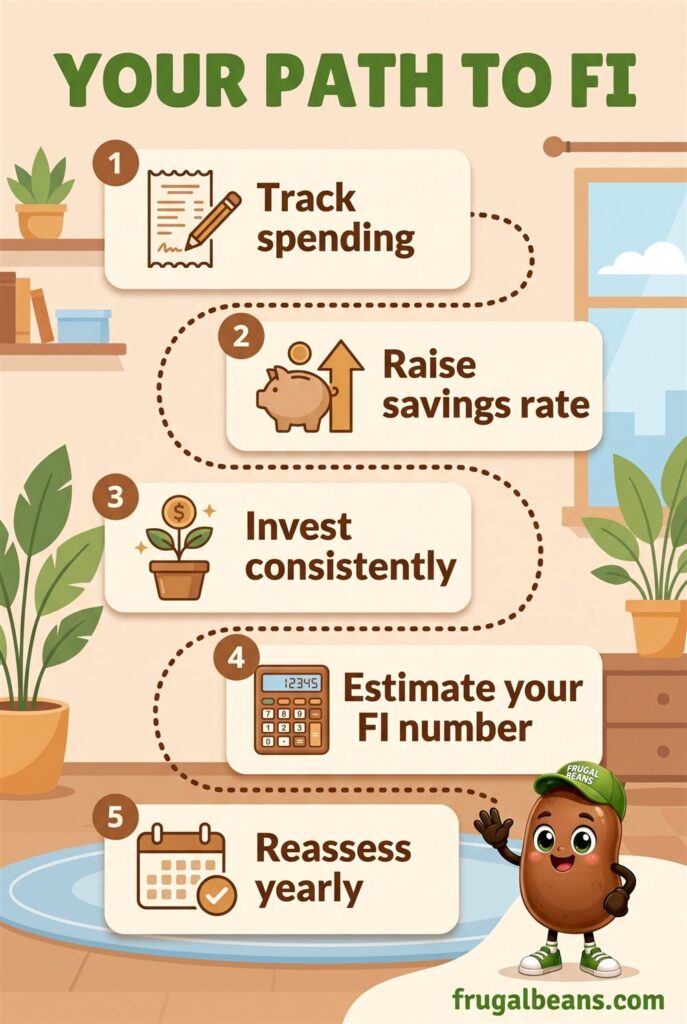
- Track spending. Know where the money actually goes before you try to change it.
- Raise your savings rate. Nudge it up after every raise, payoff, or canceled bill.
- Invest consistently. Automate contributions into simple, diversified investments.
- Estimate your FI number. Use yearly expenses times 25 as a rough starting point.
- Reassess yearly. Update your budget, your number, and your goals as life changes.
Practical Tips for Everyday Navigation
Give every irregular bill a runway. List annual costs and transfer one-twelfth of each amount into a separate sinking fund every month. When the bill arrives, the money is waiting.
Use a waiting period for nonessential purchases. For a costly item, wait a day or a week depending on the price. The pause separates a need from an emotional reaction and gives you time to compare.
Direct raises before they disappear. When income increases, assign part of the raise to investing or debt repayment before adjusting everyday spending. Keep some portion for enjoyment so progress does not feel like permanent deprivation.
Make convenience deliberate. Paying for delivery, prepared meals, or a closer home may be worthwhile if it buys time and fits the plan. Frugality is useful when it supports your values, not when it turns every decision into punishment. Our frugal living tips focus on that balance.
Measure progress with several gauges. Track savings, debt reduction, emergency-fund months, and the choices your money can support. Net worth may move unpredictably while your behavior steadily improves.
Schedule a calm money meeting. Partners can meet for thirty minutes with the same agenda each time: upcoming bills, account balances, one decision, and one positive result. Avoid meetings during arguments or right after stressful purchases.
Protect the downside first. Before seeking a higher return, ask what could force you to sell at the worst moment. Reserves, insurance, a diversified portfolio, and manageable fixed costs make the plan more durable.
Common Turbulence on the Way to Financial Independence
Job loss, illness, a new child, caregiving, divorce, relocation, or a major repair can require a temporary reduction in investing. Pausing contributions is not failure if it protects the household. Resume the previous rate when conditions stabilize.
Beware of extremes. Cutting every enjoyable activity can create burnout and make the plan impossible to sustain—a real risk for anyone chasing lean FIRE too hard. Chasing a very high return can expose essential money to unacceptable risk. Assuming expenses will fall dramatically in later life can create a misleading target. Model several futures, including higher health costs, a longer life, and a period of lower investment returns.
Taxes and account rules can influence the best order for saving, but complexity has a cost. If a strategy requires constant monitoring or creates anxiety, simplify it. For complicated situations, understand how a professional is paid before agreeing to advice.
The Many Resources in the Pilot’s Kit
A good financial plan is supported by a collection of resources rather than one perfect trick. Your kit can include a one-page net-worth statement, a spending tracker, a debt list, account statements, a short written investment plan, an insurance summary, and a calendar of annual bills. Keep the documents secure and tell a trusted household member where important information is stored.
Learning resources matter too. Read plain-language explanations of taxes, retirement accounts, investing, insurance, and consumer protections. Government sites such as Investor.gov are a good neutral starting point. Compare advice, especially when someone is selling a product. A useful resource explains costs, risks, trade-offs, and bad scenarios rather than promising certainty.
Blogs and podcasts from people pursuing financial independence and early retirement can be motivating. One example is the Captain FI blog and podcast mentioned at the top of this post, where an Australian pilot shares his own journey and interviews guests about investing and early retirement. Just remember that its account, tax, and pension details are written for Australians.
A community can provide encouragement, but never outsource judgment. Another household’s income, costs, health needs, and responsibilities may differ completely from yours. Use outside ideas as prompts, not instructions to copy.
FIRE Movement FAQ
What is the FIRE movement?
The FIRE movement is a personal finance approach built around financial independence, retire early. Followers spend deliberately, save a large share of their income, and invest it so that, eventually, investments and other income can cover their essential costs. “Retire early” is optional; many people use independence to work less or change careers rather than stop working.
How do you calculate your FIRE number?
A common rough method is to multiply your expected yearly expenses by 25, which reflects the 4% rule of thumb. For example, $40,000 a year times 25 is $1,000,000. Treat it as an estimate: longer retirements, taxes, health costs, and other income such as Social Security can all change the figure.
What is lean FIRE?
Lean FIRE means reaching financial independence on a modest, essentials-focused budget. Because spending is lower, the FIRE number is lower and can be reached sooner, but there is less margin for surprises such as medical bills or long market downturns.
Is the FIRE movement realistic on an average income?
Full early retirement is harder on an average income, but the habits still pay off. Tracking spending, raising your savings rate, and investing consistently can build an emergency fund, reduce debt, and create more choices over time, even if your timeline is longer than the headline stories.
The Bottom Line
The FIRE movement is not about never spending, never worrying, or predicting the market perfectly. It is about a household that knows its essential costs, protects against serious setbacks, saves automatically, invests with a clear purpose, and reviews the route without panic.
Start with one cockpit check this week. Find your true monthly essentials, cancel one unused expense, set up one automatic transfer, or list your debts and interest rates. Then repeat the process next month. Financial independence grows from ordinary decisions made consistently, not from a dramatic leap.
The most valuable destination is not simply an early retirement date. It is the ability to choose work, rest, generosity, learning, and family time with less fear. When your money supports those choices, you are practicing financial freedom along the way.
Ways to Save Money on a Tight Budget: 11 Smart Budgeting Tips
The best ways to save money on a tight budget start with a plan, not a punishment. A budget is simply a plan for using the money that comes into your household. It is not a test of willpower or a demand that you stop enjoying your life. When money is tight, a useful budget gives each dollar a job before it disappears into small purchases, surprise bills, and fees you never meant to pay.
Many people avoid budgeting because they think they need perfect records, a complicated spreadsheet, or a bigger paycheck first. In reality, a household budget can start with three numbers: what you bring home, what you must spend, and what you want your money to accomplish. The goal is not to predict every expense. The goal is to see where your money goes and make a few deliberate changes.
The 11 budgeting tips below are written for real households: changing schedules, uneven paychecks, rising bills, and competing priorities. Use them as a system rather than a list of rules. Start with one or two, then build on what works.
What a Tight Budget Really Needs
A tight budget is one where income barely covers, or sometimes does not cover, the basics. In that situation, the usual advice to “cut back on lattes” misses the point. What you need first is stability: bills paid on time, no surprise overdrafts, and a little cash between you and the next emergency.
That changes the order of operations. On a tight budget, protecting essentials comes before investing, and avoiding fees comes before chasing small discounts. A single late fee or a string of overdraft charges can wipe out a month of careful grocery savings. Keep that in mind as you read: the most powerful ways to save money on a tight budget are often about timing and structure, not deprivation.
If you are new to living on less, our guide to frugal living for beginners covers the mindset behind these habits.
1. Set One Small Goal With a Number and a Date
“Save more” is a good wish but a weak plan. Turn it into a specific target, such as saving $1,200 for car repairs by December or paying off a $900 credit card balance in six months. A number tells you how much is needed, while a date tells you how quickly you must act.
When money is tight, start smaller. A first goal of $300 for a starter buffer is more motivating than a goal you cannot imagine reaching. Break any target into manageable pieces. A $1,200 goal over twelve months is $100 per month. If you are paid every two weeks, setting aside about $46 from each paycheck gets you close. Each deposit is visible proof that the plan is working.
2. Build a Bare-Bones Budget From Take-Home Pay
Use the money that actually reaches your bank account, not your salary before taxes and deductions. Take-home pay is the amount available for bills, spending, saving, and debt payments. If your income changes from month to month, build the plan on a cautious estimate based on a lower typical month, not your best one.
Then write a bare-bones budget: the minimum your household needs to get through a month safely. A tight budget works best when you know this number by heart.
What goes in a bare-bones budget
- Housing: rent or mortgage, plus required insurance.
- Utilities: power, heat, water, and a basic phone plan.
- Food: groceries for simple home meals, not takeout.
- Transportation: fuel, transit, and the car payment if you need the car for work.
- Minimum debt payments, so nothing goes late.
- Essential health costs, such as prescriptions.
Everything else is a choice. That does not make it wrong, but it does make it adjustable. Knowing the difference is what lets you make fast, calm decisions in a lean month.
3. Track Spending for Two Weeks on a Tight Budget
A budget based on guesses is hard to trust. For two to four weeks, record every purchase without criticizing yourself. Include cash, automatic payments, delivery fees, bank fees, and small items such as snacks or parking.
Group transactions into broad categories that make sense for your life: housing, utilities, groceries, transportation, insurance, health care, debt payments, savings, eating out, entertainment, and personal spending. If a category is too broad to guide a decision, split it. If it holds only one tiny expense, combine it with a related category.
After tracking, compare what you expected with what actually happened. You may find that groceries are reasonable but convenience meals are high, or that a forgotten annual fee is the real source of stress. On a tight budget, good information is worth more than good intentions.

4. Separate Fixed, Flexible and Occasional Costs in a Tight Budget
Fixed expenses are usually the same each month, such as rent or a loan payment. Flexible expenses change, such as groceries, fuel, or clothing. Occasional expenses arrive less often, but they are still predictable: car registration, school supplies, gifts, medical deductibles, or yearly insurance premiums.
Occasional expenses are what break a tight budget, because they do not show up every month. Create a sinking fund, which is money set aside gradually for a known future cost. If a $600 insurance bill is due in six months, save $100 per month. The bill stops being a surprise and becomes part of the plan. Physical envelopes or labeled jars work for some households; separate savings labels in one account work for others.
|
Expense type |
Examples |
Tight budget approach |
|
Fixed |
Rent, loan payment, internet plan |
Pay first; renegotiate or shop around at renewal |
|
Flexible |
Groceries, fuel, dining out |
Set a range and check it weekly |
|
Occasional |
Repairs, gifts, annual fees |
Divide the cost by the months until it is due |
|
Irregular income |
Overtime, gig work, seasonal pay |
Cover the bare-bones budget from dependable income; assign extras on purpose |
5. Give Every Dollar a Job (Including a Little Fun)
A zero-based budget assigns a planned use to all expected income. “Zero-based” does not mean your bank account must reach zero. It means income minus planned spending, saving, and debt payments equals zero on paper. Unassigned money on a tight budget tends to vanish without a decision.
Still include a small amount for enjoyment. A modest allowance for coffee, a hobby, or a cheap night out keeps the plan livable. If the budget leaves no room for ordinary pleasures, you may follow it for a week and then abandon it completely. A planned $20 of personal spending is more useful than an unrealistic promise to spend nothing.
For couples or families, consider separate no-questions-asked amounts if that reduces friction. They do not need to be equal if incomes or responsibilities differ. What matters is agreeing on the system before the money is spent.
6. Automate Bills and Savings Without Risking Overdraft Fees
Automation moves money according to a decision you have already made. Schedule bills for the days right after payday, and set a small transfer to savings on payday too. Moving the money early keeps your goals from becoming “whatever is left at the end of the month.”
On a tight budget, timing matters as much as the amount. Start with a transfer you can sustain. If $75 per paycheck causes overdrafts, try $20 and increase it after two or three successful months. Keep a small cushion in checking for timing differences, because a payment that lands a day before your paycheck can trigger a fee.
Protect yourself from overdraft and late fees
- Ask your billers whether you can move due dates closer to payday. Some will.
- Turn on low-balance alerts in your banking app.
- Review whether you have opted in to overdraft coverage for debit card purchases. The Consumer Financial Protection Bureau explains how bank account fees and overdraft coverage work and what your choices are.
- If you know a payment will be late, call before the due date. Providers often have more options before an account falls behind.
Paying on time also protects your credit history, which affects what you pay for loans, insurance, and even some rentals. The CFPB’s guide to credit reports and scores explains how to check your reports for free and dispute errors.
7. Build a Small Emergency Buffer, Even on a Tight Budget
An emergency fund is cash reserved for an unexpected, necessary expense, such as a broken water heater, a cut in hours, or an urgent car repair. It is different from money for planned costs. A birthday gift is not an emergency, even if it was forgotten until the last minute.
When you are trying to save money on a tight budget, the first milestone can be very small: $100, then $300, then $500. Even $10 a week adds up to $520 over a year. Once that first buffer is in place, consider building toward several weeks or months of bare-bones expenses. The right long-term amount depends on income stability, health needs, dependents, and other support you can count on.
Keep emergency money in a safe account you can reach quickly but do not see every time you buy groceries. The main benefit is not earning the highest return. It is having an alternative to a payday loan or a high-interest card when life goes wrong. If you own your home, our free Homeowner Repair Cost Playbook helps you estimate which repairs to plan for so the buffer is the right size.

8. Cut Fixed Costs: The Biggest Ways to Save Money on a Tight Budget
When a budget is tight, focus on the largest controllable costs first. Housing, transportation, insurance, phone plans, and debt interest usually matter more than eliminating every small treat. A $50 monthly cut to one fixed bill saves $600 a year, and it keeps saving without any extra effort from you.
Phone, internet, and insurance
Check whether a lower-cost plan would meet your needs, especially if you rarely use all your data or channels. Compare insurance at renewal rather than letting it roll over automatically. Ask your current providers whether they have a cheaper plan before you switch; sometimes a phone call is enough.
Subscriptions and automatic renewals
Review subscriptions together, at one sitting. Cancel what you no longer use, pause what you use seasonally, and ask whether a lower tier would do the same job. For larger costs, compare the full price over time rather than only the monthly payment. A small monthly charge can still be expensive when it runs for years.
Groceries and everyday spending on a tight budget
Groceries are flexible, not fixed, but they respond well to systems. Plan a few reliable meals, keep a short list, and compare unit prices on the shelf tag, which show the cost per ounce or per count. A bigger package is only a bargain if you will use all of it. If convenience meals are draining the budget, our look at whether meal delivery services are worth it walks through the real cost.

Change systems, not willpower
Set a waiting period for nonessential purchases. A 48-hour pause can separate a genuine need from an impulse without forcing you to reject every want. Try a “replace, do not simply remove” approach: if takeout is the problem, keep one planned restaurant meal and prepare two quick alternatives at home. Practical substitutions last longer than shame. You will find more ideas like these in our list of simple ways to save money.
9. Hold a 15-Minute Tight Budget Check-In Each Week
A budget is a living plan, so check it before the month is over. Set aside 15 minutes once a week to review account balances, upcoming bills, recent spending, and progress toward your goal. That is long enough to catch problems and short enough to repeat.
Ask three questions: What has changed? What must be paid before the next check-in? What adjustment protects the most important goal? You might move $15 from entertainment to the car-repair fund, postpone a purchase, or simply confirm that everything is on track. On a tight budget, the weekly check-in is where overdrafts get prevented instead of discovered.
10. Plan for Irregular Income, Windfalls and Hard Months
If your pay varies, build the bare-bones budget around your lowest typical month. In better months, assign the extra on purpose: first to any bill that is behind, then to the emergency buffer, then to a sinking fund. Some households park extra income in a holding account and “pay themselves” a steady amount each month, which smooths out the ups and downs.
A windfall is money above your normal income, such as a tax refund, bonus, gift, or unusually strong freelance month. Decide in advance how to divide it. For example, a $900 tax refund might add $500 to the emergency buffer, $250 to debt repayment, and $150 to something your family enjoys.
Difficult months need a plan too. Identify expenses that can pause or shrink temporarily, such as extra debt payments, travel, or optional subscriptions. Protect housing, utilities, food, transportation, insurance, minimum debt payments, and essential health costs first. A flexible budget is not a failed budget. It is a budget that tells you which choices to make when conditions change.
11. Review and Adjust Your Tight Budget Every Month
Set a monthly appointment with your budget. Compare planned amounts with actual spending, notice your progress, and update categories that no longer fit. A raise, a new child-care cost, a move, a medical bill, or a paid-off loan can change the whole picture.
Do not change ten categories at once. If groceries ran over again, first ask whether the amount was unrealistic, prices changed, or meal planning needs attention. Then make one specific adjustment and watch the result. Small corrections compound over time.
A 5-Step Plan to Save Money on a Tight Budget
If the 11 budgeting tips feel like a lot, start with this short version. It mirrors the infographic and fits on a sticky note on the fridge.
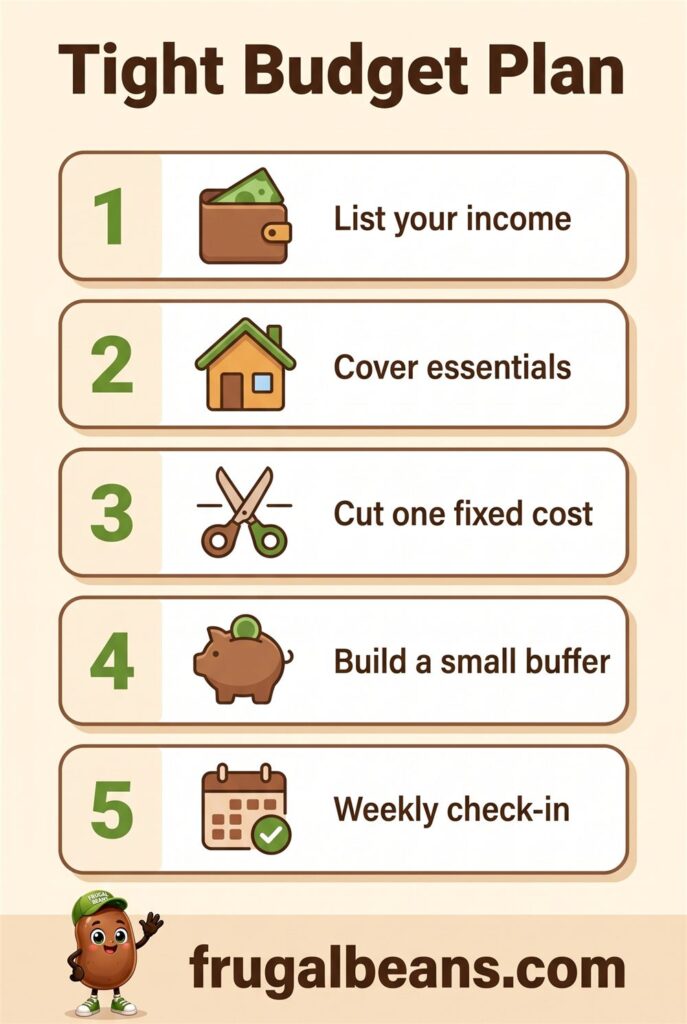
- List your income. Write down take-home pay for the month, using a cautious figure if it varies.
- Cover essentials. Fill in the bare-bones budget: housing, utilities, food, transportation, minimum payments, and health needs.
- Cut one fixed cost. Call one provider this week, such as your phone, internet, or insurance company, and ask for a lower plan.
- Build a small buffer. Automate a transfer you can sustain, even $10 a week, until you reach your first milestone.
- Hold a weekly check-in. Spend 15 minutes reviewing balances and upcoming bills so nothing catches you off guard.
More Ways to Save Money on a Tight Budget Without Feeling Deprived
The budgeting tips that last are the ones that are easy to see and easy to repeat. Keep the system visible. A one-page budget on paper, a basic spreadsheet, or a notes app is enough if you will actually use it. Choose the tool that makes your numbers easy to understand, not the one with the most features.
Use separate labels or accounts for goals when possible. Seeing “car repairs” and “holiday gifts” as distinct balances makes it less likely you will spend one goal’s money on another. If separate accounts create fees or confusion, use clear categories in one account instead.
Budget with ranges when precision would be false. Groceries might be planned at $400 to $450, while rent may be exactly $1,200. A range reflects real variation while still giving you a boundary. At the end of the month, learn from where the result landed.
Look at the house itself, too. Food waste, energy use, and small repairs left too long are quiet leaks in a tight budget. Our guide to how to save money at home walks through each room, and these frugal living tips add everyday habits that cost nothing to start.
Finally, connect the budget to something meaningful. A paid-off credit card can mean less stress. A small buffer can mean sleeping through the night when the car makes a strange noise. The budget is not the destination; it is the way everyday decisions support the life you want.
Ways to Save Money on a Tight Budget: Frequently Asked Questions
What are the best ways to save money on a tight budget?
Start with the biggest, most repeatable savings: lower one fixed bill, avoid overdraft and late fees by lining up due dates with payday, and plan simple meals so groceries stay predictable. Then automate a small transfer to an emergency buffer. These changes save more than cutting tiny treats.
How much should I save if I live on a tight budget?
Any consistent amount counts. Start with what you can sustain without overdrawing your account, even $5 or $10 a week, and increase it after a few successful months. Ten dollars a week becomes $520 over a year, which is a real cushion for a minor emergency.
Is a budget still useful if my income changes every month?
Yes, and it may be even more useful. Build the bare-bones budget on your lowest typical month, cover essentials from dependable income, and assign extra income on purpose when it arrives. A holding account that pays you a steady amount each month can smooth out the swings.
How do I avoid overdraft fees on a tight budget?
Keep a small cushion in checking, turn on low-balance alerts, schedule bills right after payday, and review your overdraft coverage choices with your bank. A weekly check-in helps you spot a shortfall before a payment goes through.
The Bottom Line
Budgeting on less works best when it is specific, flexible, and connected to your priorities. Name one small goal, build a bare-bones budget from take-home pay, track real spending, and plan for both regular and occasional costs. Then automate what matters, protect a small emergency buffer, cut one fixed cost at a time, and check in weekly.
You do not need to follow all 11 budgeting tips at once, and you do not need to get every category right on the first try. The most reliable ways to save money on a tight budget are the ones you can repeat. Give your money clear jobs, leave room for ordinary enjoyment, and let each month move you a little closer to breathing room.
How to Choose a Budgeting App: 6 Smart Questions After Pocketbook
Learning how to choose a budgeting app is easier when you know what can go wrong, and the story of Pocketbook is a useful place to start. Pocketbook was a free budgeting app built for Australian households. Its promise was simple: connect your bank accounts, let the app sort your transactions into categories, and use that clearer picture to make better decisions. For a busy family, that could be much easier than keeping a spreadsheet by hand.
Here is the important part up front: Pocketbook no longer exists. Its app and web service closed on August 5, 2022, and it is not available to new or existing users anywhere. It was also never really a U.S. product; it was designed around Australian banks. So instead of a review of an app you cannot download, this guide explains what Pocketbook was, what happened to it, and how to pick a budgeting app today that is active, affordable, safe with your data, and easy to leave if you ever need to.
The short version: a budgeting app is a visibility tool, not a complete financial plan. It can show you where money went and remind you about upcoming bills. It cannot agree on priorities with your partner or make choices for you. Keep that in mind and you will choose a better tool, and use it better, too.
What Happened to Pocketbook?
Pocketbook was founded in Sydney in 2012 by Bosco Tan and Alvin Singh as a free budget planner and personal finance app. In September 2016, the Australian buy-now-pay-later company Zip bought it, for about A$7.5 million according to Startup Daily. At the time of the closure, Zip said the app had more than 800,000 users.
In July 2022, Pocketbook announced that it would shut down on August 5, 2022. Users had until August 4 to export their categorized transactions as a CSV file, a plain spreadsheet format. After that, the company said it would delete users’ personal information and securely delete their financial and transaction data. Pocketbook’s own notice did not give a reason. News reports said Zip wanted to concentrate on its core business in Australia and New Zealand.
Was Pocketbook ever available in the U.S.?
Not in any practical sense. Pocketbook worked by connecting to Australian banks such as Westpac, Commonwealth Bank, ANZ, and NAB, and reviews always described it as an app for Australian accounts. A U.S. reader could not have linked an American checking account to it. Today the old Pocketbook web address shows unrelated content, so be wary of any download or website that claims to be Pocketbook.
Pocketbook is not the only budgeting app to close
Pocketbook’s closure was not unusual. In the U.S., Intuit shut down its popular free budgeting app Mint in March 2024 and pointed users toward Credit Karma, another Intuit service that did not offer the same budgeting features. Its users had to find a new tool and rebuild their categories. The lesson is the same in both countries: any app can change, be sold, or close, so choose one with that possibility in mind.
What Pocketbook Did Well (and What a Budgeting App Should Do)

Pocketbook’s central feature was account aggregation. In plain language, account aggregation means bringing information from several financial accounts into one view. A user could connect bank accounts and cards, then review spending without opening each bank app separately. Many budgeting apps work this way today, so its feature list is still a good checklist.
- Connected account viewing: balances and transactions from several accounts in one place. That helps couples, people with several cards, and anyone who loses track of which account pays which bill.
- Automatic categorization: transactions sorted into groups such as groceries, transportation, bills, and entertainment, so similar purchases can be totaled together.
- Budgets and spending limits: an expected amount for each category, compared with what you actually spent.
- Bill reminders: recurring payments highlighted so a subscription, utility bill, or annual charge does not sneak up on you.
- Spending analysis: summaries that show patterns over time, such as frequent takeout meals or unusually high gas costs.
Pocketbook’s approach was more about observation than control. A user could see that the household had spent $520 on groceries in a month, but the app could not stop another grocery trip. The user still had to decide whether the amount was reasonable and adjust next week’s shopping or move money from another category. Every budgeting app works this way. It informs; you decide.
Where automatic budgeting falls short
The categories were never perfect. A single big-box store receipt might include groceries, toiletries, and a birthday gift, yet show up as one grocery transaction. A transfer from savings to checking might be counted as spending if you did not mark it as a transfer. Automatic does not mean infallible. Checking and correcting a few transactions each week is part of using any budgeting app responsibly.
Data quality matters too. Bank connections can fail, transactions can arrive late, and duplicates can distort a total. An app that says $1,100 is available when a large card payment has not posted yet is not reassuring; it is misleading. Treat the dashboard as a helpful summary, not the final word on your bank balance.
How to Choose a Budgeting App: 6 Questions to Ask
When you are deciding how to choose a budgeting app, these six questions cover what matters most. They mirror the lessons from Pocketbook and from other apps that have closed. Use the infographic as a quick checklist, then read the notes below.
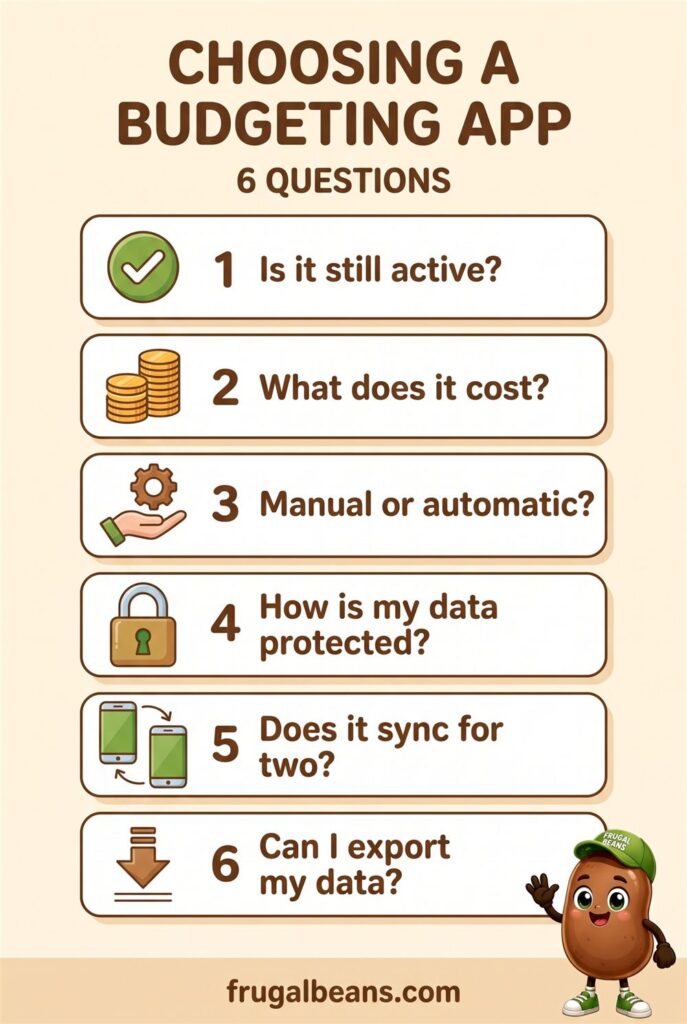
1. Is it still active?
This sounds obvious, but old review articles stay online for years after an app closes. Before you sign up, check that the app has been updated recently in your phone’s app store, that the company’s website is current, and that it supports U.S. banks if it connects to accounts. A budgeting app that has not been updated in a long time may be on its way out.
2. What does it cost?
Budgeting apps come in a few pricing styles: free with ads or upsells, a monthly or yearly subscription, or a one-time purchase. Free is not automatically cheaper. Pocketbook was free, and free services still need a way to make money, whether through advertising, selling other financial products, or eventually charging a fee. A paid subscription is not automatically better, either. Compare the yearly cost with what you expect to save, and watch for free trials that renew automatically.
3. Manual or automatic?
Automatic apps import transactions from linked accounts. They save time but need access to your financial data. Manual apps ask you to type in each purchase. That takes more effort, but many people find the act of entering a purchase makes them think twice about it, and no bank connection is required. Neither style is right for everyone; pick the one you will actually keep using.
4. How is my data protected?
This is the question most people skip. Read how the app connects to your bank, what it stores, whether it shares or sells data, and how to delete your account. We cover this in detail in the privacy section below.
5. Does it sync for two?
If you share finances with a partner or roommate, check whether two people can use the same budget on different phones, and whether changes sync quickly. A budget only one person can see tends to become one person’s job and the other person’s surprise.
6. Can I export my data?
Pocketbook users had a short window to download a CSV file before their data was deleted. Choose a budgeting app that lets you export your transactions and categories at any time, and do it every few months. Your budget history should belong to you, not to the app.
Budgeting App Privacy: Connecting Your Bank Accounts Safely

Connecting a budgeting app to a bank account requires careful thought. Even when an app uses strong security, you are still placing sensitive financial information with another company. Before linking anything, understand what information is collected, how access works, whether your login details are stored, and how to revoke access.
How budgeting apps connect to your bank
Pocketbook used a method called screen scraping, which typically required users to hand over their online banking password so the service could log in on their behalf. Many apps now connect through the bank’s own sign-in page or through a data-sharing service, so the app never sees your password. When you link an account, notice which screen asks for your password. If it is the app rather than your bank, think carefully before continuing.
The rules around this are still developing in the U.S. The Consumer Financial Protection Bureau’s page on personal financial data rights explains its rule on how banks must share your data with you and with apps you authorize, and notes that the agency has been reconsidering parts of that rule, including data security and privacy.
A simple privacy checklist
- Read the privacy policy’s sections on data sharing, selling, and deletion before you link an account.
- Link only the accounts you need for budgeting. A checking account and one credit card may be enough.
- Turn on two-step verification for both the app and your bank.
- Use a unique password for the budgeting app that you do not use anywhere else.
- Check your bank’s settings for a list of connected apps, and remove any you no longer use.
- Download only from your phone’s official app store, and double-check the developer name.
- When you stop using an app, delete your account inside the app rather than just removing it from your phone.
If you ever suspect your banking login has been misused, contact your bank right away. The FTC’s IdentityTheft.gov lets you report identity theft and get a personal recovery plan.
Paper, Spreadsheet, or Budgeting App?

Part of knowing how to choose a budgeting app is knowing when you do not need one. Pocketbook’s closure reminds us that the method matters more than the tool. Each option has real strengths.
|
Method |
Good for |
Watch out for |
|
Paper notebook |
People who think best with a pen; no data sharing at all |
Easy to skip a week; no automatic totals |
|
Spreadsheet |
Full control, free, easy to move anywhere |
Takes setup time; manual entry |
|
Your bank’s built-in tools |
Spending summaries with no extra app or data sharing |
Usually covers only that bank’s accounts |
|
Manual budgeting app |
Mindful tracking on your phone without linking accounts |
You must enter every purchase |
|
Automatic budgeting app |
Seeing several accounts in one place with little effort |
Data access, possible fees, and the risk the service changes or closes |
Many households combine methods: an app for day-to-day tracking and a simple spreadsheet for annual expenses, debt balances, and savings goals. If you are new to all of this, our guide to frugal living for beginners is a gentle place to start.
Tracking vs. Budgeting: The Biggest Lesson From Pocketbook
The biggest weakness of Pocketbook, beyond the fact that it closed, was how easily tracking could be confused with budgeting. Tracking records what happened. Budgeting decides what should happen next. Pocketbook was stronger at the first job than the second, and so are many apps today.
Here is how its strengths and limits compared:
|
Area |
What Pocketbook did well |
What users still had to handle |
|
Account overview |
Brought multiple accounts into one view |
Checking that balances and connections were current |
|
Spending categories |
Reduced manual entry |
Correcting misclassified or combined purchases |
|
Budget tracking |
Made category spending easy to compare |
Choosing realistic limits and responding to overspending |
|
Bill awareness |
Made recurring payments easier to notice |
Keeping enough cash available on the due date |
|
Cost |
Was free to use |
Accepting that free services can change or close |
|
Long-term planning |
Revealed day-to-day spending patterns |
Building savings, debt, and annual-expense plans separately |
A sample monthly plan
Whatever budgeting app you choose, it works best alongside a written plan. Consider a household with $5,000 of monthly take-home pay. It might have $2,100 for housing and utilities, $900 for groceries and transportation, $500 for debt payments, $400 for insurance and other regular costs, and $600 for personal and family spending. That adds up to $4,500, leaving $500 for savings and irregular expenses.
A good budgeting app makes it easy to notice if personal spending has reached $850 by the 20th of the month, leaving too little for the final ten days. The app spots the problem; the plan tells you what to do about it. For help setting realistic category amounts, see our budgeting tips for a tight budget.
How to Choose a Budgeting App You Will Actually Use
The best features in the world do not help if you stop opening the app after two weeks. Try a short test before you commit.
- Test for two weeks. Use a free trial or free tier and pay attention to whether you open the app without being reminded.
- Time the weekly review. If catching up takes more than about ten minutes, the app may be too complicated for you.
- Check the categories. Can you rename them, split a transaction, and mark transfers easily?
- Look at the reminders. Bill alerts should help, not nag. Too many notifications get ignored.
- Try an export. Download your data once during the trial so you know it works.
- Decide before the trial ends. Set a calendar reminder a few days before any paid renewal.
Practical Tips for Using Any Budgeting App
Although Pocketbook is gone, its basic workflow still works with a current app, your bank’s tools, or a spreadsheet. These steps help an ordinary household get value without turning budgeting into a daily chore.
Start with one month of observation
Do not change every habit on the first day. Review one normal month and identify the largest categories. This creates a baseline and reduces the chance of setting unrealistic targets. If takeout was $240 last month, a $180 target is a realistic first step; zero probably is not.
Separate needs, wants, and timing problems
A high expense is not automatically wasteful. A medical bill is different from an impulse purchase. A low balance may be a timing problem caused by an annual insurance premium rather than overspending. Label the reason before deciding what to cut.
Create an irregular-expense fund
Add up predictable annual costs and divide by twelve. If car registration, insurance, gifts, and school costs total $2,400 a year, setting aside $200 a month keeps those bills from becoming emergencies. Home repairs belong here too; our free Homeowner Repair Cost Playbook lists typical lifespans and repair costs for major home systems so you can plan ahead.
Review categories every week
A ten-minute weekly review is usually more useful than a stressful end-of-month investigation. Check new transactions, correct errors, and compare what is left in each category with the days left in the month.
Keep a small buffer
A budget that assigns every cent may look efficient but can fail when a prescription, repair, or price increase appears. Keep a modest cushion in checking or a miscellaneous category. The right amount depends on your income and obligations.
Use app data as a prompt, not a verdict
If a category looks wrong, investigate. If the app says you are on target, still check pending card charges and upcoming bills. Technology should support your judgment, not replace it.
Keep your key records outside the app
Keep a simple file with your monthly budget, an annual-expense calendar, debt balances, savings goals, and contact details for your financial providers. That makes it easy to switch tools and helps a partner understand the plan. If Pocketbook users had kept a file like this, its closure would have been an inconvenience rather than a setback. For more ideas on trimming the categories your app reveals, see our practical ways to save money and tips on how to save money at home.
How to Choose a Budgeting App: Frequently Asked Questions
What happened to the Pocketbook budgeting app?
Pocketbook, an Australian budgeting app owned by Zip, closed on August 5, 2022. Users could export their transactions as a CSV file until August 4, after which the company said it would delete personal and financial data. It is not available anywhere today.
Is it safe to connect a budgeting app to my bank account?
It can be, but it is a real decision. Prefer apps that connect through your bank’s own sign-in page rather than asking for your banking password, turn on two-step verification, link only the accounts you need, and remove access in your bank’s settings when you stop using an app.
How do I choose a budgeting app if I have never budgeted before?
Start simple. Pick one that is actively updated, fits your price limit, and matches your style: manual if you want to think about each purchase, automatic if you want the least effort. Use it for a month to observe before you set strict limits.
Is a free budgeting app worth it?
A free budgeting app can work well, but understand how the company makes money, whether through ads, offers for other financial products, or paid upgrades. Free services can also change or close, as Pocketbook did, so export your data regularly.
The Bottom Line
Pocketbook was a good example of what a budgeting app can do: bring accounts together, sort spending into categories, flag bills, and turn vague worry into specific facts. It also showed the limits. Categories needed correcting, a dashboard did not create a plan, and when the service closed, users had a short window to save their history.
So when you think about how to choose a budgeting app, ask six questions: is it active, what does it cost, manual or automatic, how is my data protected, does it sync for two, and can I export my data? Then keep your key records somewhere you control and review your numbers every week. Whether your tool is a phone app, a spreadsheet, or a paper notebook, you still supply the decisions. A good budget will not make your spending perfect, but it gives you enough clarity to adjust before a small problem becomes a big one.

Get the free Homeowner Repair Cost Playbook
Which systems fail first, what they cost, the warning signs, and the repair-or-replace rule. 15 printable pages.
Free. No spam.
Free tool
Repair or replace?
Got a quote for your furnace, AC, water heater or an appliance? Check it in under a minute.
Free tool
What needs replacing next?
Enter the install years for your furnace, AC, water heater and appliances. See what is due first and what to save each month.