Are Meal Delivery Services Worth It? 7 Smart Ways to Decide
Are meal delivery services worth it for your household, or are they just an expensive way to answer the question “what’s for dinner?” A box arrives with measured ingredients and a recipe card, or a tray arrives ready to heat. The convenience can be real, especially for a busy family, a new parent, or someone who wants to cook more often without planning every meal. The price can also be much higher than it first appears.
Whether meal delivery services pay off depends less on the advertised price per serving and more on how they fit your actual habits. You need to count delivery fees, skipped boxes, unused ingredients, grocery spending, takeout, food waste, and the value of your own time. A service can be a sensible purchase if it replaces expensive last-minute meals and food that would otherwise spoil. It can be a poor deal if it adds another food expense without replacing anything.
This guide gives you a simple way to decide using your own numbers. You will work out a real cost per serving, compare meal kits with prepared meals, groceries, and takeout, spot the hidden charges, and then run through seven smart questions that tell you whether a subscription has earned a place in your budget.
What You Are Paying For with Meal Delivery Services
Meal delivery services fall into two broad categories, and the money trade-offs are different for each. Some companies offer both types, so it helps to know which one you are actually comparing.
Meal Kits
Meal kits send measured ingredients and step-by-step instructions that you cook at home. The bill usually covers the ingredients, recipe development, portioning, packing, insulated shipping, and delivery. You are also paying for the planning work that a grocery trip normally requires: someone else picked the recipes, wrote the shopping list, and bought exactly the amounts you need.
Prepared Meals
Prepared-meal services send food that is fully cooked or mostly cooked, so you only need to heat and serve it. Here you are paying for cooking labor, packaging, refrigeration, and the convenience of skipping the stove entirely. Prepared meals usually save more time than meal kits, but the portions and variety may feel more limited.
The Two Options You Are Really Competing With
Every delivered meal is competing with two familiar alternatives: groceries you cook yourself, and takeout or restaurant delivery. Cooking from groceries is usually the cheapest per serving but takes the most planning and time. Takeout is fast and requires no cleanup but is usually the most expensive. Meal kits and prepared meals sit somewhere in between, and that middle position is exactly why the answer is different for every household.

In every case, the listed price rarely tells the whole story. A weekly order might advertise eight servings at $10 each, or $80. After a delivery fee, the total might be $95. If one meal is too spicy, another is not filling enough, and two servings end up in the freezer, your effective cost is far higher than $10 per serving. The useful number is the cost of food you actually eat, not the number printed in the promotion.
The Real Meal Kit Cost: Hidden Charges to Count
Before deciding, calculate the full meal kit cost of a typical order. Include every recurring charge and the costs that the order itself creates. A meal kit may require cooking oil, salt, spices, butter, or other pantry items. A prepared meal may require side dishes, drinks, or extra portions for a bigger appetite. Use this table as a checklist when you look at your first few orders.
|
Expense to check |
Why it matters |
Question to ask |
|
Menu price |
The advertised price is usually only the starting point. |
What is the price before and after discounts? |
|
Delivery fee |
A weekly charge can materially change the cost of small orders. |
Can I combine orders or qualify for free delivery? |
|
Taxes and surcharges |
These may appear at checkout rather than on the menu page. |
What is the final charge on my statement? |
|
Pantry add-ons |
Missing oil, spices, or staples create extra grocery trips. |
Do I already have the required basics? |
|
Unused servings |
Food that is never eaten is part of the cost. |
How many portions will realistically be eaten? |
|
Replacement meals |
A kit may not replace takeout if it is inconvenient. |
Will this prevent another food purchase? |
|
Subscription waste |
Forgotten skips can create unwanted boxes. |
How easy is it to pause or cancel? |
Shipping and Delivery Fees
Many services charge a flat delivery fee per box. On a large order, that fee is spread across many servings and barely moves the math. On a small order, it can add a noticeable amount to each plate. Always divide the fee into your per-serving number rather than treating it as a separate, forgettable line.
Skipped Boxes and Missed Deadlines
Most subscriptions ship automatically unless you skip a week before a cutoff date. If you travel, work irregular shifts, or simply forget, a box can arrive that nobody has time to cook. That box still counts toward your real meal kit cost, even if half of it goes in the trash.
Auto-Renew and Introductory Discounts
Welcome offers can make the first box look like a bargain, while later boxes cost the full price. Decide whether the regular price works before the discount runs out, and set a reminder for the date the subscription renews. If you want to stop a recurring charge, the Consumer Financial Protection Bureau explains how to stop automatic payments from your bank account, including telling the company in writing and keeping records of the date you asked. Remember that stopping a payment is not the same as canceling the service, so cancel the subscription itself, too.
Portions and Pantry Add-Ons
Check serving sizes against the people you are feeding. A box marketed for a family may provide smaller portions than active teenagers or hungry adults expect. If you routinely add bread, rice, salad, or a second main dish, add those costs to the order before you calculate anything.
Are Meal Delivery Services Worth It Compared with Groceries and Takeout?
The fairest way to compare options is one number: effective cost per serving. Use this simple calculation for every option you are considering:
Total cost ÷ servings actually eaten = effective cost per serving.
Here is a worked example using made-up numbers. Suppose a two-person household orders three meal kits with two servings each. The food costs $66, delivery costs $10, and the household spends $4 on missing pantry ingredients. The order total is $80 for six planned servings, or about $13.33 per serving. If one serving is thrown away and one portion is too small to count as a full meal, the order provides only four satisfying meals. The effective cost is then $20 per satisfying meal.
A Four-Way Example (Illustrative Numbers Only)
To see how the comparison works, here is the same week of six dinner servings priced four ways. These figures are examples to show the arithmetic, not real prices from any company or store. Replace them with what you actually pay.
|
Option |
Example weekly cost |
Servings eaten |
Cost per serving |
|
Meal kit |
$80 (food, delivery, pantry add-ons) |
6 |
About $13.33 |
|
Prepared meals |
$75 (six trays at $11 plus $9 delivery) |
6 |
$12.50 |
|
Groceries |
$30 in ingredients |
6 |
$5.00 |
|
Takeout |
$90 (two orders for two at $45 each) |
4 |
$22.50 |
In this example, groceries win easily on price, and takeout loses badly. The meal kit and prepared meals land in the middle. That is the key insight: whether meal delivery services save money depends almost entirely on which column they are replacing. If the kit replaces the grocery column, it costs more. If it replaces the takeout column, it may cost less.

Be Honest About Your Real Alternative
Do not compare a meal kit only with the cheapest possible grocery basket. Compare it with what you actually buy when you are tired, rushed, or out of ingredients. For a grocery benchmark, the USDA publishes USDA Food Plans, which estimate the cost of a healthy diet at four levels, from the Thrifty plan up through the Low-Cost, Moderate-Cost, and Liberal plans, along with monthly cost-of-food reports. They can give you a rough sense of where your own grocery spending sits.
Time matters, too. Consider a household that spends $25 on groceries for a home-cooked dinner for four, or $6.25 per serving. If preparing it takes 90 minutes, the household may still prefer a $55 kit, or $13.75 per serving, on a stressful evening. That preference puts a value on time, which is fine, but it still needs a spending limit.
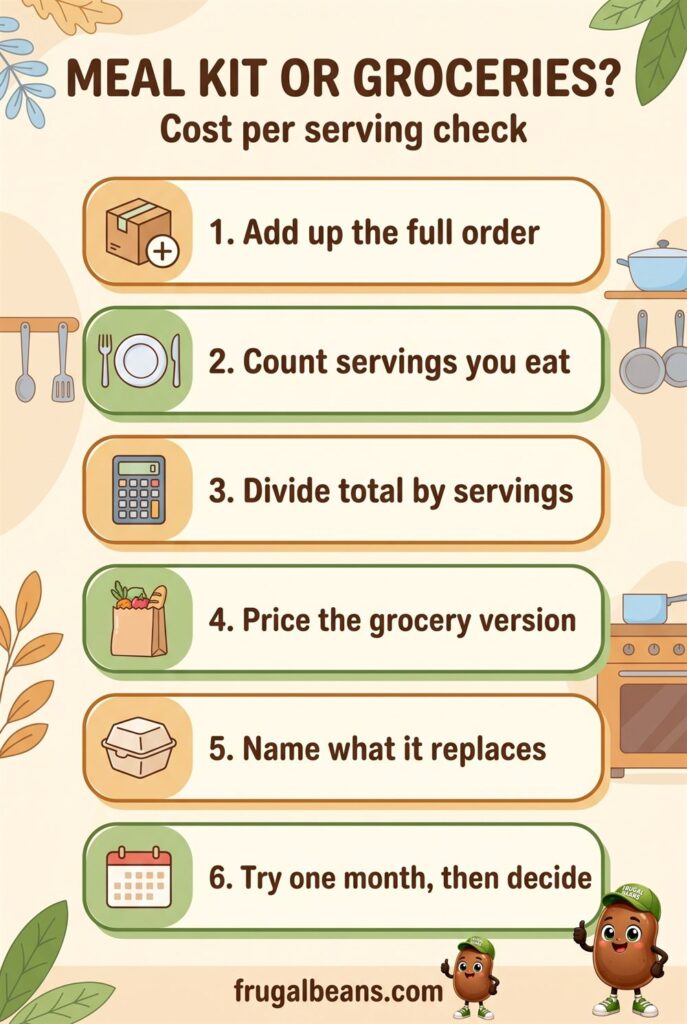
Meal Kit or Groceries? A 6-Step Cost Check
If you want a quick routine instead of a spreadsheet, use these six steps after your first two or three deliveries. The infographic below follows the same steps, so you can save it and keep it handy.
- Add up the full order. Use the final charge on your statement, plus delivery, tax, and any pantry items you had to buy.
- Count the servings you actually eat. Leave out anything thrown away, frozen and forgotten, or too small to count as a meal.
- Divide the total by those servings. That is your effective cost per serving.
- Price the grocery version. After cooking a favorite recipe, write down what the same ingredients would cost at your usual store.
- Name what it replaces. Write down the specific takeout order, restaurant lunch, or wasted grocery run the box is supposed to prevent.
- Try one month, then decide. Track every food charge for four weeks, compare the totals, and keep, shrink, or cancel the plan.
The one-month check is where the truth shows up. Record meal kit charges, grocery purchases, restaurant orders, convenience foods, and food thrown away. A service that replaces four takeout meals and reduces grocery waste may earn its cost. A service that replaces one planned grocery dinner while adding another charge probably does not.
Are Meal Delivery Services Worth It? 7 Smart Questions to Decide
Once you know your cost per serving, these seven questions turn the numbers into a decision. Answer them honestly, ideally with whoever else eats at your table.
1. Which Existing Spending Will It Replace?
This is the most important question. If your grocery bill stays the same and you keep ordering takeout, meal delivery becomes a new expense rather than a replacement. Name the specific spending it will cut, such as Friday takeout or the lunch you buy near work.
2. Will Your Household Eat Most of What Arrives?
Picky eaters, small appetites, and unexpected dinner invitations all reduce the servings you actually eat. Every uneaten serving raises the cost of the ones you do eat.
3. Does the Price Still Fit After the Discount Ends?
Judge the service on its regular price, not the welcome offer. If the full price only works by squeezing groceries or savings, it does not really fit.
4. Is Your Schedule Predictable Enough?
Weekly boxes work best for steady routines. Frequent travel, rotating shifts, or a busy social calendar make it more likely that food sits in the refrigerator until it spoils.
5. Do the Portions Match Your Appetites?
If one adult routinely eats one and a half servings, budget for that reality instead of trusting the label. Extra sides and second dinners quietly erase the advertised price.
6. Can You Skip, Pause, and Cancel Easily?
Read the skip deadlines and cancellation steps before you sign up. A subscription that is hard to control can turn convenience into recurring waste.
7. Is the Time You Save Worth the Premium?
You may decide that saving 30 minutes on a hard evening is worth $12 extra per serving. That can be a valid choice if it is planned and affordable. The problem is not paying for convenience; it is paying for it by accident, repeatedly, or with money you need for higher priorities.
A simple rule of thumb: if you can answer yes to most of these questions, try the service for one month and track it. If you answer no to two or more of the first three, the service is probably a lifestyle luxury rather than a useful part of your food budget.
When Are Meal Delivery Services Worth It? Who They Suit Best
Meal delivery services are most worthwhile when it solves a specific, expensive problem. These are the situations where the numbers most often work.
Busy Households That Rely on Takeout
Suppose a couple spends $45 on takeout twice a week because nobody wants to plan dinner after work. That is $90 a week. A three-meal kit costing $75 may be cheaper if it reliably replaces those orders and all six servings are eaten. The kit is not cheaper than cooking from the least expensive ingredients, but it may be cheaper than the household’s real alternative.
People Who Overbuy Groceries
Meal kits may help households that regularly buy produce with good intentions and then throw it away. Buying ingredients for one or two planned recipes reduces the temptation to purchase a large bundle that spoils. The savings are not automatic, because packaging can be substantial and per-serving prices are usually higher than bulk grocery prices. Still, measured portions may cut waste for people who struggle to use full-size packages.
One-Person Households
Buying a wide range of ingredients for one person often means repeated leftovers or spoiled food. A prepared meal can be a reasonable middle ground when the alternative is a restaurant lunch or a skipped meal followed by convenience-store snacking.
Short, Demanding Seasons
A new baby, recovery from surgery, a move, or a stretch of long workdays can make cooking feel impossible. A short, deliberate run of meal kits or prepared meals during that season can be cheaper and calmer than a month of takeout. Set an end date when you start.
New Cooks Building Confidence
Meal kits can work like a paid cooking class. If a few weeks of kits teach you a handful of dinners you can then shop for yourself, the service may pay for itself in the skills you keep.
When Meal Delivery Services Are Probably Not Worth It
Meal delivery is less attractive when you already plan and cook efficiently. A household that buys affordable staples, uses leftovers, and enjoys cooking may pay a large premium for tasks it can do easily. The service may still be enjoyable, but treat it as a convenience purchase rather than a savings strategy.
Meal delivery services are also a poor fit for unpredictable schedules, as the questions above showed. Large households should look carefully at portion sizes, and households with allergies or strict diets may find that the affordable menu choices are limited. And if money is tight right now, a premium dinner subscription is usually one of the first things to pause. Our guide to saving money on a tight budget covers where to focus first.
Cheaper Ways to Get Meal Kit Convenience
Much of what meal kits sell is planning, not food. You can copy that planning at grocery prices with a few simple habits.

Build Your Own Kit
On the weekend, choose three dinners and write a list for just those meals. Bag or box the ingredients for each dinner together in the refrigerator, so weeknight cooking feels like opening a kit. Plan to cook the most perishable dinner first.
Keep Two Default Dinners
Keep the ingredients for two low-effort meals on hand at all times, such as pasta with frozen vegetables, eggs and toast, bean tacos, or rice bowls. These protect the budget on nights when you would otherwise order takeout. Our list of ways to save money at home includes more food habits like this.
Cook Once, Eat Twice
Double a recipe and freeze labeled portions. A freezer full of your own meals works much like a prepared-meal delivery, without the shipping fee. If you are new to this kind of planning, our frugal living for beginners guide is a gentle place to start.
Tips for Getting Better Value from Meal Kits
If you decide to subscribe, these habits make meal kits and prepared meals more useful without turning them into a complicated project:
- Start with the smallest practical order. Try one or two weeks before committing to a large plan, and measure what your household eats, not what the menu promises.
- Set a calendar reminder before the menu deadline. Review the upcoming box, skip weeks you do not need, and check the final charge.
- Give each box a clear job. If Friday takeout is your regular splurge, choose a meal that works on Friday.
- Use every ingredient. Cook the most perishable produce first, and use leftover herbs, sauces, or vegetables in another meal.
- Keep basic pantry supplies on hand. Oil, salt, pepper, rice, and common seasonings prevent emergency grocery runs.
- Treat discounts as a trial, not the permanent price. Decide whether the regular price works before you continue.
- Pause or cancel promptly. Read the service’s rules for skips and cancellations, and keep a note of the date you canceled.
- Set a monthly ceiling. Treat delivery as part of the food budget. For example, you might allow two boxes a month while leaving room for groceries and an occasional restaurant meal.
For more ideas on trimming everyday costs without feeling deprived, browse our frugal living tips.
Are Meal Delivery Services Worth It? Frequently Asked Questions
Is a meal kit cheaper than buying groceries?
Usually not, when you compare it with cooking the same recipe from your own groceries. A meal kit can still save money if it replaces takeout or prevents you from buying groceries you would otherwise throw away. Price the grocery version of one favorite kit recipe to see the gap for yourself.
How do I calculate meal kit cost per serving?
Add up the final charge for the order, including delivery, tax, and any pantry items you had to buy. Then divide by the number of servings your household actually ate. That effective cost per serving is the number to compare with groceries and takeout.
What hidden costs come with meal delivery services?
The common ones are delivery fees, taxes added at checkout, boxes that ship because you missed a skip deadline, the jump from an introductory price to the regular price, pantry add-ons, extra sides for small portions, and servings that go uneaten.
Is meal delivery worth it for one person?
It can be. Cooking for one often leads to spoiled ingredients or repeated leftovers, so prepared meals or a small kit can be reasonable if they replace restaurant lunches or wasted groceries. Run the cost-per-serving check for a month before committing to a long plan.
The Bottom Line
Meal delivery services are worth it for some households, but they are not automatically a money-saving solution. Their value comes from what they replace and how consistently the food gets eaten. A service can cut takeout, limit grocery waste, simplify a demanding week, or provide manageable portions for one person. It can also create forgotten charges, uneaten food, and a bigger monthly food bill.
So, are meal delivery services worth it for you? Calculate the full meal kit cost or delivered price, use realistic serving counts, and compare the result with your actual alternatives. Start small, track one month, and set a clear spending limit. If the service buys meaningful time without undermining your budget, keep it as a deliberate convenience. If it only adds another food expense, cancel it and put the money toward groceries, savings, or a meal plan that works better for your household.
Leave a Reply

Get the free Homeowner Repair Cost Playbook
Which systems fail first, what they cost, the warning signs, and the repair-or-replace rule. 15 printable pages.
Free. No spam.
Free tool
Repair or replace?
Got a quote for your furnace, AC, water heater or an appliance? Check it in under a minute.
Free tool
What needs replacing next?
Enter the install years for your furnace, AC, water heater and appliances. See what is due first and what to save each month.
One Response to Are Meal Delivery Services Worth It? 7 Smart Ways to Decide