How to Compare Contractor Quotes: Free Side-by-Side Tool

When you compare contractor quotes, the lowest number is not always the cheapest job. Two quotes for “a new furnace” or “a new water heater” can describe very different work, and the gap is usually in what one quote quietly leaves out. This free contractor quote comparison tool lines up to three written quotes side by side, shows what each one includes, flags missing items and warning signs, and gives you the questions to send each contractor before you sign.
Loading the contractor quote comparison tool… If it doesn’t appear, please make sure JavaScript is turned on.
Why You Should Compare Contractor Quotes Item by Item
The Federal Trade Commission advises homeowners to get multiple written estimates, not to automatically choose the lowest bidder, and to ask for an explanation when there is a big difference between estimates. That advice is the heart of this tool. A price only means something once you know what it covers.
Consider three quotes to replace a furnace: $4,100, $5,400 and $6,900. At first glance the cheapest one wins by $1,300. But if the $4,100 quote leaves out the permit, the removal of the old furnace and a load calculation, and comes with no labor warranty, the comparison changes. The only fair way to compare contractor quotes is to make sure they describe the same job, then compare the prices.
How the Contractor Quote Comparison Tool Works
- Pick the job type. Furnace, AC or heat pump replacement, water heater replacement, a repair, or another home project. The checklist changes to match.
- Enter each quote. Add the company name, total price and the parts and labor warranties in years, for up to three quotes.
- Tick what each quote includes. Items such as the permit, haul-away, an itemized price and a payment schedule. Items marked with a red star are ones every complete quote should have.
- Tick any warning signs. Pressure to sign today, a demand for full payment up front, a request that you get the permit, a price given by phone without a visit, or a push toward a lender the contractor knows.
- Compare. You get a card for each quote with its price, how many checklist items it covers, missing must-haves, warning signs and how far it sits from the middle quote. Then you get a list of questions to send each contractor about the gaps.
Click “Load an example” to see how it works with three sample furnace quotes. Your entries are saved only in your own browser, so you can come back to them. Nothing is sent to Frugal Beans or the contractors. The tool never recommends a contractor; it only shows what each quote says on paper.
What Every Contractor Quote Should Include
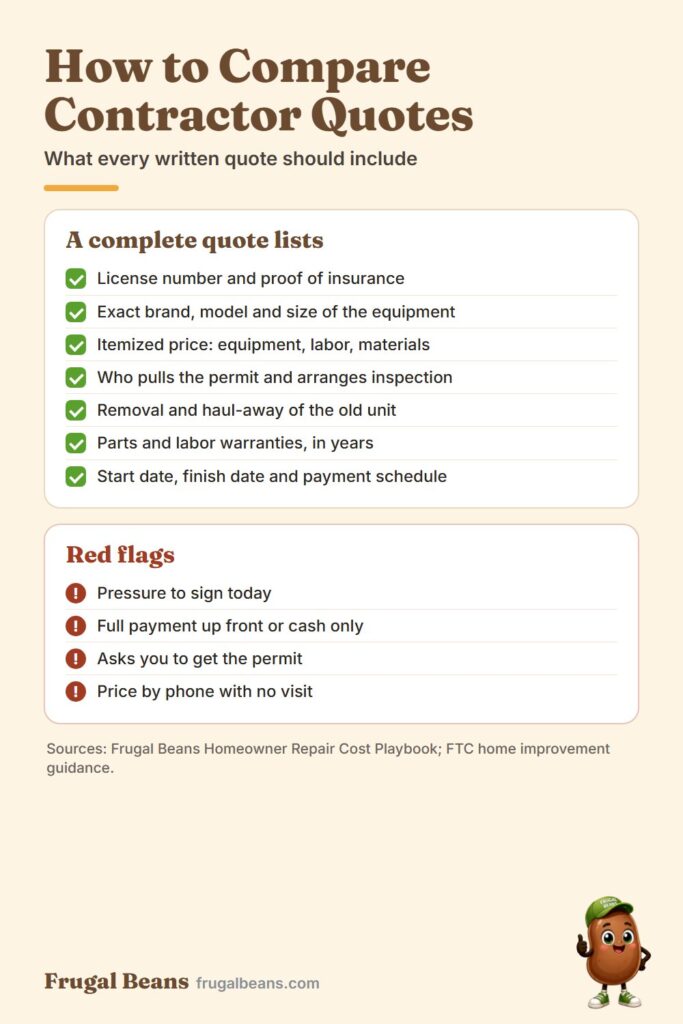
Whatever the job, a complete written quote should cover these items. They come from the quote checklist in our Homeowner Repair Cost Playbook and the FTC’s home improvement guidance.
- Company name, license number and proof of insurance. The FTC recommends hiring only licensed and insured contractors and checking the license with your state or county.
- Exact brand, model number and size of any equipment, so you can look it up and compare like with like.
- An itemized price that separates equipment, labor, materials, permit and disposal.
- Who pulls the permit and arranges the inspection. A reputable contractor handles this.
- Removal and haul-away of the old equipment.
- Parts and labor warranties in years, and whether the installer registers the product for the full manufacturer warranty.
- Start and completion dates and a written payment schedule.
- Rebates or incentives the contractor will document for you.
The FTC also says a written estimate should describe the work, the materials, the completion date and the price, and that you should ask for a written contract even if your state does not require one.
How to Compare HVAC Quotes
When you compare HVAC quotes for a furnace, air conditioner or heat pump, a few extra items matter a great deal:
- A load calculation. Often called a Manual J, it sizes the new system for your home’s insulation, windows and climate. A quote that simply matches the old unit’s size may be too big or too small. The U.S. Department of Energy recommends sizing heating and cooling equipment this way.
- The efficiency rating. AFUE for furnaces and SEER2 for air conditioners and heat pumps. Two quotes for the same price can be for very different efficiency levels.
- Ductwork. Whether the contractor will inspect the ducts, and whether any sealing or repair is included.
- The extras. A new thermostat, the pad, the refrigerant line set and electrical work can be included or charged on top.
- Venting and coil changes. High-efficiency furnaces need new venting, and a new air conditioner may need a matching indoor coil.
When you compare HVAC quotes, line up these five items before you look at the totals. They explain most of the price differences between heating and cooling contractors.
If you are still deciding between repairing and replacing, run the repair quote through our free repair or replace calculator first. To check a replacement price against national ranges, use the furnace replacement cost estimator.
How to Compare Water Heater Quotes
The same approach works when you compare contractor quotes for a water heater. Check that each quote lists the tank size or tankless flow rate, spells out any venting, gas or electrical upgrades, and includes code items such as an expansion tank and drain pan where required. Switching from a tank to tankless, or from electric to gas, adds work that a simple swap does not. Our water heater replacement cost estimator shows what those extras usually cost.
How to Compare Repair Quotes
Repair quotes need a different checklist. A good repair quote names the specific failed part, records the unit’s model number and age, says whether the part is original-manufacturer or generic and what warranty it carries, and states whether the diagnostic fee is credited toward the repair. A quote that won’t name the failed part is not one you can compare against anything. For air conditioners, our AC repair cost by symptom tool shows what common parts cost.
Red Flags When You Compare Contractor Quotes

The FTC lists several tactics that can signal a home improvement scam. Watch for them as you compare contractor quotes:
- Pressure for an immediate decision. A legitimate contractor will give you time to compare.
- Asking for full payment up front or accepting only cash. The FTC advises never paying the full amount in advance, notes that some states limit how much a contractor can ask as a down payment, and says to hold the final payment until the work is done and you are satisfied.
- Asking you to get the building permits. The contractor should handle permits for the work they do.
- Knocking on your door because they are “in the area” or claiming to have leftover materials from another job.
- Suggesting you borrow money from a lender they know. Shop around for financing yourself and never sign a document you have not read or that has blank spaces.
A price given over the phone without seeing the job is another warning sign. It usually means the final bill will be different from the quote.
A Worked Example: Comparing Three Furnace Quotes
Here is the sample the tool loads when you click “Load an example,” walked through step by step. It shows why a contractor quote comparison has to look past the total.
- Quote A, $5,400. It lists the license and insurance, the exact model, the permit, a payment schedule, a load calculation and the efficiency rating: 6 of 14 checklist items. It offers a 10-year parts warranty but only a 1-year labor warranty.
- Quote B, $6,900. It covers 12 of 14 items, including haul-away, an itemized price, duct inspection, the thermostat and electrical work, and product registration. Labor is warranted for 2 years.
- Quote C, $4,100. It names the model and little else: 1 of 14 items, no license shown, no permit, no payment schedule and no load calculation. The contractor also pushed to sign the same day.
On price alone, C looks $1,300 cheaper than A and $2,800 cheaper than B. When you compare contractor quotes item by item, C turns out to be the least complete and carries a warning sign. The next step is to send A and C the questions the tool lists, ask them to add the missing items in writing, and compare contractor quotes again once all three describe the same job.
Common Reasons Contractor Quotes Differ
Large gaps between quotes are normal, and most have an ordinary explanation:
- Different equipment. A higher-efficiency or larger unit costs more. Check the model numbers.
- Different scope. One quote includes duct sealing, a new thermostat or haul-away; another does not.
- Permits and code work. A contractor who pulls the permit and brings the job up to code will price that in.
- Warranty length. A longer labor warranty is a real cost to the contractor and a real benefit to you.
- Labor rates and demand. Busy seasons and emergency timing push prices up.
A careful contractor quote comparison separates these legitimate differences from padding or corner-cutting.
Price Differences: What They Usually Mean
The tool flags any quote more than about 20% below or 25% above the middle quote. Neither is automatically bad, but both deserve a question.
- A much lower quote often leaves something out, uses a lower-grade or smaller unit, or skips the permit. Ask what it does not include, then ask the contractor to add the missing items in writing.
- A much higher quote may include upgrades, more labor warranty, duct work or better equipment. Ask what it includes that the others do not. Sometimes the extra is worth it; sometimes it is padding.
- Quotes that are close together are a good sign that the market price is clear. Then the decision comes down to warranties, scope and how comfortable you are with each contractor.
Warranties: The Part of the Quote People Skip
There are usually two warranties on a replacement. The manufacturer’s parts warranty covers the equipment itself, and it often depends on the product being registered within a set time after installation. The installer’s labor warranty covers the work, and it can range from a few months to many years. A quote with a 10-year parts warranty and a 1-year labor warranty is very different from one with 10 years on both. Enter both numbers in the tool so they show up side by side when you compare contractor quotes.
Questions to Ask Before You Sign

The tool builds a question list for each quote from the items it is missing. Send the questions in writing so the answers are on record. A few questions are worth asking every contractor:
- Can you give me your license number and a certificate of insurance?
- What exactly is included in this price, and what would cost extra?
- Will you pull the permit and arrange the inspection?
- How many years are the parts and labor warranties, and will you register the equipment?
- What is the payment schedule, and how much is due before work starts?
- What start and completion dates will you put in the contract?
Once you have the answers, update the checkboxes and run the contractor quote comparison again. Often the quotes end up much closer than they first looked.
What to Check in the Final Contract
When you have chosen a quote, the FTC recommends that the written contract include the contractor’s name, address, phone number and license number; an estimated start and completion date; any promises made during conversations about the scope of work and costs; and, if you signed at home or anywhere other than the seller’s permanent place of business, a written statement of your right to cancel within three business days. Make sure every blank space is filled in before you sign, and keep your contractor quote comparison with the signed contract so you can check that everything promised made it in.
A Printable Contractor Quote Comparison Checklist
Prefer paper? Click “Print the comparison” in the tool to print the filled-in grid and results, or use the quote checklist on page 12 of our free Playbook. Bring it to each contractor visit so every estimate covers the same list. When you compare HVAC quotes on paper, add a column for the efficiency rating and the size the contractor recommends, since those two numbers explain many price differences.
How Many Quotes Should You Get?
Three written quotes is a common target for any large job. One quote gives you nothing to compare against. Two can show you a difference but not which one is unusual. Three usually shows a clear middle, which is why the tool measures each quote against the middle price. For small repairs, one or two quotes and a clear explanation of the failed part may be enough. For a full system replacement, three is worth the extra phone calls.
Frequently Asked Questions
How do I compare contractor quotes fairly?
Make sure every quote describes the same job. List what each one includes, such as the equipment model, permit, haul-away and warranties, and ask the contractors to add any missing items in writing. Only then compare the prices. The contractor quote comparison tool above does this side by side.
Should I always choose the lowest quote?
No. The FTC specifically advises against automatically choosing the lowest bidder. A low quote may leave out the permit, use a smaller unit or come with a short labor warranty. Compare what each quote covers first; a contractor quote comparison makes the gaps easy to see.
What should I look for when I compare HVAC quotes?
Check that each quote includes a load calculation to size the system, the exact model and efficiency rating, whether ductwork is inspected or sealed, and whether the thermostat, pad, line set and electrical work are included. Then compare the parts and labor warranties.
How much should I pay up front?
Not the full amount. Some states limit how much a contractor can ask for as a down payment, so check with your state or local consumer protection office. Hold the final payment until the work is finished and you are satisfied.
Does the tool save or share my quotes?
Your entries are saved only in your own browser so you can come back to them. Nothing is sent to Frugal Beans or to any contractor. Use “Clear everything” to remove them.
Does the tool recommend a contractor?
No. It only shows what each quote includes on paper and where the gaps are. The choice is yours, based on the full picture of price, scope, warranties and how each contractor answers your questions.
The Bottom Line
To compare contractor quotes well, line them up item by item, ask about every gap and warning sign, and only compare prices once the quotes describe the same job. The free tool above does the lining up for you and writes the questions. For the full quote checklist, typical costs and warning signs for every major home system, get our free Homeowner Repair Cost Playbook.
Sources: home improvement estimate, contract and scam guidance from the Federal Trade Commission; load-based equipment sizing from the U.S. Department of Energy; quote checklist from the Frugal Beans Homeowner Repair Cost Playbook. This tool provides general information, not legal, financial or contracting advice.

Get the free Homeowner Repair Cost Playbook
Which systems fail first, what they cost, the warning signs, and the repair-or-replace rule. 15 printable pages.
Free. No spam.
Free tools
Got a quote? Check it in under a minute.
Ballpark a new furnace before the contractor visits.
Price a tank, tankless or heat pump model.
Warm air, ice or noise? See the likely part and price.