9 Finance Podcasts to Help You Reach Financial Independence
Finance podcasts, and financial independence podcasts in particular, are one of the easiest ways to learn about money without sitting down with a textbook. Financial independence sounds like a distant, all-or-nothing destination. In practice, it is a household project built from ordinary decisions: spending a little less than you earn, protecting your income, paying down expensive debt, and investing for the future. You do not need a perfect budget or a high salary to begin. You need useful information and a way to turn that information into manageable actions.
Good finance podcasts bring personal-finance ideas into the parts of life where decisions actually happen. You can listen while walking, folding laundry, cooking dinner, or commuting. A good episode may explain an unfamiliar term, show how another family handled a tradeoff, or help you question a habit that no longer fits your goals. This list rounds up nine of the best personal finance podcasts for anyone working toward financial independence, but it is a collection of resources, not a ranking. Each of these podcasts has a different voice and emphasis, so the best choice depends on what your household needs right now.
Updated October 2026: We checked every show on this list against its official site and podcast feed. All nine were publishing new episodes in October 2026. An earlier version of this post listed Afford Anything twice and included a show we could not verify, so we replaced those two entries with How to Money and Catching Up to FI, both of which are active and easy to find in any podcast app.

What Financial Independence Means (and Why Finance Podcasts Help)
Financial independence usually means having enough savings and investments, or another reliable source of income, to cover your essential lifestyle without depending entirely on a paycheck. Some people want to leave full-time work early, which is the “RE” in FIRE (Financial Independence, Retire Early). Others want flexibility to change careers, work part time, care for family, or retire with less anxiety. The destination can vary. The useful first steps are similar.
That is where financial independence podcasts earn their place. They are free, they fit into time you already spend on chores, and they let you hear real people work through real decisions. Hearing a host explain a concept three different ways over a few months often sticks better than reading one article once.
Podcasts also have limits. A host does not know your taxes, your workplace benefits, your health, or your tolerance for risk. Treat every episode as a starting point for your own thinking, not personal advice. If you are brand new to managing money, our guide to frugal living for beginners is a gentle place to build the basics alongside your listening.
Finance Podcasts vs. Financial Independence Podcasts
“Finance podcasts” is a broad label. It covers everything from market news and stock-picking shows to business interviews and household budgeting. Financial independence podcasts are a narrower group: they focus on building enough savings, investments, or other income that work becomes more of a choice. Many of them also cover everyday personal finance, such as debt payoff, budgeting, and retirement accounts, because those habits are the foundation of FI.
For most households, that narrower focus is the more useful one. Daily market commentary can be interesting, but it rarely tells you what to do with your next paycheck. The shows on this list stick closer to decisions you control: what you spend, what you save, how you invest for the long term, and what you want the money to do.
How to Choose the Best Personal Finance Podcasts for Your Goals
Before you press play on any of these financial independence podcasts, identify the question you are trying to answer. If the question is “How do we stop overspending?” a show about behavior may be more useful than one about investing. If you have an emergency fund but do not know how to invest, choose a practical investing discussion. If money conversations cause tension at home, look for patient, judgment-free conversations.
It also helps to match a show to your stage. Some FIRE podcasts assume you already know what an index fund is. Others start from zero. Some lean toward real estate and side businesses, while others focus on mindset and behavior. Sample one or two episodes of any of these finance podcasts before deciding whether it fits.
The table below is a quick map of the nine finance podcasts on this list. Use the right-hand column as a question to carry while you listen.
|
Podcast |
Especially useful for |
A question to carry while listening |
|
ChooseFI |
Building a flexible FI plan |
Which lever can we improve first? |
|
Afford Anything |
Understanding tradeoffs |
What are we willing to exchange for freedom? |
|
The Stacking Benjamins Show |
Broad financial education |
Which basic topic needs attention? |
|
So Money with Farnoosh Torabi |
Mindset and money behavior |
What belief is shaping our choices? |
|
Money Guy Show |
Saving and investing systems |
What should happen to each dollar? |
|
BiggerPockets Money |
Real estate and alternative routes |
What risks would this strategy bring? |
|
Earn & Invest |
Income, investing and purpose |
What is all this money for? |
|
How to Money |
Everyday money decisions |
What can we apply this week? |
|
Catching Up to FI |
Starting later in life |
What can we still change from here? |
9 Essential Finance Podcasts for Financial Independence
Each of the financial independence podcasts below is listed with who hosts the show, what it is good for, who it suits, and its status when we checked in October 2026. Links go to each show’s official page.
1. ChooseFI (Brad Barrett and Jonathan Mendonsa)
ChooseFI is a strong starting point if you have heard “financial independence” but are unsure what it means in daily life. The show was founded by Jonathan Mendonsa and Brad Barrett, and Jonathan returned as Brad’s full-time co-host in early 2026. Its central idea is that progress comes from several levers, not one dramatic trick: earning more, spending intentionally, reducing recurring costs, and investing consistently.
The useful lesson for an ordinary household is flexibility. You do not have to copy an extreme savings rate or make every purchase a test of discipline. You might compare insurance, cancel unused subscriptions, or direct a modest raise toward a retirement account. The show helps you see these choices as connected parts of one plan.
Good for: learning the core FI framework, cutting big recurring costs, and hearing from a large community of listeners. Suits: beginners and intermediate listeners who want an optimistic, practical tone. May not suit: anyone who wants deep technical investing analysis every episode. Status: publishing new weekly episodes as of October 2026.
2. Afford Anything (Paula Pant)
Afford Anything focuses on the decisions behind money. Its name comes from host Paula Pant’s idea that you can afford anything, but not everything. That framing helps households discuss priorities without pretending a spreadsheet can choose their values. The show’s description says it covers financial psychology, increasing income, investing, real estate, and entrepreneurship, with new episodes on Tuesdays and Fridays. Joe Saul-Sehy joins Paula for regular listener Q&A episodes.
This is useful when you are balancing travel, a car replacement, family support, and retirement. The answer is not automatically to eliminate every enjoyable expense. Decide which goals deserve money now, which need a sinking fund, and which can wait. A sinking fund is money set aside gradually for a known future expense. Saving $100 a month for a $1,200 annual bill makes it predictable instead of an emergency.
When listening, ask whether a suggested tradeoff fits your values, time horizon, and responsibilities. A financially independent life should contain freedom, not just a larger account balance.
Good for: decision-making frameworks, economics explained plainly, and thoughtful expert interviews. Suits: listeners who like to think through the “why” before the “how.” May not suit: people who want quick tips in under ten minutes. Status: publishing new episodes as of October 2026.
3. The Stacking Benjamins Show (Joe Saul-Sehy and Josh “OG” Bannerman)
The Stacking Benjamins Show takes a conversational, often silly approach to serious personal-finance subjects. Hosts Joe Saul-Sehy, a former financial advisor, and Josh “OG” Bannerman, a Certified Financial Planner, present the show as a chat around a card table in Joe’s mom’s basement. That breadth and humor help listeners who need general education rather than one narrow strategy.
Think of it as a tour of the financial neighborhood: taxes, insurance, retirement accounts, investing, and behavior. You may not need every topic today, but you can notice which one deserves a closer look. If an episode introduces asset allocation, pause and define it. Asset allocation is the way investments are divided among categories such as stocks, bonds, and cash. The mix affects both growth potential and the size of possible losses.
Good for: broad money literacy with a light touch. Suits: people who find most personal finance podcasts dry. May not suit: listeners who want a strictly early-retirement focus or no banter. Status: publishing several new episodes a week as of October 2026.
4. So Money with Farnoosh Torabi
So Money is hosted by Farnoosh Torabi, a financial strategist, TV host and bestselling author. It mixes interviews with authors, entrepreneurs, and public figures with “Ask Farnoosh” episodes that answer listener questions. It fits listeners whose financial questions are partly emotional. Money can represent safety, status, independence, family loyalty, or past hardship, and those meanings affect spending and saving even when the arithmetic is clear.
Consider a couple who repeatedly overspends on takeout. The problem may not be a lack of cooking knowledge. They may be exhausted by work and caregiving, or they may never have agreed on a realistic food budget. A useful response could be preparing two easy meals on the weekend, setting aside a specific convenience-food amount, and removing shame from the discussion.
Use this kind of conversation to identify your money scripts, the repeated beliefs you inherited or developed. Examples include “debt is normal,” “talking about money is rude,” and “spending proves success.” Naming a belief gives you room to choose a different behavior.
Good for: money mindset, careers, couples, and big life transitions. Suits: listeners who want empathy along with strategy. May not suit: people who want a step-by-step FIRE roadmap. Status: publishing new episodes as of October 2026.

5. Money Guy Show (Brian Preston and Bo Hanson)
The Money Guy Show is helpful for people who want an organized order of operations. Hosts Brian Preston and Bo Hanson are financial advisors (yes, our mascot Bo approves of the name). Their signature framework, the “Financial Order of Operations,” is a nine-step sequence for deciding what to do with each dollar next.
Financial independence becomes easier when money has assigned jobs. A household can decide how much to keep in cash, how to handle high-interest debt, how to use workplace retirement benefits, and how to invest additional savings. Suppose your household receives a $300 monthly raise. You could let it disappear into general spending, or split it deliberately: $150 toward a car-repair fund, $100 toward retirement, and $50 for enjoyment. There is no universal split, but deciding before the money is absorbed gives the raise a lasting effect.
Good for: clear priorities and savings-rate thinking. Suits: people who like checklists and want to know “what next.” May not suit: listeners who prefer open-ended philosophical discussions. Remember that the hosts run an advisory firm, so weigh any service mentions as you would any business. Status: publishing new episodes as of October 2026.
6. BiggerPockets Money (Mindy Jensen and Scott Trench)
BiggerPockets Money is one of the best-known FIRE podcasts, hosted by Mindy Jensen and Scott Trench. Many episodes feature listeners walking through their own numbers on the way to early retirement, alongside discussions of real estate, entrepreneurship, and side businesses. These approaches can create income or ownership, but they also require time, knowledge, capital, and tolerance for uncertainty. The lesson is not that every household should become a landlord. It is that financial independence can have more than one route.
Keep a risk checklist nearby. Ask how much money could be lost, how much unpaid work is involved, whether income is dependable, and what happens if the market changes. Rental property is not simply “passive income.” It can involve repairs, vacancies, insurance, taxes, legal requirements, and difficult tenant conversations. If you are weighing property, our free Homeowner Repair Cost Playbook shows how big-ticket repairs can affect the math.
Good for: real-life FI case studies and real estate perspectives. Suits: people curious about multiple paths to FI who like hearing actual numbers. May not suit: anyone who wants to avoid investing and property talk entirely. Status: publishing new episodes several times a week as of October 2026.
7. Earn & Invest (Jordan Grumet, “Doc G”)
Earn & Invest is hosted by Jordan Grumet, a physician known as Doc G, who has worked in hospice care and wrote the book Taking Stock. According to the show’s description, Monday episodes are panel discussions on financial topics and Thursday episodes are interviews with experts. It suits households that have focused on cutting costs and now want to think about the other side of the equation: earning, investing, and what the money is ultimately for.
There is a limit to how much spending can be reduced, but earning capacity may grow through skills, career moves, business income, or better use of workplace benefits. Extra income is most powerful when converted into durable progress. A $5,000 raise can improve life immediately, but directing part of it toward retirement, debt reduction, or a business reserve can improve future choices.
Do not treat higher income as a cure for every problem. More income can bring taxes, work stress, or pressure to spend more. Pair every earning goal with a destination for the money: current needs, security, and meaningful enjoyment. Doc G often brings the conversation back to purpose, which is a helpful counterweight to pure number-crunching.
Good for: investing ideas, career and income, and the meaning behind money. Suits: mid-career listeners and anyone who already has the basics covered. May not suit: complete beginners looking for budgeting fundamentals. Status: publishing new episodes twice a week as of October 2026.
8. How to Money (Joel Larsgaard and Matt Altmix)
How to Money is hosted by best friends Joel Larsgaard and Matt Altmix and distributed by iHeartPodcasts. It replaces a show from our earlier list that we could not verify. The tone is friendly and practical, and the show regularly answers listener questions alongside interviews and news discussion. Among the podcasts on this list, it is one of the more approachable personal finance podcasts for people who want everyday decisions explained, from car buying to retirement accounts.
A daily or near-daily listening habit works well for single concepts such as opportunity cost, lifestyle inflation, or negotiating. Opportunity cost means what you give up when you choose one use for money, time, or attention over another. If you spend $80, the cost may include the emergency-fund contribution that $80 could have supported. Lifestyle inflation is the tendency for spending to rise as income rises. These ideas become useful when you notice them in ordinary decisions, like the ones in our list of simple ways to save money.
Good for: everyday money choices and listener Q&A. Suits: people in their 20s to 40s building good habits, and anyone who likes a relaxed, funny format. May not suit: listeners who want an exclusive focus on early retirement. Status: publishing new episodes several times a week as of October 2026.
9. Catching Up to FI (Bill Yount and Jackie Cummings Koski)
Catching Up to FI is a podcast for late starters of any age. Co-host Bill Yount is an emergency medicine physician who reached financial independence later in life, and Jackie Cummings Koski is a Certified Financial Planner and Accredited Financial Counselor who wrote F.I.R.E. for Dummies. It replaces the duplicate Afford Anything entry from our earlier list.
Like the best FIRE podcasts, this show can encourage listeners who learn from relatable stories. Financial progress is often invisible for months or years, and starting at 45 or 55 can feel discouraging after hearing stories of people who retired at 35. Hearing how others handle debt, saving, career changes, and setbacks later in life can make the process feel attainable.
Borrow the process, not the person’s numbers. Someone else’s rapid debt payoff may make you feel behind. A better comparison is whether your own debt balance, cash reserve, savings rate, or investments are improving. Net worth is what you own minus what you owe. It is one measure, not a measure of your character.
Good for: mindset, catch-up strategies, and realistic stories. Suits: anyone who feels “too late” for FIRE. May not suit: young listeners who want content aimed at their stage. Status: publishing new episodes as of October 2026.
How to Get the Most From Finance Podcasts
Listening alone will not change a balance sheet. The best financial independence podcasts give you ideas; your household turns them into results. Keep a note with three headings: idea, why it matters to us, and next step. This turns listening into learning instead of an endless stream of interesting advice.

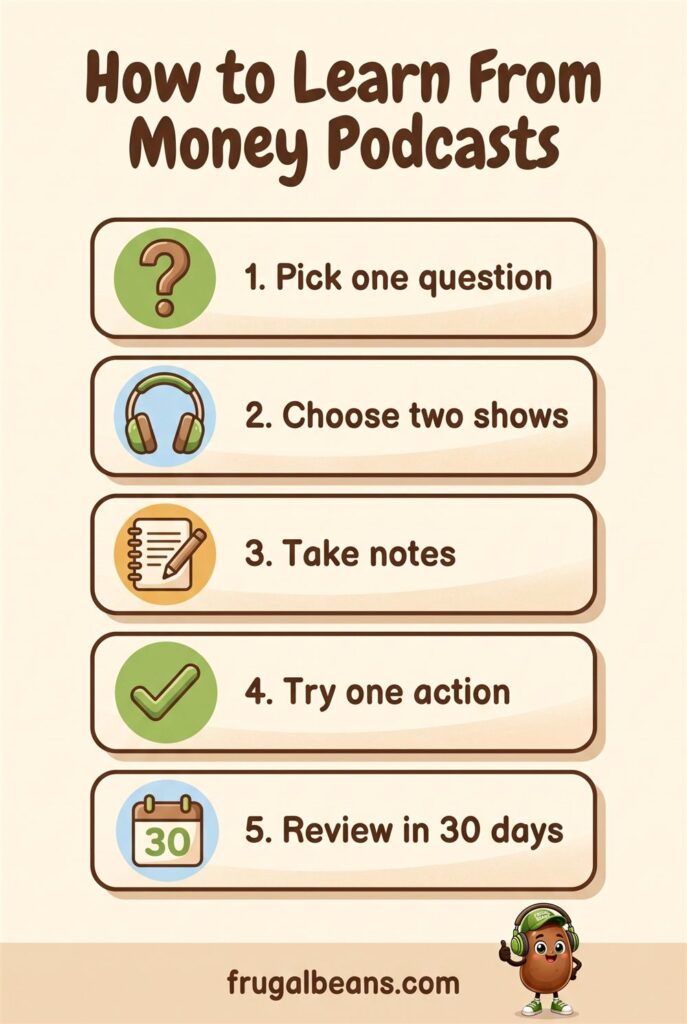
Use this process to turn ideas into household practice:
- Choose one current problem. Start with credit-card debt, an inconsistent emergency fund, or uncertainty about retirement savings.
- Select two contrasting shows. Compare a behavior-focused episode with a systems-focused one, such as So Money and the Money Guy Show.
- Write down one action, not ten. Check an employer match, list annual bills, or set up a $25 automatic transfer.
- Test it for thirty days. If a transfer causes overdrafts, reduce it and repair the system rather than abandoning saving.
- Discuss the decision together. Ask, “What do we want this money to do?” rather than “Why did you spend that?”
- Verify recommendations. Product, investment, tax, and legal details require checking before you act. Podcast discussion is education, not individualized advice.
- Keep an idea parking lot. Revisit interesting strategies during a quarterly review instead of acting on impulse.
The infographic below sums up the five core steps. Print it, or save it on your phone next to your podcast app.
Check the math with free, neutral tools
Many FIRE podcasts talk about compound growth. Instead of taking a host’s example at face value, plug in your own numbers. The SEC’s Investor.gov site offers a free compound interest calculator that shows how regular contributions could grow under the assumptions you choose. For retirement-timing questions, the CFPB’s retirement planning tools are a neutral place to start.
Make listening fit your life
Pair podcasts with tasks you already do: a walk, the dishes, meal prep, or a drive. Speed up playback if one of your podcasts feels slow, and skip episodes that do not apply to you. There is no prize for finishing a back catalog. If you listen while cooking, you are already practicing one of the best habits in our guide to saving money at home.
Hold a monthly money meeting
Use an episode as a prompt for a short monthly check-in. Review cash savings, high-interest debt, and long-term investments. Then name one win and one adjustment. A $400 debt reduction, a new automatic transfer, or a calm partner conversation all count. If money is tight right now, our budgeting tips for a tight budget can help you find the first dollars to work with.
Financial Independence Podcasts vs. Other Ways to Learn
Podcasts are not the only tool, and they work best in combination. Books go deeper on a single idea. Free government resources offer neutral, non-commercial explanations. A fee-only advisor can look at your specific situation. Personal finance podcasts sit in the middle: they are free, regular, and good at keeping money on your mind week after week.
Have a question about your own situation?
JustAnswer lets you ask a finance expert online, as a paid consultation, when a podcast episode raises a question about your own budget, debt or savings plan.
Partner link. Frugal Beans may earn a commission if you buy a consultation, at no extra cost to you. An online consultation is general guidance, not a substitute for a fee-only advisor who reviews your full situation.
Be aware that many finance podcasts are supported by advertising. A sponsor mention is not an endorsement of that product for your household. Compare any product against alternatives, read the fees, and decide on your own timeline. The same caution applies to guests who are promoting a book, course, or business.
Finally, remember that frugality and financial independence are partners. Lower recurring costs reduce how much you need to save, and every dollar saved can work toward your goals. Our collection of frugal living tips pairs well with almost any show on this list.
Financial Independence Podcasts: Frequently Asked Questions
What are the best financial independence podcasts for beginners?
ChooseFI, How to Money, and The Stacking Benjamins Show are approachable starting points because they explain terms as they go and cover a wide range of topics. If you are starting later in life, Catching Up to FI speaks directly to that situation. Try one episode of each and keep the one whose tone you enjoy.
What are the best personal finance podcasts for everyday money questions?
The best personal finance podcasts are the ones that match your current problem. From this list, How to Money and The Stacking Benjamins Show cover a wide range of everyday topics, the Money Guy Show lays out a step-by-step order for saving and investing, and So Money focuses on money mindset and behavior. Broader finance podcasts can be useful too, but a show built around household decisions is usually easier to act on.
Are FIRE podcasts only for people who want to retire early?
No. FIRE podcasts focus on building enough savings and investments to give you choices, and many listeners never plan to stop working entirely. The same habits help with changing careers, working part time, caring for family, or simply feeling less anxious about money.
Is it safe to follow investment advice from podcasts?
Treat podcast content as education, not personal advice. Hosts cannot see your taxes, debts, or goals. Use episodes to learn concepts, check numbers with neutral tools such as Investor.gov, and talk with a qualified professional before making big decisions.
How many finance podcasts should I listen to?
One or two is plenty. Listening to many podcasts at once can create information overload and conflicting advice. Pick one show that matches your current problem and one with a contrasting viewpoint, then take one action at a time.
The Bottom Line
These nine financial independence podcasts offer different doors into the same goal. ChooseFI introduces the framework. Afford Anything clarifies tradeoffs. The Stacking Benjamins Show broadens your vocabulary. So Money examines behavior. The Money Guy Show supports systems. BiggerPockets Money explores real estate and alternative paths. Earn & Invest connects income, investing, and purpose. How to Money tackles everyday choices. Catching Up to FI shows that it is never too late to start.
You do not need to listen to all nine finance podcasts or follow every strategy. Start with one question, take one measured action, and review what happened. Financial independence is not a contest to imitate another household. It is the growing ability to make choices because your money supports your needs, priorities, and future.
Let the podcasts provide ideas. Let your household values set the direction. Let your own numbers decide the pace.

Get the free Homeowner Repair Cost Playbook
Which systems fail first, what they cost, the warning signs, and the repair-or-replace rule. 15 printable pages.
Free. No spam.
Free tools
Got a quote? Check it in under a minute.
Ballpark a new furnace before the contractor visits.
Price a tank, tankless or heat pump model.
Warm air, ice or noise? See the likely part and price.
Leave a Reply